
Whoso List to Hunt BY SIR THOMAS WYATT

‘Whoso List to Hunt’ BY SIR THOMAS WYATT
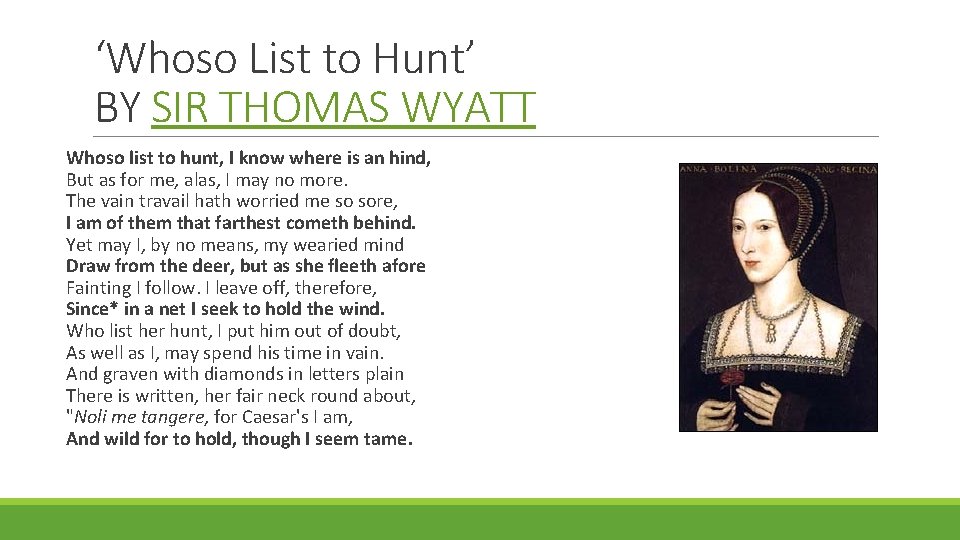
‘Whoso List to Hunt’ BY SIR THOMAS WYATT Whoso list to hunt, I know where is an hind, But as for me, alas, I may no more. The vain travail hath worried me so sore, I am of them that farthest cometh behind. Yet may I, by no means, my wearied mind Draw from the deer, but as she fleeth afore Fainting I follow. I leave off, therefore, Since* in a net I seek to hold the wind. Who list her hunt, I put him out of doubt, As well as I, may spend his time in vain. And graven with diamonds in letters plain There is written, her fair neck round about, "Noli me tangere, for Caesar's I am, And wild for to hold, though I seem tame.
Context Poem about Anne Boleyn was executed in 1536. Why? Accused of infidelity whilst married to Henry VIII also wanted to marry Jane Seymore. Also, Anne Boleyn couldn’t give Henry VIII a son and heir. It was rumoured that she had some kind of relationships with Sir Thomas Wyatt in the 1520 s (before her marriage to Henry VIII). In 1536 Wyatt imprisoned in the Tower of London for possibly committing adultery with Anne Boleyn. He was set free. Wyatt was not allowed to pursue Anne Boleyn and critics presume this poem is about her: she is the ‘hind’ that he can no longer hunt.
Wyatt’s poems Many of them were published posthumously in 1557 (Wyatt: 1503 – 1542) including this one. A lot of his poems were translations and imitations of Petrarchan sonnets rhyme scheme but he also wrote his own and changed the rhyme scheme in the sestet. Petrarchan typically has an octave of: abba and varying sestets. Wyatt typically wrote: abba cddc ee and some call this the English sonnet (Shakespeare used it) He contributed to the English sonnet rhyme scheme: three quatrains and a rhyming couplet. Petrarchan sonnets are traditionally written from the point of view of a man longing for a woman to return his love. Octave establishes/describes a problem volta/turn sestet resolves or reflects on the problem. Is this the case is Whoso list to…. . ? Is the unattainable love shown at the start with the specific description in the sestet ?
The poem: The poem is a metaphor for the pursuit of a woman. Whoso list to hunt, I know where is an hind, But as for me, alas, I may no more. The vain travail hath worried me so sore, I am of them that farthest cometh behind. Yet may I, by no means, my wearied mind Draw from the deer, but as she fleeth afore Fainting I follow. I leave off, therefore, Since in a net I seek to hold the wind. This is the octave: what is being said?
The poem: The poem is a metaphor for the pursuit of a woman. Who list her hunt, I put him out of doubt, As well as I, may spend his time in vain. And graven with diamonds in letters plain There is written, her fair neck round about, "Noli me tangere*, for Caesar's I am, And wild for to hold, though I seem tame. *"Touch me not; I am Caesar's. “ The sestet: what is being said?
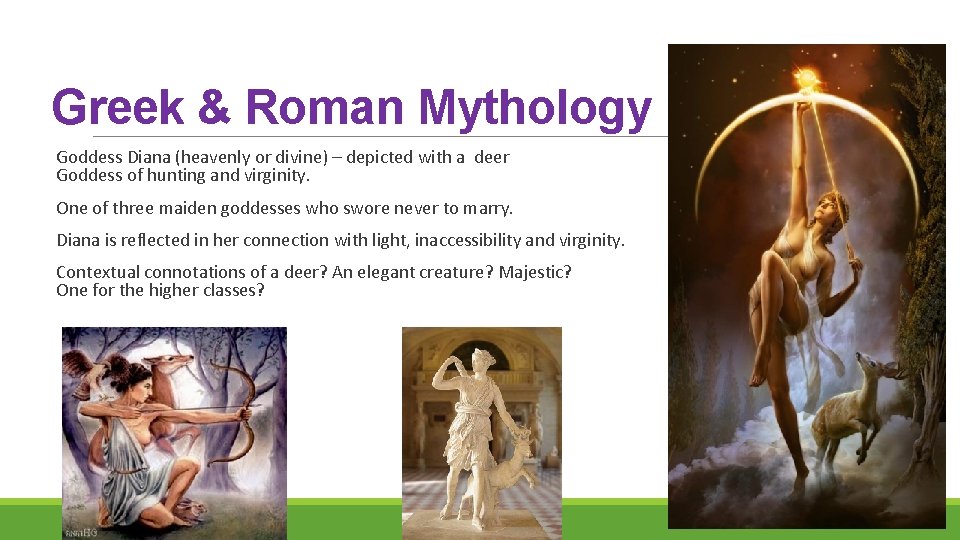
Greek & Roman Mythology Goddess Diana (heavenly or divine) – depicted with a deer Goddess of hunting and virginity. One of three maiden goddesses who swore never to marry. Diana is reflected in her connection with light, inaccessibility and virginity. Contextual connotations of a deer? An elegant creature? Majestic? One for the higher classes?
Analysing the poem Form: Points about Petrarchan sonnet, typicalities, the pursuit of a woman. Atypical in the sense that he does not refer to this pursuit through courtly love but instead using the allegory of hunting, describing her as a deer. The woman has more personality and ‘wildness’ in this sonnet than in usual sonnets where the woman is compared to a beautiful but inanimate object. Relates to masculine desire and ownership. Structure: Look at the syntax of the lines – withholding information and building suspense within the poem, just as in a hunt – therefore, identify any key lines with caesura breaks and enjambment. What does the final rhyming couplet suggest? Metre: irregular! Mostly iambic pentametre but some lines have a different number of syllables, why might this be? Language: Identify language that relates to: - Possession - love – courtly or romantic - hyperbolic - semantic field of hunting - use of personal pronouns
AO 5 Poem can be seen as a comment on the Tudor court of Henry VIII and the role Anne Boleyn played in it OR the end of a relationship. The reference in the poem is to Caesar (king/emperor) Caesar was, like Henry, a leader early in late teens, a handsome and strong young man and was significant in the political and aesthetic changes and developments of his realm. Both were literate, charismatic and influential. However, other less favorable parallels can be drawn. Both Caesar and Henry VIII incurred huge debt during their respective offices. There were many subjects who were held captive, sometimes executed, on charges of treason. Caesar faced questions regarding his unsuitable choices of women. Wyatt may also be alluding to these less appealing aspects of Caesar in his comparison if we see the passion in the poem to be borne of frustration and anger Most critics , because of this context, see the poem, as about Anne Boleyn. However it does make points about the way women are seen and the failure of the pursuit of an objectified woman.
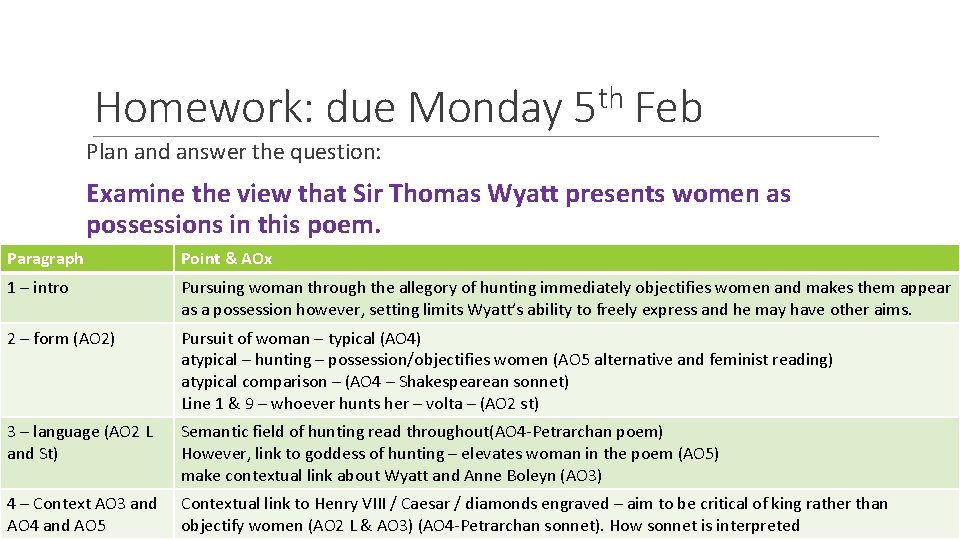
Homework: due Monday 5 th Feb Plan and answer the question: Examine the view that Sir Thomas Wyatt presents women as possessions in this poem. Paragraph Point & AOx 1 – intro Pursuing woman through the allegory of hunting immediately objectifies women and makes them appear as a possession however, setting limits Wyatt’s ability to freely express and he may have other aims. 2 – form (AO 2) Pursuit of woman – typical (AO 4) atypical – hunting – possession/objectifies women (AO 5 alternative and feminist reading) atypical comparison – (AO 4 – Shakespearean sonnet) Line 1 & 9 – whoever hunts her – volta – (AO 2 st) 3 – language (AO 2 L and St) Semantic field of hunting read throughout(AO 4 -Petrarchan poem) However, link to goddess of hunting – elevates woman in the poem (AO 5) make contextual link about Wyatt and Anne Boleyn (AO 3) 4 – Context AO 3 and AO 4 and AO 5 Contextual link to Henry VIII / Caesar / diamonds engraved – aim to be critical of king rather than objectify women (AO 2 L & AO 3) (AO 4 -Petrarchan sonnet). How sonnet is interpreted
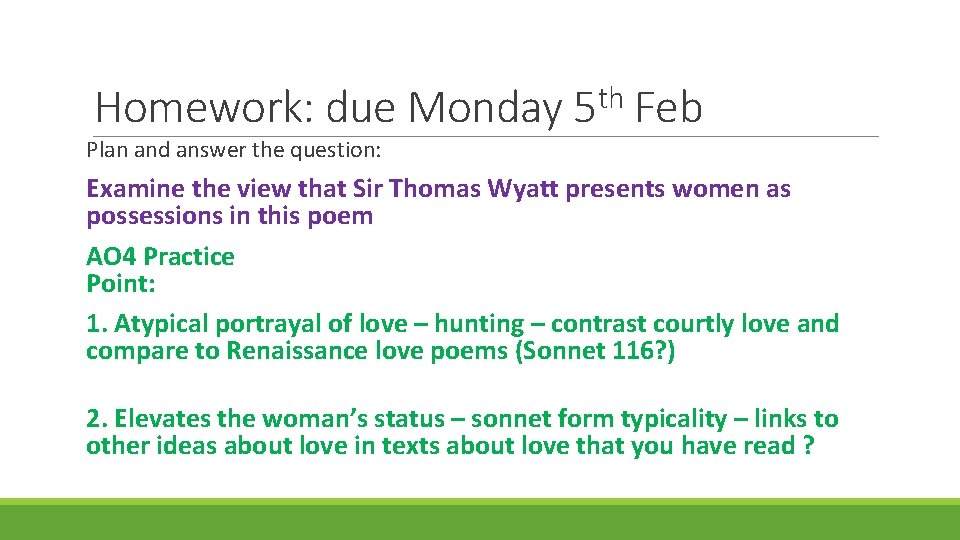
Homework: due Monday 5 th Feb Plan and answer the question: Examine the view that Sir Thomas Wyatt presents women as possessions in this poem AO 4 Practice Point: 1. Atypical portrayal of love – hunting – contrast courtly love and compare to Renaissance love poems (Sonnet 116? ) 2. Elevates the woman’s status – sonnet form typicality – links to other ideas about love in texts about love that you have read ?
- Slides: 11