
Whose Blood Was It Target 2 2 Whose
Whose Blood Was It? Target 2 -2
§Whose blood was it? § What is blood? § How can we tell different people’s blood apart? Target 2 -2
§ Blood is used to transport waste and nutrients in our bodies § Blood is made up of different blood cells floating in a clear liquid called plasma What is blood?
§ All human blood contains the same 3 types of cells § Red blood cells § White blood cells § Platelets § Human blood can also contain antigens § Antigens are molecules that can trigger an immune response § If no immune response is triggered, they are harmless Is all blood the same?
§ Blood Type Antigens are the most common antigens in human blood, and are the most useful for comparing blood samples § “A” § “B” § “Rh” § 93% of people have at least 1 blood type antigen in their blood Blood Type Antigens
§ ABO System § Based on A and B antigens § A = A only § B = B only § AB = both A and B § O = neither A nor B § Rh factor § Added on to A/B/O type § + = Rh present § - = Rh not present Blood Typing
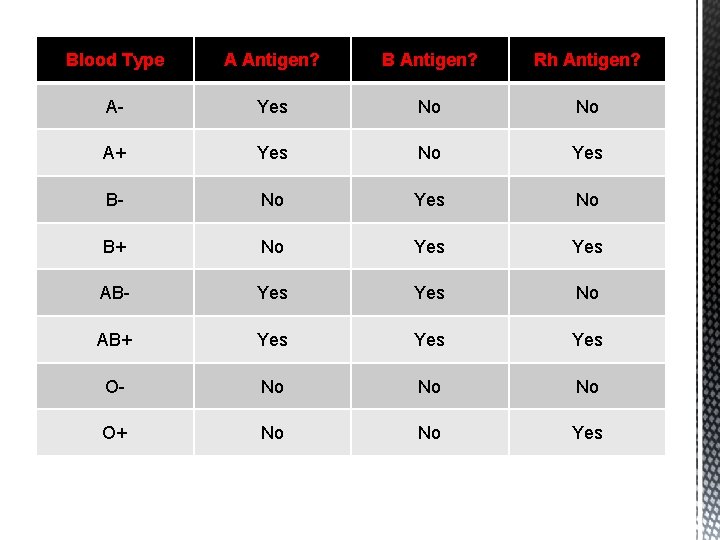
Blood Type A Antigen? B Antigen? Rh Antigen? A- Yes No No A+ Yes No Yes B- No Yes No B+ No Yes AB- Yes No AB+ Yes Yes O- No No No O+ No No Yes
§ We use antibodies to test for each antigen § Simulate the immune response § Each antibody will attack one specific antigen § If we observe an attack, we know the antigen is present § If we do not observe an attack, we know the antigen is not present § Attack = chemical reaction in the blood (clumps of solid molecules form) Testing for Blood Type
§ You have a sample of blood, 3 antibody serums, and a sample dish with 3 wells. § Place 5 drops of blood in each well. § Add 2 drops of Anti-A serum in well “A” § Add 2 drops of Anti-B serum in well “B” § Add 2 drops of Anti-Rh serum in well “Rh” § Watch your sample wells for any signs of clumping or solid particles § If you are having trouble, stir with a clean toothpick § Do NOT use the same toothpick in more than 1 well! § What antigens are present in your sample? Process
§ We can test for blood type even on old or dried blood, when we cannot get DNA § Since many people have each blood type, we can only include or exclude matches § Include: This person may have left this blood § Exclude: This person did not leave this blood § Even if we include a suspect, we cannot prove the suspect committed the crime on the basis of blood alone What can we learn?
§ Plan and perform blood testing in the case of Mrs. Ward § Pre-Lab Assignment: Plan § What samples will you need to collect? § What will you be comparing? § What materials will you need? § What will your procedure be? § What data table will you use to collect data? Your Task
- Slides: 11