
Whole School Approach to Academic Vocabulary Tiered Words

Whole School Approach to Academic Vocabulary Tiered Words
Acknowledgement of Country We meet today on the land of the Dja Wurrung People, and we acknowledge them as the traditional custodians of this land on which, Eaglehawk Secondary College is located and extend our respect to their Elders, past, present and future.
AIP - Fully implement a College Literacy approach across the Curriculum Plan, focusing on improving Reading and Writing evidence–based instruction and on building the capacity of every teacher to be a teacher of Literacy Why: To understand the importance of vocabulary in the terms of student achievement. What: To understand the vocabulary gap and explore ways that teachers can help close that gap. How: Improvement in the use of tier two and three words in all aspects of student learning and staff will use a common language when talking about tiered words.

English is Easy by Ben Knight • https: //www. youtube. com/watch? v=h. LCu 6 MVb_WQ
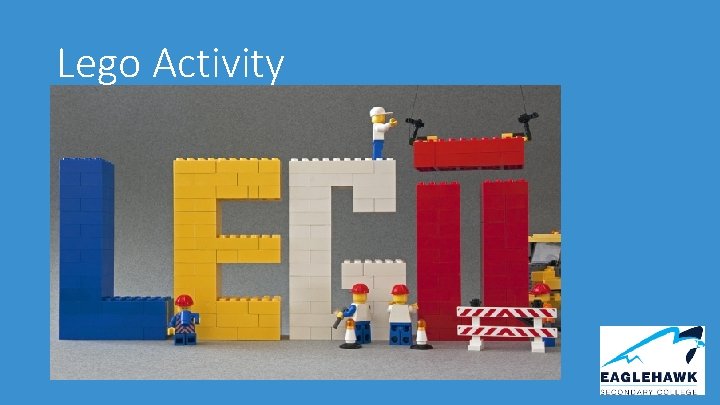
Lego Activity
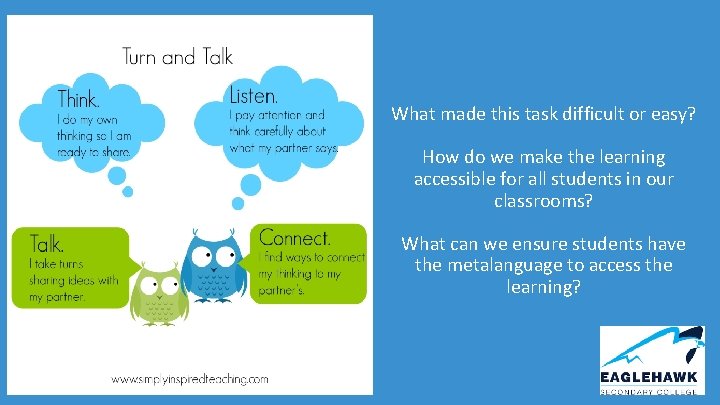
What made this task difficult or easy? How do we make the learning accessible for all students in our classrooms? What can we ensure students have the metalanguage to access the learning?
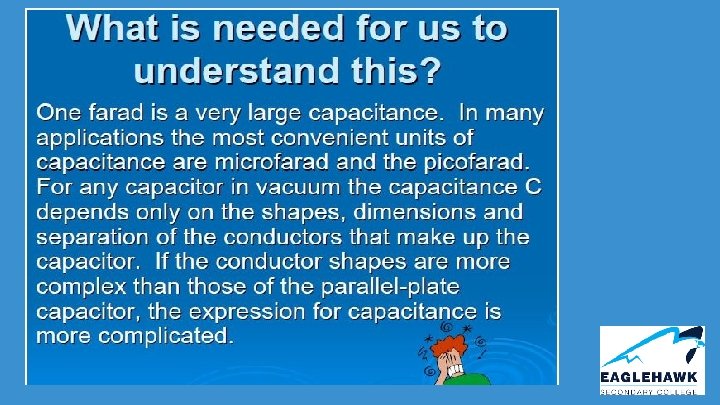
Activity on Vocab
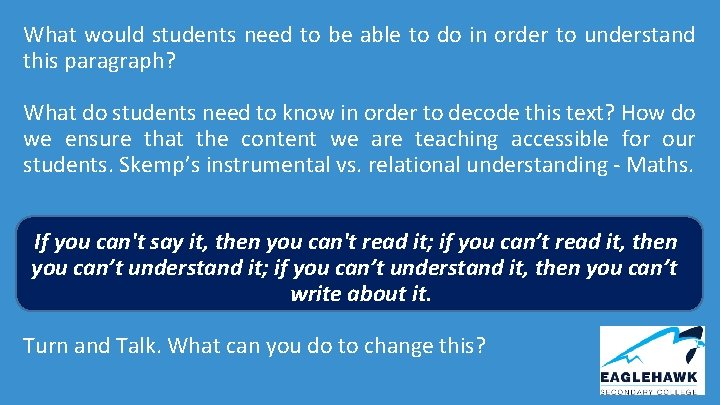
What would students need to be able to do in order to understand this paragraph? What do students need to know in order to decode this text? How do we ensure that the content we are teaching accessible for our students. Skemp’s instrumental vs. relational understanding - Maths. If you can't say it, then you can't read it; if you can’t read it, then you can’t understand it; if you can’t understand it, then you can’t write about it. Turn and Talk. What can you do to change this?
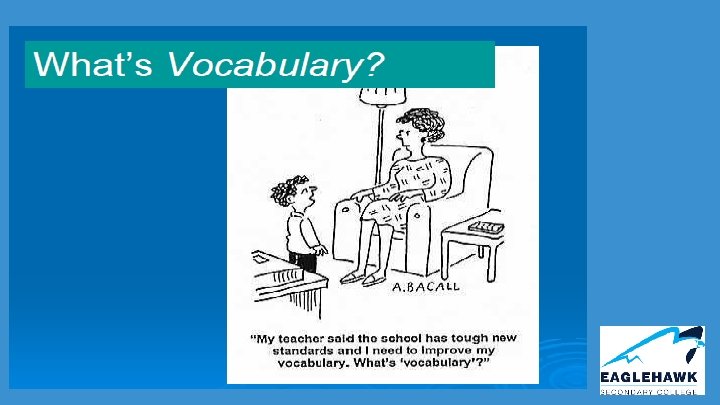
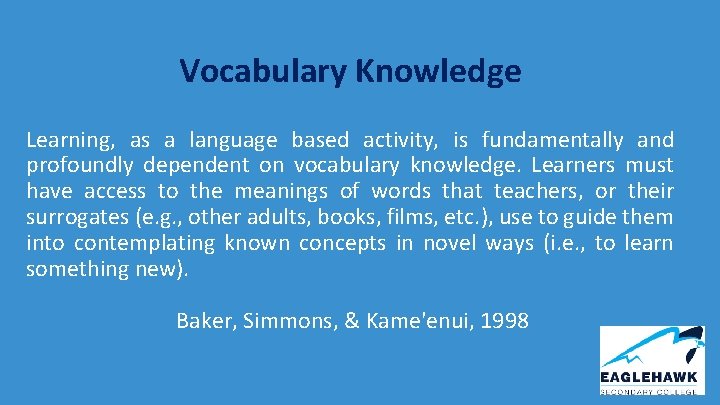
Vocabulary Knowledge Learning, as a language based activity, is fundamentally and profoundly dependent on vocabulary knowledge. Learners must have access to the meanings of words that teachers, or their surrogates (e. g. , other adults, books, films, etc. ), use to guide them into contemplating known concepts in novel ways (i. e. , to learn something new). Baker, Simmons, & Kame'enui, 1998
Effective Instruction The key ingredients of successful vocabulary development involves: the teaching of specific words and the provision of direct instruction involving word learning strategies.
The Four Peas of Vocabulary 1. Provide opportunities for reading wide and reading volume with accountability. 2. Preview the text to determine which word to teach. 3. Pre-teach meaningful words and phrases. 4. Provide direct instruction and multiple exposures of the vocabulary in reading, writing, listening and speaking.
Most Effective Strategies ● ● ● ● Direct, explicit instruction of words in context Using simple conceptual maps Teaching specific context clues Selecting meaningful words to teach Increasing independent reading Directly teaching word learning strategies Connecting new concepts/meanings to existing knowledge base
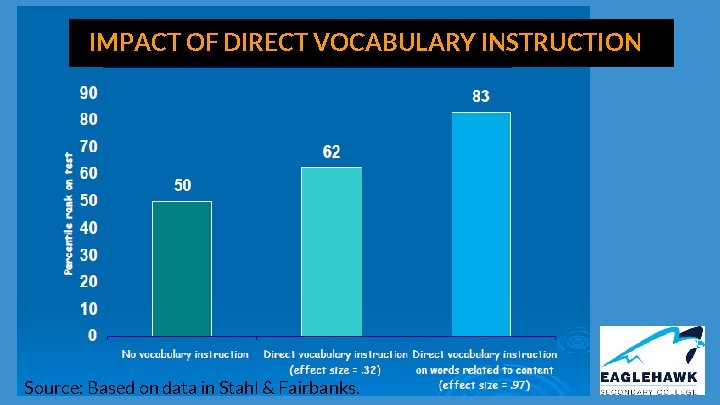
IMPACT OF DIRECT VOCABULARY INSTRUCTION Source: Based on data in Stahl & Fairbanks.
Why teach vocabulary? ● The difference in vocabulary knowledge is a key factor in disparities in academic achievement. ● Vocabulary is a predictor of content area performance (Espin & Foegen, 1996) One of the most enduring findings in reading research is the extent to which students’ vocabulary knowledge relates to their reading comprehension (Anderson & Freebody, 1981; Baumann, Kame’ennui & Ash, 2003; Becker, 1977; Davis, 1942; Whipple, 1925)
Direct teaching of vocabulary might be one of the most underused activities in Prep - 12 education. The lack of vocabulary instruction might be a result of misconceptions about what it means to teach vocabulary and its potential effect on student learning. Perhaps the biggest misconception is that teaching vocabulary means teaching formal dictionary definitions (Marzano et al. 2002).
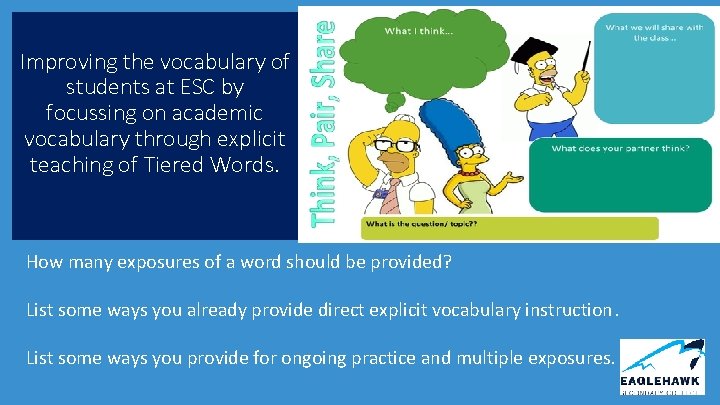
Improving the vocabulary of students at ESC by focussing on academic vocabulary through explicit teaching of Tiered Words. How many exposures of a word should be provided? List some ways you already provide direct explicit vocabulary instruction. List some ways you provide for ongoing practice and multiple exposures.
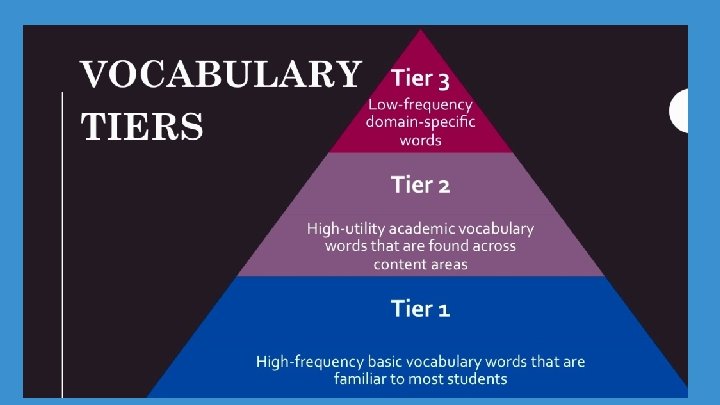
Tier 1 Basic vocab- happy, talk, cold Clearly important- especially for ELLs and very naïve learners Easy, decodable and already familiar Connected with prior knowledge Tier 2 High frequency – avoid, fortunate, industrious Play a large role in verbal functioning across a variety of domains Necessary to understanding…GENERALISABLE Goal for instruction – aim to teach 300 -500 words per year!!!! Tier 3 Low frequency May be specific to domains (e. g. isotope) Instruct when need arises
Sample Lesson On the following sample lesson is based on a research proven routine for instruction linked to Robert Marzano’s six step vocabulary development (2009), Kate Kinsella’s vocabulary instruction routine (2010), and Doug Fisher and Nancy Frey’s Gradual Release of Responsibility (2007). Keep the pace snappy. Steps one through six should take just 15 -20 minutes total. Although tempting to spread out over days, research shows that steps 1 -6 must be done together within a lesson. Step 6 may be repeated as often as needed as well as independent practice with the words.
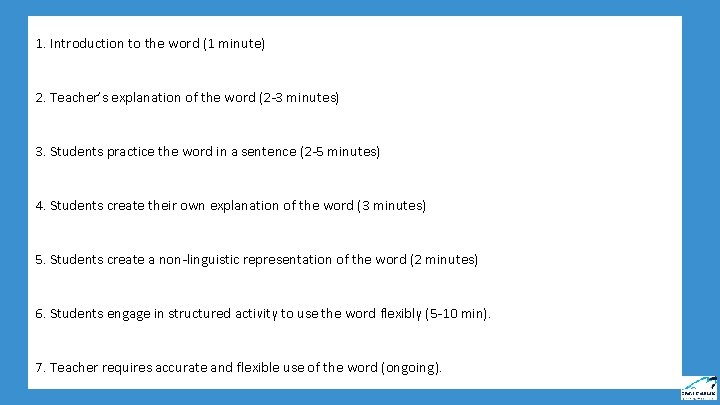
1. Introduction to the word (1 minute) 2. Teacher’s explanation of the word (2 -3 minutes) 3. Students practice the word in a sentence (2 -5 minutes) 4. Students create their own explanation of the word (3 minutes) 5. Students create a non-linguistic representation of the word (2 minutes) 6. Students engage in structured activity to use the word flexibly (5 -10 min). 7. Teacher requires accurate and flexible use of the word (ongoing).
More explanation: 7. Teacher requires accurate and flexible use of the word (ongoing). Activities such as-written assignments, collaborative projects, class discussions, homework and exit tickets. In assessment such as- quizzes, tests and writing rubrics. Ongoing focus in all subjects throughout the year.
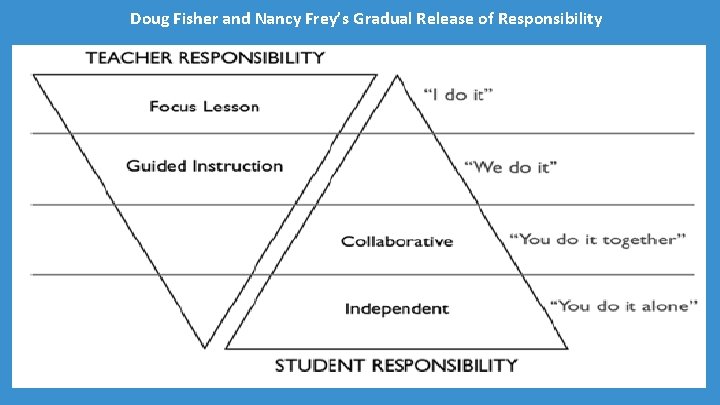
Doug Fisher and Nancy Frey’s Gradual Release of Responsibility
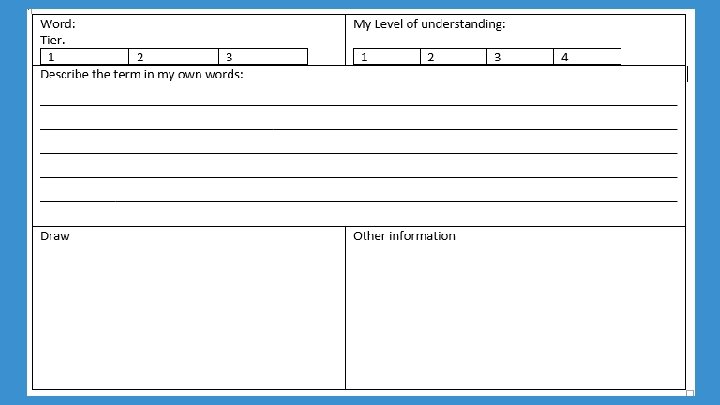
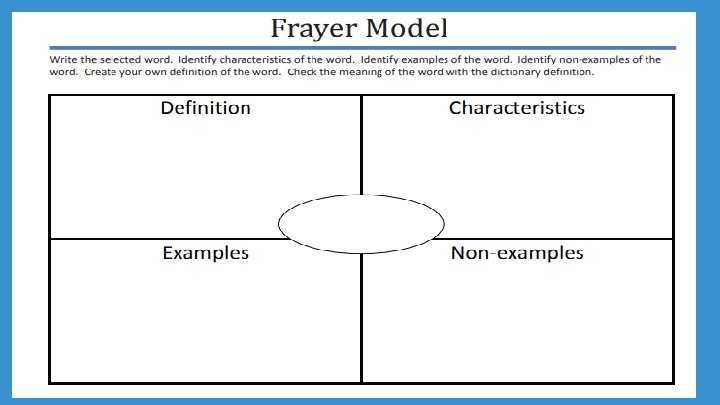
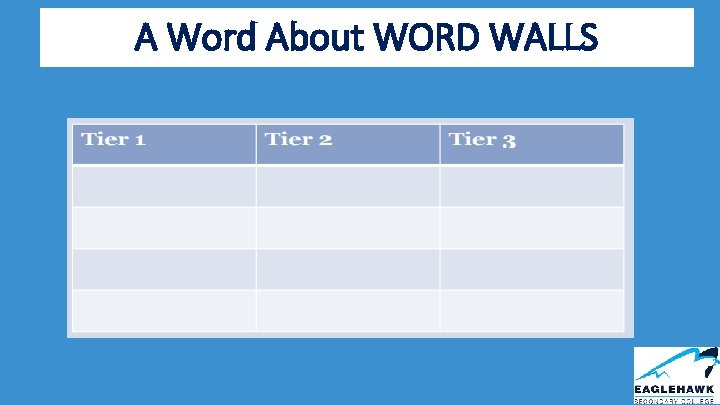
A Word About WORD WALLS
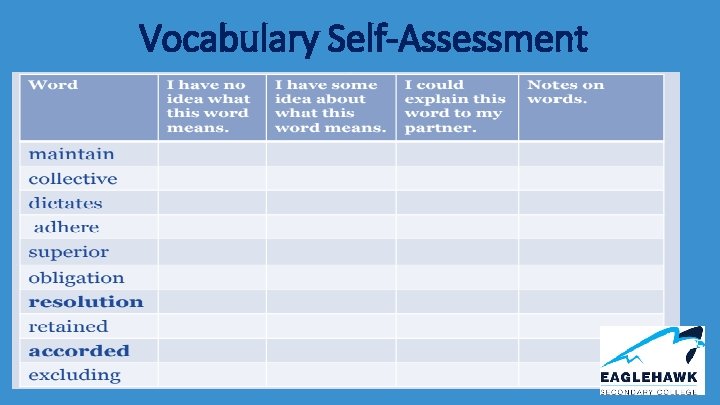
Vocabulary Self-Assessment
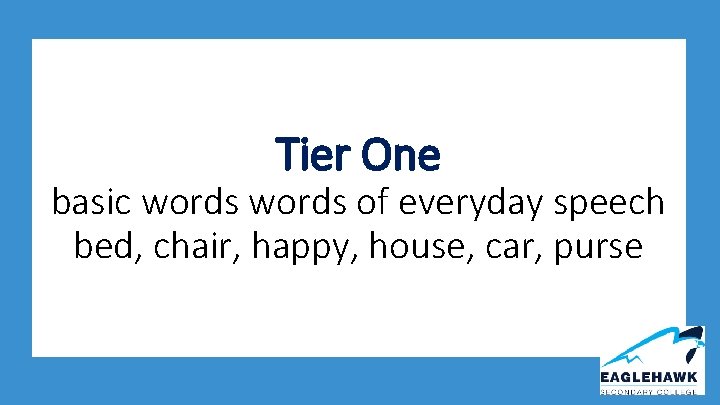
Tier One basic words of everyday speech bed, chair, happy, house, car, purse
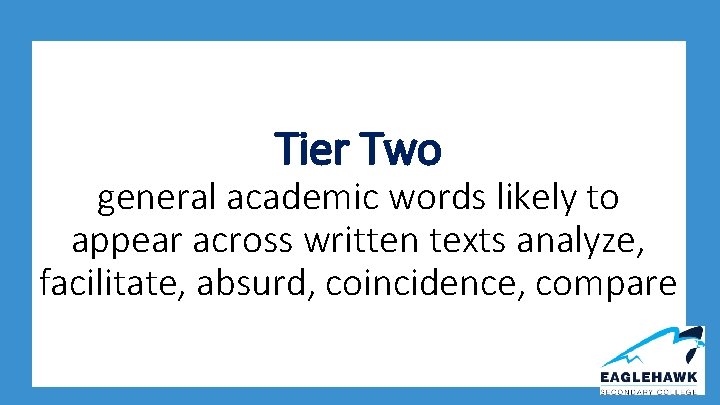
Tier Two general academic words likely to appear across written texts analyze, facilitate, absurd, coincidence, compare
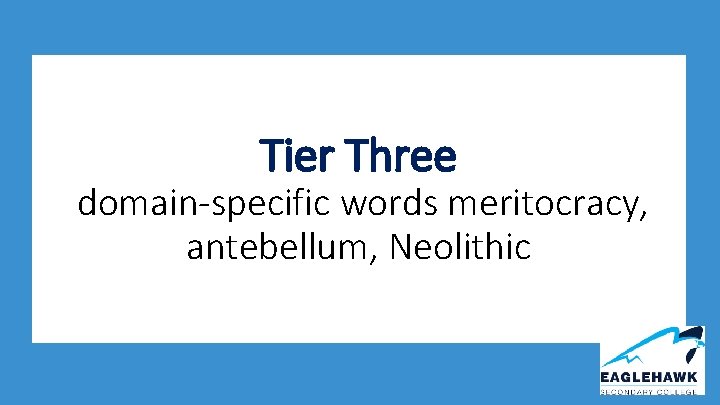
Tier Three domain-specific words meritocracy, antebellum, Neolithic
Recap Explicit teaching of tiered words takes place in a language and word-rich environment. It includes intentional teaching of selected words and repeated exposure to them. It also includes word-learning strategies that help students to learn new words independently
- Slides: 31