
Whole Number Class VI Sub Mathematics Prepared by
Whole Number Class : VI Sub. : Mathematics Prepared by: Suraj Kumar, TGT Maths Kendriya Vidyalaya Danapur Cantt. (FS), Patna
Introduction Predecessor and successor: Given any natural number, you can add 1 to that number and get the next number i. e. you get its successor. The successor of 16 is 16 + 1 = 17, that of 19 is 19 +1 = 20 and so on. The number 16 comes before 17, we say that the predecessor of 17 is 17– 1=16, the predecessor of 20 is 20 – 1 = 19, and so on.
Whole Numbers If we add the number zero to the collection of natural numbers, we get the collection of whole numbers. Thus, the numbers 0, 1, 2, 3, . . . form the collection of whole numbers. Therefore, all natural numbers are also whole numbers. Every whole number has a successor. Every whole number except zero has a predecessor.
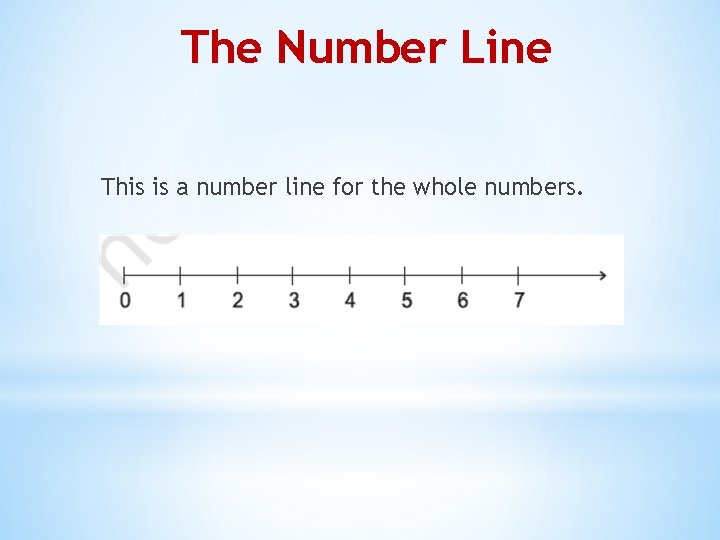
The Number Line This is a number line for the whole numbers.
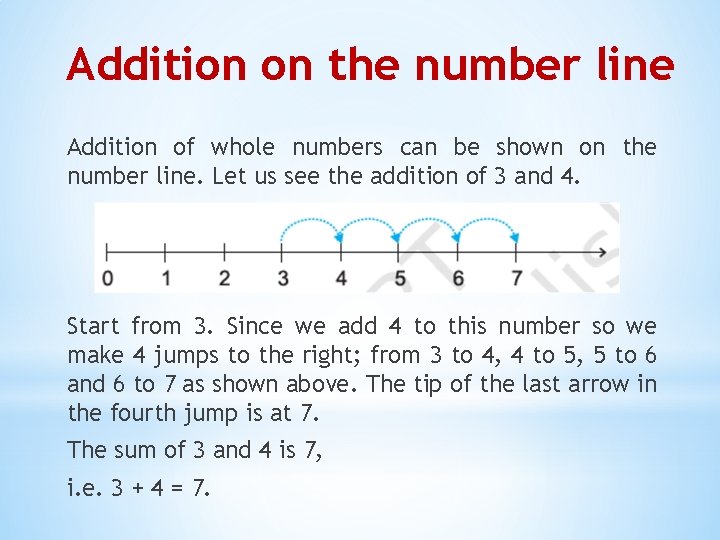
Addition on the number line Addition of whole numbers can be shown on the number line. Let us see the addition of 3 and 4. Start from 3. Since we add 4 to this number so we make 4 jumps to the right; from 3 to 4, 4 to 5, 5 to 6 and 6 to 7 as shown above. The tip of the last arrow in the fourth jump is at 7. The sum of 3 and 4 is 7, i. e. 3 + 4 = 7.
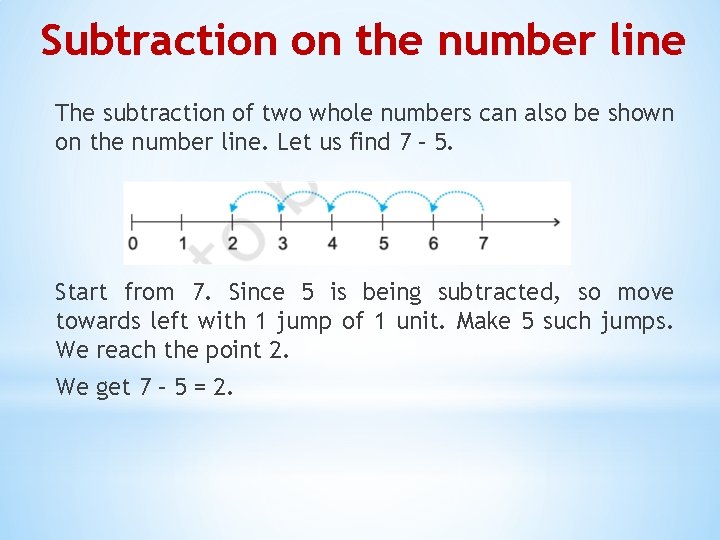
Subtraction on the number line The subtraction of two whole numbers can also be shown on the number line. Let us find 7 – 5. Start from 7. Since 5 is being subtracted, so move towards left with 1 jump of 1 unit. Make 5 such jumps. We reach the point 2. We get 7 – 5 = 2.
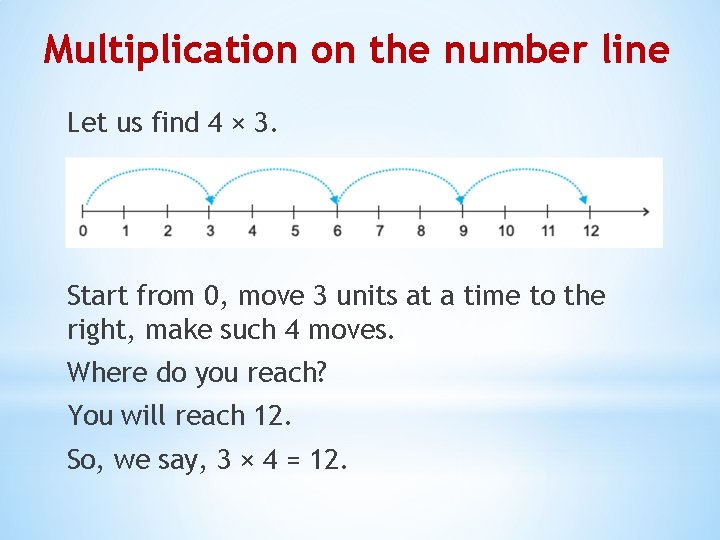
Multiplication on the number line Let us find 4 × 3. Start from 0, move 3 units at a time to the right, make such 4 moves. Where do you reach? You will reach 12. So, we say, 3 × 4 = 12.
Properties of Whole Numbers Closure property : Whole numbers are closed under addition and also under multiplication. Adding two whole numbers always gives a whole number. Similarly, multiplying two whole numbers always gives a whole number 5 + 5 = 10, a whole number 0 + 15 = 15, a whole number 7 × 8 = 56, a whole number 5 × 5 = 25, a whole number Whole numbers are not closed under subtraction and under division. Commutativity of addition and multiplication: We can add two whole numbers in any order. 4 + 6 = 6 + 4. We can multiply two whole numbers in any order. 4 × 5 = 5 × 4. Associativity of addition and multiplication : (2 + 3) + 4 = 5 + 4 = 9 2 + (3 + 4) = 2 + 7 = 9 Therefore, (2 + 3) + 4 = 2 + (3 + 4) This is associativity of addition for whole numbers.
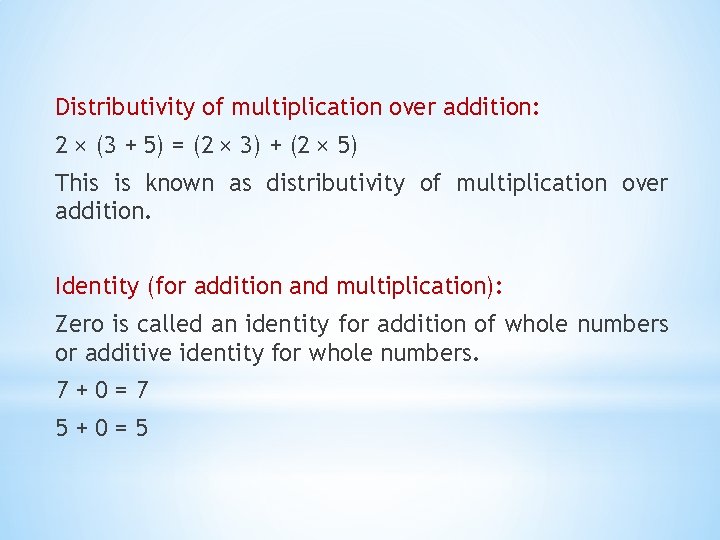
Distributivity of multiplication over addition: 2 × (3 + 5) = (2 × 3) + (2 × 5) This is known as distributivity of multiplication over addition. Identity (for addition and multiplication): Zero is called an identity for addition of whole numbers or additive identity for whole numbers. 7+0=7 5+0=5

Thank you.
- Slides: 10