
Whole Health for Pain Suffering Day 1 Morning
![Mindful Awareness and Veteran Mental Health Pain >= 6/10 n=23 Baseline (Mean[SD]) Post-test (Mean[SD])](https://slidetodoc.com/presentation_image_h2/a9239481f553de8b0eba03cb5d6ddc4b/image-138.jpg "Mindful Awareness and Veteran Mental Health Pain >= 6/10 n=23 Baseline (Mean[SD]) Post-test (Mean[SD])")
- Slides: 152
Whole Health for Pain & Suffering Day 1 Morning • • Course Overview New Perspectives on Pain and Suffering Chronic Pain: Starting with ME Mindful Awareness
Whole Health for Pain and Suffering A Whole Health Approach Day 1 Welcome!
1. Course Overview Whole Health for Pain and Suffering
This course was created by: Veterans Health Administration Office of Patient Centered Care & Cultural Transformation (OPCC&CT) Pacific Institute for Research and Evaluation (PIRE) University of Wisconsin-Madison Family Medicine and Community Health Integrative Health
Module 1 • Course Origins • Course Structure and Goals • Course Materials • Setting Intentions • Community Agreements and Introductions • Whole Health in the VA: A Review
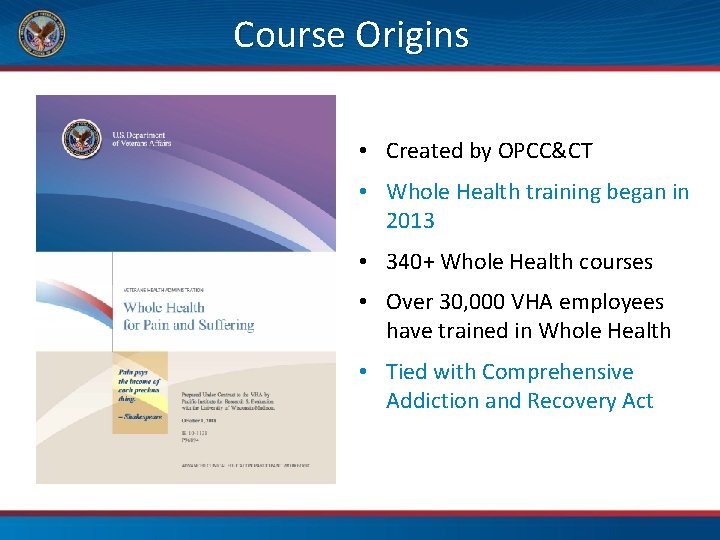
Course Origins • Created by OPCC&CT • Whole Health training began in 2013 • 340+ Whole Health courses • Over 30, 000 VHA employees have trained in Whole Health • Tied with Comprehensive Addiction and Recovery Act
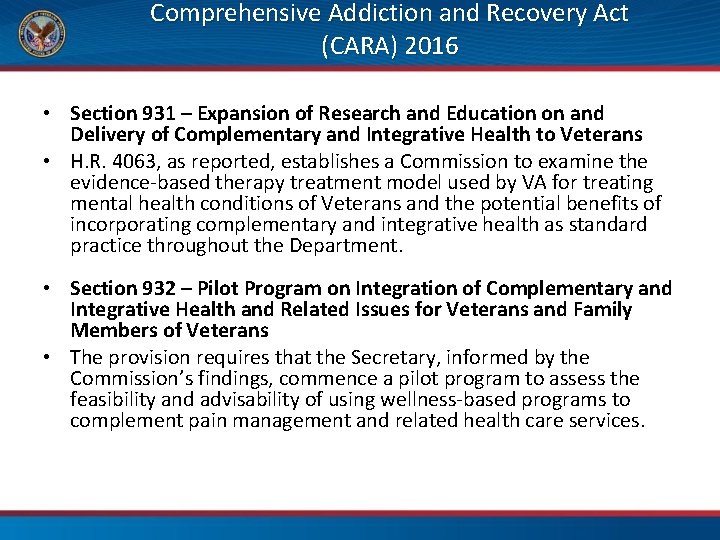
Comprehensive Addiction and Recovery Act (CARA) 2016 • Section 931 – Expansion of Research and Education on and Delivery of Complementary and Integrative Health to Veterans • H. R. 4063, as reported, establishes a Commission to examine the evidence-based therapy treatment model used by VA for treating mental health conditions of Veterans and the potential benefits of incorporating complementary and integrative health as standard practice throughout the Department. • Section 932 – Pilot Program on Integration of Complementary and Integrative Health and Related Issues for Veterans and Family Members of Veterans • The provision requires that the Secretary, informed by the Commission’s findings, commence a pilot program to assess the feasibility and advisability of using wellness-based programs to complement pain management and related health care services.
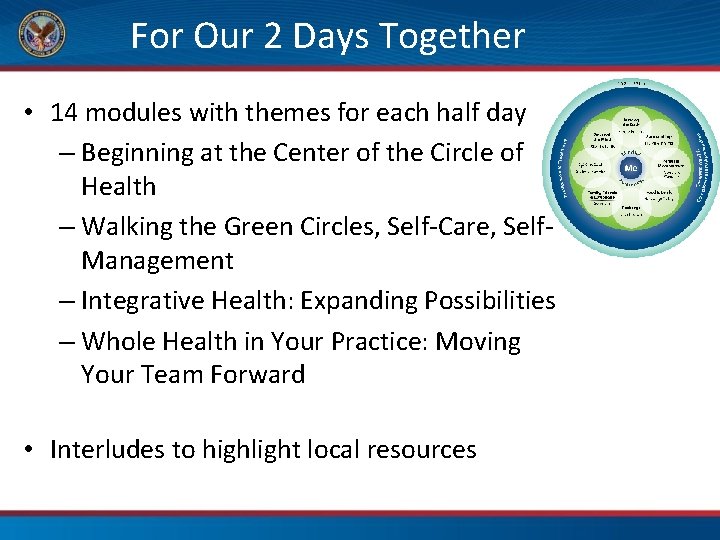
For Our 2 Days Together • 14 modules with themes for each half day – Beginning at the Center of the Circle of Health – Walking the Green Circles, Self-Care, Self. Management – Integrative Health: Expanding Possibilities – Whole Health in Your Practice: Moving Your Team Forward • Interludes to highlight local resources
About This Course What are we trying to accomplish? 1. Untangle the web of chronic pain 2. Use the Whole Health model to individualize the pain and suffering experience 3. Gain exposure to non-pharmacologic approaches to pain care using Whole Health 4. Develop a common language in caring for Veterans with chronic pain and suffering 5. Network: employ the wisdom of the group
Course Materials
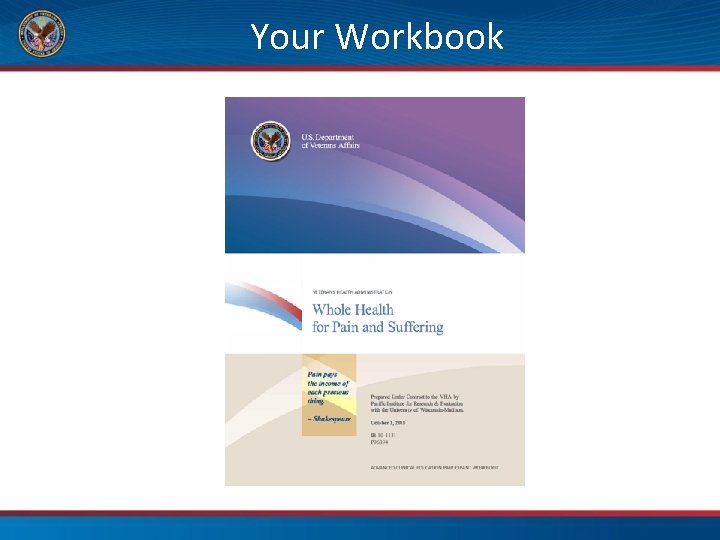
Your Workbook
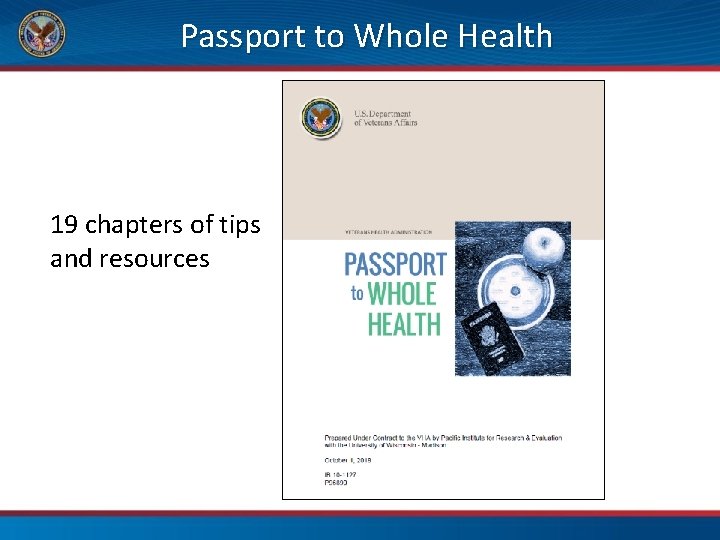
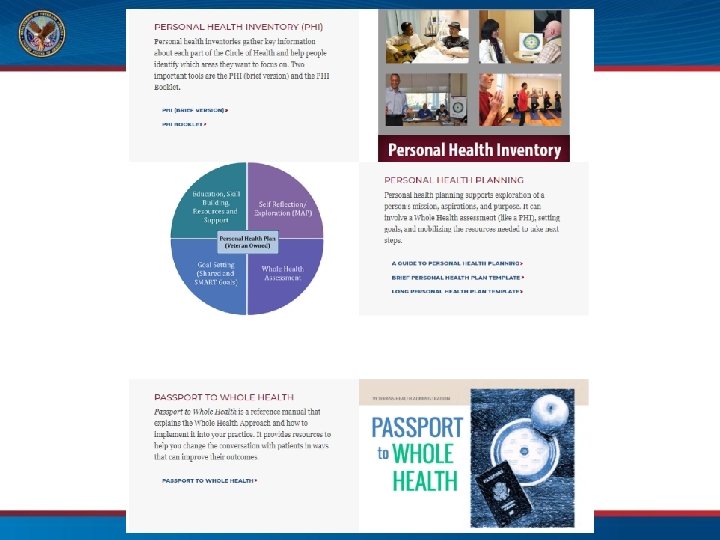
Passport to Whole Health 19 chapters of tips and resources
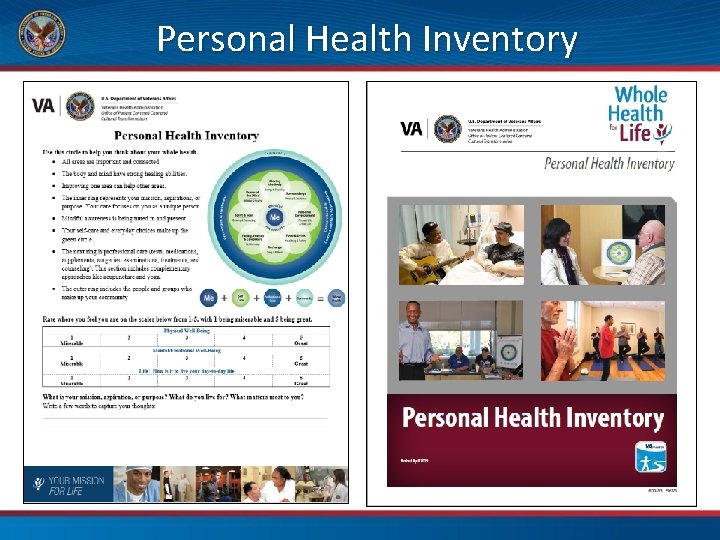
Personal Health Inventory
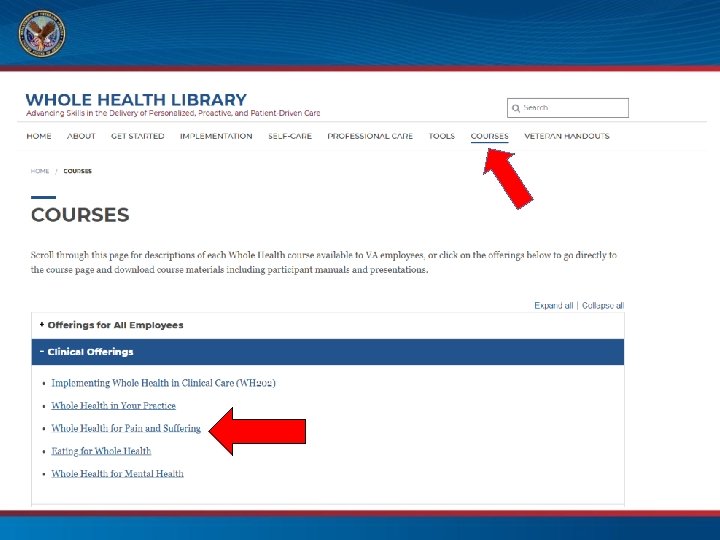
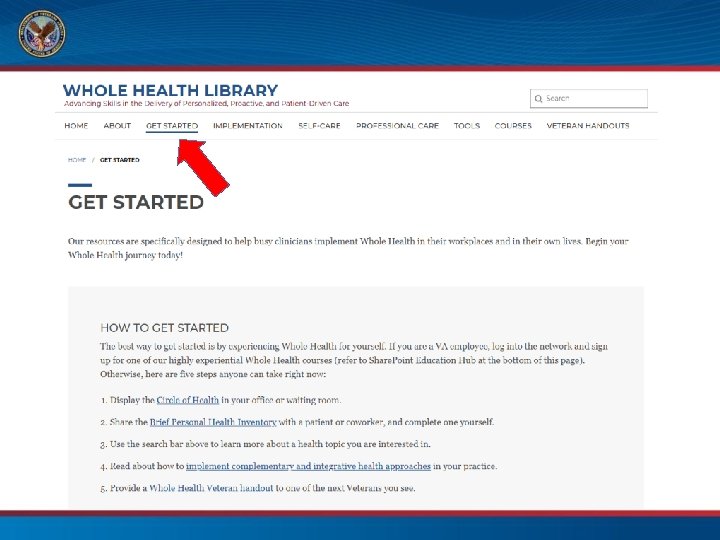
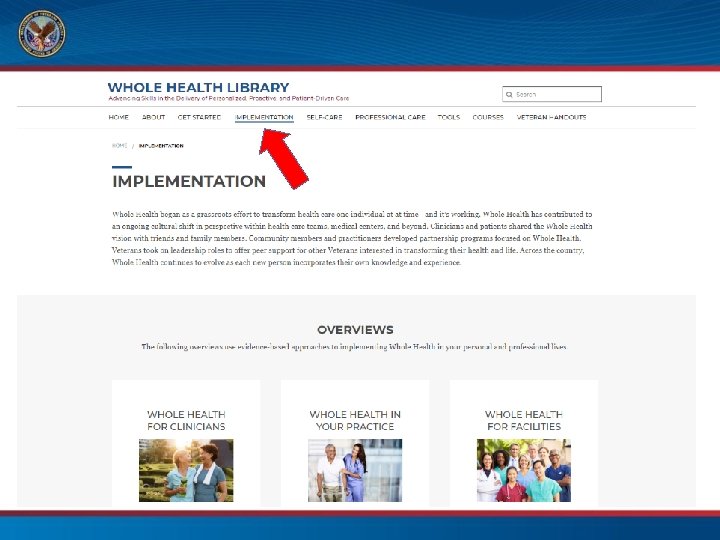
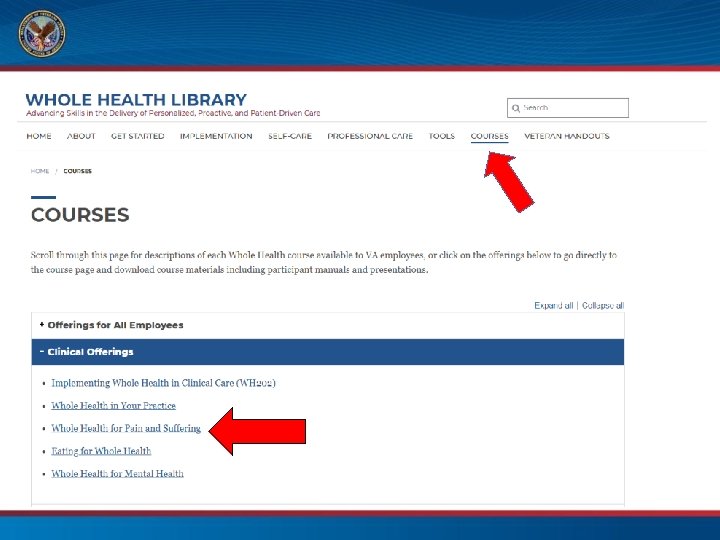
To Access Course Slides You can even do it on your phone! Whole Health course materials under “Courses ” on the Whole Health Library Website https: //wholehealth. wisc. edu
Setting Intentions GOOD: Understand the concepts of Whole Health and Complementary & Integrative Health for Pain and Suffering BETTER: . . . learn skills to use right away EVEN BETTER: . . . implement Whole Health approaches on your team at a team, facility, and/or system level BEST: . . . apply them to your own life!
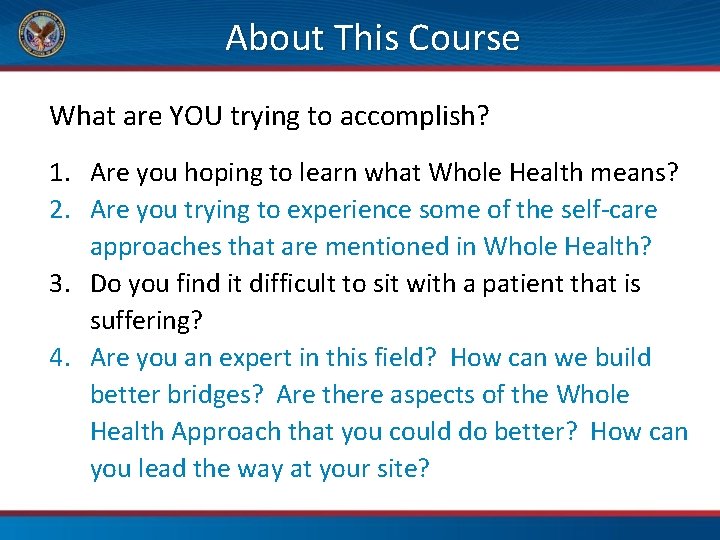
About This Course What are YOU trying to accomplish? 1. Are you hoping to learn what Whole Health means? 2. Are you trying to experience some of the self-care approaches that are mentioned in Whole Health? 3. Do you find it difficult to sit with a patient that is suffering? 4. Are you an expert in this field? How can we build better bridges? Are there aspects of the Whole Health Approach that you could do better? How can you lead the way at your site?
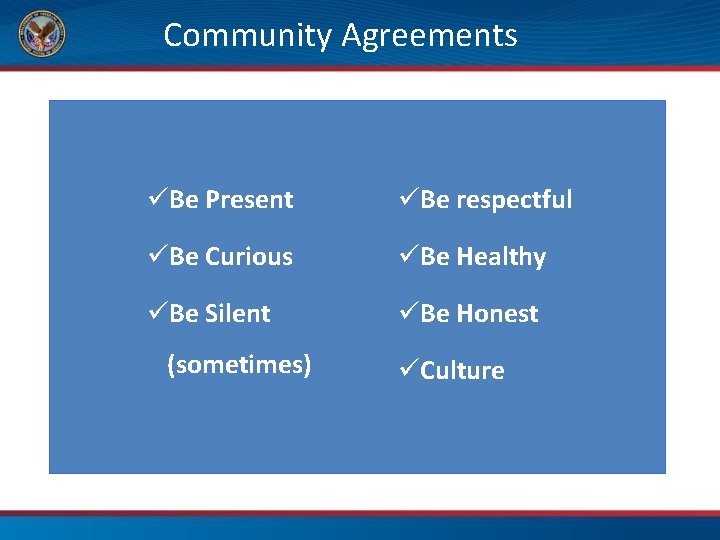
Community Agreements üBe Present üBe respectful üBe Curious üBe Healthy üBe Silent üBe Honest (sometimes) üCulture
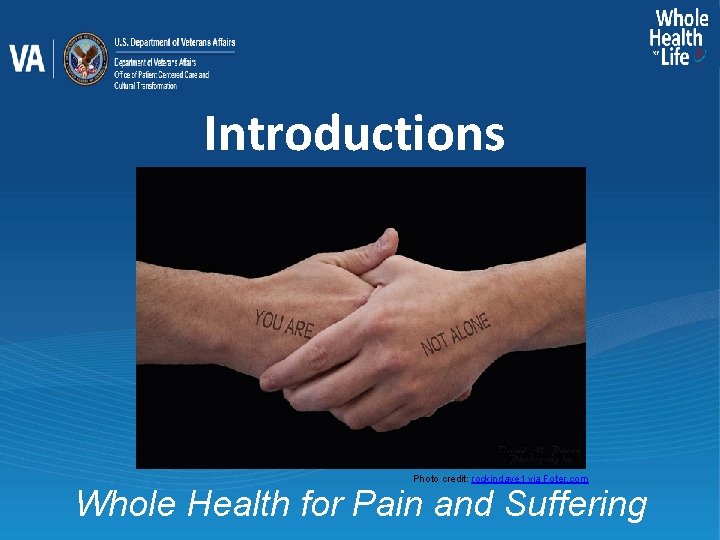
Introductions Photo credit: rockindave 1 via Foter. com Whole Health for Pain and Suffering
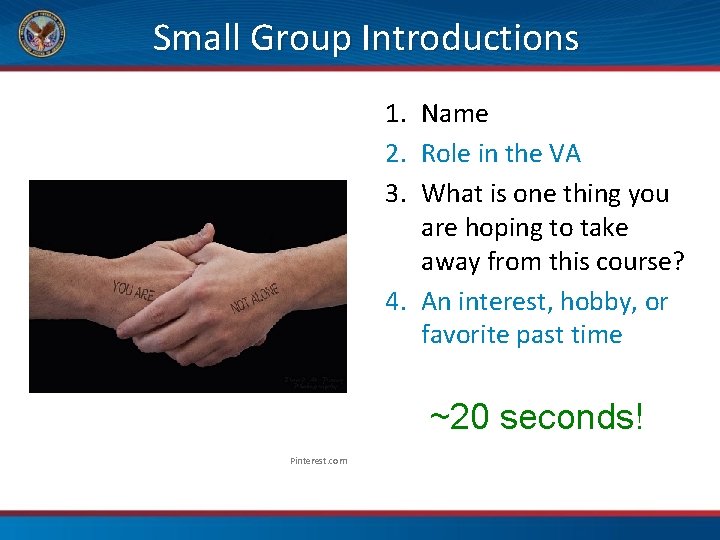
Small Group Introductions 1. Name 2. Role in the VA 3. What is one thing you are hoping to take away from this course? 4. An interest, hobby, or favorite past time ~20 seconds! Pinterest. com
The VA health care system is changing.
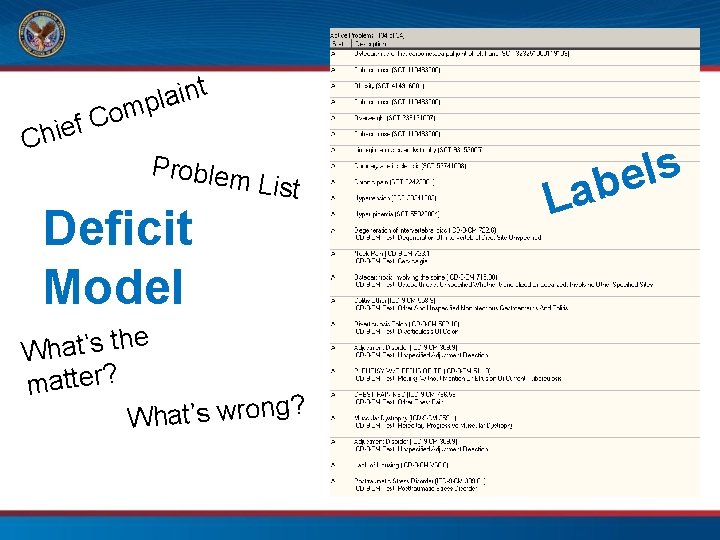
t n i a l mp o C f Chie Problem Deficit Model List he t s ’ t a h W matter? ? g n o r w ’s t a h W L s l e ab
Find It, Fix It
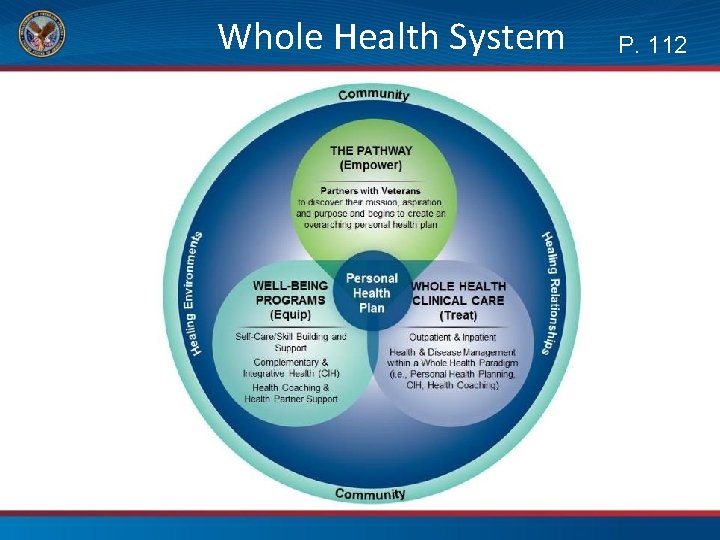
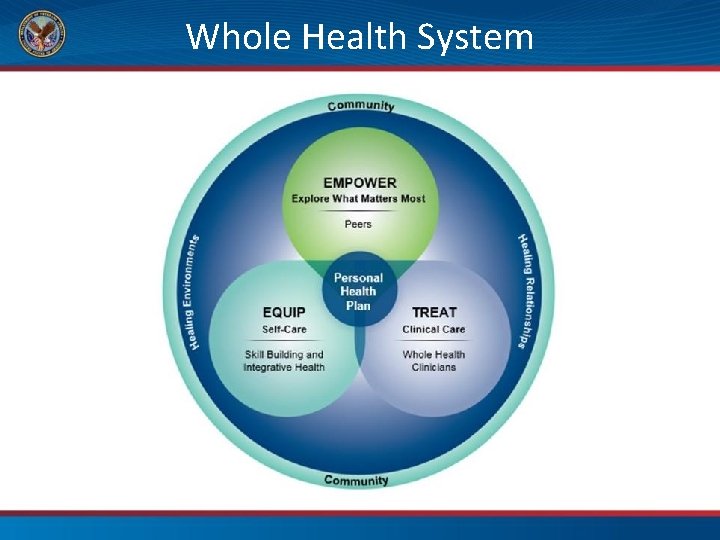
Whole Health System Personal Health Plan P. 112
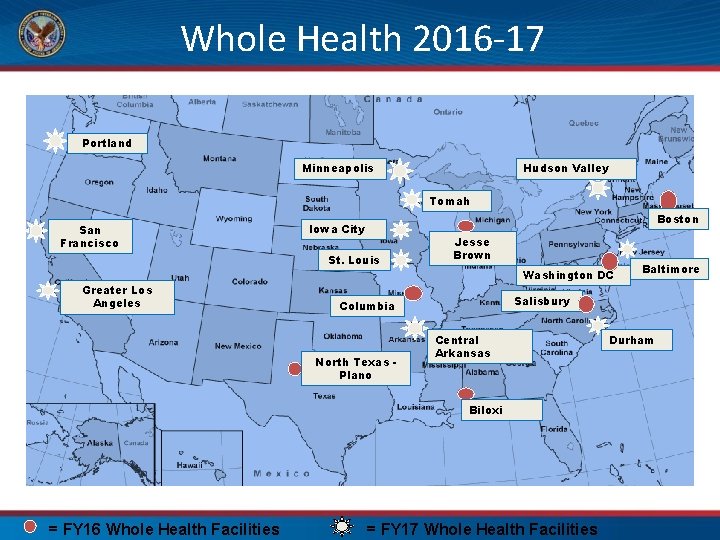
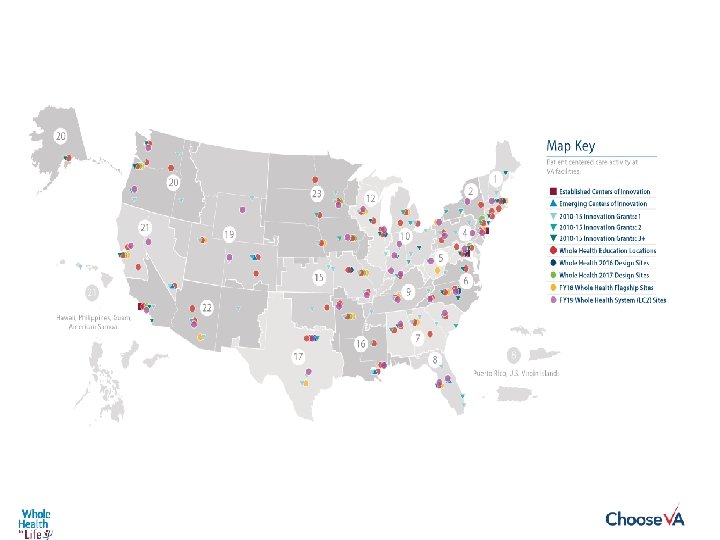
Whole Health 2016 -17 Portland Minneapolis San Francisco Greater Los Angeles Hudson Valley Tomah Hudson Valley Boston Tomah Iowa City St. Louis Jesse Brown North Texas Plano Washington DC Salisbury Columbia Boston Baltimore Salisbury Central Arkansas Biloxi = FY 16 Whole Health Facilities Baltimore = FY 17 Whole Health Facilities Durham
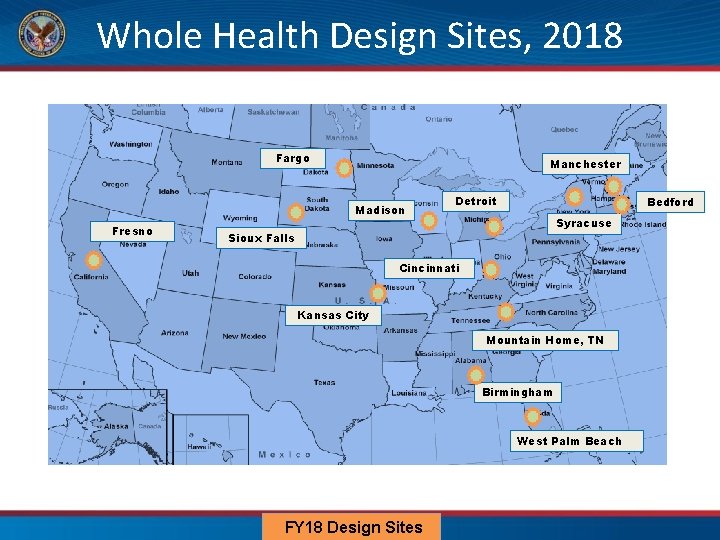
Whole Health Design Sites, 2018 Fargo Manchester Madison Fresno Detroit Bedford Syracuse Sioux Falls Cincinnati Kansas City Mountain Home, TN Birmingham West Palm Beach FY 18 Design Sites
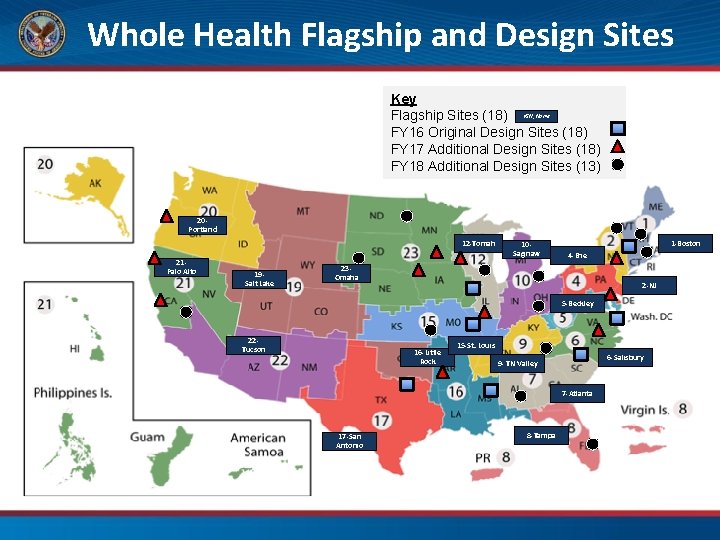
Whole Health Flagship and Design Sites Key Flagship Sites (18) VSN, Name FY 16 Original Design Sites (18) FY 17 Additional Design Sites (18) FY 18 Additional Design Sites (13) 20 Portland 12 -Tomah 21 Palo Alto 19 Salt Lake 10 Saginaw 1 -Boston 4 -Erie 23 Omaha 2 -NJ 5 -Beckley 22 Tucson 16 -Little Rock 15 -St. Louis 6 -Salisbury 9 - TN Valley 7 -Atlanta 17 -San Antonio 8 -Tampa
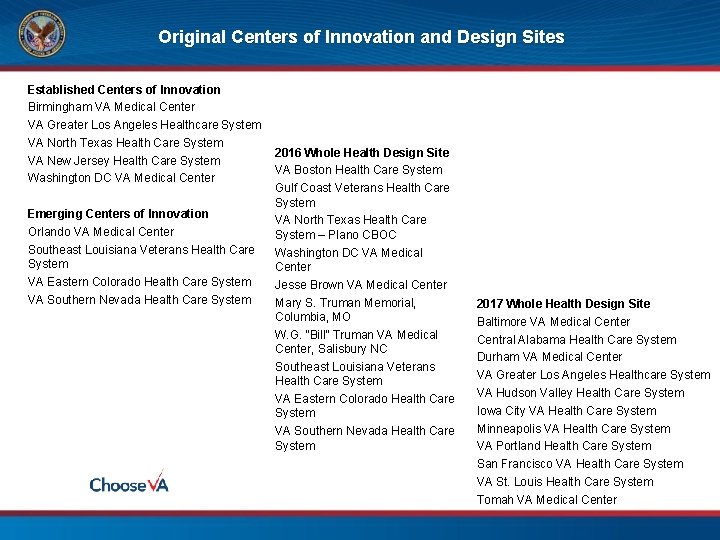
Original Centers of Innovation and Design Sites Established Centers of Innovation Birmingham VA Medical Center VA Greater Los Angeles Healthcare System VA North Texas Health Care System VA New Jersey Health Care System Washington DC VA Medical Center Emerging Centers of Innovation Orlando VA Medical Center Southeast Louisiana Veterans Health Care System VA Eastern Colorado Health Care System VA Southern Nevada Health Care System 2016 Whole Health Design Site VA Boston Health Care System Gulf Coast Veterans Health Care System VA North Texas Health Care System – Plano CBOC Washington DC VA Medical Center Jesse Brown VA Medical Center Mary S. Truman Memorial, Columbia, MO W. G. “Bill” Truman VA Medical Center, Salisbury NC Southeast Louisiana Veterans Health Care System VA Eastern Colorado Health Care System VA Southern Nevada Health Care System 2017 Whole Health Design Site Baltimore VA Medical Center Central Alabama Health Care System Durham VA Medical Center VA Greater Los Angeles Healthcare System VA Hudson Valley Health Care System Iowa City VA Health Care System Minneapolis VA Health Care System VA Portland Health Care System San Francisco VA Health Care System VA St. Louis Health Care System Tomah VA Medical Center
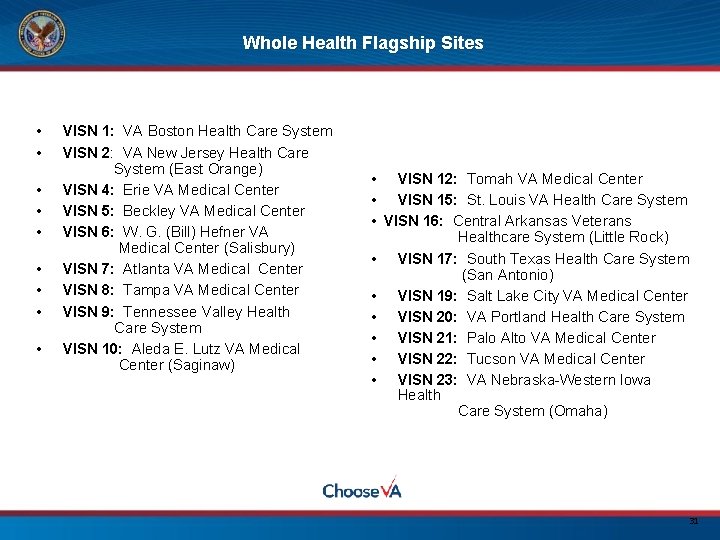
Whole Health Flagship Sites • • • VISN 1: VA Boston Health Care System VISN 2: VA New Jersey Health Care System (East Orange) VISN 4: Erie VA Medical Center VISN 5: Beckley VA Medical Center VISN 6: W. G. (Bill) Hefner VA Medical Center (Salisbury) VISN 7: Atlanta VA Medical Center VISN 8: Tampa VA Medical Center VISN 9: Tennessee Valley Health Care System VISN 10: Aleda E. Lutz VA Medical Center (Saginaw) • VISN 12: Tomah VA Medical Center • VISN 15: St. Louis VA Health Care System • VISN 16: Central Arkansas Veterans Healthcare System (Little Rock) • VISN 17: South Texas Health Care System (San Antonio) • VISN 19: Salt Lake City VA Medical Center • VISN 20: VA Portland Health Care System • VISN 21: Palo Alto VA Medical Center • VISN 22: Tucson VA Medical Center • VISN 23: VA Nebraska-Western Iowa Health Care System (Omaha) 31
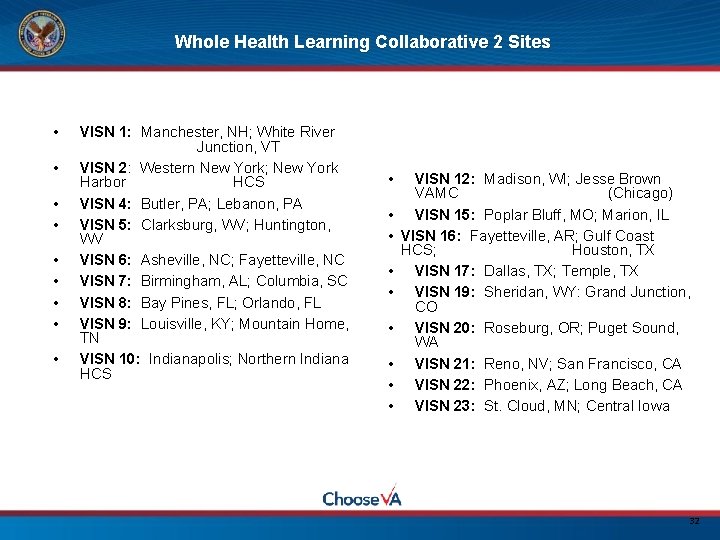
Whole Health Learning Collaborative 2 Sites • • • VISN 1: Manchester, NH; White River Junction, VT VISN 2: Western New York; New York Harbor HCS VISN 4: Butler, PA; Lebanon, PA VISN 5: Clarksburg, WV; Huntington, WV VISN 6: Asheville, NC; Fayetteville, NC VISN 7: Birmingham, AL; Columbia, SC VISN 8: Bay Pines, FL; Orlando, FL VISN 9: Louisville, KY; Mountain Home, TN VISN 10: Indianapolis; Northern Indiana HCS • • • VISN 12: Madison, WI; Jesse Brown VAMC (Chicago) VISN 15: Poplar Bluff, MO; Marion, IL VISN 16: Fayetteville, AR; Gulf Coast HCS; Houston, TX VISN 17: Dallas, TX; Temple, TX VISN 19: Sheridan, WY: Grand Junction, CO VISN 20: Roseburg, OR; Puget Sound, WA VISN 21: Reno, NV; San Francisco, CA VISN 22: Phoenix, AZ; Long Beach, CA VISN 23: St. Cloud, MN; Central Iowa 32
The VA health care system is leading the change towards a better approach to pain care
Time to Pause and Create • You have the answers • This is time to put them into action Pause Be Present Proceed Towards Whole Health P. 7
Movement Break!
2. New Perspectives on Pain and Suffering Whole Health for Pain and Suffering
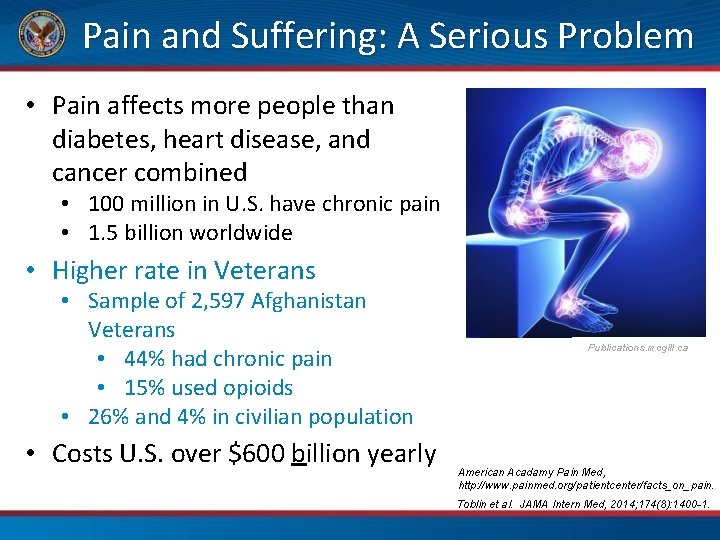
Pain and Suffering: A Serious Problem • Pain affects more people than diabetes, heart disease, and cancer combined • 100 million in U. S. have chronic pain • 1. 5 billion worldwide • Higher rate in Veterans • Sample of 2, 597 Afghanistan Veterans • 44% had chronic pain • 15% used opioids • 26% and 4% in civilian population • Costs U. S. over $600 billion yearly Publications. mcgill. ca American Acadamy Pain Med, http: //www. painmed. org/patientcenter/facts_on_pain. aspx et al. JAMA Intern Med, 2014; 174(8): 1400 -1. Toblin
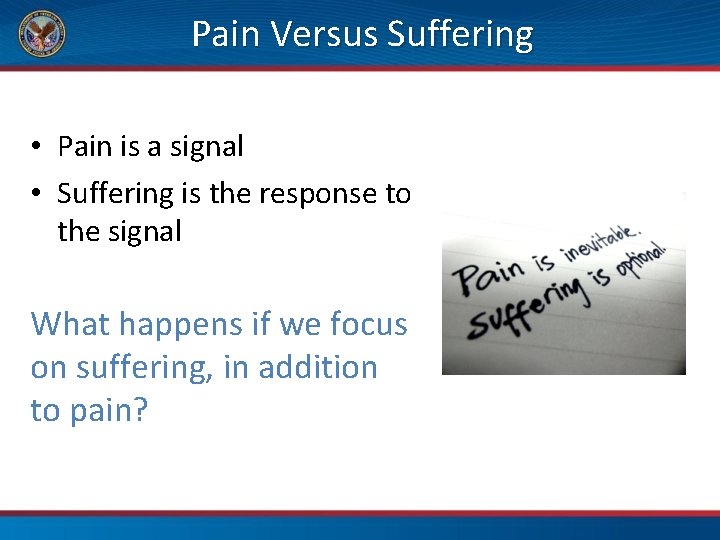
Pain Versus Suffering • Pain is a signal • Suffering is the response to the signal What happens if we focus on suffering, in addition to pain?
The Unfortunate Reality… Pain and suffering are a serious problem They are complex Treating them is also complex The “conventional” approach has limitations • Opioids, in particular, are problematic • •
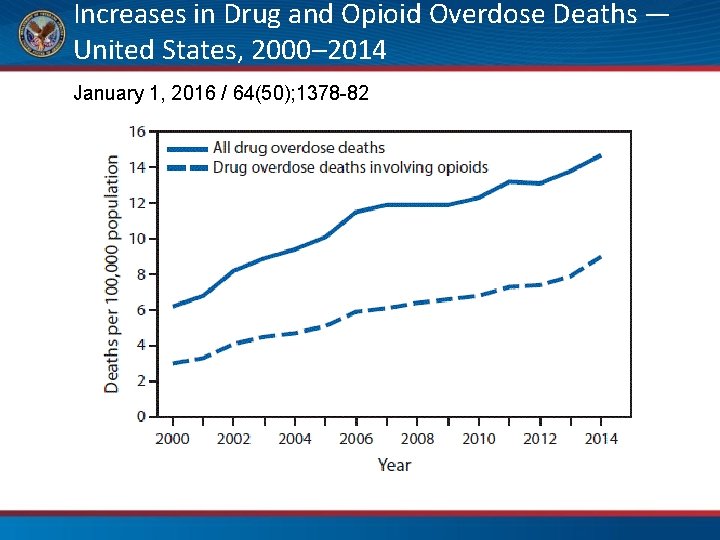
Increases in Drug and Opioid Overdose Deaths — United States, 2000– 2014 January 1, 2016 / 64(50); 1378 -82
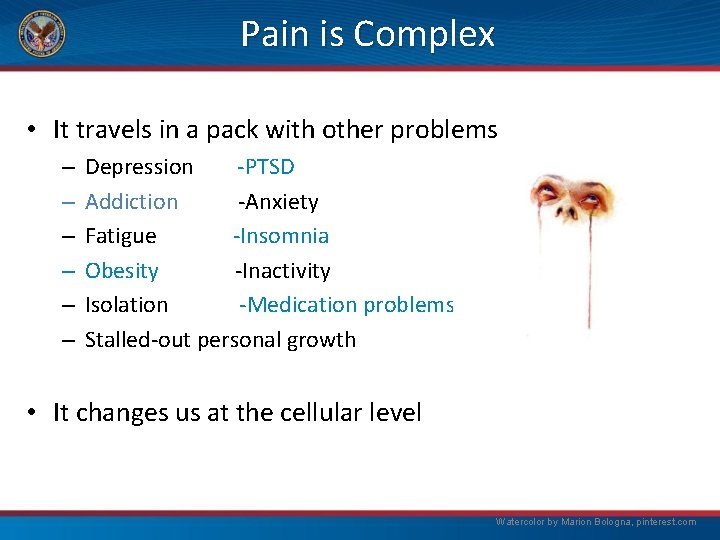
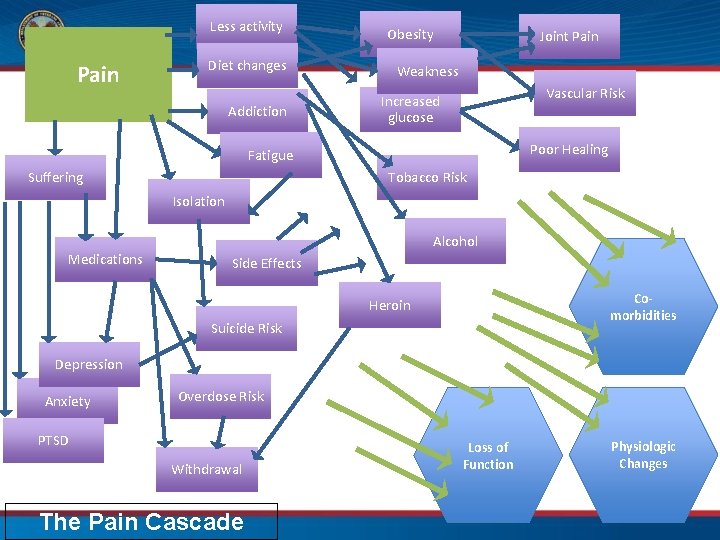
Pain is Complex • It travels in a pack with other problems – – – Depression -PTSD Addiction -Anxiety Fatigue -Insomnia Obesity -Inactivity Isolation -Medication problems Stalled-out personal growth • It changes us at the cellular level Watercolor by Marion Bologna, pinterest. com
Less activity Pain Diet changes Addiction Obesity Joint Pain Weakness Vascular Risk Increased glucose Poor Healing Fatigue Suffering Tobacco Risk Isolation Alcohol Medications Side Effects Comorbidities Heroin Suicide Risk Depression Anxiety Overdose Risk PTSD Withdrawal The Pain Cascade Loss of Function Physiologic Changes
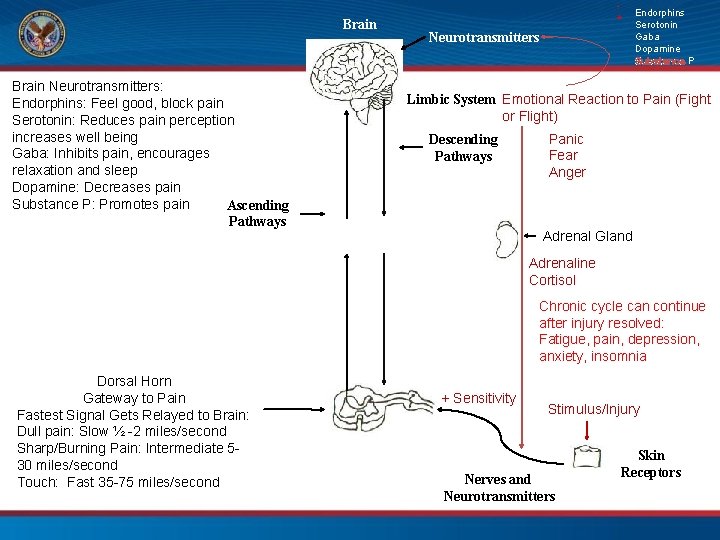
Brain Neurotransmitters: Endorphins: Feel good, block pain Serotonin: Reduces pain perception increases well being Gaba: Inhibits pain, encourages relaxation and sleep Dopamine: Decreases pain Substance P: Promotes pain Ascending Pathways + Neurotransmitters Endorphins Serotonin Gaba Dopamine Substance P Limbic System Emotional Reaction to Pain (Fight or Flight) Descending Pathways Panic Fear Anger Adrenal Gland Adrenaline Cortisol Chronic cycle can continue after injury resolved: Fatigue, pain, depression, anxiety, insomnia Dorsal Horn Gateway to Pain Fastest Signal Gets Relayed to Brain: Dull pain: Slow ½ -2 miles/second Sharp/Burning Pain: Intermediate 530 miles/second Touch: Fast 35 -75 miles/second + Sensitivity Stimulus/Injury Nerves and Neurotransmitters Skin Receptors
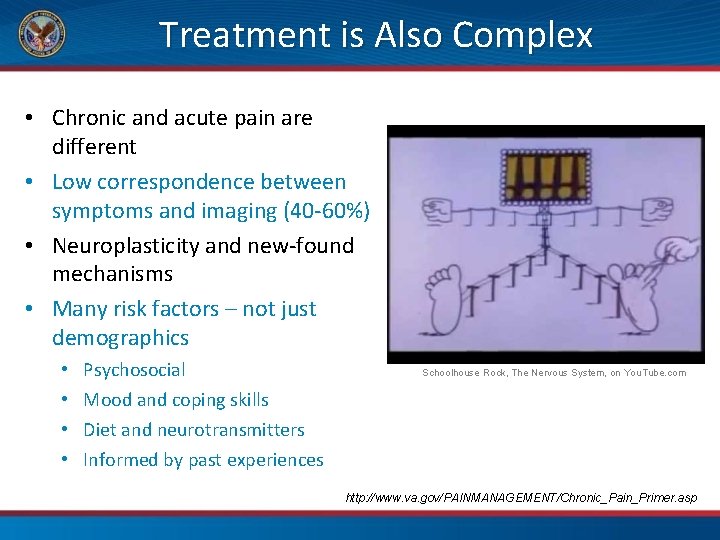
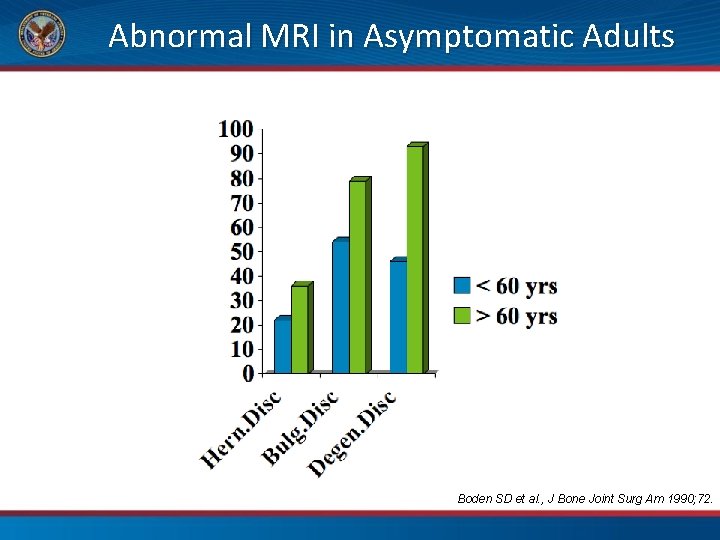
Treatment is Also Complex • Chronic and acute pain are different • Low correspondence between symptoms and imaging (40 -60%) • Neuroplasticity and new-found mechanisms • Many risk factors – not just demographics • • Psychosocial Mood and coping skills Diet and neurotransmitters Informed by past experiences Schoolhouse Rock, The Nervous System, on You. Tube. com http: //www. va. gov/PAINMANAGEMENT/Chronic_Pain_Primer. asp
Abnormal MRI in Asymptomatic Adults Boden SD et al. , J Bone Joint Surg Am 1990; 72.
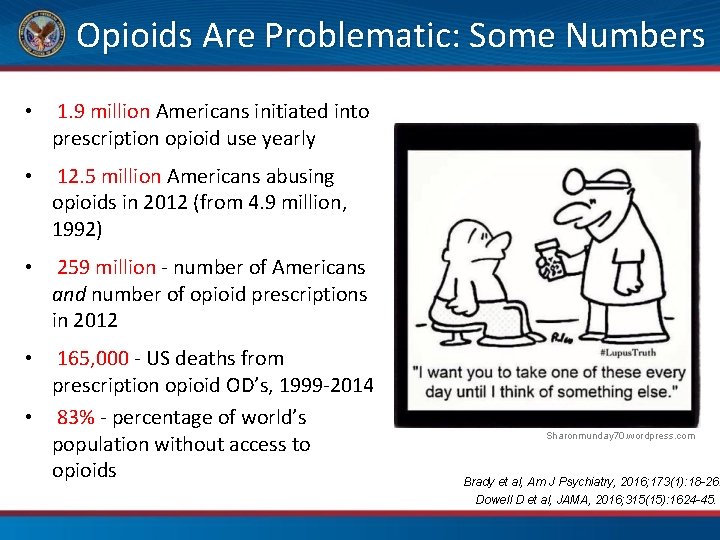
Opioids Are Problematic: Some Numbers • 1. 9 million Americans initiated into prescription opioid use yearly • 12. 5 million Americans abusing opioids in 2012 (from 4. 9 million, 1992) • 259 million - number of Americans and number of opioid prescriptions in 2012 165, 000 - US deaths from prescription opioid OD’s, 1999 -2014 • 83% - percentage of world’s population without access to opioids • Sharonmunday 70. wordpress. com Brady et al, Am J Psychiatry, 2016; 173(1): 18 -26. Dowell D et al, JAMA, 2016; 315(15): 1624 -45.
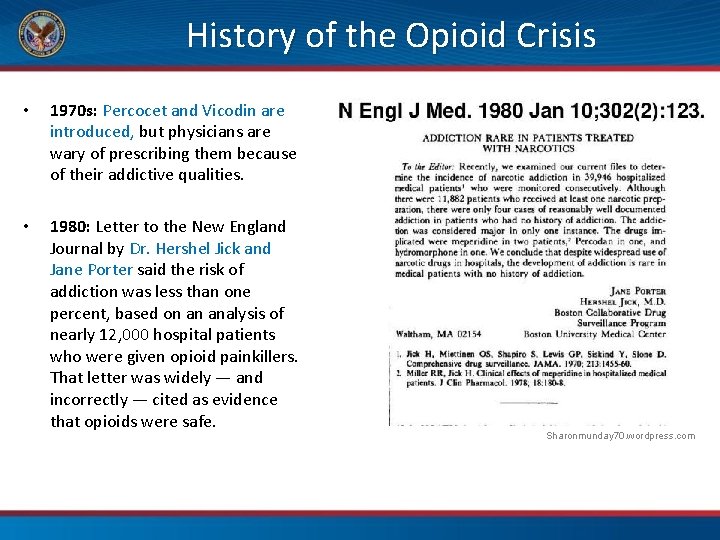
History of the Opioid Crisis • 1970 s: Percocet and Vicodin are introduced, but physicians are wary of prescribing them because of their addictive qualities. • 1980: Letter to the New England Journal by Dr. Hershel Jick and Jane Porter said the risk of addiction was less than one percent, based on an analysis of nearly 12, 000 hospital patients who were given opioid painkillers. That letter was widely — and incorrectly — cited as evidence that opioids were safe. Sharonmunday 70. wordpress. com
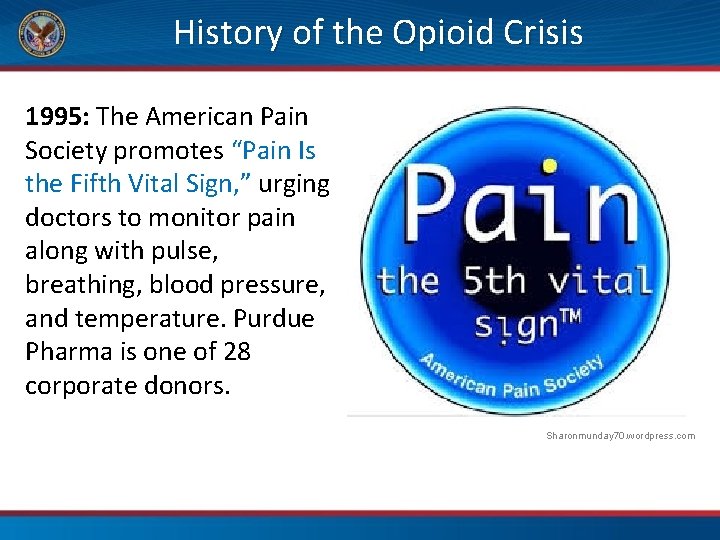
History of the Opioid Crisis 1995: The American Pain Society promotes “Pain Is the Fifth Vital Sign, ” urging doctors to monitor pain along with pulse, breathing, blood pressure, and temperature. Purdue Pharma is one of 28 corporate donors. Sharonmunday 70. wordpress. com
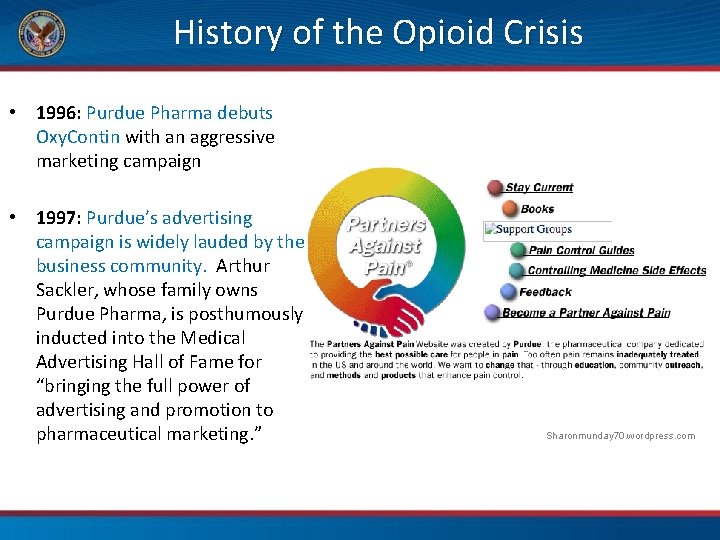
History of the Opioid Crisis • 1996: Purdue Pharma debuts Oxy. Contin with an aggressive marketing campaign • 1997: Purdue’s advertising campaign is widely lauded by the business community. Arthur Sackler, whose family owns Purdue Pharma, is posthumously inducted into the Medical Advertising Hall of Fame for “bringing the full power of advertising and promotion to pharmaceutical marketing. ” Sharonmunday 70. wordpress. com
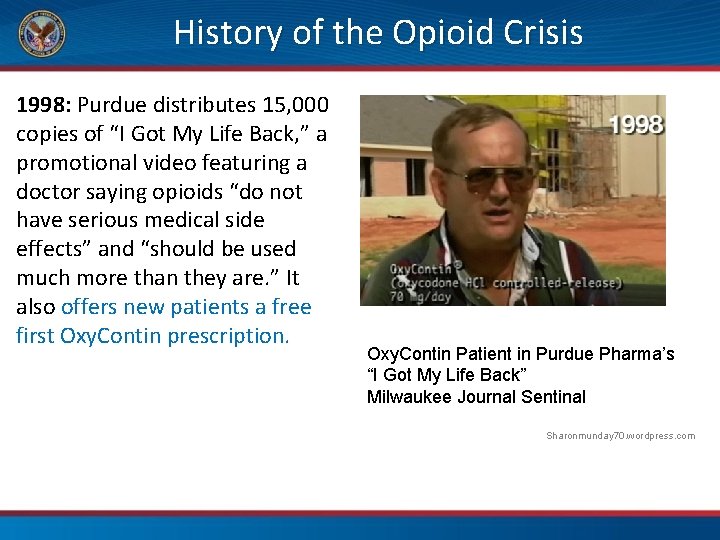
History of the Opioid Crisis 1998: Purdue distributes 15, 000 copies of “I Got My Life Back, ” a promotional video featuring a doctor saying opioids “do not have serious medical side effects” and “should be used much more than they are. ” It also offers new patients a free first Oxy. Contin prescription. Oxy. Contin Patient in Purdue Pharma’s “I Got My Life Back” Milwaukee Journal Sentinal Sharonmunday 70. wordpress. com
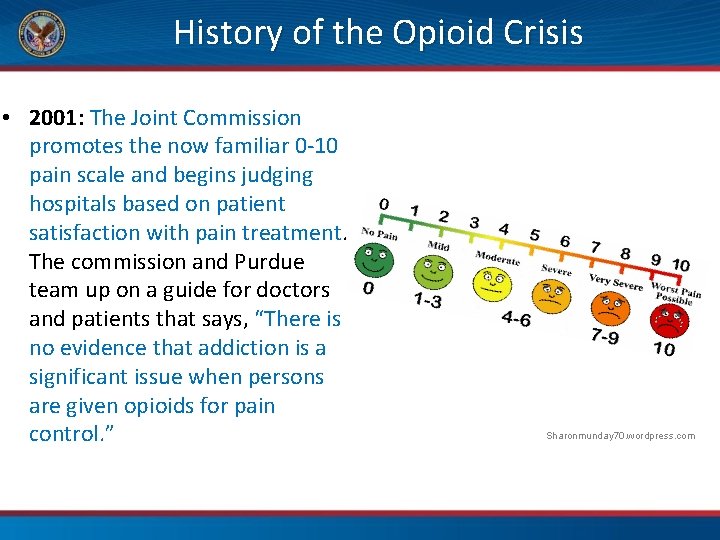
History of the Opioid Crisis • 2001: The Joint Commission promotes the now familiar 0 -10 pain scale and begins judging hospitals based on patient satisfaction with pain treatment. The commission and Purdue team up on a guide for doctors and patients that says, “There is no evidence that addiction is a significant issue when persons are given opioids for pain control. ” Sharonmunday 70. wordpress. com
History of the Opioid Crisis • 2009: The Joint Commission removes the requirement to assess all patients for pain. By now, the United States is consuming the vast majority of the world’s opioid painkillers: 99 percent of all hydrocodone and 81 percent of all oxycodone. • 2010: Cheap, strong Mexican heroin makes its way to American rural and suburban areas. Annual Oxy. Contin sales exceed $3 billion. Sharonmunday 70. wordpress. com
Why Opioids are Problematic • Mu receptors-analgesia-upregulation creates dependency • Central acting-dopamine-sense of well being can lead to addiction • NMDA receptors possible site of opiate hyperalgesia • Perfect storm for patients with chronic pain and associated co-morbidities
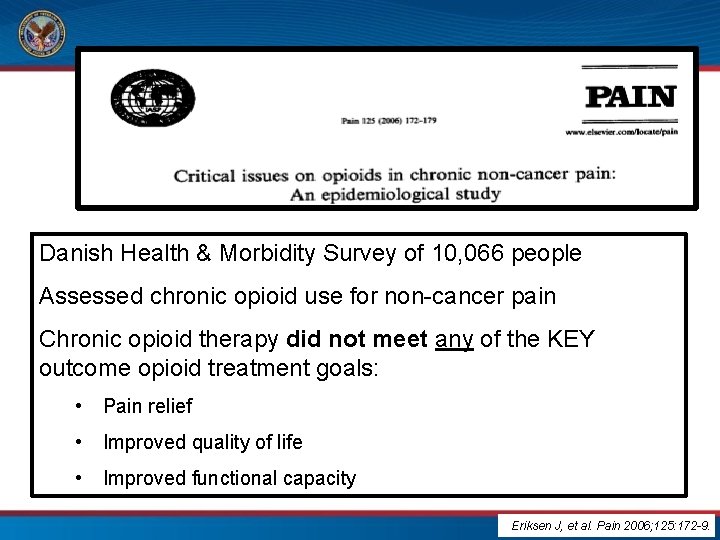
Danish Health & Morbidity Survey of 10, 066 people Assessed chronic opioid use for non-cancer pain Chronic opioid therapy did not meet any of the KEY outcome opioid treatment goals: • Pain relief • Improved quality of life • Improved functional capacity Eriksen J, et al. Pain 2006; 125: 172 -9.
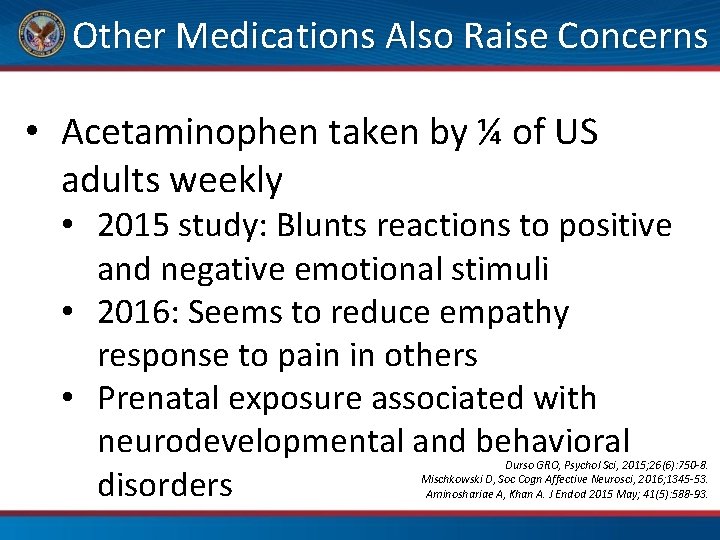
Other Medications Also Raise Concerns • Acetaminophen taken by ¼ of US adults weekly • 2015 study: Blunts reactions to positive and negative emotional stimuli • 2016: Seems to reduce empathy response to pain in others • Prenatal exposure associated with neurodevelopmental and behavioral disorders Durso GRO, Psychol Sci, 2015; 26(6): 750 -8. Mischkowski D, Soc Cogn Affective Neurosci, 2016; 1345 -53. Aminoshariae A, Khan A. J Endod 2015 May; 41(5): 588 -93.
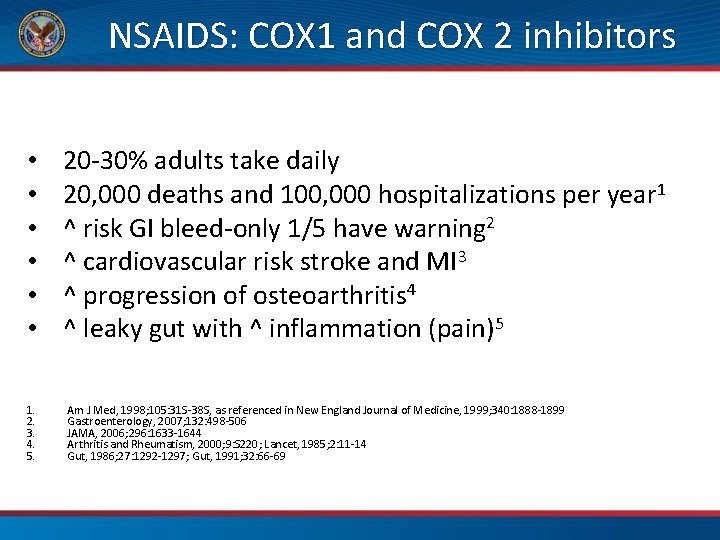
NSAIDS: COX 1 and COX 2 inhibitors • • • 1. 2. 3. 4. 5. 20 -30% adults take daily 20, 000 deaths and 100, 000 hospitalizations per year 1 ^ risk GI bleed-only 1/5 have warning 2 ^ cardiovascular risk stroke and MI 3 ^ progression of osteoarthritis 4 ^ leaky gut with ^ inflammation (pain)5 Am J Med, 1998; 105: 31 S-38 S, as referenced in New England Journal of Medicine, 1999; 340: 1888 -1899 Gastroenterology, 2007; 132: 498 -506 JAMA, 2006; 296: 1633 -1644 Arthritis and Rheumatism, 2000; 9: S 220; Lancet, 1985; 2: 11 -14 Gut, 1986; 27: 1292 -1297; Gut, 1991; 32: 66 -69
We are often told what not to do. But what do we do instead?
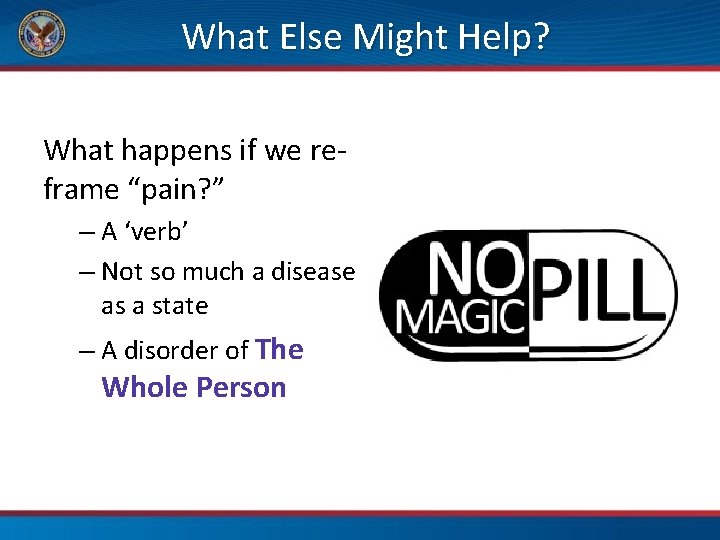
What Else Might Help? What happens if we reframe “pain? ” – A ‘verb’ – Not so much a disease as a state – A disorder of The Whole Person
How do you define Whole Health?
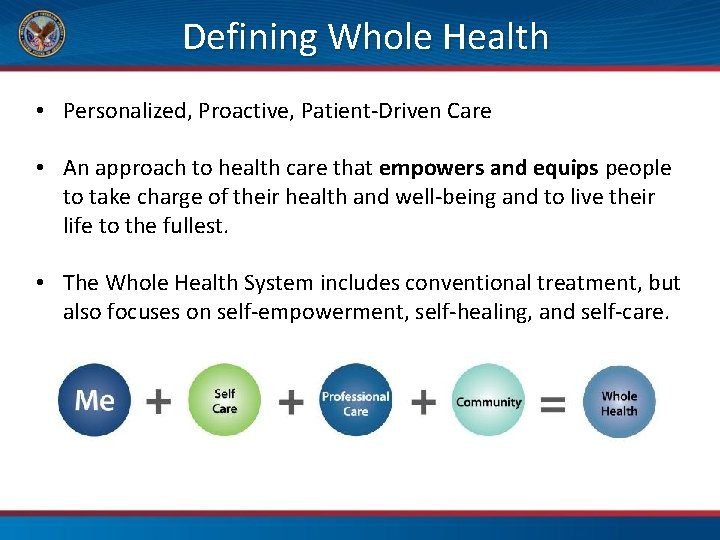
Defining Whole Health • Personalized, Proactive, Patient-Driven Care • An approach to health care that empowers and equips people to take charge of their health and well-being and to live their life to the fullest. • The Whole Health System includes conventional treatment, but also focuses on self-empowerment, self-healing, and self-care.
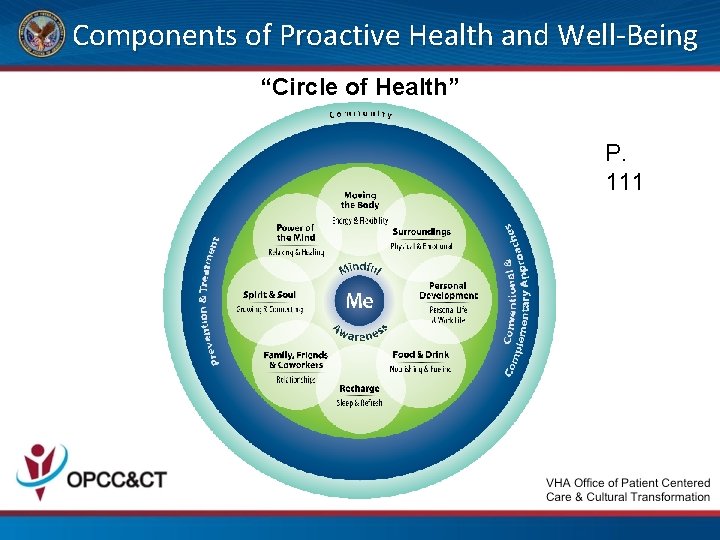
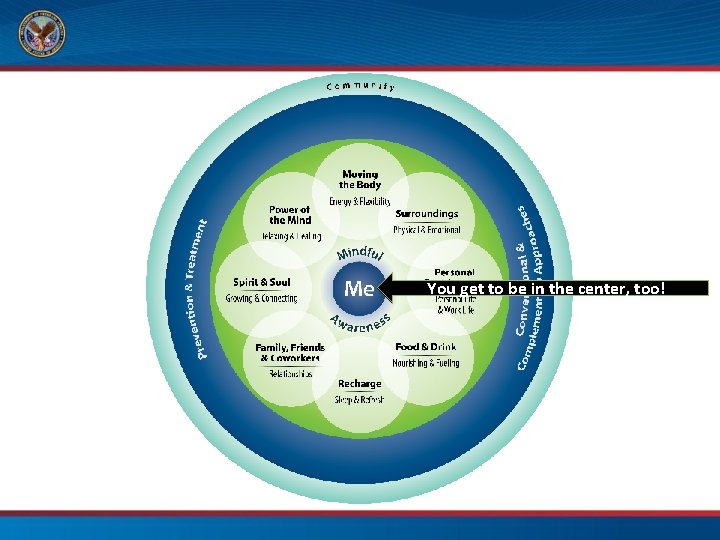
Components of Proactive Health and Well-Being “Circle of Health” P. 111
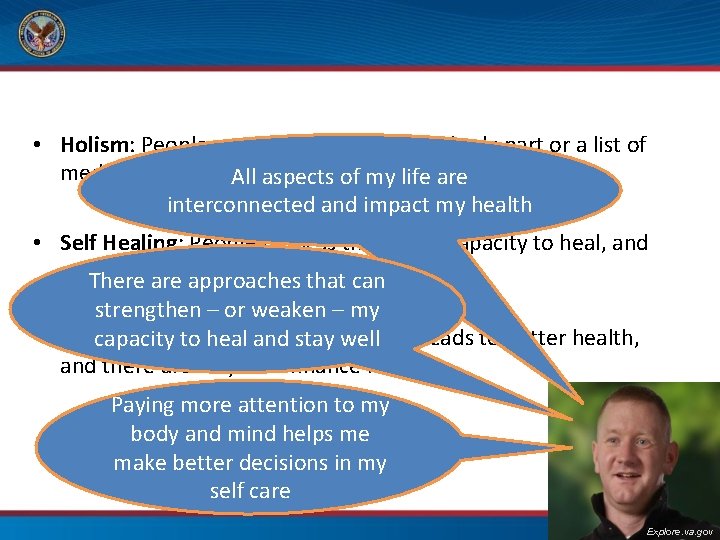
Core Concepts for Transforming to Whole Health • Holism: People are more than a broken body part or a list of medical problems. All aspects of my life are interconnected and impact my health • Self Healing: People possess the innate capacity to heal, and mobilizing that is an important priority There approaches that can strengthen – or weaken – my • Mindful Awareness: Self-awareness leads to better health, capacity to heal and stay well and there are ways to enhance it Paying more attention to my body and mind helps me make better decisions in my self care Explore. va. gov
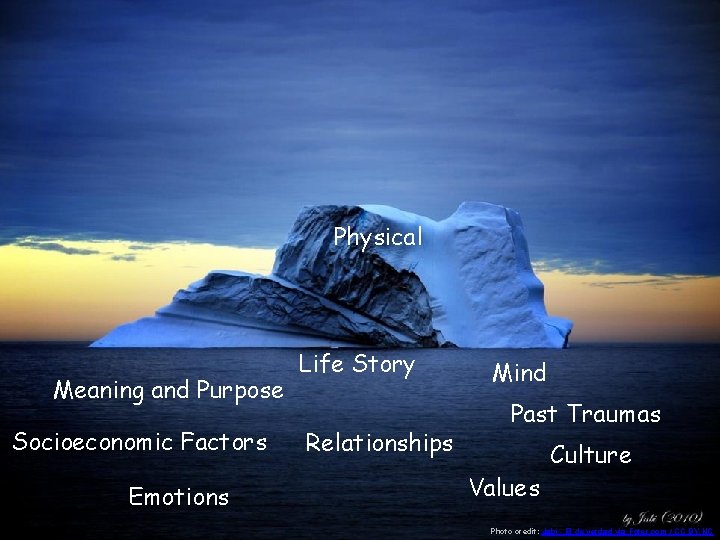
Physical Meaning and Purpose Socioeconomic Factors Emotions Life Story Relationships Mind Past Traumas Values Culture Photo credit: Jabi - El de verdad via Foter. com / CC BY-NC
Whole Health System
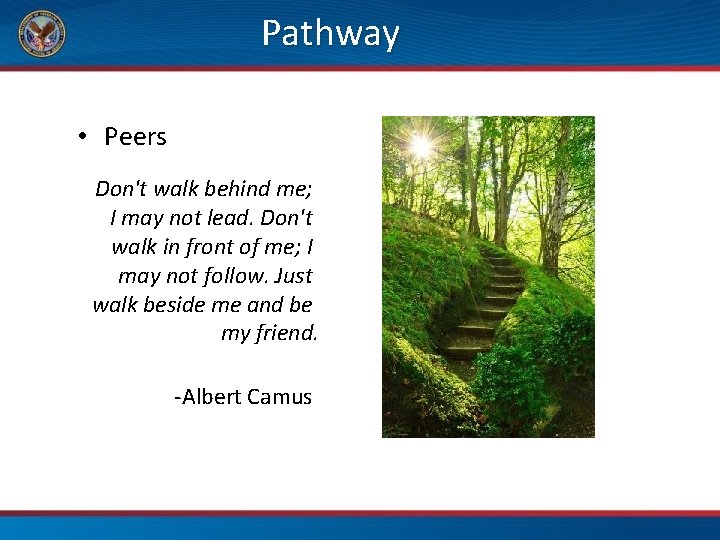
Pathway • Peers Don't walk behind me; I may not lead. Don't walk in front of me; I may not follow. Just walk beside me and be my friend. -Albert Camus
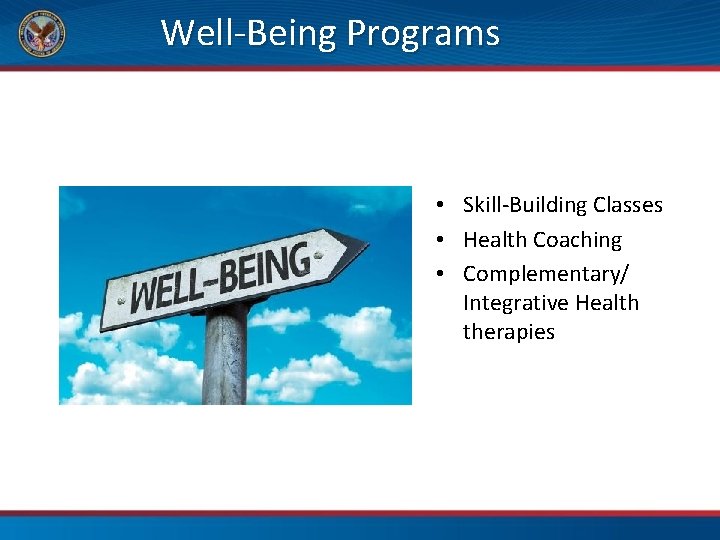
Well-Being Programs • Skill-Building Classes • Health Coaching • Complementary/ Integrative Health therapies
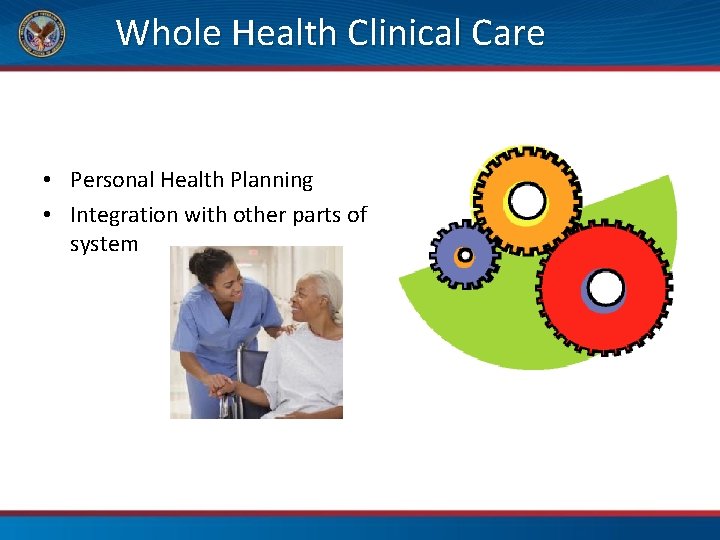
Whole Health Clinical Care • Personal Health Planning • Integration with other parts of system
Ten Reasons to Practice Whole Health 1. You get to know your patients better. 2. Your work feels more fulfilling. 3. It helps cultivate mindful awareness. 4. You are reminded of the “Power of You. ” 5. It makes your patients more satisfied with their care. 6. It is more empowering for patients. 7. Patients do better. 8. It works well for teams. 9. It has the potential to save resources. 10. It saves time.
The Elevator Speech Exercise • Draft out a 30 - second elevator speech using the form on page 9 • Can use suggested elements or add your own • Give your speech to a partner, and listen to your partner’s speech • Offer constructive feedback • We will invite volunteers to share
Whole Health Resources Page 10
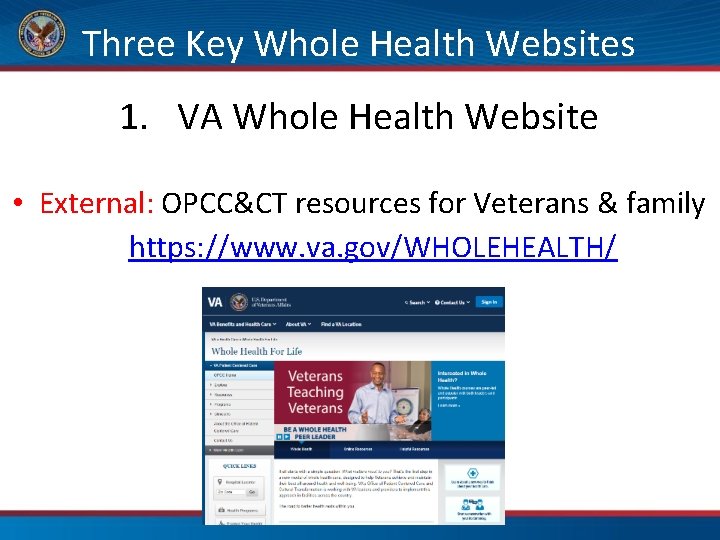
Three Key Whole Health Websites 1. VA Whole Health Website • External: OPCC&CT resources for Veterans & family https: //www. va. gov/WHOLEHEALTH/
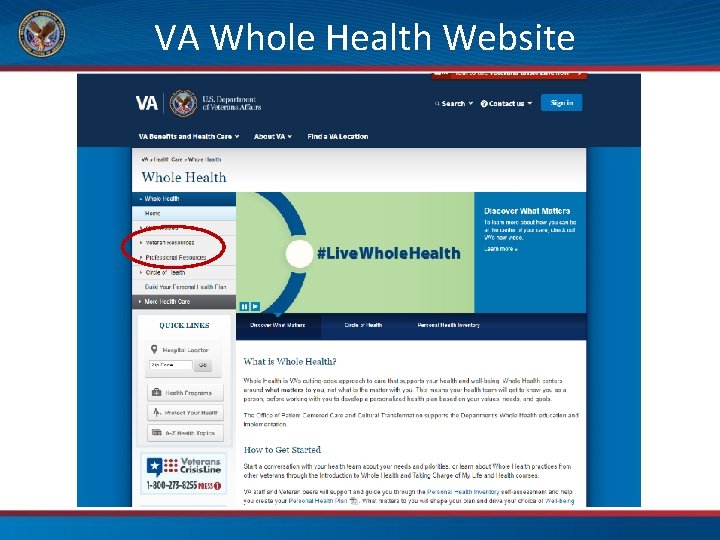
VA Whole Health Website
Three Key Whole Health Websites: 2. OPCC&CT Share. Point • Internal – OPCC&CT Share. Point https: //dvagov. sharepoint. com/sites/VHAOP CC/Pages/Default. aspx – Education Hub on Share. Point https: //dvagov. sharepoint. com/sites/VHAOP CC/Education/Site. Pages/Home. aspx? Ajax. Delt a=1&is. Start. Plt 1=1565725923678
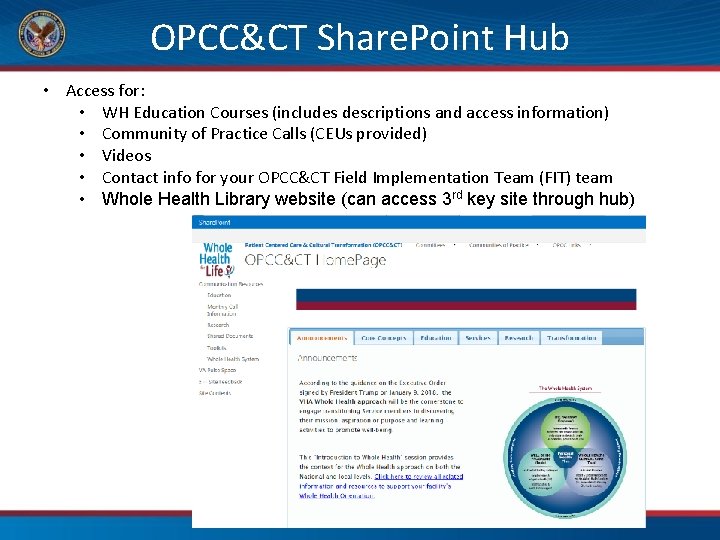
OPCC&CT Share. Point Hub • Access for: • WH Education Courses (includes descriptions and access information) • Community of Practice Calls (CEUs provided) • Videos • Contact info for your OPCC&CT Field Implementation Team (FIT) team • Whole Health Library website (can access 3 rd key site through hub)
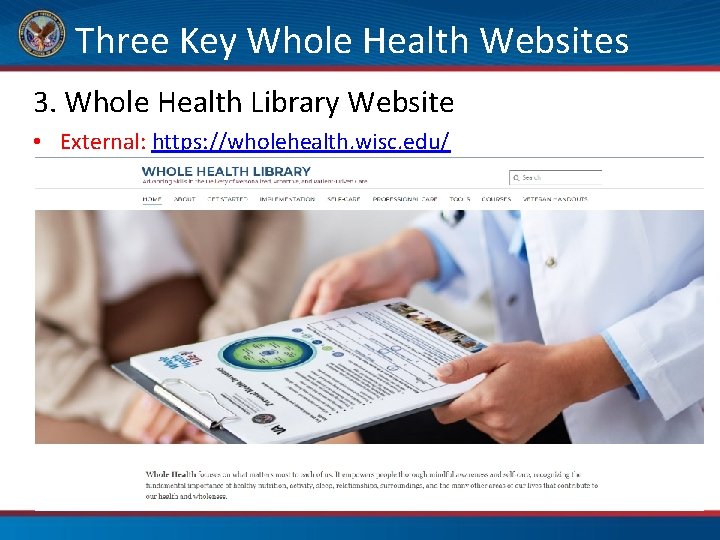
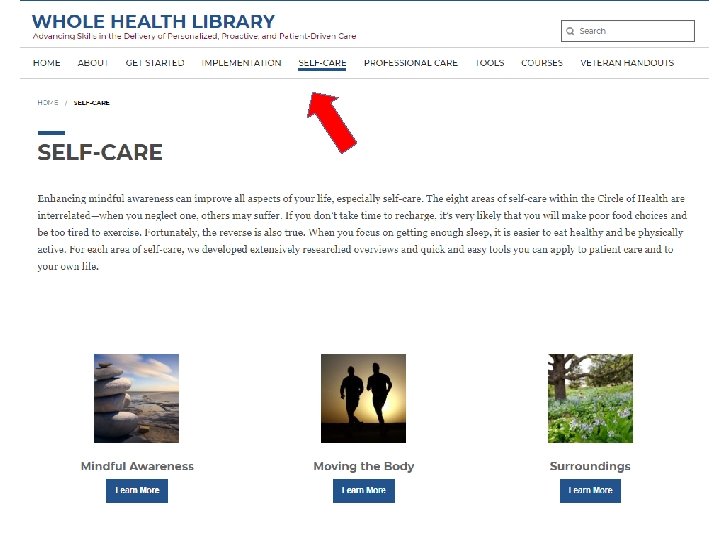
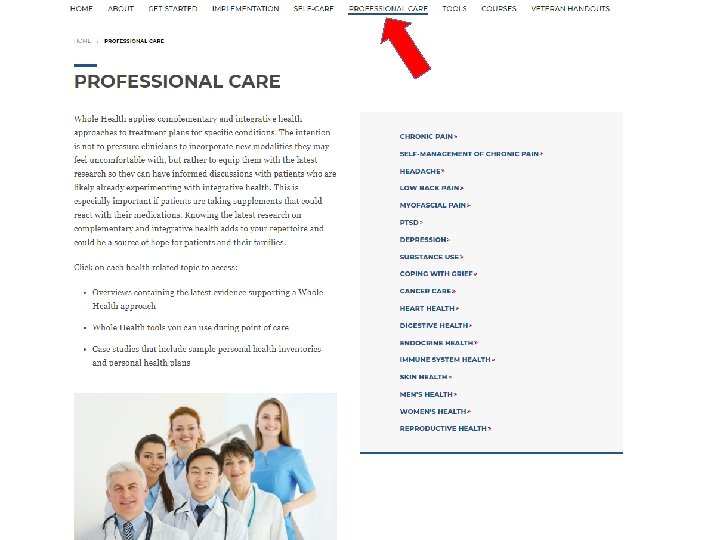
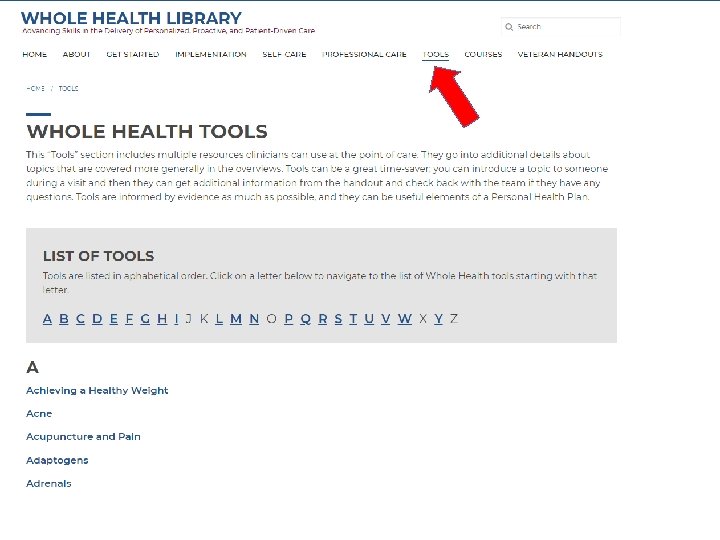
Three Key Whole Health Websites 3. Whole Health Library Website • External: https: //wholehealth. wisc. edu/
Whole Health Library Website • Over 200 different Whole Health topic overviews and tools • Course materials (brochures, workbooks, PPTs) for all the OPCC&CT clinical courses
Time to Pause and Create • You have the answers • This is time to put them into action Pause Be Present Proceed Towards Whole Health P. 18
Take a Break! https: //pixabay. com/photos/wisconsinpanorama-fields-meadow-1826836/
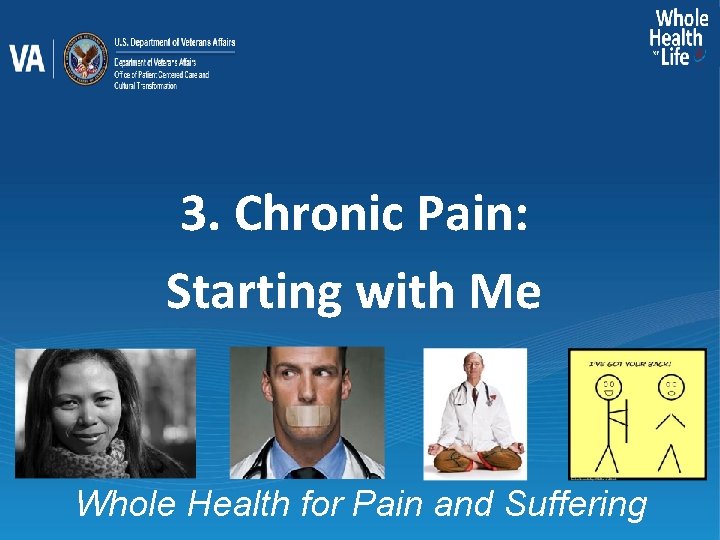
3. Chronic Pain: Starting with Me Whole Health for Pain and Suffering
You get to be in the center, too!
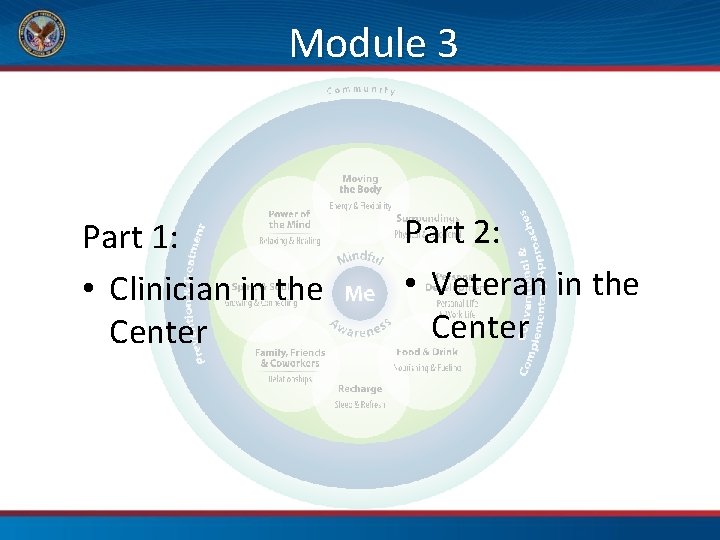
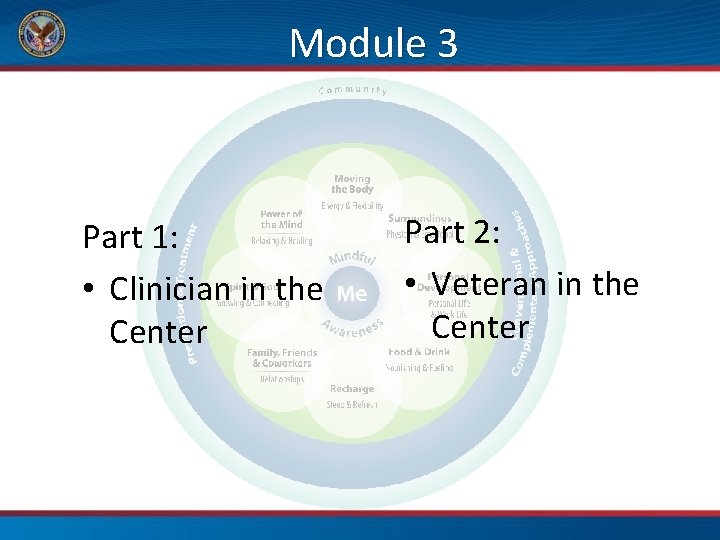
Module 3 Part 1: • Clinician in the Center Part 2: • Veteran in the Center
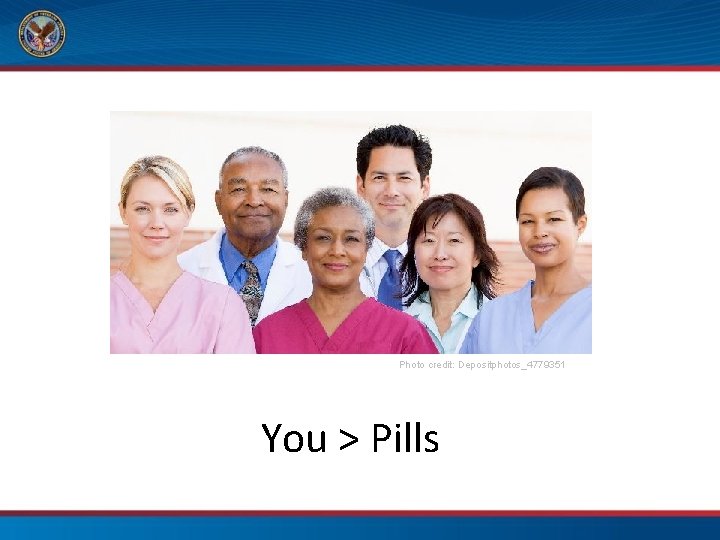
The Clinician Effect Photo credit: Depositphotos_4779351 You > Pills
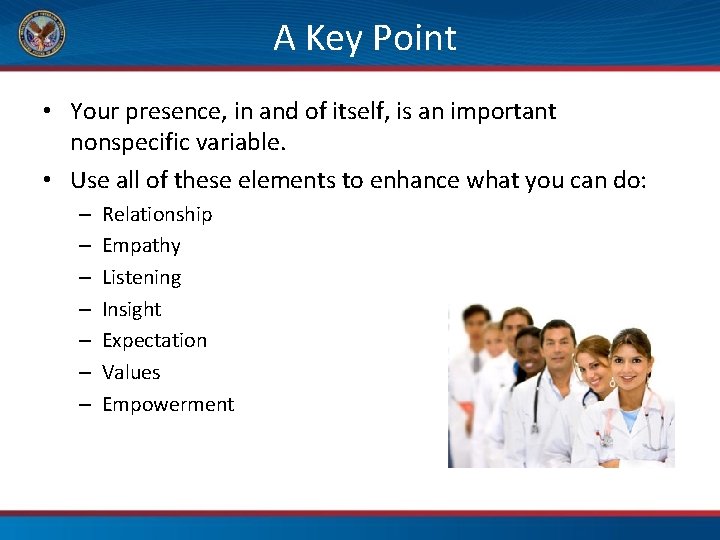
A Key Point • Your presence, in and of itself, is an important nonspecific variable. • Use all of these elements to enhance what you can do: – – – – Relationship Empathy Listening Insight Expectation Values Empowerment
What Is a “Good Back Consult? ” • Patients emphasized the importance of: – – – An explanation of what was being done and found Understandable information on the cause Receiving reassurance Discussing psychosocial issues Discussing what can be done • Most important part of "Good Back Consult” The specialist took the patient seriously • Conclusion: The findings may represent an important potential for enhancing clinical communication with patients. Laerum E et al. J Rehabil Med. 2006 Jul; 38(4): 255 -62. .
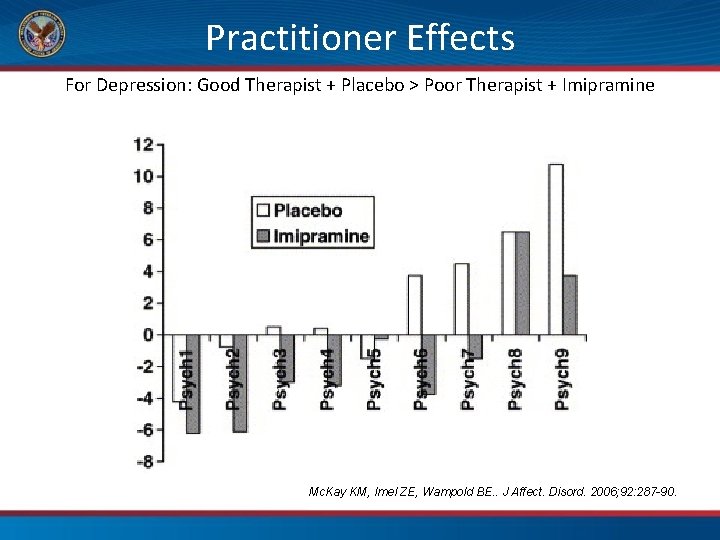
Practitioner Effects For Depression: Good Therapist + Placebo > Poor Therapist + Imipramine Mc. Kay KM, Imel ZE, Wampold BE. . J Affect. Disord. 2006; 92: 287 -90.
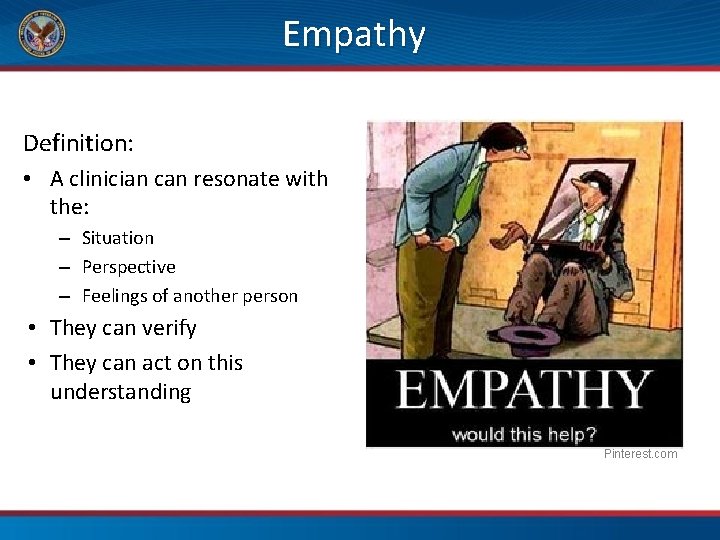
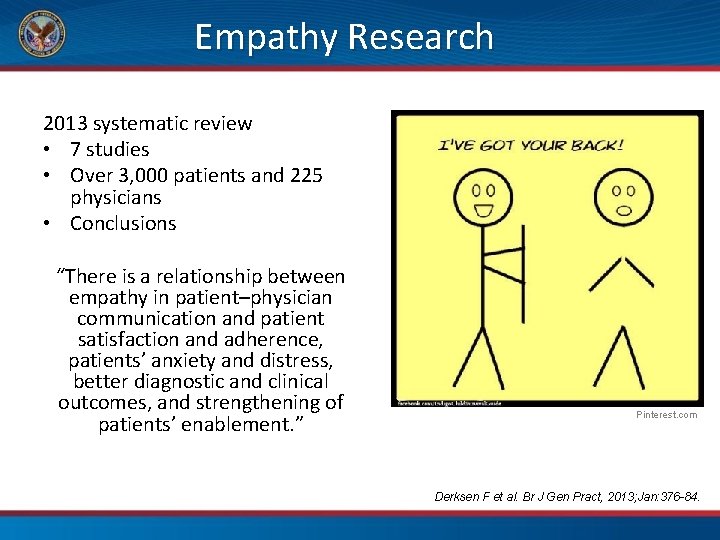
Empathy Definition: • A clinician can resonate with the: – Situation – Perspective – Feelings of another person • They can verify • They can act on this understanding Pinterest. com
Empathy Research 2013 systematic review • 7 studies • Over 3, 000 patients and 225 physicians • Conclusions “There is a relationship between empathy in patient–physician communication and patient satisfaction and adherence, patients’ anxiety and distress, better diagnostic and clinical outcomes, and strengthening of patients’ enablement. ” Pinterest. com Derksen F et al. Br J Gen Pract, 2013; Jan: 376 -84.
Video: Empathy Brene Brown on Empathy https: //youtu. be/1 Evwgu 369 Jw
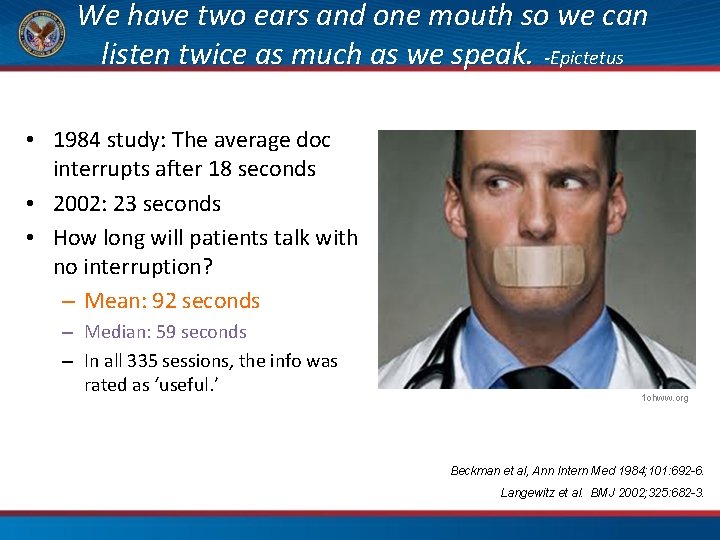
We have two ears and one mouth so we can listen twice as much as we speak. -Epictetus • 1984 study: The average doc interrupts after 18 seconds • 2002: 23 seconds • How long will patients talk with no interruption? – Mean: 92 seconds – Median: 59 seconds – In all 335 sessions, the info was rated as ‘useful. ’ 1 ohww. org Beckman et al, Ann Intern Med 1984; 101: 692 -6. Langewitz et al. BMJ 2002; 325: 682 -3.
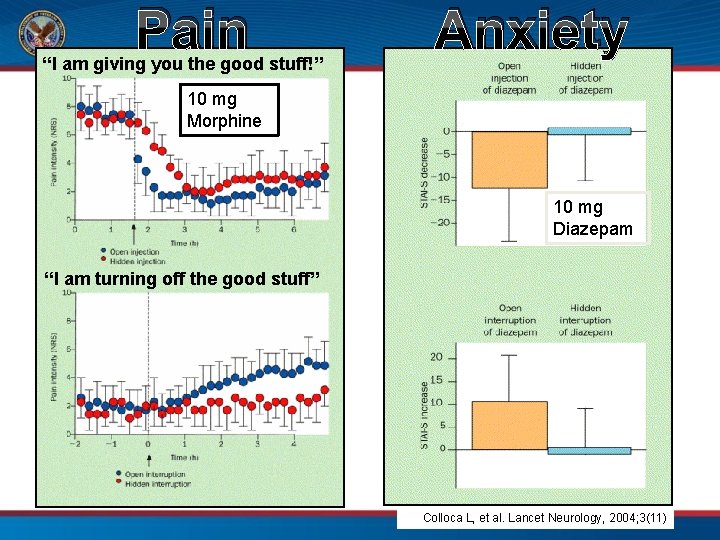
Pain “I am giving you the good stuff!” Anxiety 10 mg Morphine 10 mg Diazepam “I am turning off the good stuff” Colloca L, et al. Lancet Neurology, 2004; 3(11)
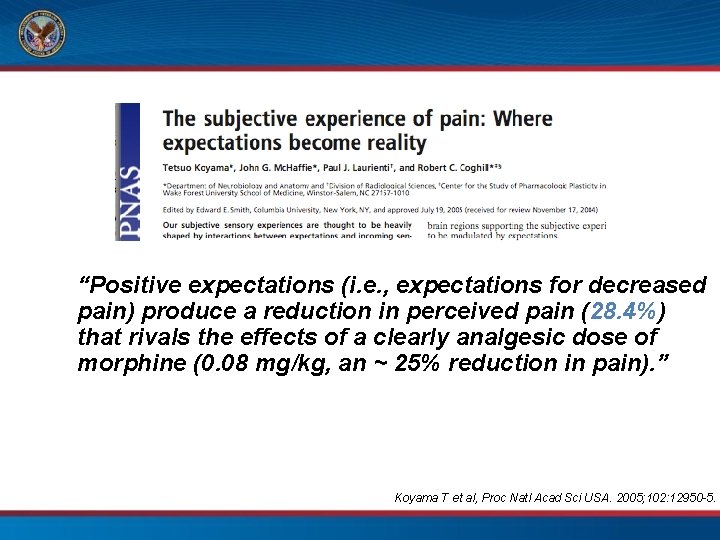
“Positive expectations (i. e. , expectations for decreased pain) produce a reduction in perceived pain (28. 4%) that rivals the effects of a clearly analgesic dose of morphine (0. 08 mg/kg, an ~ 25% reduction in pain). ” Koyama T et al, Proc Natl Acad Sci USA. 2005; 102: 12950 -5.
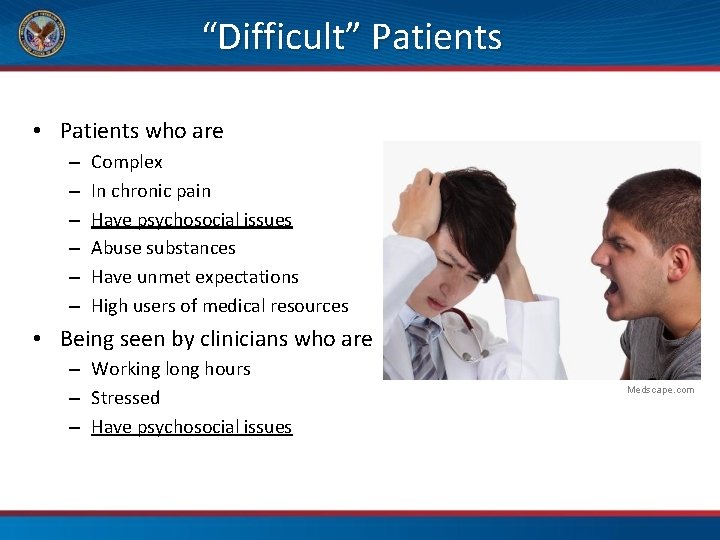
“Difficult” Patients • Patients who are – – – Complex In chronic pain Have psychosocial issues Abuse substances Have unmet expectations High users of medical resources • Being seen by clinicians who are – Working long hours – Stressed – Have psychosocial issues Medscape. com
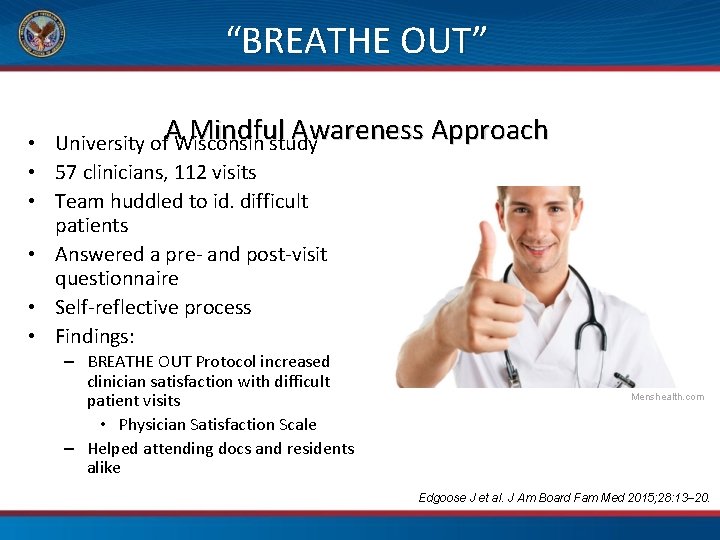
“BREATHE OUT” Mindfulstudy Awareness Approach • University of. AWisconsin • 57 clinicians, 112 visits • Team huddled to id. difficult patients • Answered a pre- and post-visit questionnaire • Self-reflective process • Findings: – BREATHE OUT Protocol increased clinician satisfaction with difficult patient visits • Physician Satisfaction Scale – Helped attending docs and residents alike Menshealth. com Edgoose J et al. J Am Board Fam Med 2015; 28: 13– 20.
Let’s Practice! https: //pixabay. com/photos/piano-keys-classical-music-3505109/
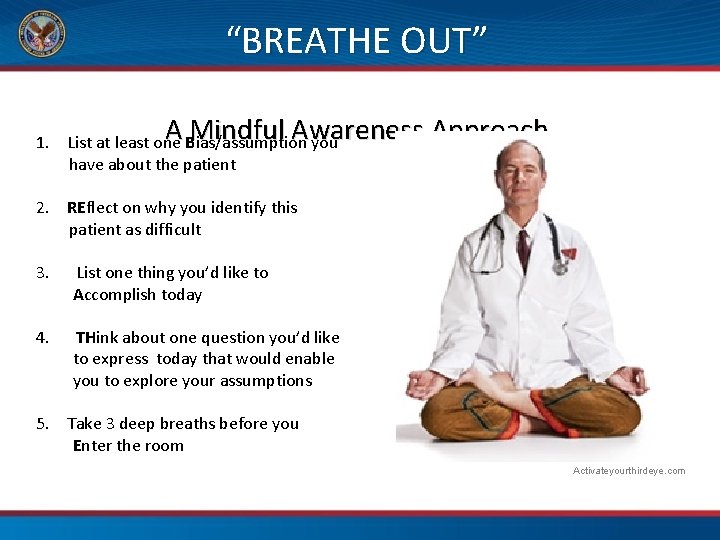
“BREATHE OUT” A Mindful Awareness Approach 1. List at least one Bias/assumption you have about the patient 2. REflect on why you identify this patient as difficult 3. List one thing you’d like to Accomplish today 4. THink about one question you’d like to express today that would enable you to explore your assumptions 5. Take 3 deep breaths before you Enter the room Activateyourthirdeye. com
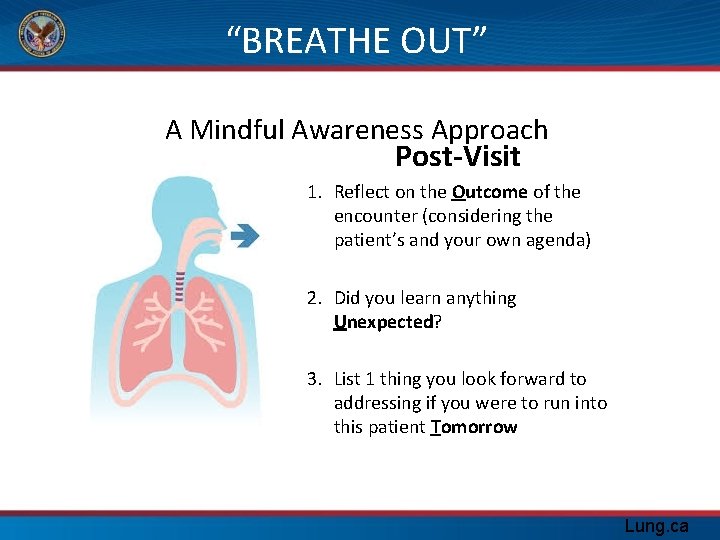
“BREATHE OUT” A Mindful Awareness Approach Post-Visit 1. Reflect on the Outcome of the encounter (considering the patient’s and your own agenda) 2. Did you learn anything Unexpected? 3. List 1 thing you look forward to addressing if you were to run into this patient Tomorrow Lung. ca
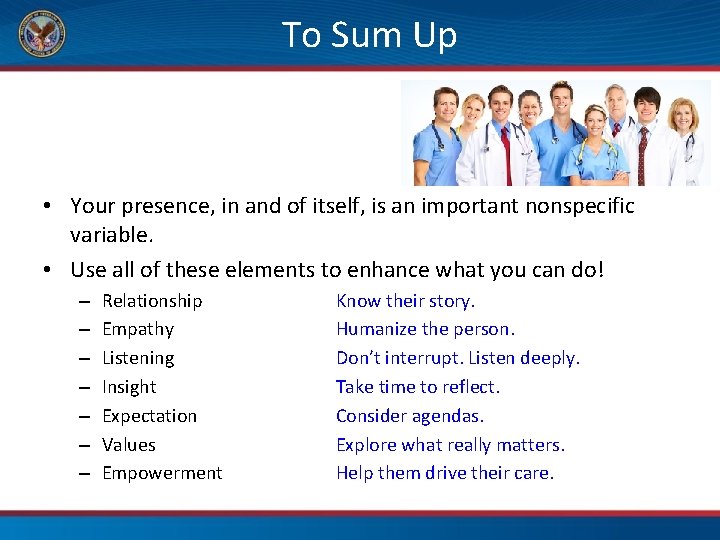
To Sum Up • Your presence, in and of itself, is an important nonspecific variable. • Use all of these elements to enhance what you can do! – – – – Relationship Empathy Listening Insight Expectation Values Empowerment Know their story. Humanize the person. Don’t interrupt. Listen deeply. Take time to reflect. Consider agendas. Explore what really matters. Help them drive their care.
Never underestimate the power of your therapeutic presence!
Module 3 Part 1: • Clinician in the Center Part 2: • Veteran in the Center
“Increasingly, chronic pain research points out that what kind of pain (the location or other descriptors…) may not be as important as who is in pain and how that pain is being experienced. ” -Bonakdar RA, Integrative Pain Management
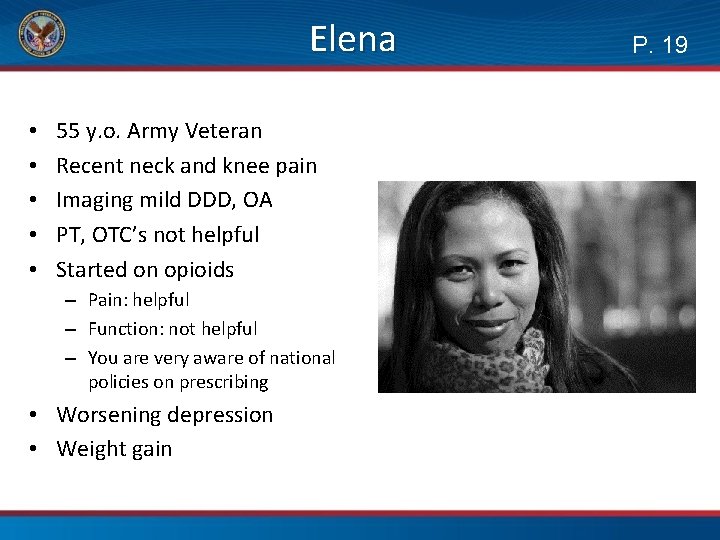
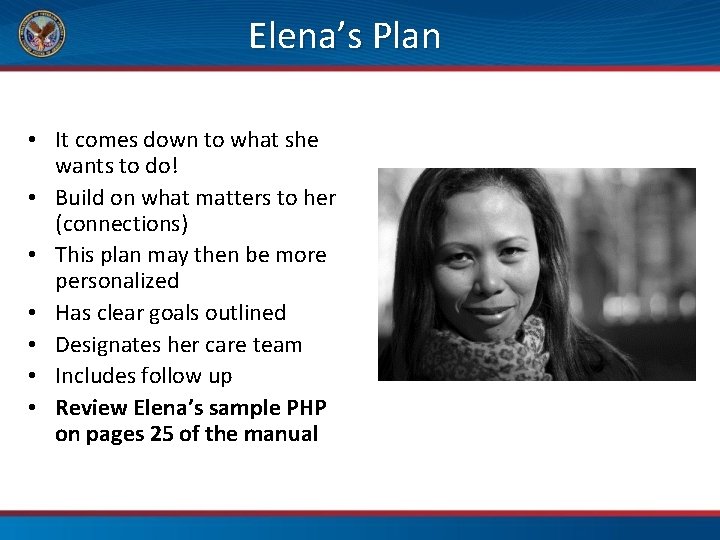
Elena • • • 55 y. o. Army Veteran Recent neck and knee pain Imaging mild DDD, OA PT, OTC’s not helpful Started on opioids – Pain: helpful – Function: not helpful – You are very aware of national policies on prescribing • Worsening depression • Weight gain P. 19
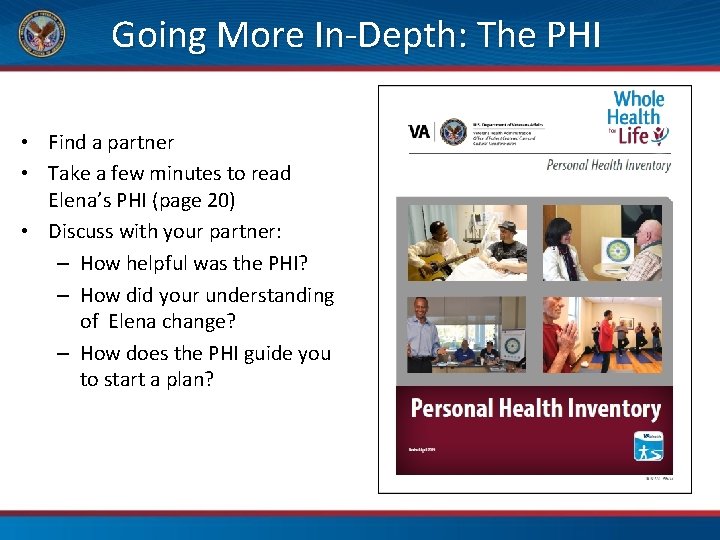
Going More In-Depth: The PHI • Find a partner • Take a few minutes to read Elena’s PHI (page 20) • Discuss with your partner: – How helpful was the PHI? – How did your understanding of Elena change? – How does the PHI guide you to start a plan?
Discussion - PHI 1) How helpful was the PHI? 2) How did your understanding of Elena change?
A Shift in Perspective From… What’s the matter with you? To… What really matters to you?
The Big Questions • What REALLY matters to you in your life? • What do you want your health for? • What brings you a sense of joy and happiness? • What gets you up in the morning?
What are the root causes of the pain and suffering?
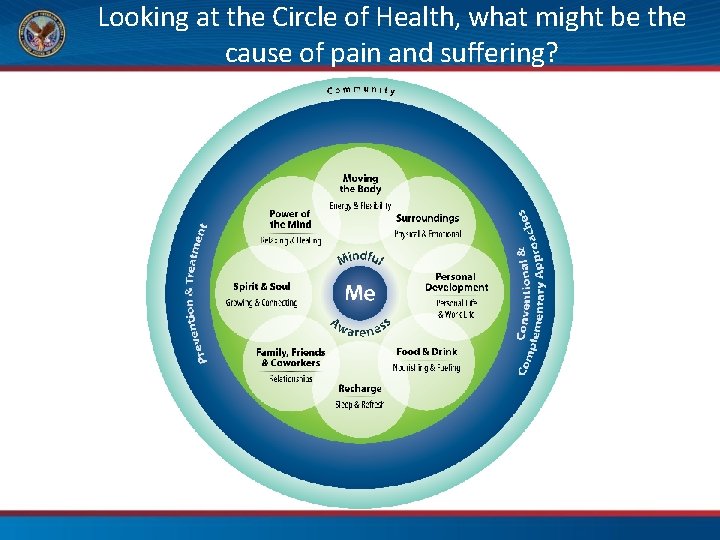
Looking at the Circle of Health, what might be the cause of pain and suffering?
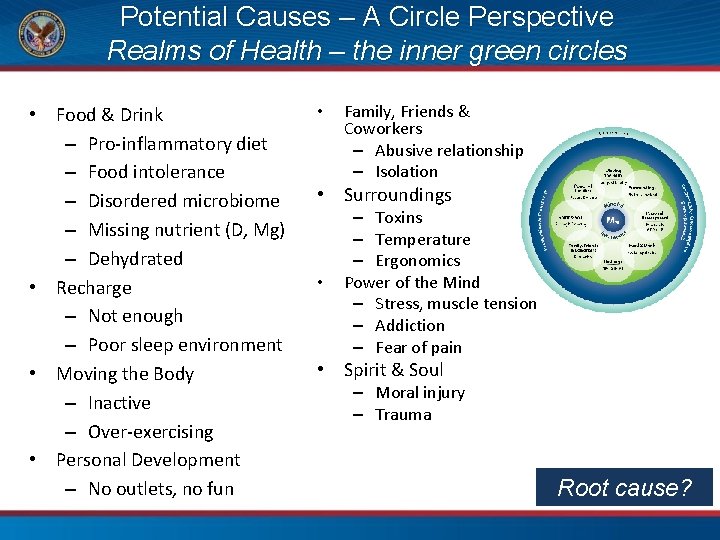
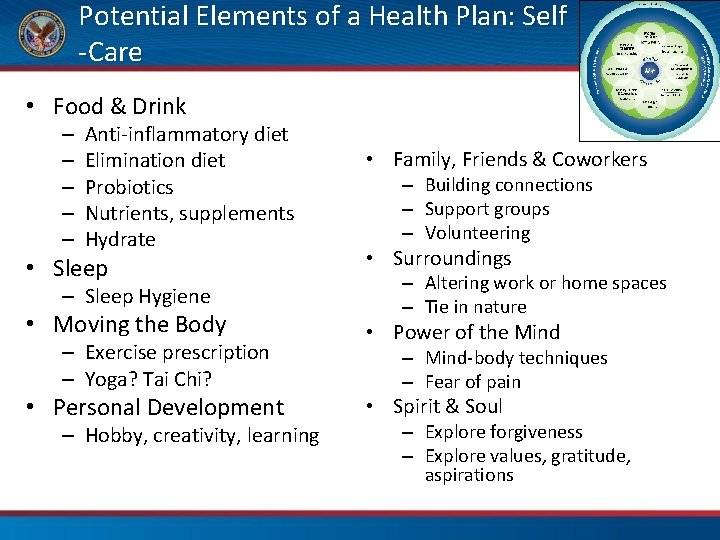
Potential Causes – A Circle Perspective Realms of Health – the inner green circles • Food & Drink – Pro-inflammatory diet – Food intolerance – Disordered microbiome – Missing nutrient (D, Mg) – Dehydrated • Recharge – Not enough – Poor sleep environment • Moving the Body – Inactive – Over-exercising • Personal Development – No outlets, no fun • Family, Friends & Coworkers – Abusive relationship – Isolation • Surroundings • – Toxins – Temperature – Ergonomics Power of the Mind – Stress, muscle tension – Addiction – Fear of pain • Spirit & Soul – Moral injury – Trauma Root cause?
What can you do about it? (Now, we can start talking about the plan!)
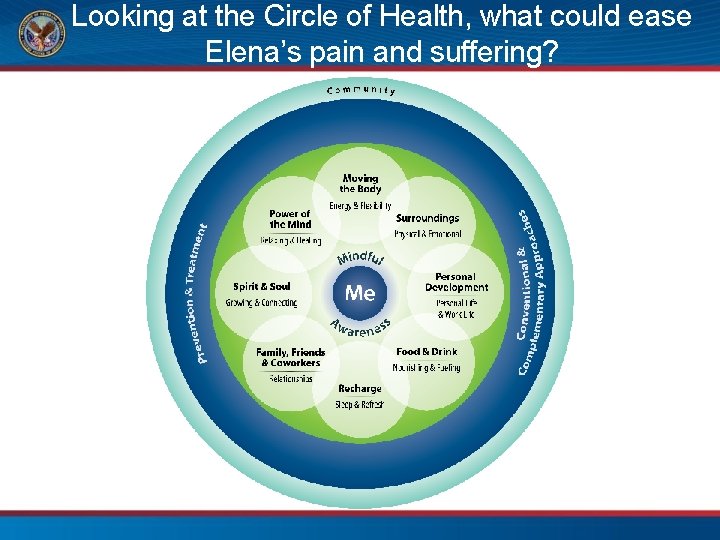
Looking at the Circle of Health, what could ease Elena’s pain and suffering?
Potential Elements of a Health Plan: Self -Care • Food & Drink – – – Anti-inflammatory diet Elimination diet Probiotics Nutrients, supplements Hydrate • Family, Friends & Coworkers – Building connections – Support groups – Volunteering • Sleep • Surroundings • Moving the Body • Power of the Mind – Sleep Hygiene – Exercise prescription – Yoga? Tai Chi? • Personal Development – Hobby, creativity, learning – Altering work or home spaces – Tie in nature – Mind-body techniques – Fear of pain • Spirit & Soul – Explore forgiveness – Explore values, gratitude, aspirations
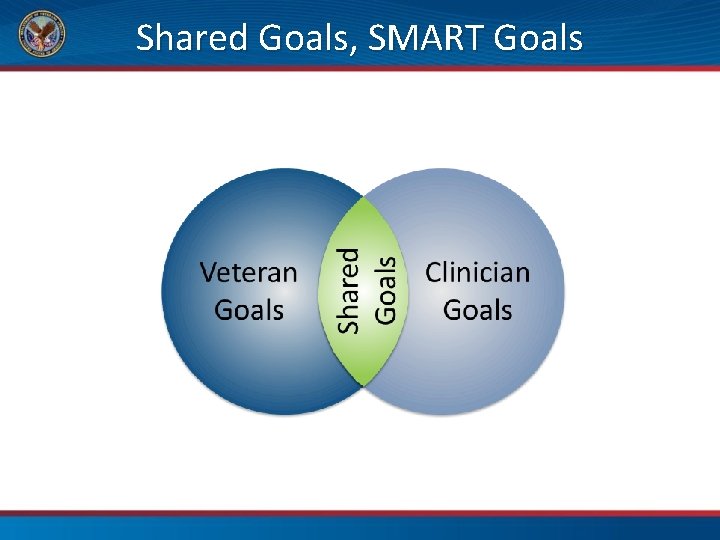
Shared Goals, SMART Goals
Why Shared Goals Are Important • We often have goals (agendas) in mind for our patients • Clinician and patient goals don’t always overlap • Patients are more likely to have success with goals that they set for themselves (adherence and engagement) • Ultimately, this personalizes care and centers it on them (is more patient centered)
How to Get to Shared Goals • Use the PHI and other assessments as a guide • Consider your patient’s responses to The Big Questions • Be clear about your agenda. Do you have major concerns that need to be addressed? • What does the patient want to do? • Support the patient’s choice of a goal
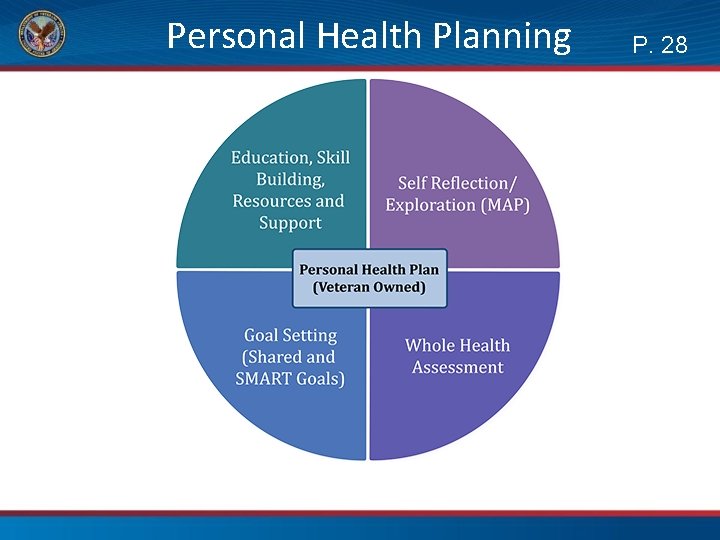
Personal Health Planning P. 28
Elena’s Plan • It comes down to what she wants to do! • Build on what matters to her (connections) • This plan may then be more personalized • Has clear goals outlined • Designates her care team • Includes follow up • Review Elena’s sample PHP on pages 25 of the manual
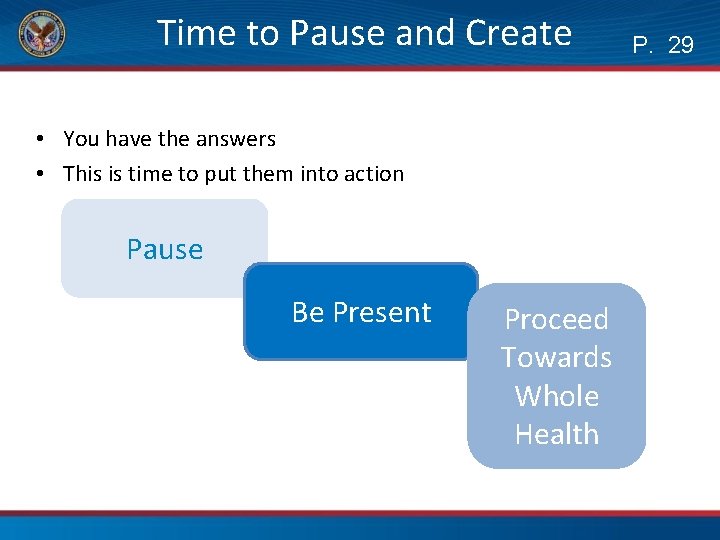
Time to Pause and Create • You have the answers • This is time to put them into action Pause Be Present Proceed Towards Whole Health P. 29
4. Mindful Awareness Whole Health for Pain and Suffering
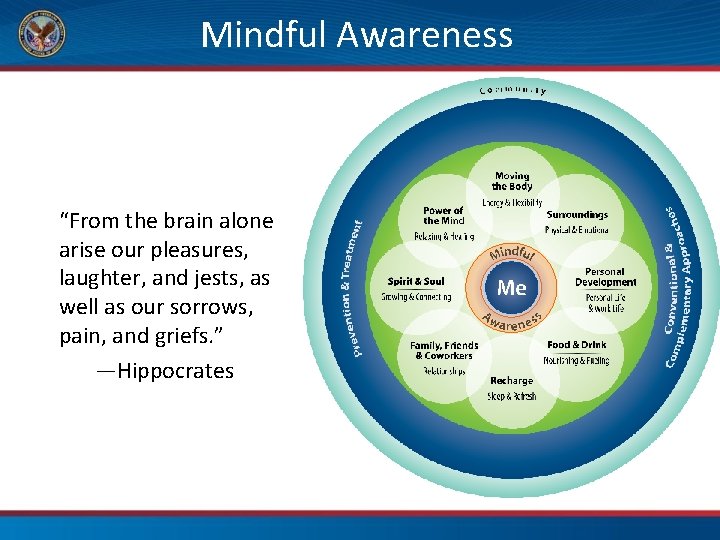
Mindful Awareness “From the brain alone arise our pleasures, laughter, and jests, as well as our sorrows, pain, and griefs. ” —Hippocrates
Mindful Awareness Is… Noticing and gaining insight into your thoughts, sensations, and feelings as they arise in the present. “Mindfulness means paying attention in a particular way; on purpose, in the present moment, and [doing so] non-judgmentally. ” – Jon Kabat-Zinn, Ph. D Founding Executive Director of the Center for Mindfulness in Medicine, Health Care, and Society at the University of Massachusetts Medical School
What Mindfulness is NOT • A relaxation exercise • Progressive muscle relaxation • Guided imagery • The Relaxation Response • An “intervention”
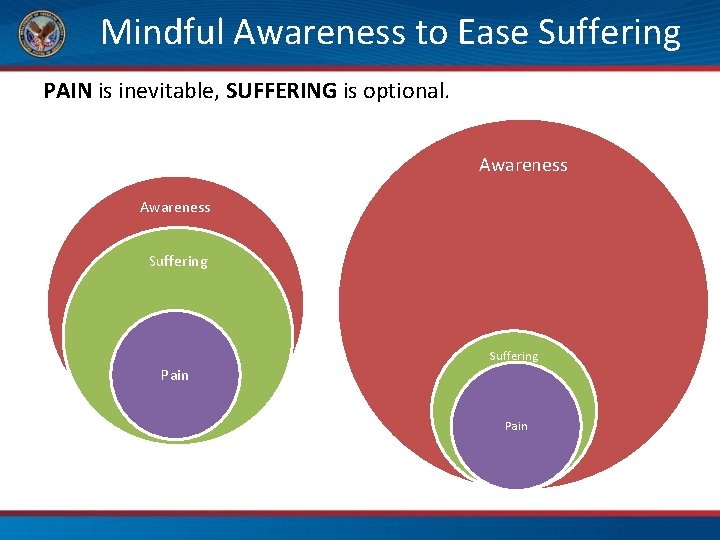
Mindful Awareness to Ease Suffering PAIN is inevitable, SUFFERING is optional. Awareness Suffering Pain
Impermanence
Mindful Awareness: What does the research tell us so far? 138
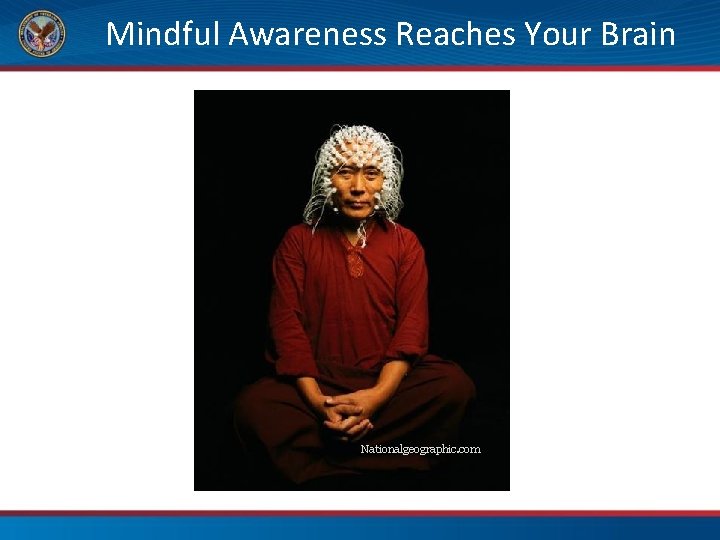
Mindful Awareness Reaches Your Brain Nationalgeographic. com
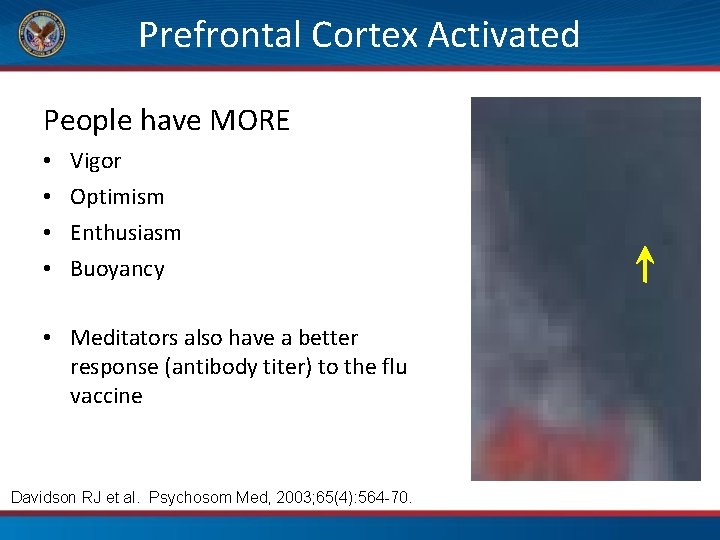
Prefrontal Cortex Activated People have MORE • • Vigor Optimism Enthusiasm Buoyancy • Meditators also have a better response (antibody titer) to the flu vaccine Davidson RJ et al. Psychosom Med, 2003; 65(4): 564 -70.
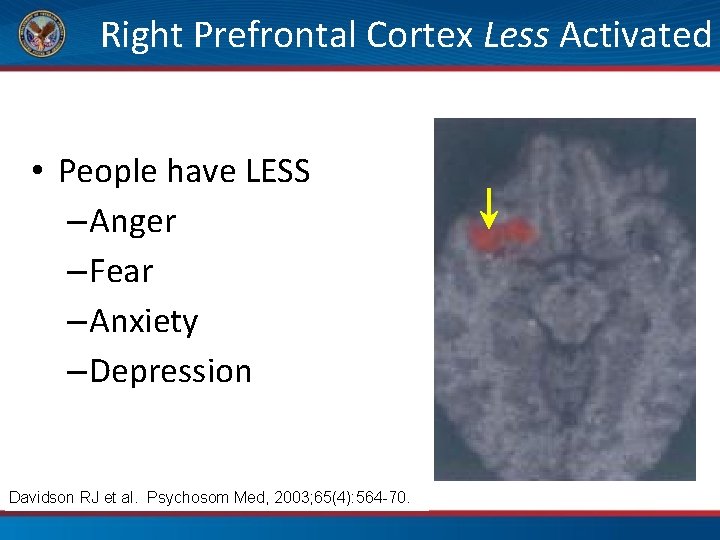
Right Prefrontal Cortex Less Activated • People have LESS – Anger – Fear – Anxiety – Depression Davidson RJ et al. Psychosom Med, 2003; 65(4): 564 -70.
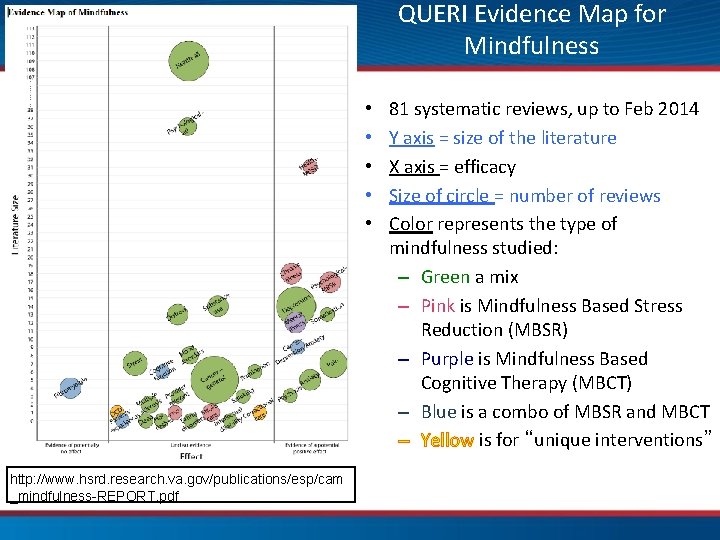
QUERI Evidence Map for Mindfulness • • • http: //www. hsrd. research. va. gov/publications/esp/cam _mindfulness-REPORT. pdf 81 systematic reviews, up to Feb 2014 Y axis = size of the literature X axis = efficacy Size of circle = number of reviews Color represents the type of mindfulness studied: – Green a mix – Pink is Mindfulness Based Stress Reduction (MBSR) – Purple is Mindfulness Based Cognitive Therapy (MBCT) – Blue is a combo of MBSR and MBCT – Yellow is for “unique interventions”
Highlights • Remember, mindfulness is not a ‘therapy’ per se • Especially responsive: Chronic stress Depression Somatization Cancer related depression and anxiety – Pain – Anxiety – Psychosis – – Photo credit: mangloard via Foter. com
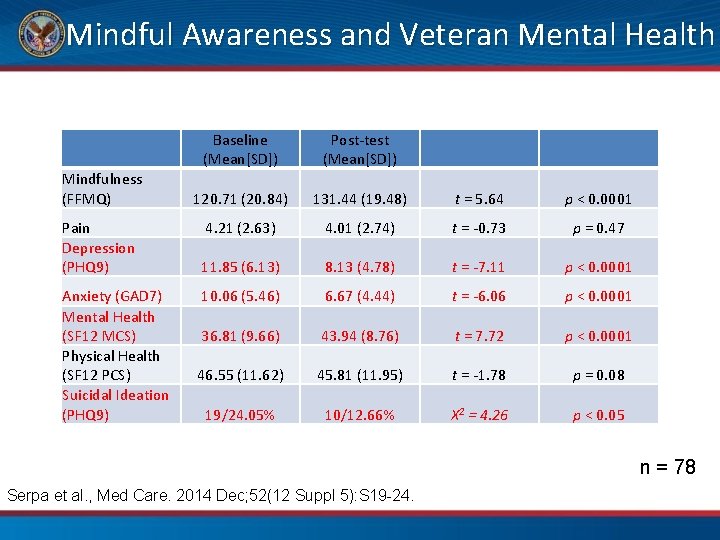
Mindful Awareness and Veteran Mental Health • MBSR program at VA Greater Los Angeles HCS • Naturalistic population – “Take all comers” • Includes Veterans with active substance use disorders, suicidal ideation, active psychosis, and severe personality disorders as well as homelessness • n = 78 • Significant reduction in anxiety, depression and suicidal ideation with improvement in Mental Health Composite scores Serpa, et al. Medical Care, 2014; 52(12 Suppl 5): S 19 -24.
Mindful Awareness and Veteran Mental Health Mindfulness (FFMQ) Pain Depression (PHQ 9) Anxiety (GAD 7) Mental Health (SF 12 MCS) Physical Health (SF 12 PCS) Suicidal Ideation (PHQ 9) Baseline (Mean[SD]) Post-test (Mean[SD]) 120. 71 (20. 84) 131. 44 (19. 48) t = 5. 64 p < 0. 0001 4. 21 (2. 63) 4. 01 (2. 74) t = -0. 73 p = 0. 47 11. 85 (6. 13) 8. 13 (4. 78) t = -7. 11 p < 0. 0001 10. 06 (5. 46) 6. 67 (4. 44) t = -6. 06 p < 0. 0001 36. 81 (9. 66) 43. 94 (8. 76) t = 7. 72 p < 0. 0001 46. 55 (11. 62) 45. 81 (11. 95) t = -1. 78 p = 0. 08 19/24. 05% 10/12. 66% X 2 = 4. 26 p < 0. 05 n = 78 Serpa et al. , Med Care. 2014 Dec; 52(12 Suppl 5): S 19 -24.
Mindful Awareness and Veteran Mental Health Pain >= 6/10 n=23 Baseline (Mean[SD]) Post-test (Mean[SD]) 4. 21 (2. 63) 4. 01 (2. 74) 7. 00 (1. 00) 6. 00 (1. 76) Serpa et al. , Med Care. 2014 Dec; 52(12 Suppl 5): S 19 -24. t = -0. 73 p = 0. 47 p < 0. 05
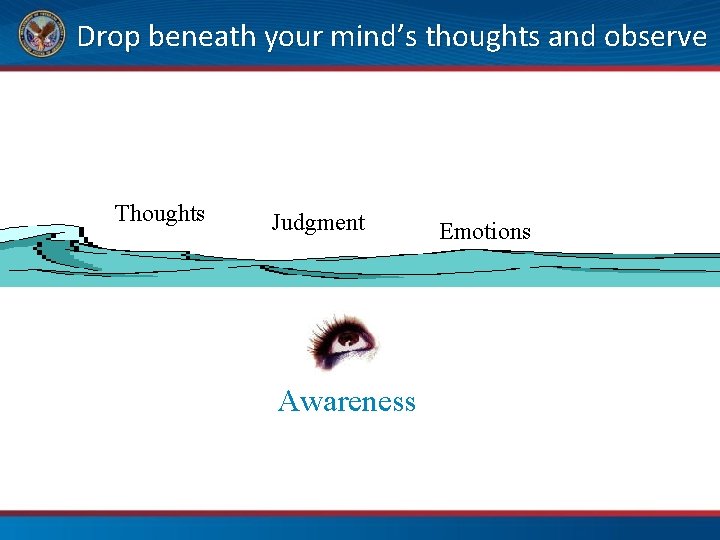
Drop beneath your mind’s thoughts and observe Thoughts Judgment Awareness Emotions
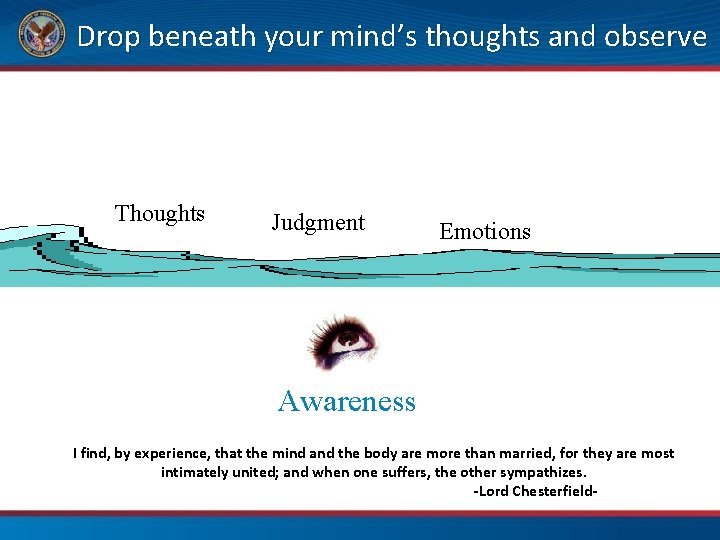
Drop beneath your mind’s thoughts and observe Thoughts Judgment Emotions Awareness I find, by experience, that the mind and the body are more than married, for they are most intimately united; and when one suffers, the other sympathizes. -Lord Chesterfield-
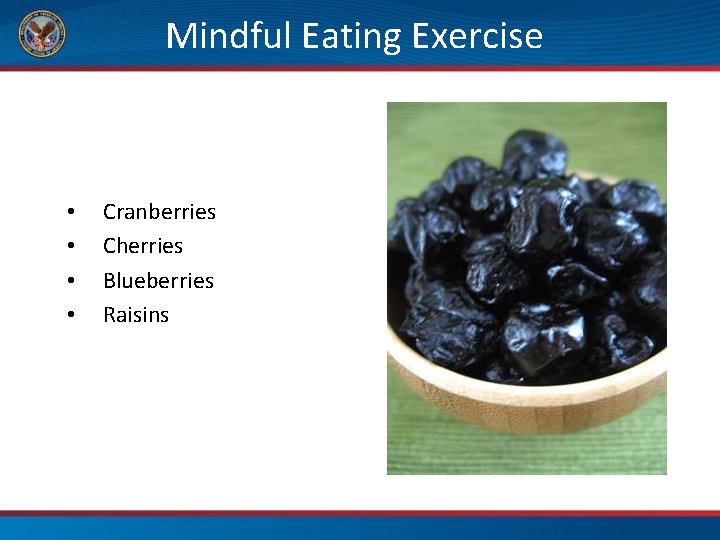
Mindful Eating Exercise • • Cranberries Cherries Blueberries Raisins
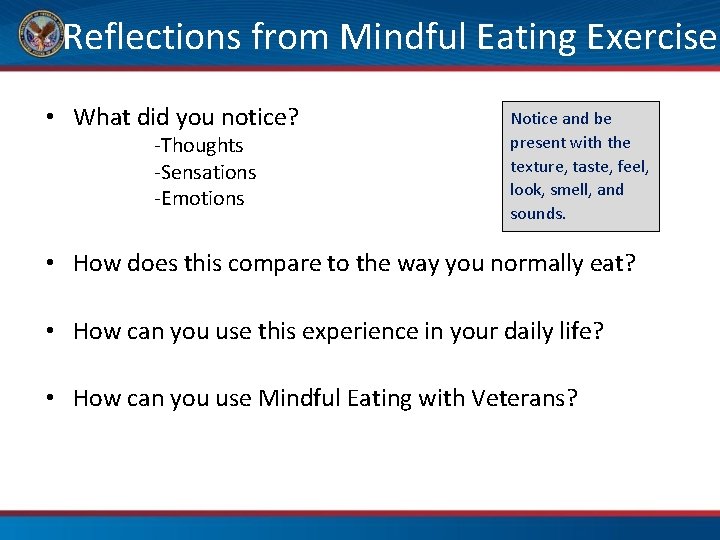
Reflections from Mindful Eating Exercise • What did you notice? -Thoughts -Sensations -Emotions Notice and be present with the texture, taste, feel, look, smell, and sounds. • How does this compare to the way you normally eat? • How can you use this experience in your daily life? • How can you use Mindful Eating with Veterans?
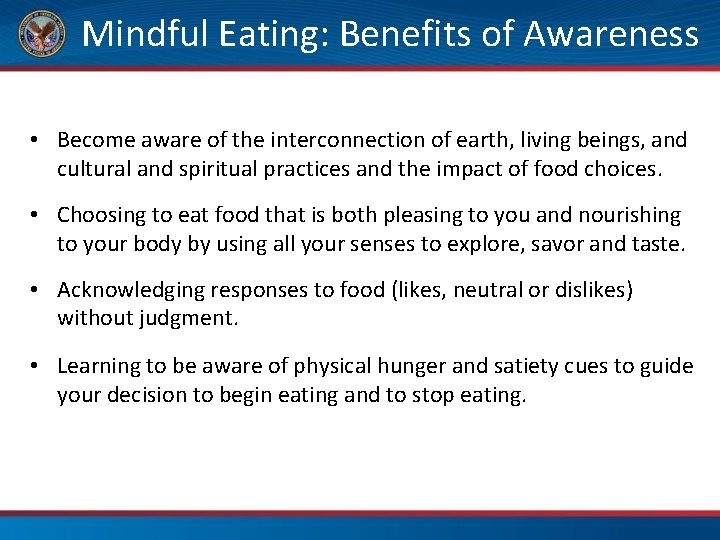
Mindful Eating: Benefits of Awareness • Become aware of the interconnection of earth, living beings, and cultural and spiritual practices and the impact of food choices. • Choosing to eat food that is both pleasing to you and nourishing to your body by using all your senses to explore, savor and taste. • Acknowledging responses to food (likes, neutral or dislikes) without judgment. • Learning to be aware of physical hunger and satiety cues to guide your decision to begin eating and to stop eating.
Mindful Awareness: How do you cultivate it?
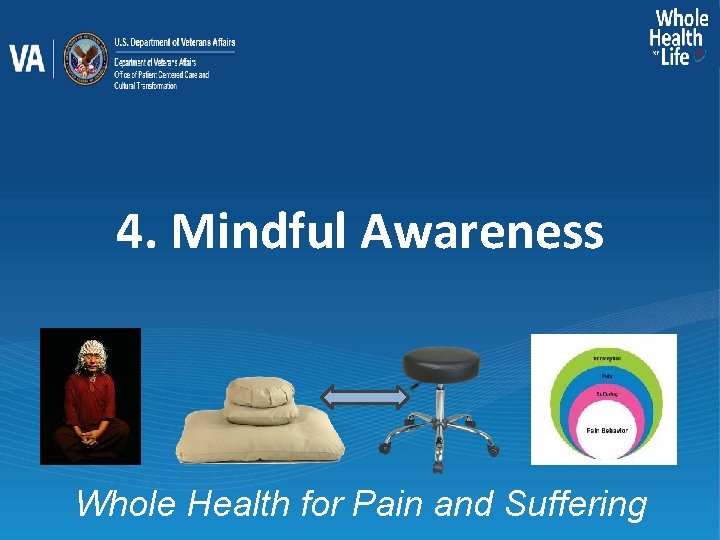
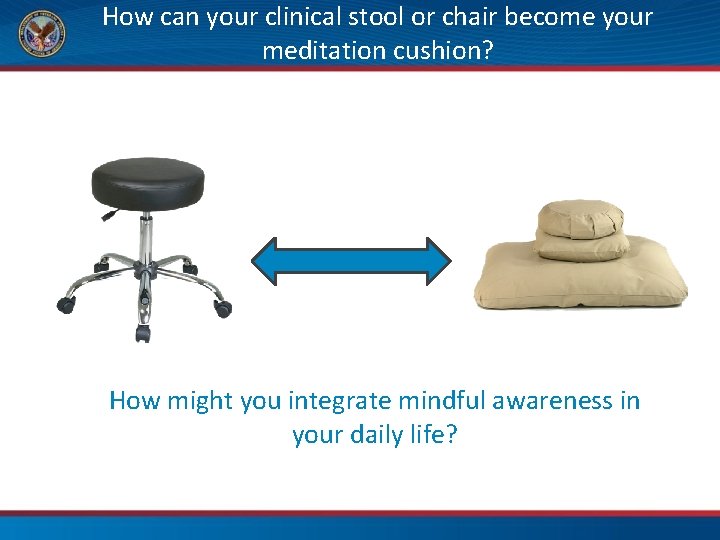
How can your clinical stool or chair become your meditation cushion? How might you integrate mindful awareness in your daily life?
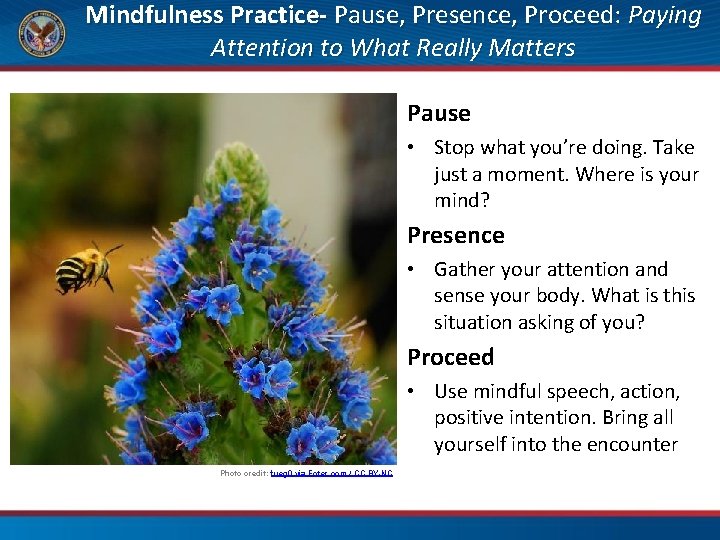
Mindfulness Practice- Pause, Presence, Proceed: Paying Attention to What Really Matters Pause • Stop what you’re doing. Take just a moment. Where is your mind? Presence • Gather your attention and sense your body. What is this situation asking of you? Proceed • Use mindful speech, action, positive intention. Bring all yourself into the encounter Photo credit: fueg 0 via Foter. com / CC BY-NC
Relational Mindfulness • Partner Practice: Step 1 – Sit shoulder-to-shoulder facing opposite directions – Consider taking three breaths – Listen to Elena’s story (page 19) – Notice what arises in your awareness as you listen • Thoughts • Emotions • Sensations in your body
Relational Mindfulness • Partner Practice: Step 2 – Person with longer hair speaks first – Practice Mindful Speaking – Practice Mindful Listening – Switch roles Prompt: What body sensations, thoughts, and emotions did you notice in listening to Elena’s story?
Relational Mindfulness • Large Group Debrief – What was it like to speak in this way? – What was it like to listen in this way? – How might this way of listening/speaking relate to our clinical encounters with people in pain and suffering?
Starting Your Own Practice • Try a few minutes a day, perhaps with a recording (see Resources, p. 65 in the Passport) • Join a class, like MBSR, or a meditation group • Introduce informal practices into your life, including in your clinical work
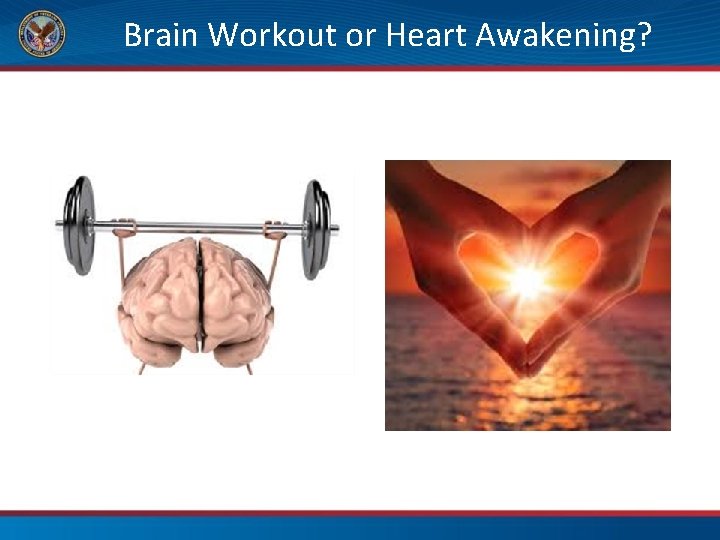
Brain Workout or Heart Awakening?
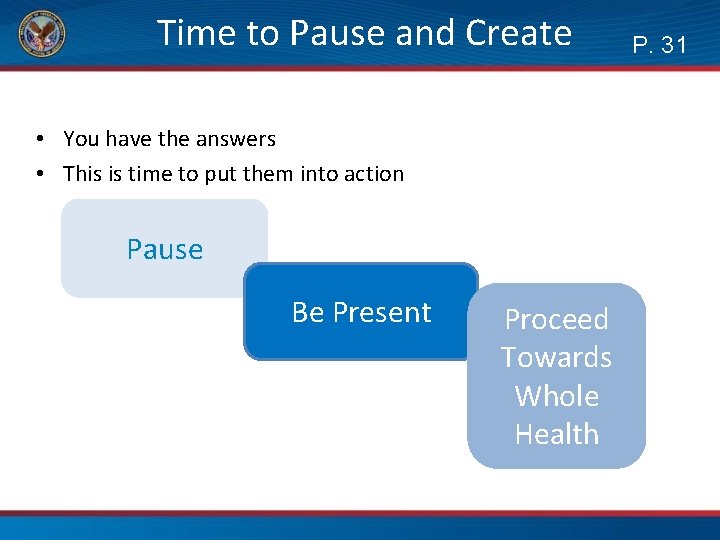
Time to Pause and Create • You have the answers • This is time to put them into action Pause Be Present Proceed Towards Whole Health P. 31