
Who What Where How Why Burke on Dramatism
Who, What, Where, How, Why? Burke on Dramatism
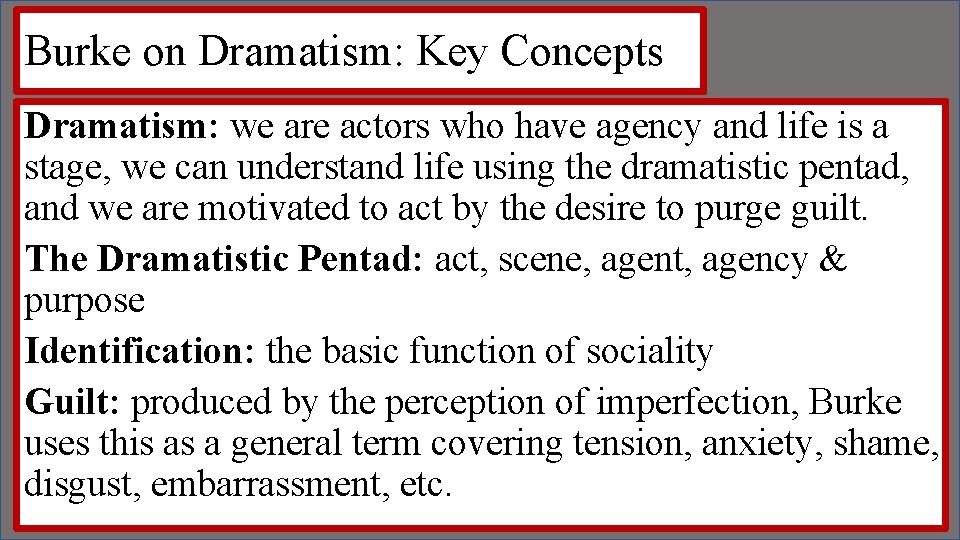
Burke on Dramatism: Key Concepts Dramatism: we are actors who have agency and life is a stage, we can understand life using the dramatistic pentad, and we are motivated to act by the desire to purge guilt. The Dramatistic Pentad: act, scene, agent, agency & purpose Identification: the basic function of sociality Guilt: produced by the perception of imperfection, Burke uses this as a general term covering tension, anxiety, shame, disgust, embarrassment, etc.
Burkean Dramatism Public ceremonies like funerals and graduations are highly dramaturgical, and fiction is easily described in dramaturgical terms, but ‘normal life’ also has a dramaturgical aspect that Burke believes offers clues to social organization more generally. Viewing life through a dramaturgical lens can be very useful in dissociating the observer from the observed, concentrating critical attention on motive and on social dynamics.

The Dramatistic Pentad • Act: “what took place, in thought or deed” Question: what was done? • Scene: “the situation in which (the act) occurred” Question: where and when it was done? • Agent: “what person or kind of person performed the act” Question: who did it? • Agency: “what means or instruments” the person used Question: how did they do it? • Purpose: the motivation behind the act Question: why did they do it?

Identification is inevitable, unconscious or semiconscious, and laden with emotional weight. Identification has to do with social unity and social distance. When individuals’ ‘substance’ overlaps they have positive identification (identify-with); when ‘substances’ repel each other individuals have negative identification (identify-against). Identification is the basic building block of sociality, but it can be falsified or manipulated through rhetoric.

Guilt Dramatism is a way of analyzing motives as they shape the course of human social life, but the originary motive of all action is the desire to purge oneself of guilt. Sociality is hierarchical and we feel guilt about our place in the hierarchy. Even people at the ‘top’ of a hierarchy are guilty about their imperfections and seek an ideal self-image. ‘The negative’ is when people reject their place in the hierarchy, often through victimage, which displaces ‘the negative’ onto a scapegoat. Victimage can be universal or fractional. This fits into what Burke calls the ‘Dramaturgical cycle. ’
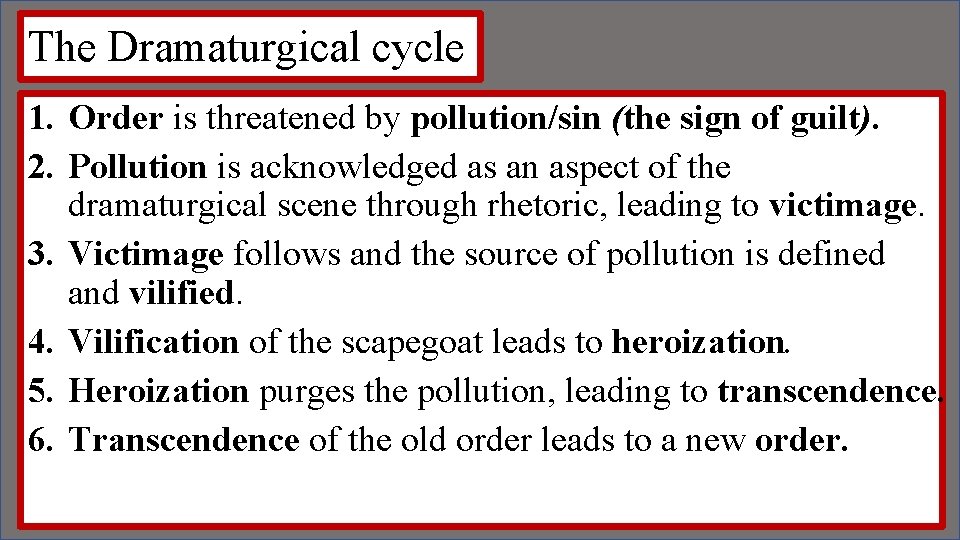
The Dramaturgical cycle 1. Order is threatened by pollution/sin (the sign of guilt). 2. Pollution is acknowledged as an aspect of the dramaturgical scene through rhetoric, leading to victimage. 3. Victimage follows and the source of pollution is defined and vilified. 4. Vilification of the scapegoat leads to heroization. 5. Heroization purges the pollution, leading to transcendence. 6. Transcendence of the old order leads to a new order.

- Slides: 9