
Who Was Sadako Sasaki Sadako Sasaki was born

Who Was Sadako Sasaki? Sadako Sasaki was born on 7 th January 1943. She was a Japanese girl, who lived in Hiroshima. On 6 th August 1945, an atomic bomb was dropped on Hiroshima by an American plane. When the bomb was dropped, Sadako was two years old.
Sadako’s Story Sadako lived with her family in an area which was close to where the atomic bomb landed. When she ran from her home with her family, she was showered with black rain. Black rain was the radioactive rain that fell on Hiroshima after the atomic bomb was dropped. At the end of 1954, Sadako became sick. She developed swellings on her neck, on her legs and behind her ears. She was eventually diagnosed with leukaemia, which is a type of blood cancer. In February 1955, Sadako was sent to a hospital and she remained there to receive treatment.

Sadako’s Paper Cranes Sadako’s father had told her about the legend of the ‘Thousand Origami Cranes’. This ancient Japanese legend promises that anyone who can fold 1000 origami paper cranes will be granted a wish. Sadako’s wish was to get better again. Her friend, Chizuko, encouraged her to fold 1000 origami paper cranes. Sadako spent her days in the hospital doing this in the hope that she would get better. Sadako died on 25 th October 1955. It is unclear how many paper cranes Sadako had made by the time of her death. Some reports claim she only made 644 and her friends made more so that the total number reached 1000. Another story claims that she had completed one batch of 1000 paper cranes and she was halfway through making a second batch when she died.
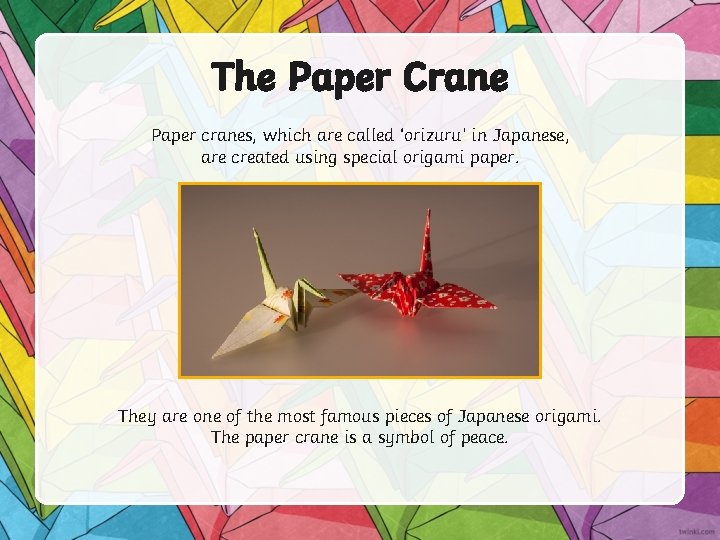
The Paper Crane Paper cranes, which are called ‘orizuru’ in Japanese, are created using special origami paper. They are one of the most famous pieces of Japanese origami. The paper crane is a symbol of peace.

Sadako’s Statue In the Hiroshima Peace Memorial Park, there is a statue of Sadako holding a crane. It was unveiled in 1958. It is known as the Children’s Peace Monument. It commemorates Sadako and all the children who were affected by the atomic bomb. After her death, Sadako came to symbolise children whose lives have been destroyed by warfare. ‘‘Hiroshima Children's Peace Monument ’’ by Aleksander Dragnes is licensed under CC BY 2. 0.

Remembering Sadako Every year, on 6 th August, in commemoration of the day the atomic bomb was dropped, young people from all over the world leave thousands of paper cranes in memory of Sadako. These paper cranes are placed in special glass cabinets around the Hiroshima Children’s Peace Memorial. There is also a statue of Sadako in the Seattle Peace Park. Children regularly leave strings of paper cranes on this statue.
- Slides: 8