
Who remembered the envelope Why What factors influence
Who remembered the envelope? Why? • What factors influence our ability to recall information? • What conclusions can we draw from this experiment?
Aim: How do we encode, store and retrieve information? 3 Box Model / Atkinson-Shiffrin Model Do Now: • # Pages – Start w/ cover as page 1 • What factors influence whether we remember or forget things? Homework: Paper Due – 11 PM Uploaded to Turnitin. com For Friday - Read text pps. 382 – 391
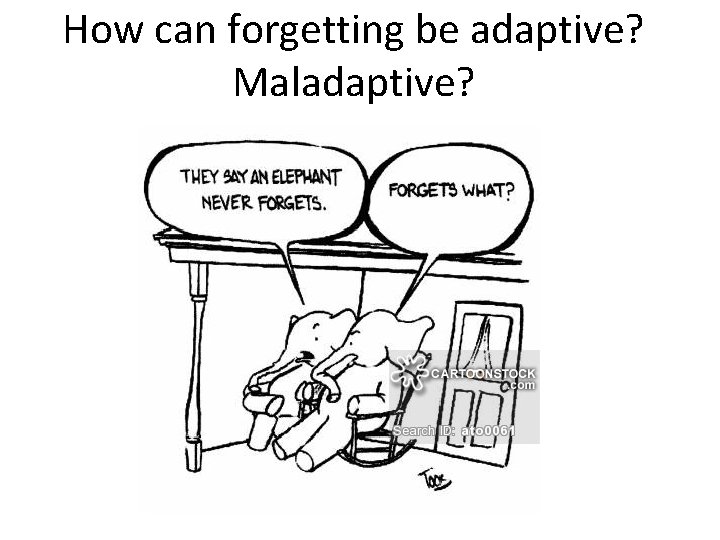
How can forgetting be adaptive? Maladaptive?
What role do emotions and sleep play in memory formation?
Stress Hormones & Memory • Extreme stress undermines learning and later recall • Prolonged stress (associated with cortisol and epinephrine) act on brain centers in the brain, it can corrode neural connections and destroy hippocampus • How does this apply to an exam?
Role of Sleep in Memories • Sleep helps with the consolidation of memories. • Studies show sleep deprivation diminishes memories.
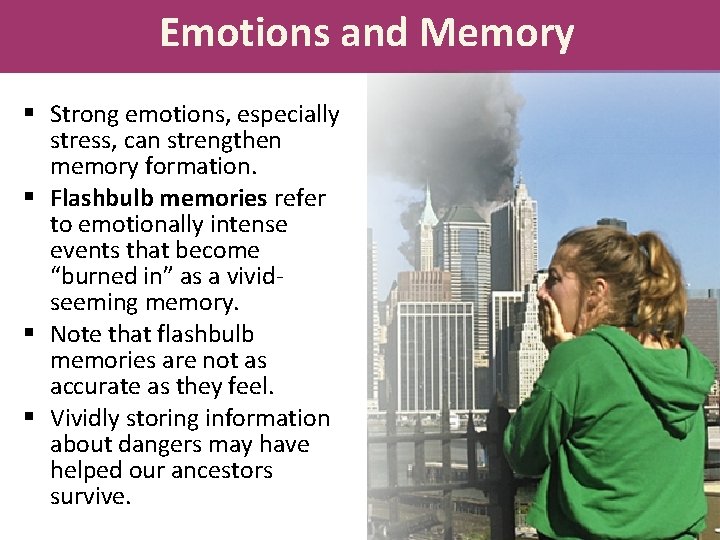
Emotions and Memory § Strong emotions, especially stress, can strengthen memory formation. § Flashbulb memories refer to emotionally intense events that become “burned in” as a vividseeming memory. § Note that flashbulb memories are not as accurate as they feel. § Vividly storing information about dangers may have helped our ancestors survive.
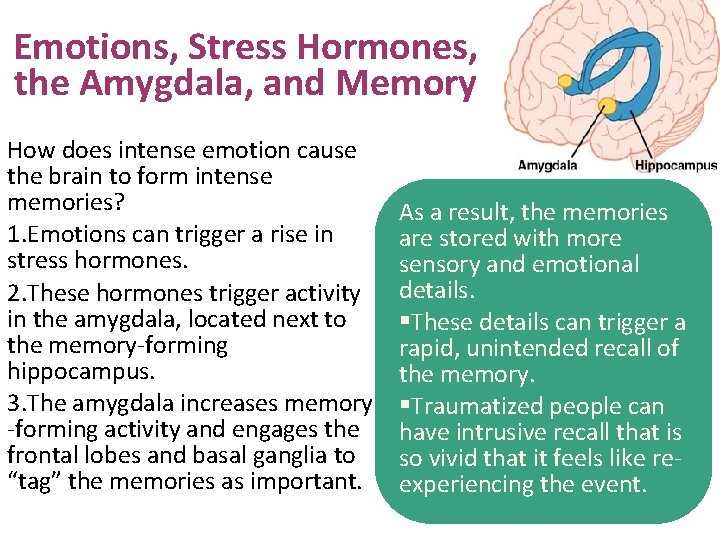
Emotions, Stress Hormones, the Amygdala, and Memory How does intense emotion cause the brain to form intense memories? 1. Emotions can trigger a rise in stress hormones. 2. These hormones trigger activity in the amygdala, located next to the memory-forming hippocampus. 3. The amygdala increases memory -forming activity and engages the frontal lobes and basal ganglia to “tag” the memories as important. As a result, the memories are stored with more sensory and emotional details. §These details can trigger a rapid, unintended recall of the memory. §Traumatized people can have intrusive recall that is so vivid that it feels like reexperiencing the event.
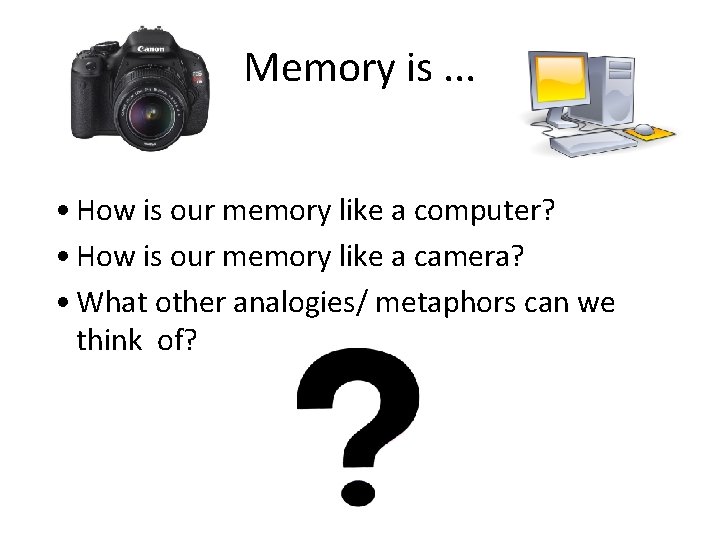
Memory is. . . • How is our memory like a computer? • How is our memory like a camera? • What other analogies/ metaphors can we think of?
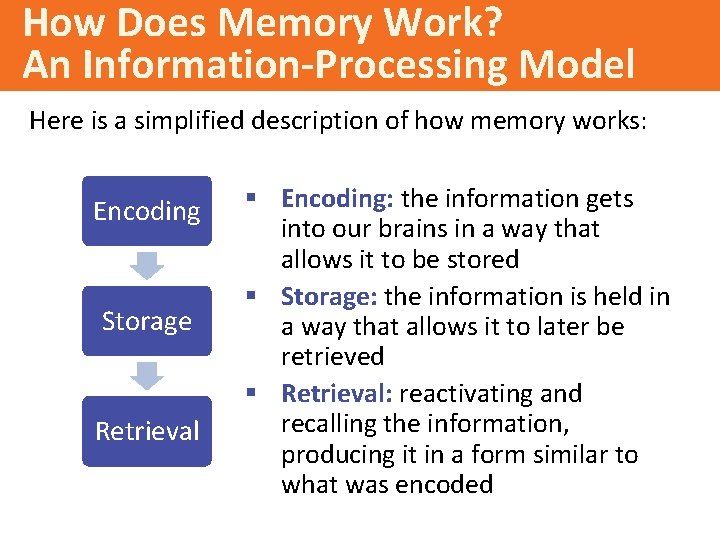
How Does Memory Work? An Information-Processing Model Here is a simplified description of how memory works: Encoding Storage Retrieval § Encoding: the information gets into our brains in a way that allows it to be stored § Storage: the information is held in a way that allows it to later be retrieved § Retrieval: reactivating and recalling the information, producing it in a form similar to what was encoded
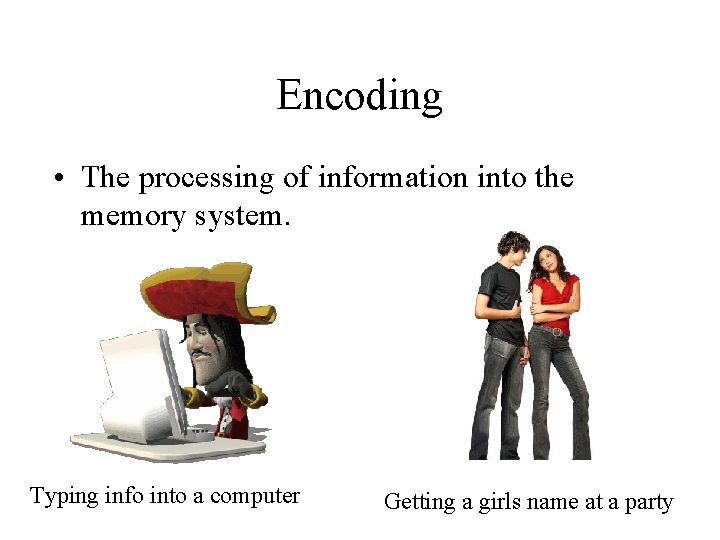
Encoding • The processing of information into the memory system. Typing info into a computer Getting a girls name at a party
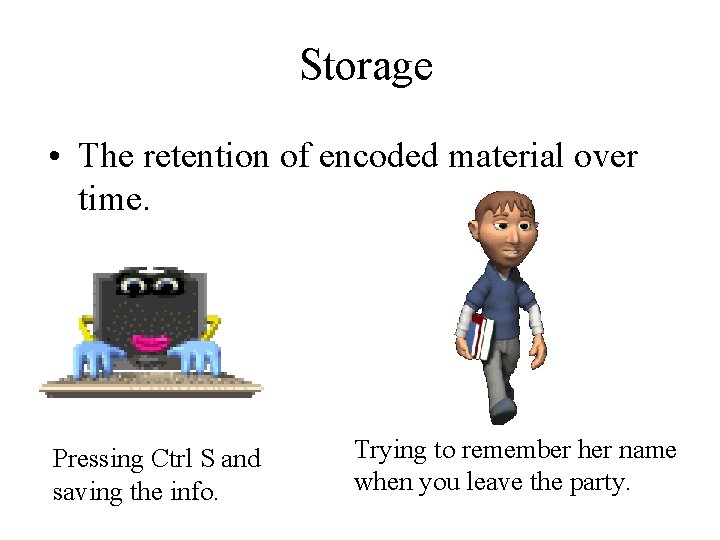
Storage • The retention of encoded material over time. Pressing Ctrl S and saving the info. Trying to remember her name when you leave the party.
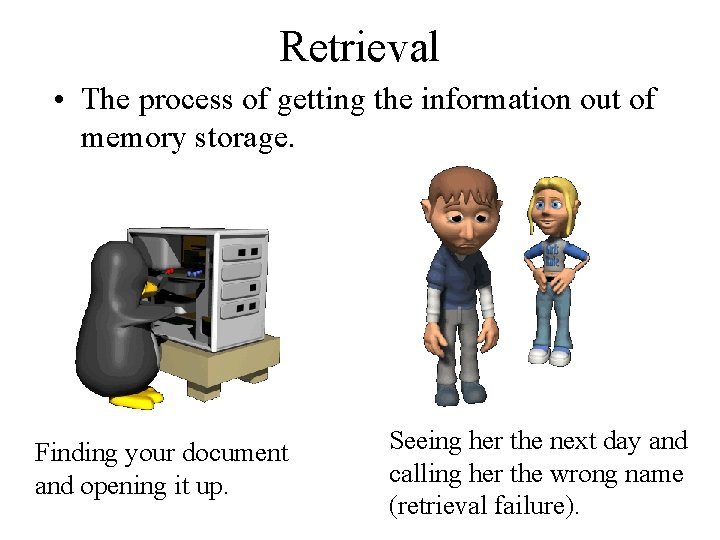
Retrieval • The process of getting the information out of memory storage. Finding your document and opening it up. Seeing her the next day and calling her the wrong name (retrieval failure).
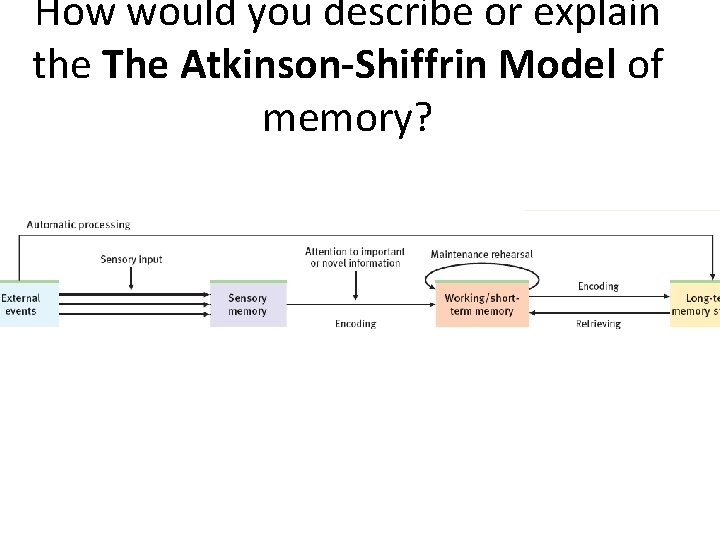
How would you describe or explain the The Atkinson-Shiffrin Model of memory?
3 Box Model of Memory Info is “processed” in 3 boxes… 1. Sensory Memory (SM) 2. Short Term Memory ( STM - aka working memory) 3. Long Term Memory -LTM
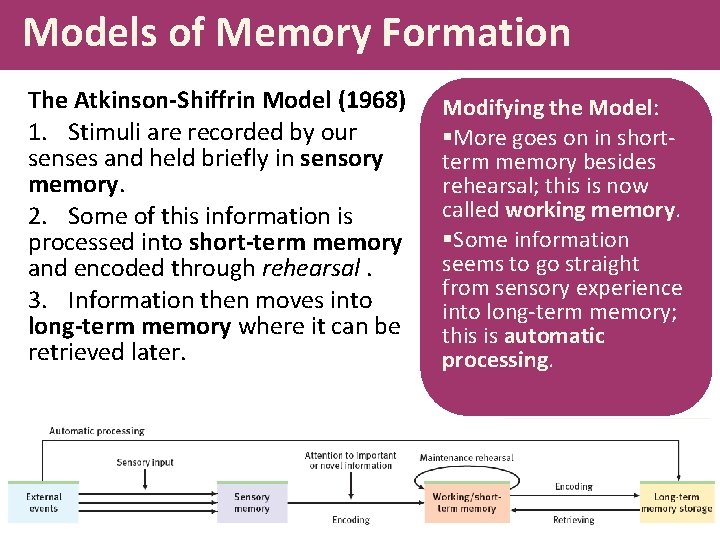
Models of Memory Formation The Atkinson-Shiffrin Model (1968) 1. Stimuli are recorded by our senses and held briefly in sensory memory. 2. Some of this information is processed into short-term memory and encoded through rehearsal. 3. Information then moves into long-term memory where it can be retrieved later. Modifying the Model: §More goes on in shortterm memory besides rehearsal; this is now called working memory. §Some information seems to go straight from sensory experience into long-term memory; this is automatic processing.
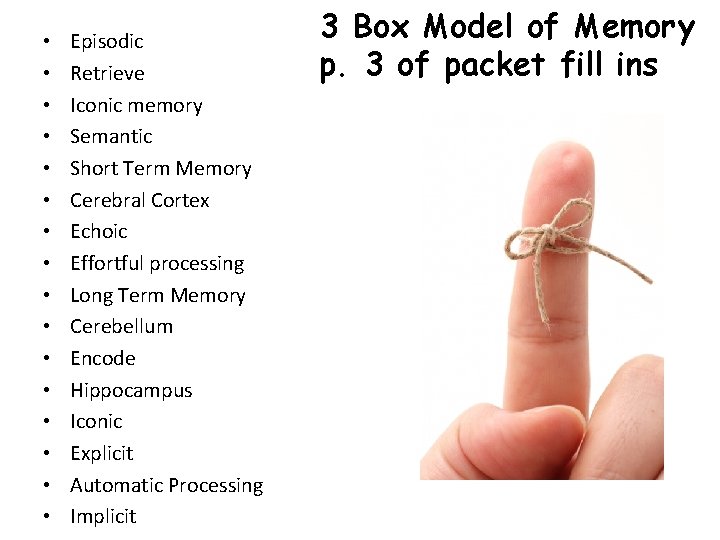
• • • • Episodic Retrieve Iconic memory Semantic Short Term Memory Cerebral Cortex Echoic Effortful processing Long Term Memory Cerebellum Encode Hippocampus Iconic Explicit Automatic Processing Implicit 3 Box Model of Memory p. 3 of packet fill ins
The Encoding and Processing of Memory: Sensory Memory Sensory memory refers to the immediate, very brief recording of sensory information before it is processed into short-term, working, or long-term memory. § We very briefly capture a sensory memory, analogous to an echo or an image, of all the sensations we take in. § How brief? Sensory memory consists of about a 3 to 4 second echo, or a 1/20 th of a second image. § Evidence of auditory sensory memory, called “echoic” memory, can occur after someone says, “what did I just say? ” Even if you weren’t paying attention, you can retrieve about the last eight words from echoic memory.
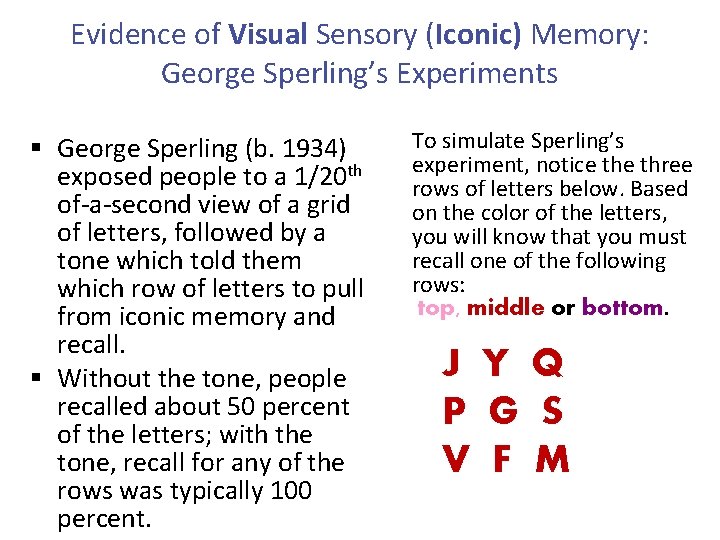
Evidence of Visual Sensory (Iconic) Memory: George Sperling’s Experiments § George Sperling (b. 1934) exposed people to a 1/20 th of-a-second view of a grid of letters, followed by a tone which told them which row of letters to pull from iconic memory and recall. § Without the tone, people recalled about 50 percent of the letters; with the tone, recall for any of the rows was typically 100 percent. To simulate Sperling’s experiment, notice three rows of letters below. Based on the color of the letters, you will know that you must recall one of the following rows: top, middle or bottom. J Y Q P G S V F M
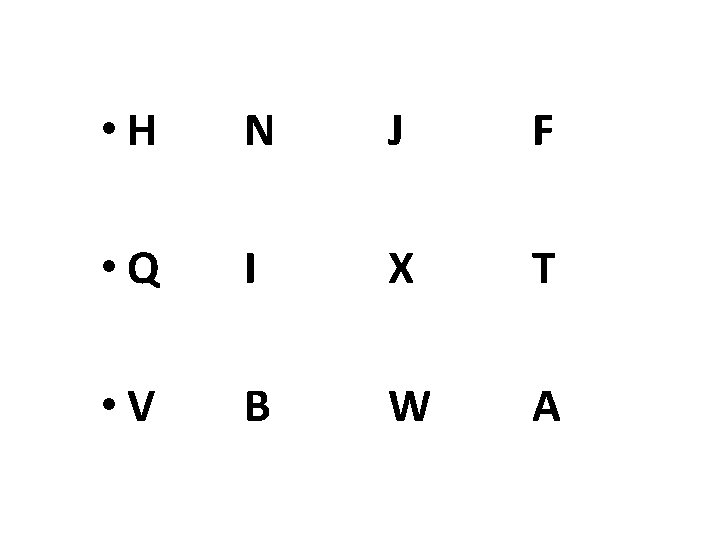
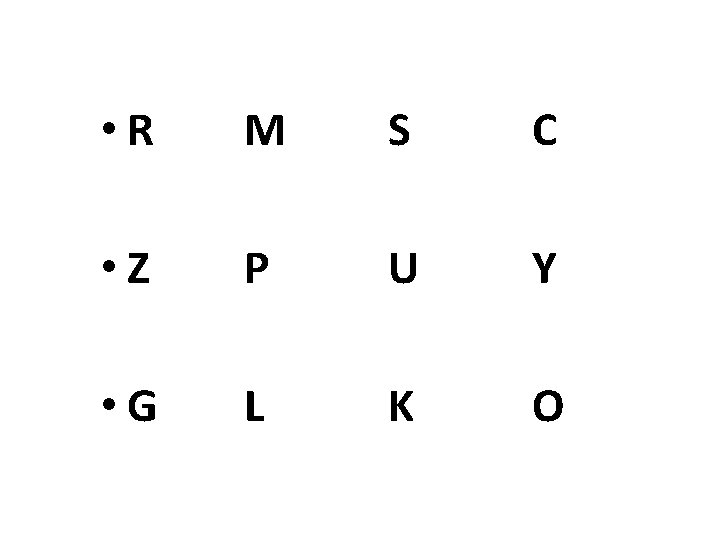
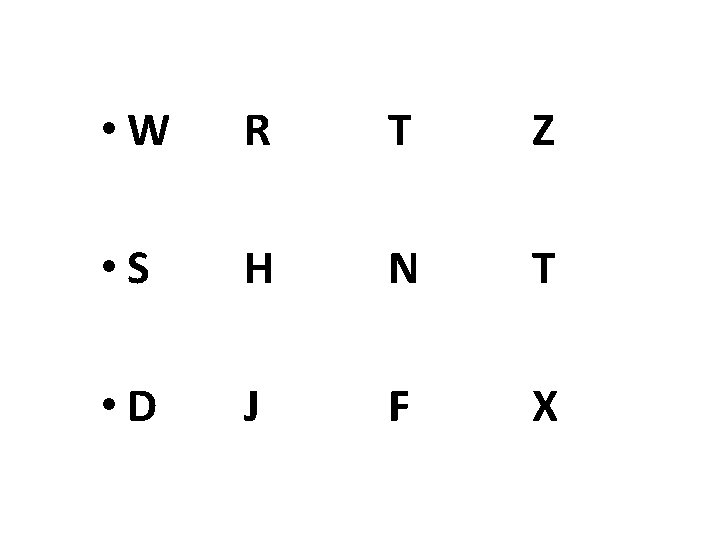
Iconic Memory George Sperling (1960) • Believed that we can see more than we can report • Believed capacity for SM was high, but duration was low( we maintain a perfect image for a few tenths of a second ) • To prove this he used two techniques: • whole report • partial report
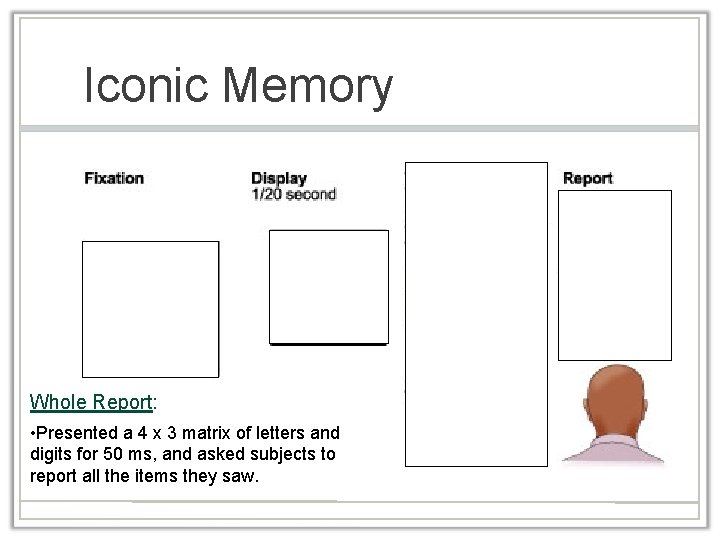
Iconic Memory 50 msec Whole Report: • Presented a 4 x 3 matrix of letters and digits for 50 ms, and asked subjects to report all the items they saw. Report Cue

ready
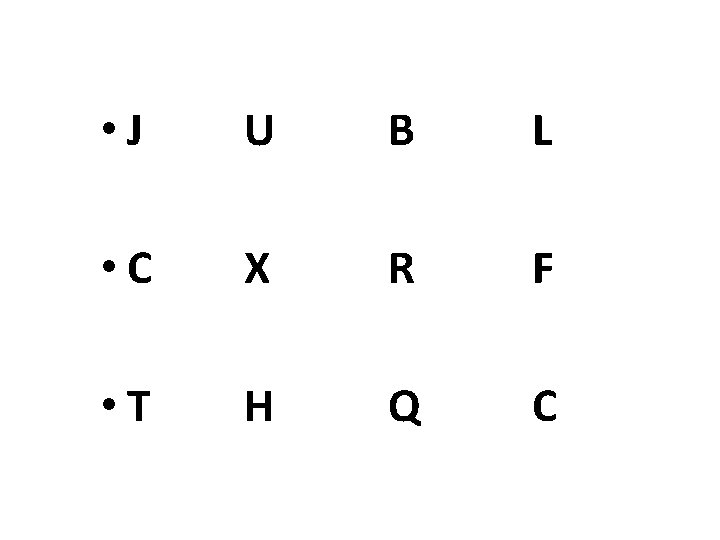
• J U B L • C X R F • T H Q C
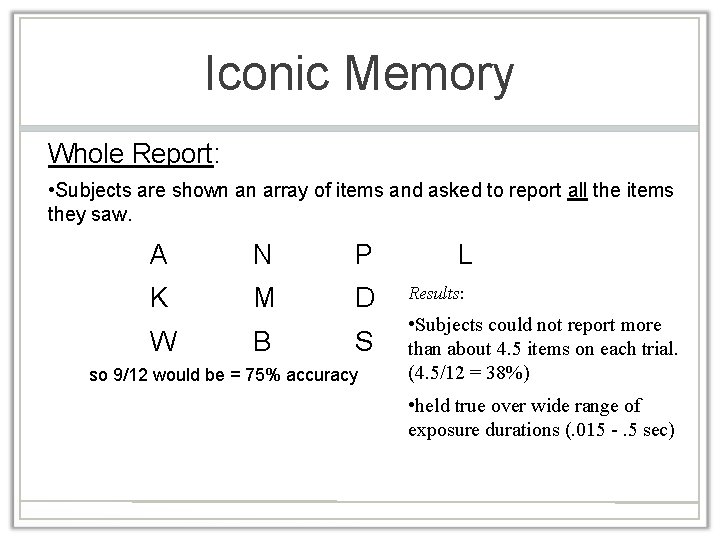
Iconic Memory Whole Report: • Subjects are shown an array of items and asked to report all the items they saw. A N P L K M D Results: T W B S so 9/12 would be = 75% accuracy • Subjects could not report more R 4. 5 items on each trial. than about (4. 5/12 = 38%) • held true over wide range of exposure durations (. 015 -. 5 sec)
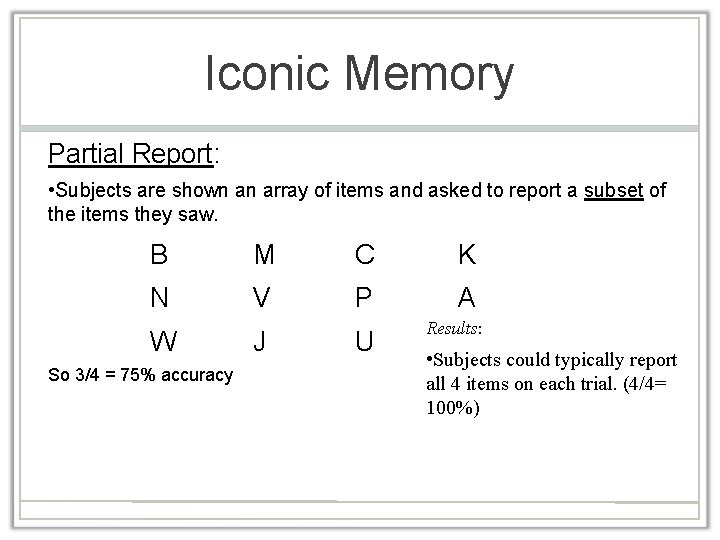
Iconic Memory Partial Report: • Subjects are shown an array of items and asked to report a subset of the items they saw. B M C K N V P A W So 3/4 = 75% accuracy J U Results: L • Subjects could typically report all 4 items on each trial. (4/4= 100%)
ready
• H N J F • Q I X T • V B W A
ready
• R M S C • Z P U Y • G L K O
ready
• W R T Z • S H N T • D J F X
ready

• G V W M • S L Q A • X D H O
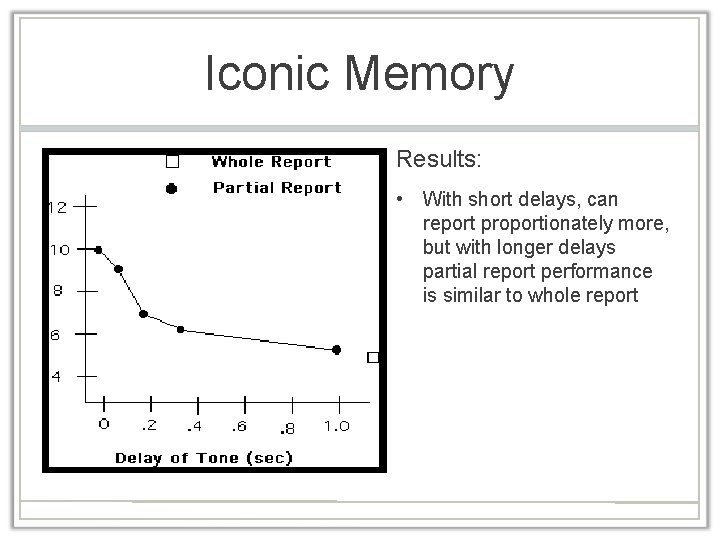
Iconic Memory Results: • With short delays, can report proportionately more, but with longer delays partial report performance is similar to whole report Report Cue
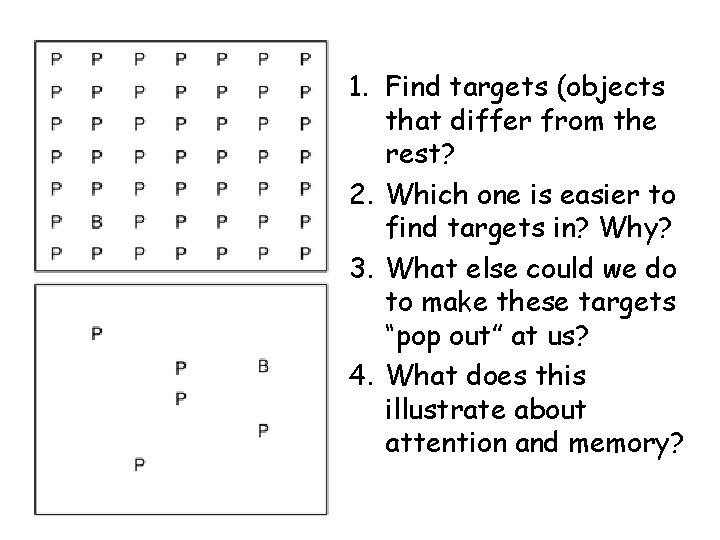
1. Find targets (objects that differ from the rest? 2. Which one is easier to find targets in? Why? 3. What else could we do to make these targets “pop out” at us? 4. What does this illustrate about attention and memory?
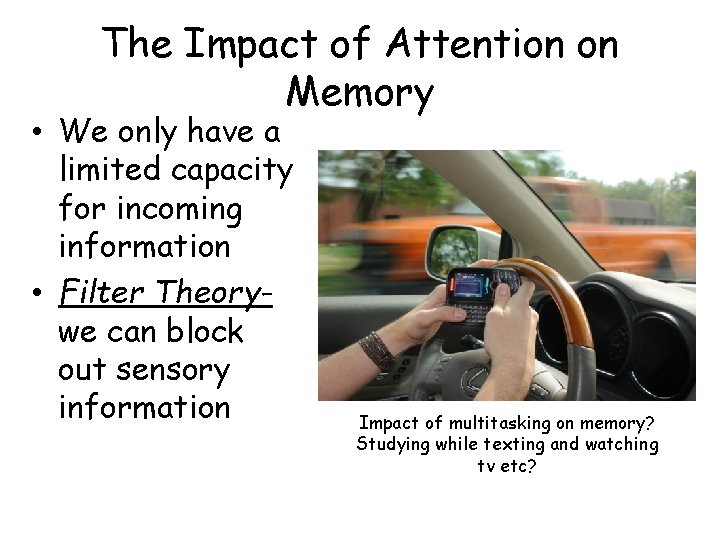
The Impact of Attention on Memory • We only have a limited capacity for incoming information • Filter Theorywe can block out sensory information Impact of multitasking on memory? Studying while texting and watching tv etc?
How attentive are we? What does this illustrate about our attention? Implications of this? • http: //www. youtube. com/watch? v=v. BPG_OBg. TWg&safety_mode=true&persist_safet y_mode=1&safe=active • http: //www. youtube. com/watch? v=ub. NF 9 QNEQLA&safety_mode=true&persist_safet y_mode=1&safe=active
Priming • We may not be aware of all that we are processing ie – priming, words on the unattended ear may affect our decisions, behavior, decisions • Implicit memory – non conscious processing, influences our behavior • Examples of studies…. https: //www. youtube. com/watch? v=Z_m. VFPCa. QJY https: //www. youtube. com/watch? v=HRAKt 0 Gak. JM
• Priming: given info and then is later tested to see if it will affect performance • Relearning method: measures retention that compares the time required to relearn material with time used in initial learning
- Slides: 39