
Who is the Father of Deep Learning Charles
- Slides: 49
Who is the Father of Deep Learning? Charles C. Tappert Seidenberg School of CSIS Pace University, New York
Summary Deep Learning is causing a revolution in artificial intelligence, winning all contests, etc. This paper evaluates candidates for the Father of Deep Learning Frank Rosenblatt developed and explored all the basic ingredients of the deep learning systems of today and should be recognized as the Father of Deep Learning perhaps together with Hinton, Le. Cun and Bengio who have just received the Turing Award as the fathers of the deep learning revolution
We credit inventors of technologies We give credit to the inventor of a technology Babbage, Turing, von Neuman, Mauchley, and Eckert are considered fathers of the computer Ada Lovelace the mother of computer programming Nathaniel Rochester the father of the assembler John Backus the father of the compiler Tim Berners-Lee the father of the World Wide Web The key creators of a technology are usually not recognized as fathers or mothers of the technology while they are still living
Artificial Intelligence (AI) refers to an artificial creation of human-like intelligence So far, AIs have been in specific narrow areas In 1997 IBM’s Deep Blue beat world’s best chess player In 2011 IBM’s Watson beat world’s best jeopardy players In 2017 Google's Alpha. Go beat world's best Go player The Google search engine quickly finds information Siri and Alexa voice services answer questions
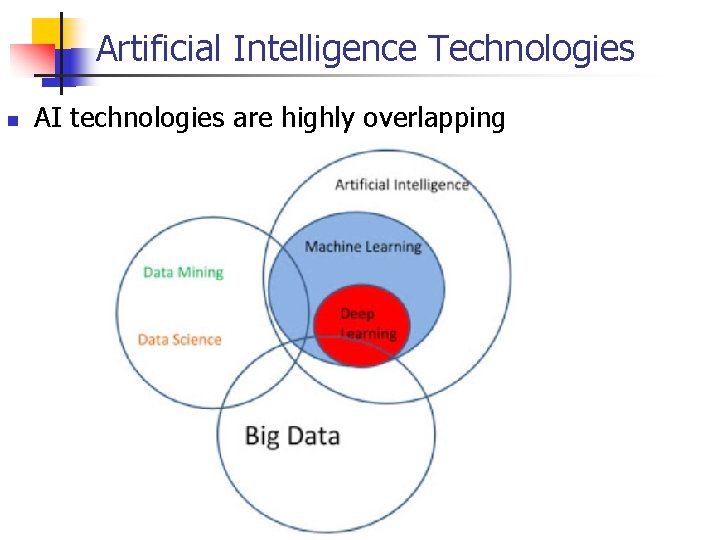
Artificial General Intelligence (AGI) There is currently a renewed focus on AGI AIs that can perform any intellectual task that a human can Machine Learning (ML) is a sub-area under AI and Deep Learning (DL) is a sub-area under ML With advances in computing power, applications in these areas can now effectively utilize large quantities of data (Big Data), thus enhancing the capabilities of data mining and data science that use ML algorithms.
Artificial Intelligence Technologies AI technologies are highly overlapping
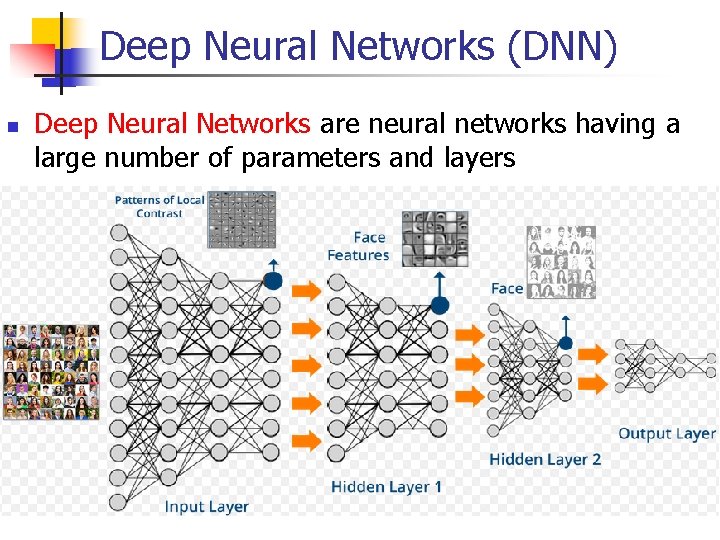
Deep Neural Networks (DNN) Deep Neural Networks are neural networks having a large number of parameters and layers
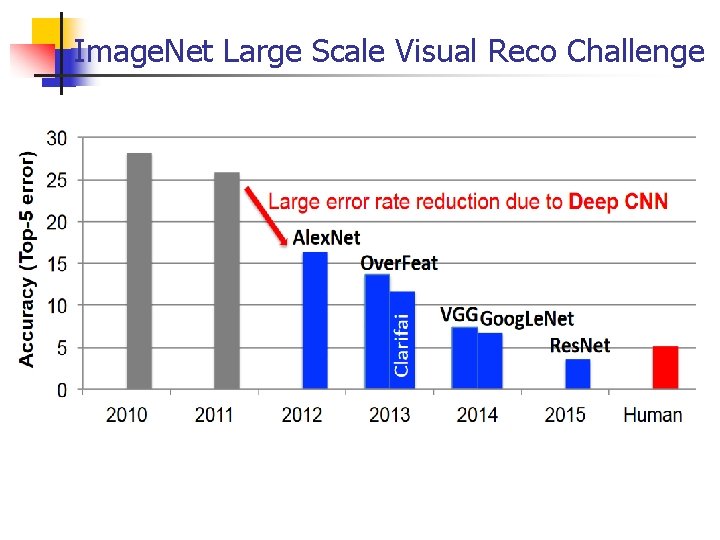
Deep Learning (DL) DL is causing real-world impact by winning the recent contests and outperforming other ML technologies in most applications DL systems have won the major visual image classification contests in recent years. A dramatic moment in the meteoric rise of DL came when a convolutional network won the Image. Net Large Scale Visual Recognition Challenge (ILSVRC) for the first time, and this challenge is now consistently won by deep networks Used in speech recognition – e. g. , Siri and Alexa
Image. Net Large Scale Visual Reco Challenge
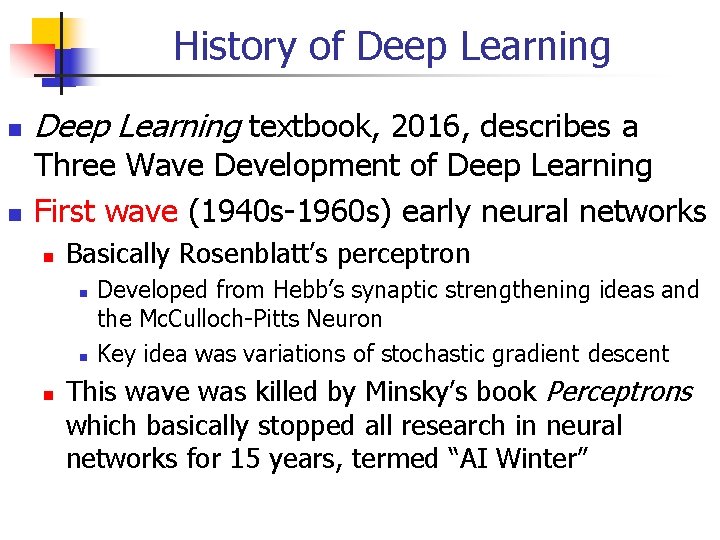
History of Deep Learning textbook, 2016, describes a Three Wave Development of Deep Learning First wave (1940 s-1960 s) early neural networks Basically Rosenblatt’s perceptron Developed from Hebb’s synaptic strengthening ideas and the Mc. Culloch-Pitts Neuron Key idea was variations of stochastic gradient descent This wave was killed by Minsky’s book Perceptrons which basically stopped all research in neural networks for 15 years, termed “AI Winter”
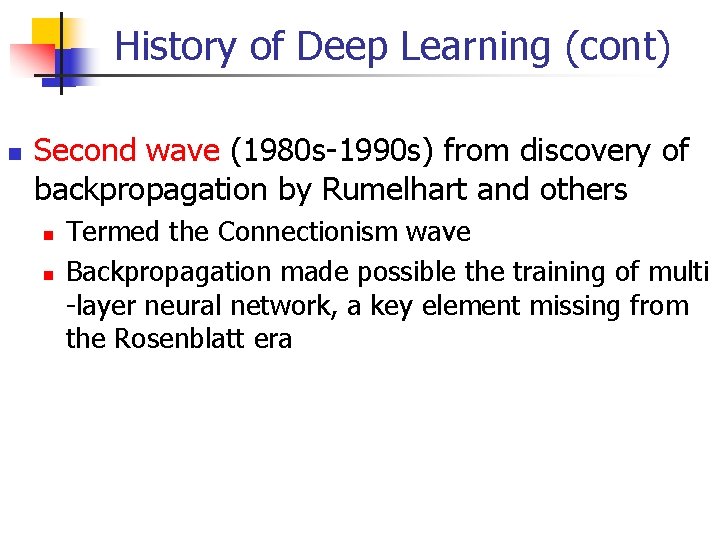
History of Deep Learning (cont) Second wave (1980 s-1990 s) from discovery of backpropagation by Rumelhart and others Termed the Connectionism wave Backpropagation made possible the training of multi -layer neural network, a key element missing from the Rosenblatt era
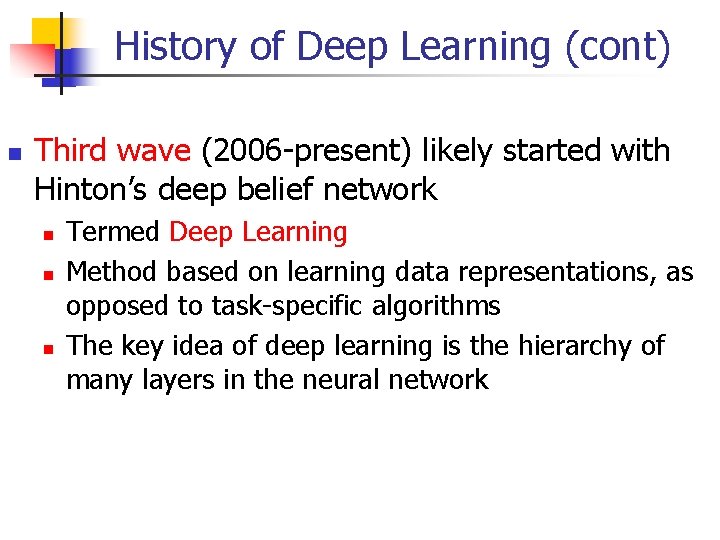
History of Deep Learning (cont) Third wave (2006 -present) likely started with Hinton’s deep belief network Termed Deep Learning Method based on learning data representations, as opposed to task-specific algorithms The key idea of deep learning is the hierarchy of many layers in the neural network
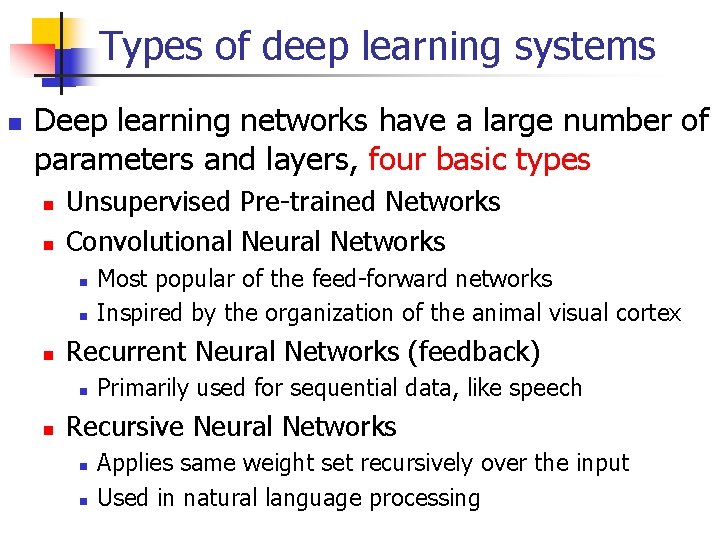
Types of deep learning systems Deep learning networks have a large number of parameters and layers, four basic types Unsupervised Pre-trained Networks Convolutional Neural Networks Recurrent Neural Networks (feedback) Most popular of the feed-forward networks Inspired by the organization of the animal visual cortex Primarily used for sequential data, like speech Recursive Neural Networks Applies same weight set recursively over the input Used in natural language processing
Father of Deep Learning Candidates We discuss the candidates as follows: Early Contributors Frank Rosenblatt Key Inventors of Backpropagation 2018 Turing Award Winners Newcomers
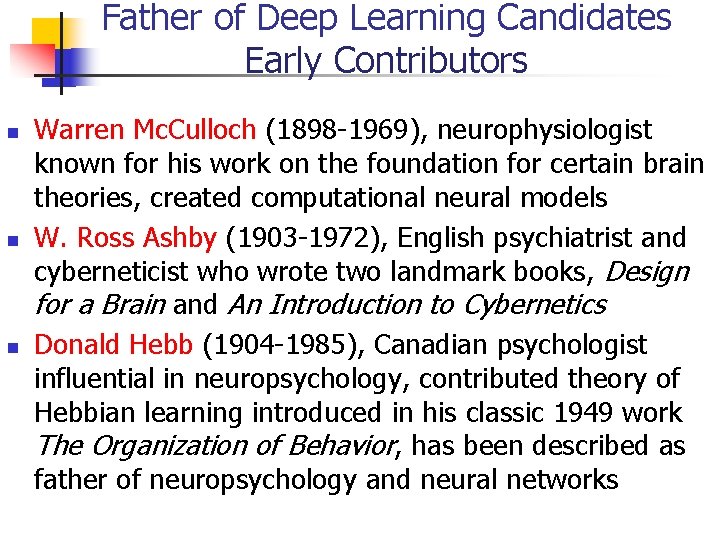
Father of Deep Learning Candidates Early Contributors Warren Mc. Culloch (1898 -1969), neurophysiologist known for his work on the foundation for certain brain theories, created computational neural models W. Ross Ashby (1903 -1972), English psychiatrist and cyberneticist who wrote two landmark books, Design for a Brain and An Introduction to Cybernetics Donald Hebb (1904 -1985), Canadian psychologist influential in neuropsychology, contributed theory of Hebbian learning introduced in his classic 1949 work The Organization of Behavior, has been described as father of neuropsychology and neural networks
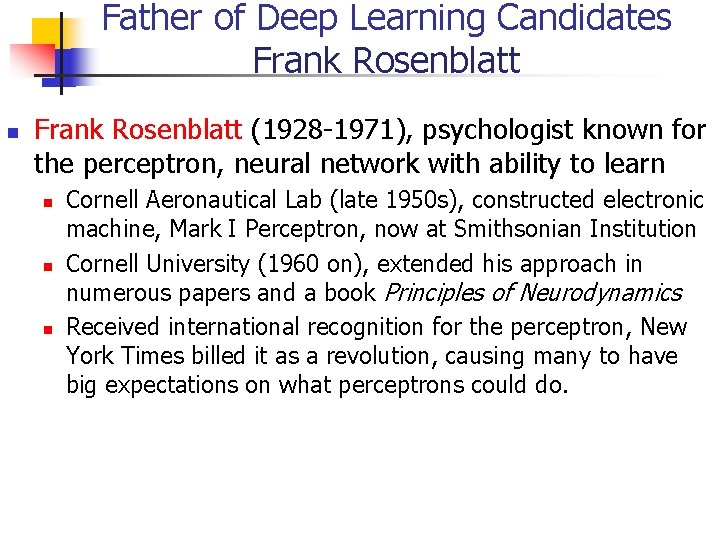
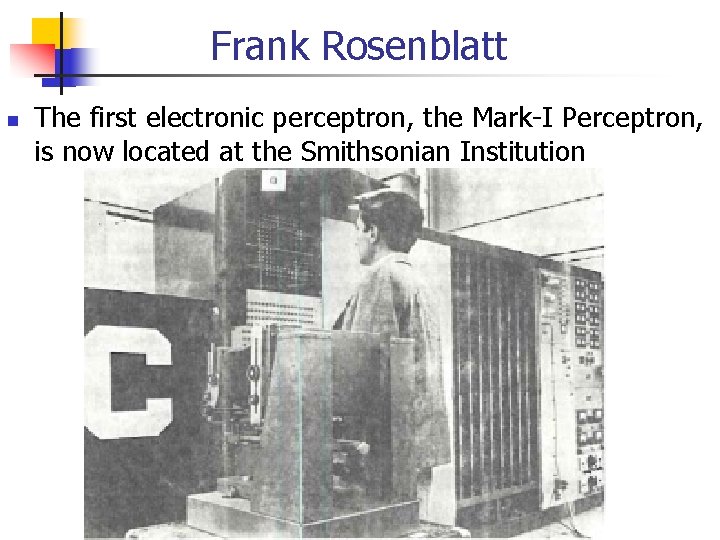
Father of Deep Learning Candidates Frank Rosenblatt (1928 -1971), psychologist known for the perceptron, neural network with ability to learn Cornell Aeronautical Lab (late 1950 s), constructed electronic machine, Mark I Perceptron, now at Smithsonian Institution Cornell University (1960 on), extended his approach in numerous papers and a book Principles of Neurodynamics Received international recognition for the perceptron, New York Times billed it as a revolution, causing many to have big expectations on what perceptrons could do.
Father of Deep Learning Candidates Frank Rosenblatt Unfortunately, Minsky’s book Perceptrons appeared in 1969 with a mathematical proof that two-layer feed-forward linear perceptrons with one trainable set of weights cannot model non-linear transformations. Although this result was trivial, the book had a pronounced effect on research funding, and led to a 15 -year hiatus of neural network research. Well after his death, research on neural networks returned to the mainstream in the 1980 s, and new researchers studied Rosenblatt's work. Most of these new researchers interpreted as a contradiction the hypotheses presented in the book Perceptrons, and a confirmation of Rosenblatt's expectations.
Father of Deep Learning Candidates Key Inventors of Backpropagation David Rumelhart (1942 -2011), psychologist, worked on symbolic AI and parallel distributed processing Applied back-propagation algorithm to multi-layer neural networks, paper by Rumelhart, Hinton & Williams, 1986 Also wrote a book Rumelhart & Mc. Clelland, 1986, described the creation of computer simulations of perception Paul Werbos (1947 - ), social scientist and machine learning pioneer best known for his 1974 dissertation which first described the process of training artificial neural networks through backpropagation of errors He also was a pioneer of recurrent neural networks
Father of Deep Learning Candidates 2018 Turing Award Winners Geoff Hinton (1947 - ), cognitive psychologist and computer scientist, most noted for his work on neural networks, and especially for restricted Boltzmann machines stacked as deep-belief networks. Co-author of highly-cited 1986 paper that popularized the backpropagation algorithm for training multi-layer neural networks (they were not the first to discover the algorithm) Viewed as a leader in the deep learning community, referred by some as "Godfather of Deep Learning" The dramatic image-recognition milestone of the Alex. Net designed by his student Alex Krizhevsky for the Imagenet challenge 2012 helped revolutionize the field of computer vision.
Father of Deep Learning Candidates 2018 Turing Award Winners (cont. ) Yann Le. Cun (1960 - ), computer scientist working in the fields of machine learning, computer vision, mobile robotics, and computational neuroscience. Professor at the Courant Institute of Mathematical Sciences at NYU, and Vice President, Chief AI Scientist at Facebook Well known for his work on optical character recognition and computer vision using convolutional neural networks (CNN), and is considered a founding father of convolutional nets
Father of Deep Learning Candidates 2018 Turing Award Winners (cont. ) Yashua Bengio (1964 - ), computer scientist, most noted for his work on neural networks and deep learning He is a professor at the Department of Computer Science and Operations Research at the Université de Montréal and scientific director of the Montreal Institute for Learning Algorithms. His research team is behind Theano
Father of Deep Learning Candidates Newcomers Kai-Fu Lee (1961 - ), venture capitalist, technology executive, writer, AI expert, currently based in Beijing Developed the world's first speaker-independent, continuous speech recognition system as his Ph. D. thesis at Carnegie Mellon. Later became an executive, first at Apple, then SGI, Microsoft, & Google He became the focus of a 2005 legal dispute between Google and Microsoft, his former employer, due to a one-year non-compete agreement that he signed with Microsoft in 2000 when he became its corporate vice president of interactive services. As a prominent figure in the Chinese internet sector, he was the founding director of Microsoft Research Asia, serving from 1998 to 2000, and president of Google China, serving from 2005 to 2009
Father of Deep Learning Candidates Newcomers (cont. ) Andrew Ng (1963 - ), computer scientist, one of the most prolific researchers in machine learning and AI His work helped incite the recent revolution in deep learning As a business executive and investor, Ng co-founded and led Google Brain and was a former Vice President and Chief Scientist at Baidu, building the company's Artificial Intelligence Group into a team of several thousand people Teaches at Stanford University and was formerly Director of its AI Lab. Also a pioneer in online education, Ng cofounded Coursera and deeplearning. ai
Father of Deep Learning Candidates Newcomers (cont. ) Jürgen Schmidhuber (1976 - ), computer scientist noted for his work in the field of artificial intelligence, deep learning and neural networks. Co-director of the Dalle Molle Institute for Artificial Intelligence Research in Manno, Switzerland Sometimes called "father of modern AI" or "father of DL” Together with his students he has published increasingly sophisticated versions of a type of recurrent neural network called the long short-term memory
Fathers of Deep Learning So who is or are the fathers of deep learning? First consider that Hinton, Le. Cun and Bengio have just received the Turing Award as the fathers of the deep learning revolution “for conceptual and engineering breakthroughs that have made deep neural networks a critical component of computing” They were recognized for the revolution caused by the revolutionary applications of deep learning networks spurred by their contributions primarily over the last ten or so years Although we evaluated several other candidates born after 1940, Hinton, Le. Cun and Bengio are the outstanding ones However, there is a candidate, Frank Rosenblatt, that created and researched earlier neural networks having characteristics similar to today’s networks
Fathers of Deep Learning After careful review of the older candidates, we feel that Rosenblatt should be considered the elder father of deep learning, and we now review his contributions Rosenblatt developed neural networks called perceptrons, probabilistic models for information, storage, and organization in the brain with the key properties of association or learning, generalization to new patterns, distributed memory, and biologically plausible brain models Most of the figures to follow were taken directly from his book Principles of Neurodynamics As was his preference, we will not capitalize “perceptron”
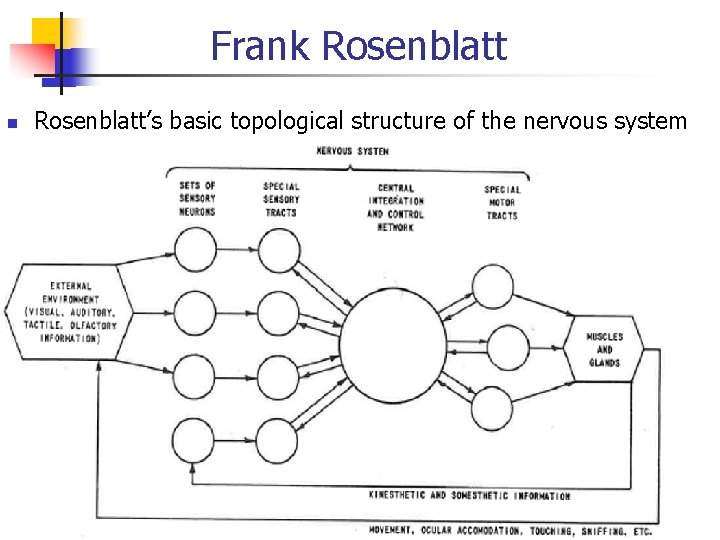
Frank Rosenblatt’s basic topological structure of the nervous system
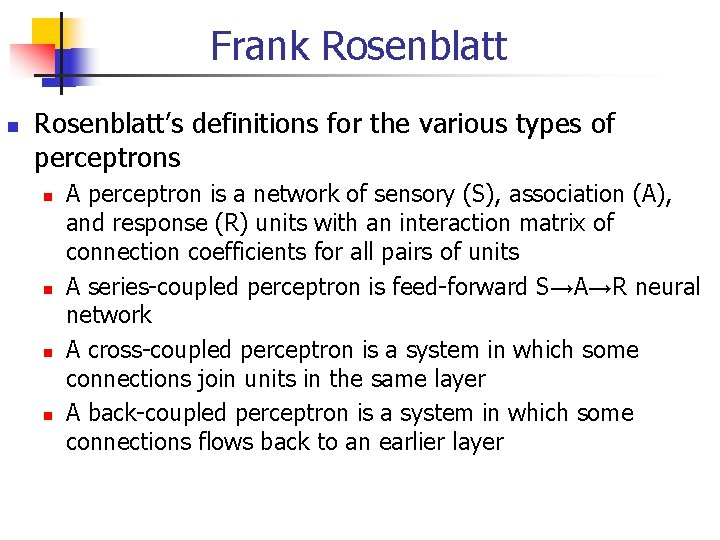
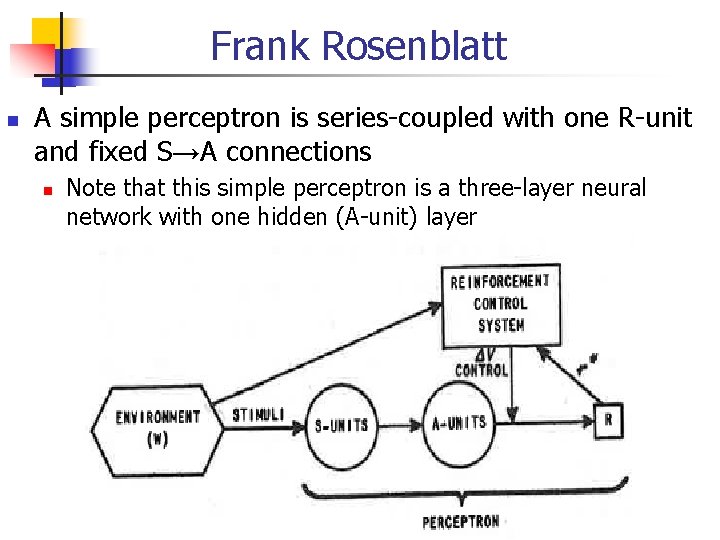
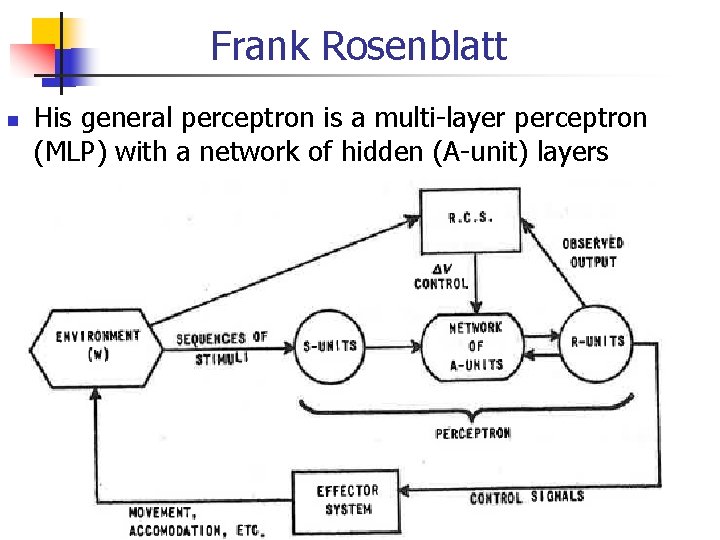
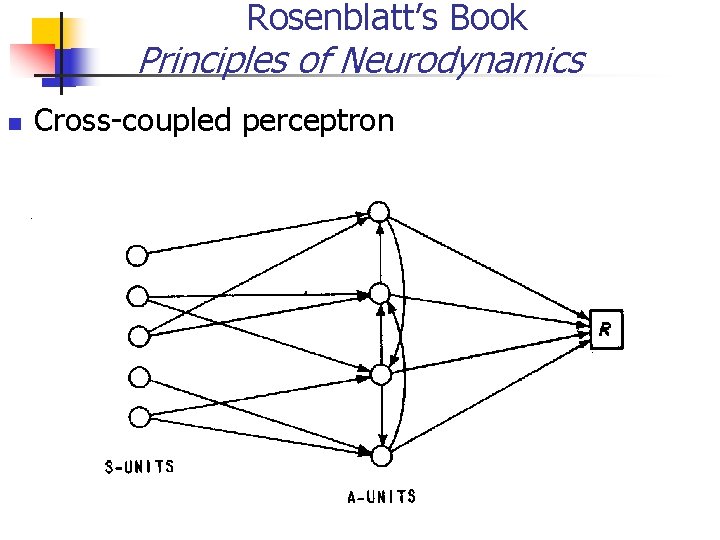
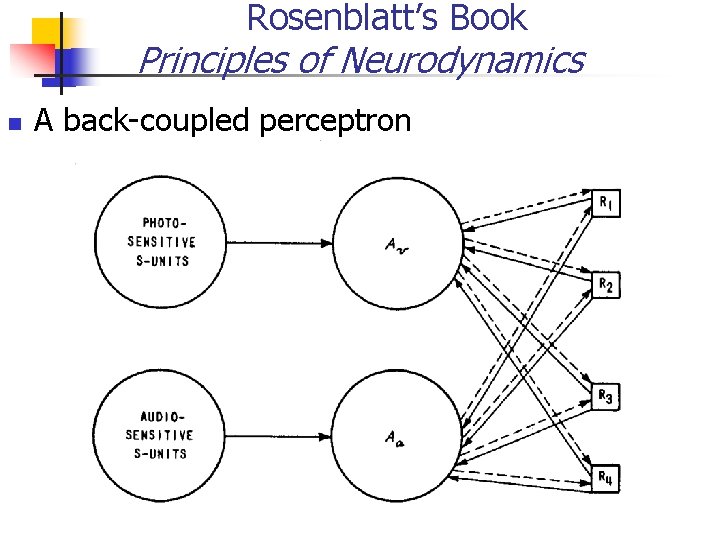
Frank Rosenblatt’s definitions for the various types of perceptrons A perceptron is a network of sensory (S), association (A), and response (R) units with an interaction matrix of connection coefficients for all pairs of units A series-coupled perceptron is feed-forward S→A→R neural network A cross-coupled perceptron is a system in which some connections join units in the same layer A back-coupled perceptron is a system in which some connections flows back to an earlier layer
Frank Rosenblatt A simple perceptron is series-coupled with one R-unit and fixed S→A connections Note that this simple perceptron is a three-layer neural network with one hidden (A-unit) layer
Frank Rosenblatt His general perceptron is a multi-layer perceptron (MLP) with a network of hidden (A-unit) layers
Frank Rosenblatt The first electronic perceptron, the Mark-I Perceptron, is now located at the Smithsonian Institution
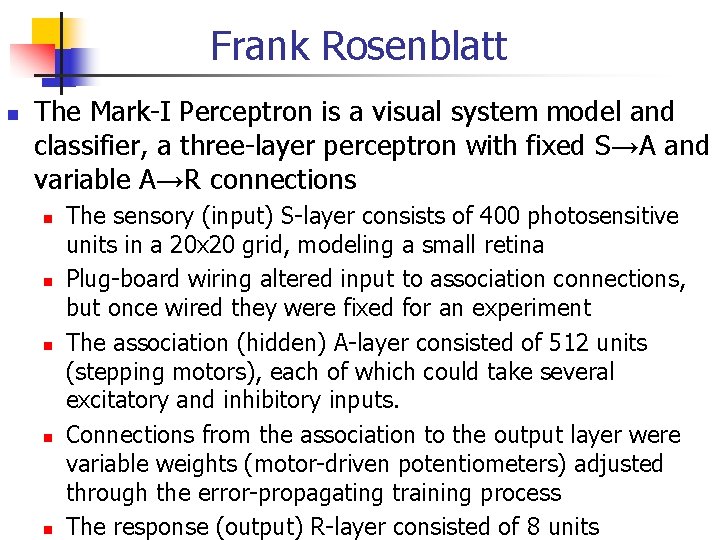
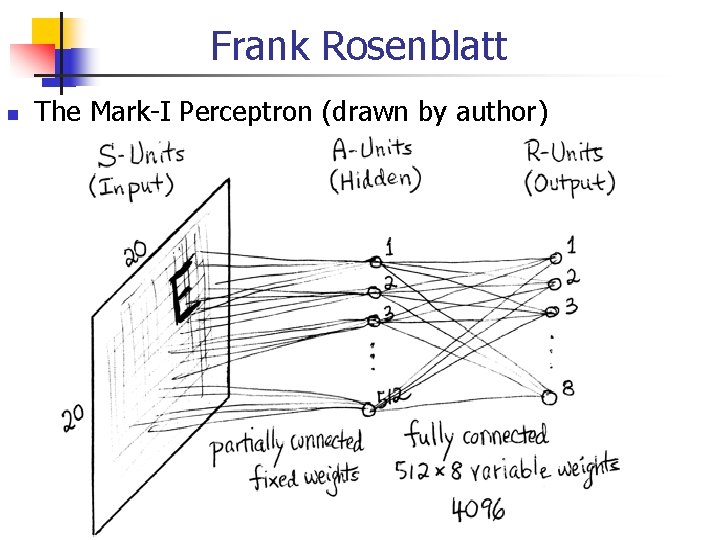
Frank Rosenblatt The Mark-I Perceptron is a visual system model and classifier, a three-layer perceptron with fixed S→A and variable A→R connections The sensory (input) S-layer consists of 400 photosensitive units in a 20 x 20 grid, modeling a small retina Plug-board wiring altered input to association connections, but once wired they were fixed for an experiment The association (hidden) A-layer consisted of 512 units (stepping motors), each of which could take several excitatory and inhibitory inputs. Connections from the association to the output layer were variable weights (motor-driven potentiometers) adjusted through the error-propagating training process The response (output) R-layer consisted of 8 units
Frank Rosenblatt The Mark-I Perceptron (drawn by author)
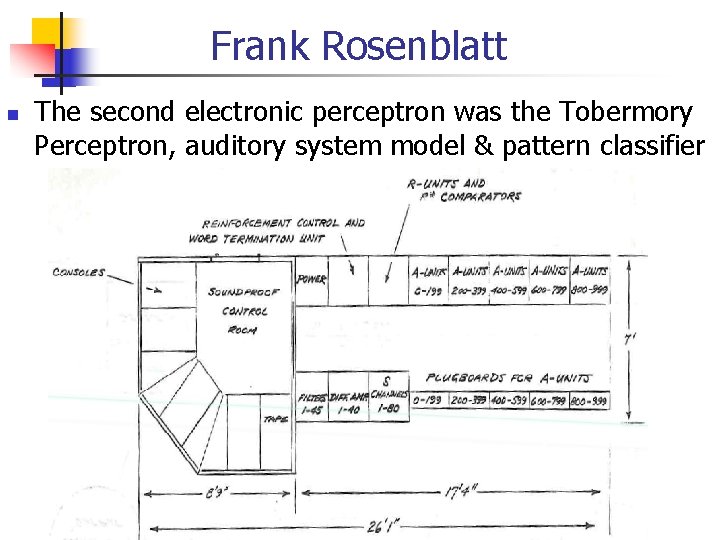
Frank Rosenblatt The second electronic perceptron was the Tobermory Perceptron, auditory system model & pattern classifier
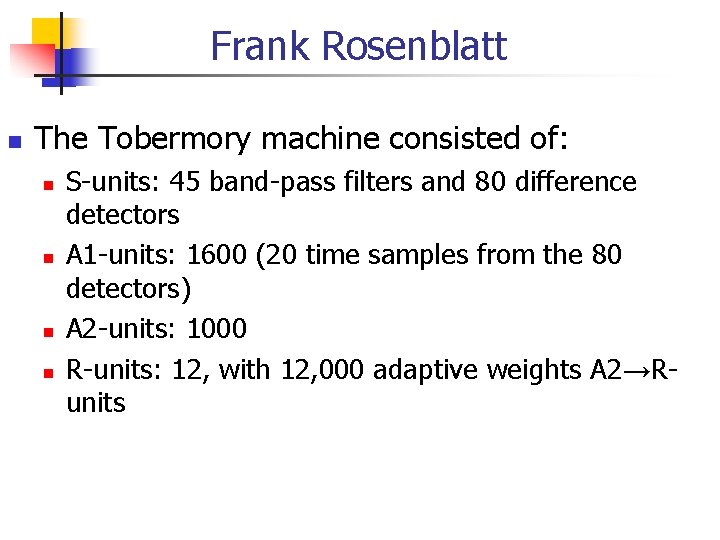
Frank Rosenblatt The Tobermory machine consisted of: S-units: 45 band-pass filters and 80 difference detectors A 1 -units: 1600 (20 time samples from the 80 detectors) A 2 -units: 1000 R-units: 12, with 12, 000 adaptive weights A 2→Runits
Frank Rosenblatt Hardware implementations made good demos but software simulations were far more flexible In the 1960 s Rosenblatt conducted many perceptron computer simulations These computer simulations required machine language coding for speed and memory usage A simulation software package was developed so a user could specify the number of layers, the number of units per layer, type of connections between layers, etc. Computer time was used at Cornell and at NYU
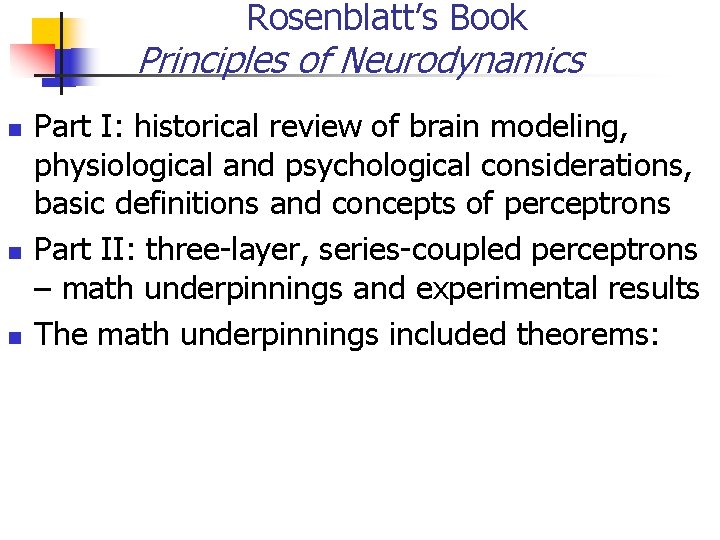
Rosenblatt’s Book Principles of Neurodynamics Part I: historical review of brain modeling, physiological and psychological considerations, basic definitions and concepts of perceptrons Part II: three-layer, series-coupled perceptrons – math underpinnings and experimental results The math underpinnings included theorems:
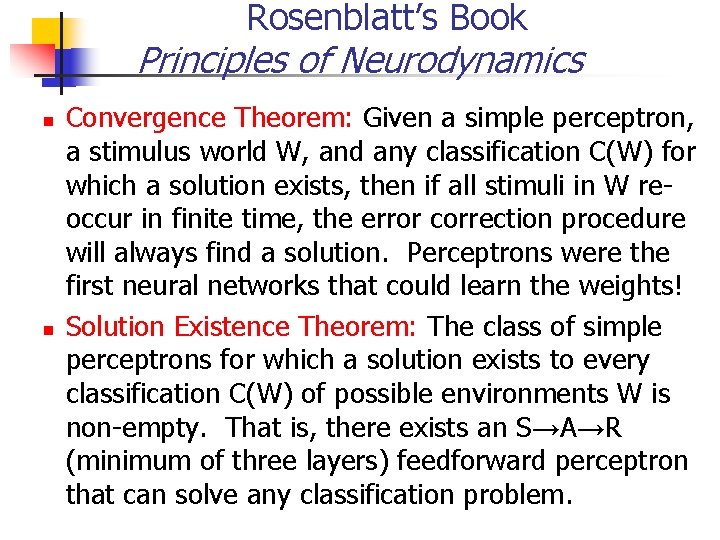
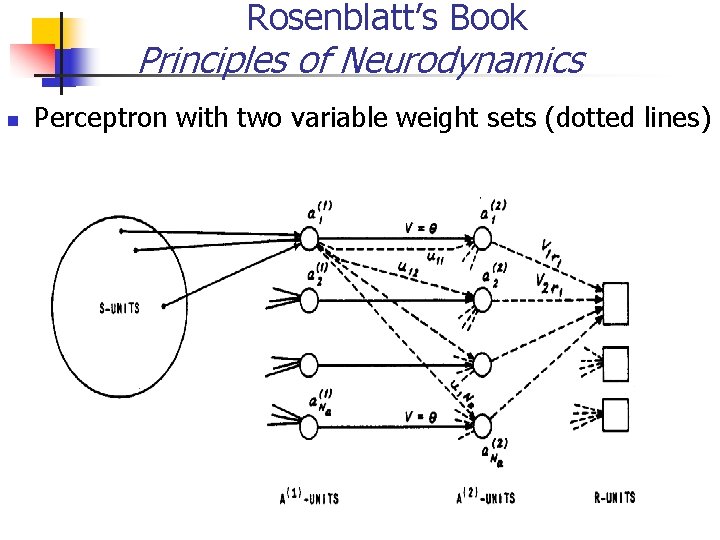
Rosenblatt’s Book Principles of Neurodynamics Convergence Theorem: Given a simple perceptron, a stimulus world W, and any classification C(W) for which a solution exists, then if all stimuli in W reoccur in finite time, the error correction procedure will always find a solution. Perceptrons were the first neural networks that could learn the weights! Solution Existence Theorem: The class of simple perceptrons for which a solution exists to every classification C(W) of possible environments W is non-empty. That is, there exists an S→A→R (minimum of three layers) feedforward perceptron that can solve any classification problem.
Rosenblatt’s Book Principles of Neurodynamics Part III covered multi-layer (more than three layers) and cross-coupled perceptrons Part VI covered back-coupled perceptrons Rosenblatt used the book to teach an interdisciplinary course "Theory of Brain Mechanisms" that drew students from Cornell's Engineering and Liberal Arts colleges
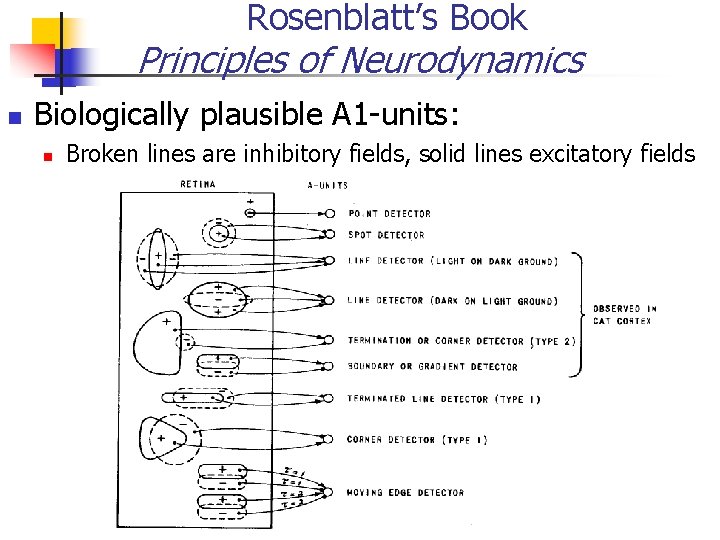
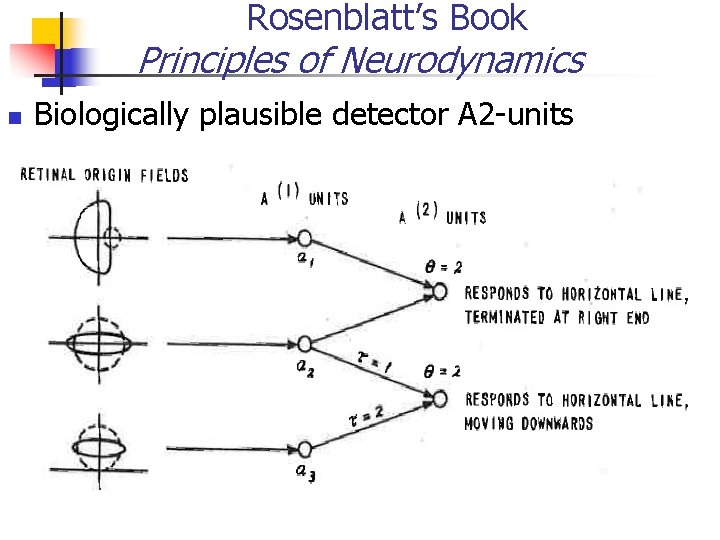
Rosenblatt’s Book Principles of Neurodynamics Biologically plausible A 1 -units: Broken lines are inhibitory fields, solid lines excitatory fields
Rosenblatt’s Book Principles of Neurodynamics Biologically plausible detector A 2 -units
Rosenblatt’s Book Principles of Neurodynamics Perceptron with two variable weight sets (dotted lines)
Rosenblatt’s Book Principles of Neurodynamics Cross-coupled perceptron
Rosenblatt’s Book Principles of Neurodynamics A back-coupled perceptron
Rosenblatt versus Minsky Rosenblatt and Minsky debated at conferences the value of biologically inspired computation Rosenblatt argued his perceptrons could do almost anything, Minsky countered they could do little Minsky, to direct government funding away from neural networks and towards his areas of interest, published Perceptrons, to assert about perceptrons, "Most of this writing. . . is without scientific value. . . ”
Rosenblatt versus Minsky (cont. ) Minsky, well aware that powerful perceptrons have multiple layers and even Rosenblatt's basic feedforward perceptrons have three layers, defined a perceptron as a two-layer machine that can handle only linearly separable problems and, for example, cannot solve the exclusive-OR problem. The book, unfortunately, stopped government funding in neural networks and precipitated an “AI Winter” that lasted about 15 years This lack of funding also ended Rosenblatt’s research in neural networks
Rosenblatt Rosenblatt had all the basically ingredients of the deep learning systems of today He was the first to develop a training algorithm for one set of weights that was guaranteed to find a solution if one existed The contest-winning DL systems are multilayer feedforward CNNs, just multilayer perceptrons with fixed, biologically-inspired connections in the early layers The Recurrent Neural Networks (RNNs) have connections within the same layer and/or connections back to earlier layers which are just Rosenblatt’s crosscoupled and back-coupled perceptrons
Rosenblatt Although conceptually the same as the perceptrons of the 1960 s, the deep learning networks, 50 years later, have advantages of: Increased computing power + GPUs Massive training data not available in 1960 s Backpropagation not available in 1960 s to allow training of the complete system, pulling everything together
Conclusions We evaluated candidates for fathers of deep learning We conclude that Rosenblatt developed and explored all of the basic ingredients of today’s DL systems And consider two additional factors: Minsky’s 1969 book triggered the “AI Winter” that stopped gov’t funding and ended Rosenblatt’s perceptron research Rosenblatt was not alive to take up his research on perceptrons when work resumed on neural networks in the 1980 s because he died in 1971. Had he been able to continue his work on perceptrons there is no telling how far he could have pushed the technology in those early years. Finally, we conclude that Frank Rosenblatt should be considered the Father of Deep Learning