
WHO Essential Medicines List ConceptProcess and Update on
- Slides: 65
WHO Essential Medicines List Concept/Process and Update on EML 2015 WHO Technical Briefing Seminar Nicola Magrini – WHO, EMP November 4, 2014 – WHO Geneva 1| Essential Medicines List: Concept and Procedures
Essential Medicines Guiding principle: A limited range of carefully selected essential medicines leads to better health care, better medicines management, and lower costs Definition: Essential medicines are those that satisfy the priority health care needs of the population Selection: Selected with due regard to disease prevalence, evidence on efficacy and safety, and comparative costeffectiveness. 2| Essential Medicines List: Concept and Procedures
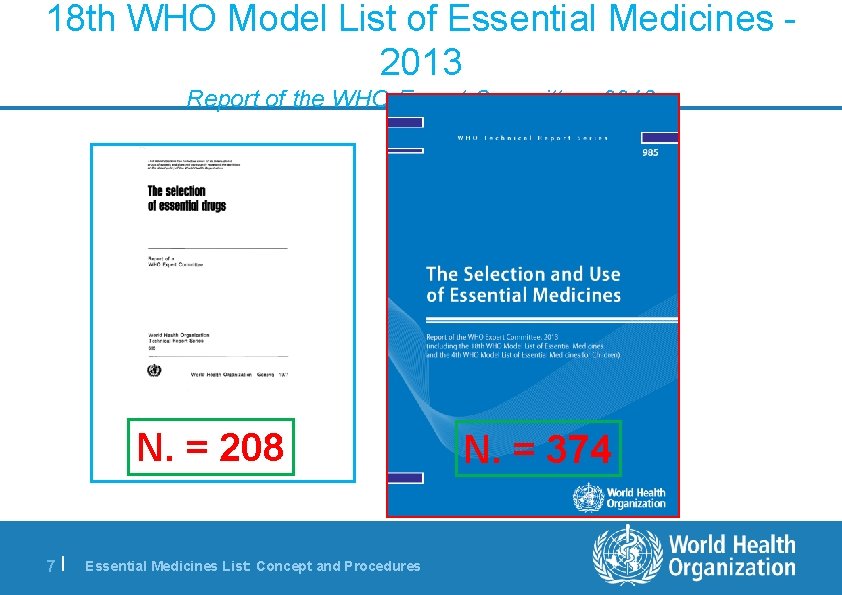
… 38 years of EML 1977 1 st Model list published, 208 active substances - List is revised every two years by WHO Expert Committee - 2002 Revised procedures approved by WHO (EB 109/8) - Last revision EML (April 2013) contains 374 medicines The first list was a major breakthrough in the history of medicine, pharmacy and public health Médecins sans Frontières, 2000 3| Essential Medicines List: Concept and Procedures
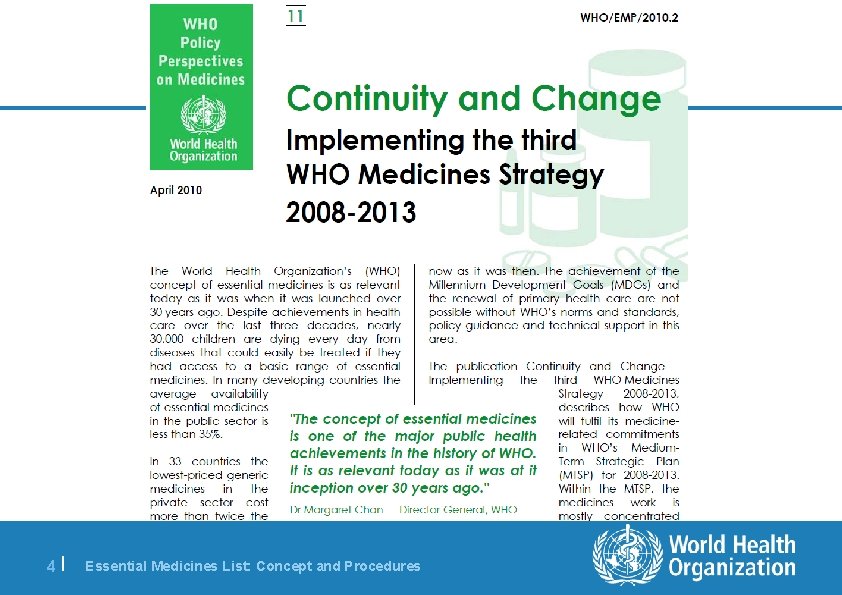
4| Essential Medicines List: Concept and Procedures
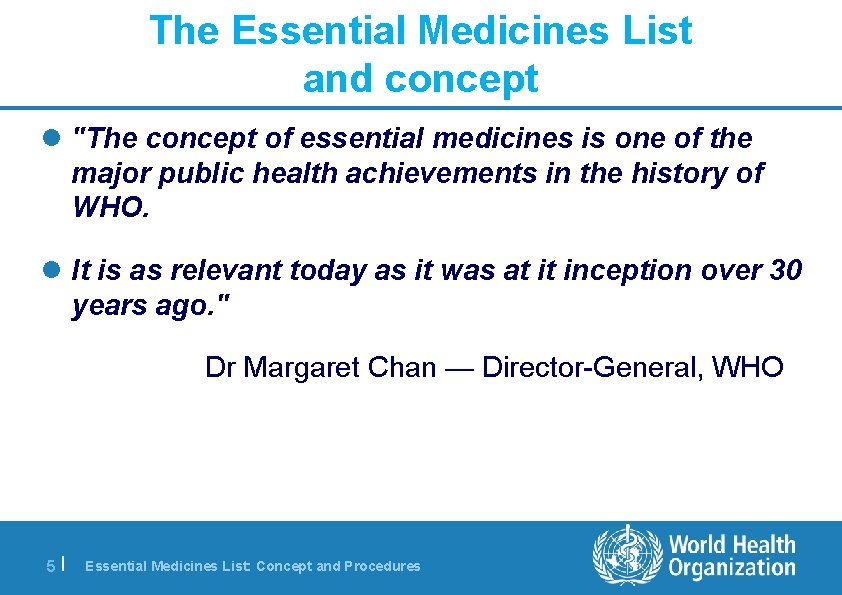
The Essential Medicines List and concept l "The concept of essential medicines is one of the major public health achievements in the history of WHO. l It is as relevant today as it was at it inception over 30 years ago. " Dr Margaret Chan — Director-General, WHO 5| Essential Medicines List: Concept and Procedures
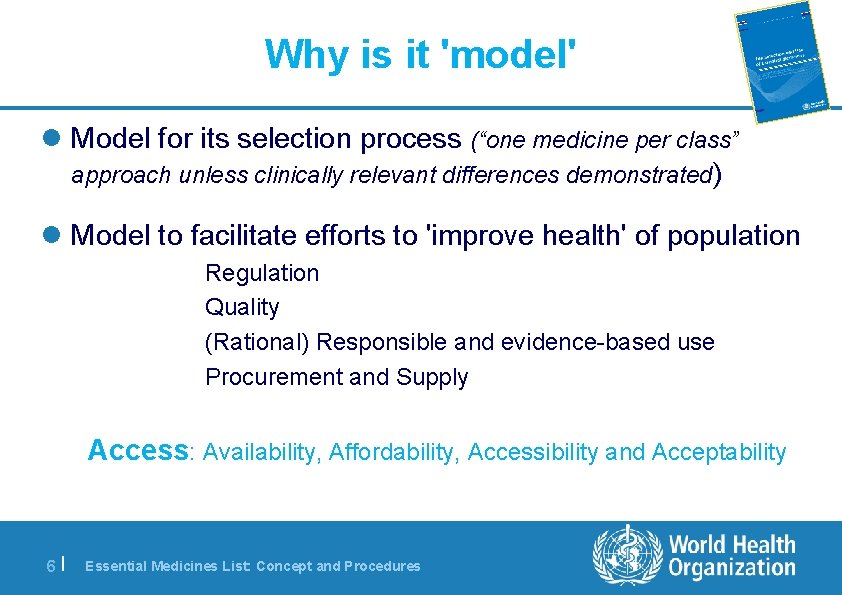
Why is it 'model' l Model for its selection process (“one medicine per class” approach unless clinically relevant differences demonstrated) l Model to facilitate efforts to 'improve health' of population Regulation Quality (Rational) Responsible and evidence-based use Procurement and Supply Access: Availability, Affordability, Accessibility and Acceptability 6| Essential Medicines List: Concept and Procedures
18 th WHO Model List of Essential Medicines 2013 Report of the WHO Expert Committee, 2013 N. = 208 7| Essential Medicines List: Concept and Procedures N. = 374
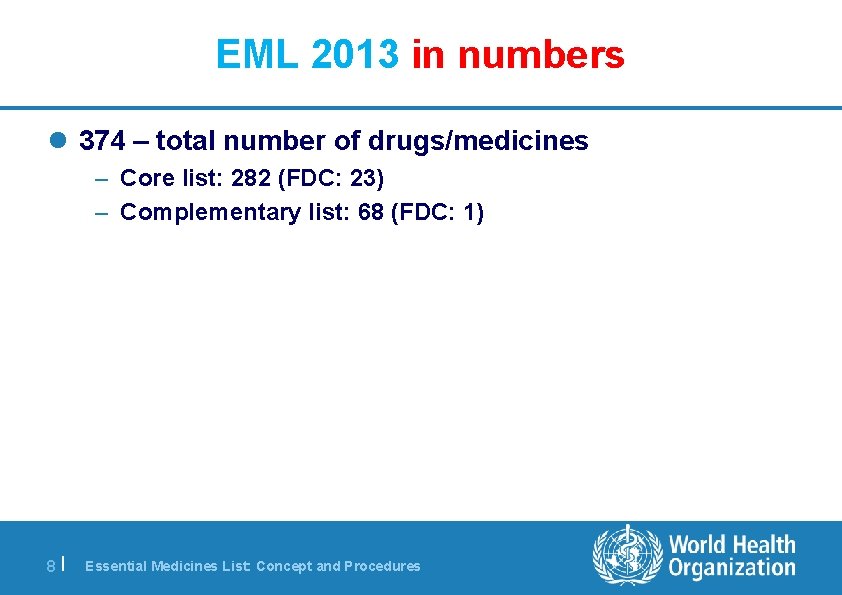
EML 2013 in numbers l 374 – total number of drugs/medicines – Core list: 282 (FDC: 23) – Complementary list: 68 (FDC: 1) 8| Essential Medicines List: Concept and Procedures
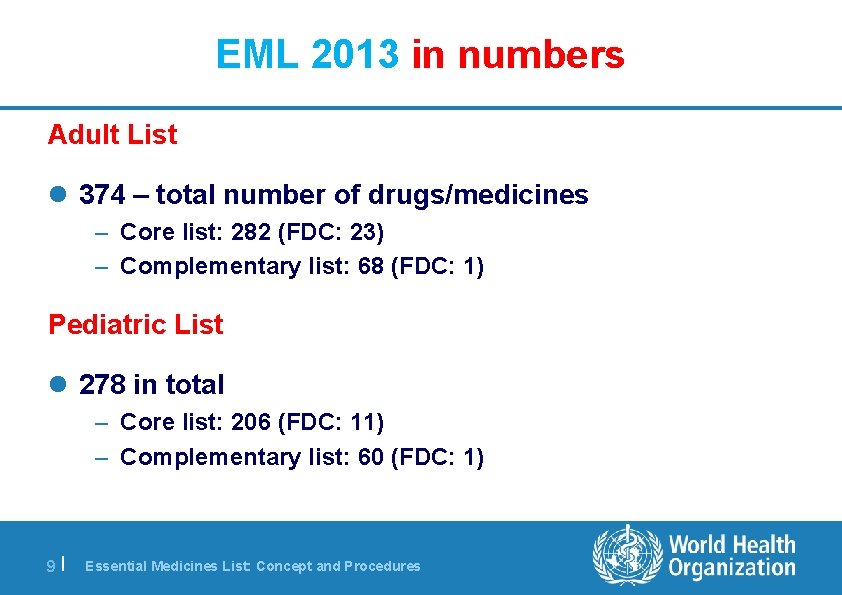
EML 2013 in numbers Adult List l 374 – total number of drugs/medicines – Core list: 282 (FDC: 23) – Complementary list: 68 (FDC: 1) Pediatric List l 278 in total – Core list: 206 (FDC: 11) – Complementary list: 60 (FDC: 1) 9| Essential Medicines List: Concept and Procedures
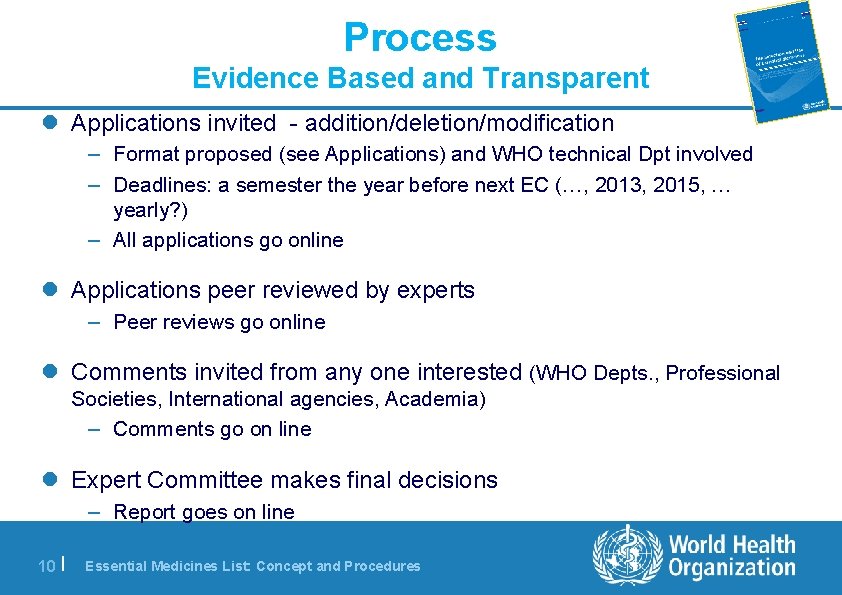
Process Evidence Based and Transparent l Applications invited - addition/deletion/modification – Format proposed (see Applications) and WHO technical Dpt involved – Deadlines: a semester the year before next EC (…, 2013, 2015, … yearly? ) – All applications go online l Applications peer reviewed by experts – Peer reviews go online l Comments invited from any one interested (WHO Depts. , Professional Societies, International agencies, Academia) – Comments go on line l Expert Committee makes final decisions – Report goes on line 10 | Essential Medicines List: Concept and Procedures
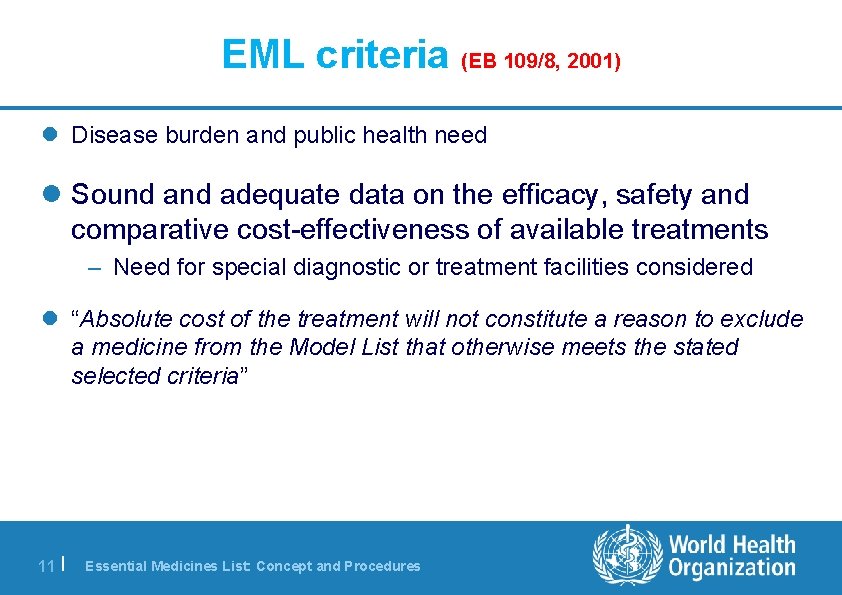
EML criteria (EB 109/8, 2001) l Disease burden and public health need l Sound adequate data on the efficacy, safety and comparative cost-effectiveness of available treatments – Need for special diagnostic or treatment facilities considered l “Absolute cost of the treatment will not constitute a reason to exclude a medicine from the Model List that otherwise meets the stated selected criteria” 11 | Essential Medicines List: Concept and Procedures
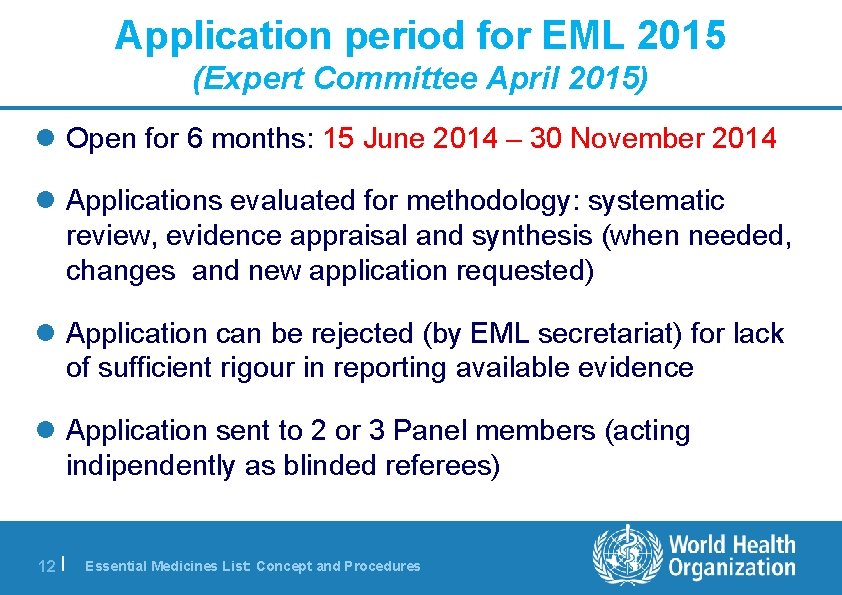
Application period for EML 2015 (Expert Committee April 2015) l Open for 6 months: 15 June 2014 – 30 November 2014 l Applications evaluated for methodology: systematic review, evidence appraisal and synthesis (when needed, changes and new application requested) l Application can be rejected (by EML secretariat) for lack of sufficient rigour in reporting available evidence l Application sent to 2 or 3 Panel members (acting indipendently as blinded referees) 12 | Essential Medicines List: Concept and Procedures
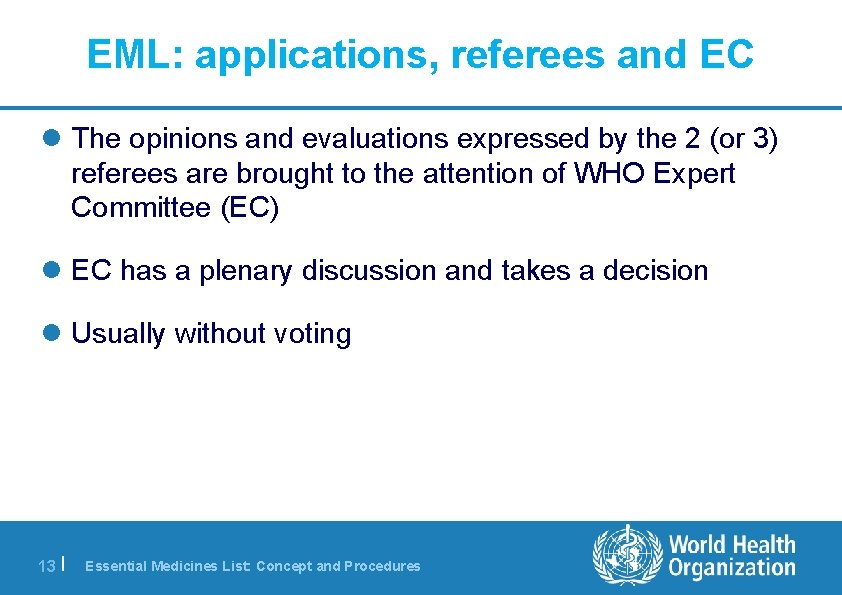
EML: applications, referees and EC l The opinions and evaluations expressed by the 2 (or 3) referees are brought to the attention of WHO Expert Committee (EC) l EC has a plenary discussion and takes a decision l Usually without voting 13 | Essential Medicines List: Concept and Procedures
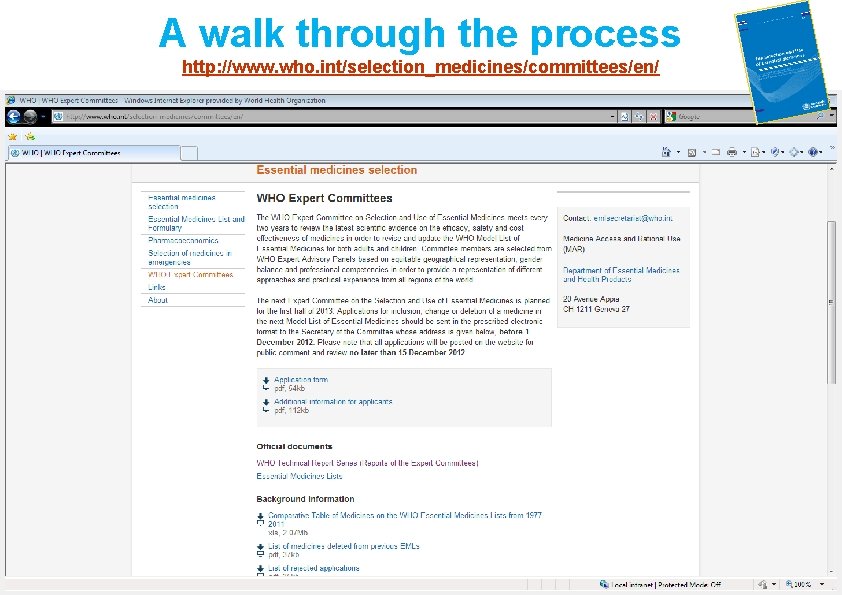
A walk through the process http: //www. who. int/selection_medicines/committees/en/ 14 | Essential Medicines List: Concept and Procedures
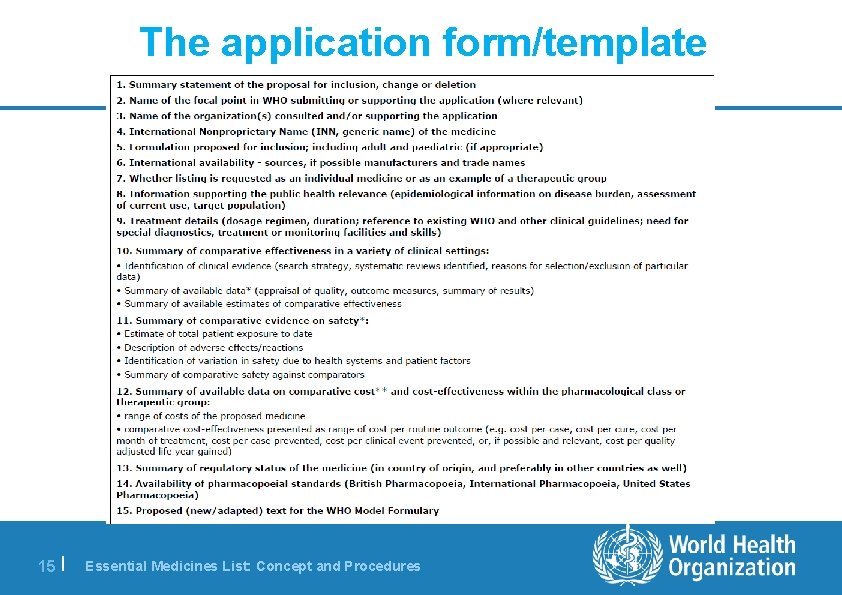
The application form/template 15 | Essential Medicines List: Concept and Procedures
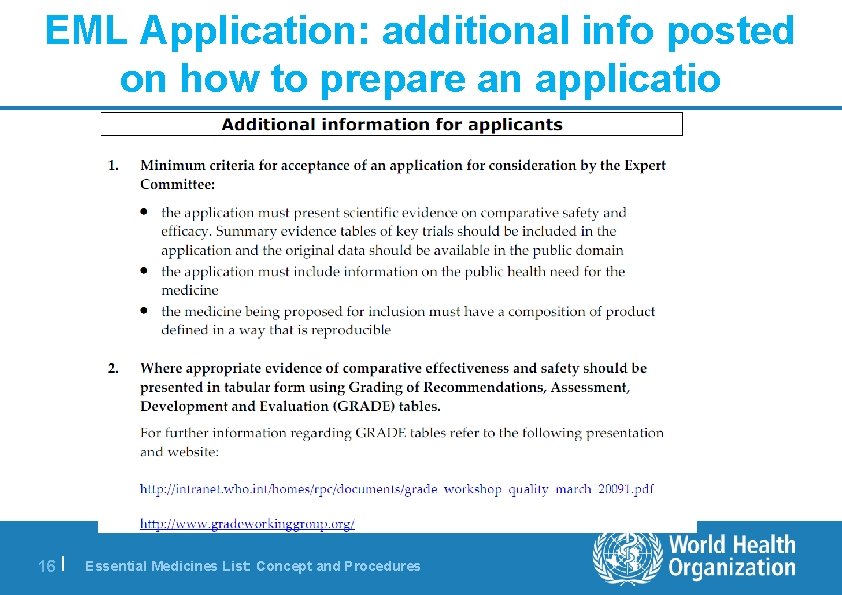
EML Application: additional info posted on how to prepare an applicatio 16 | Essential Medicines List: Concept and Procedures
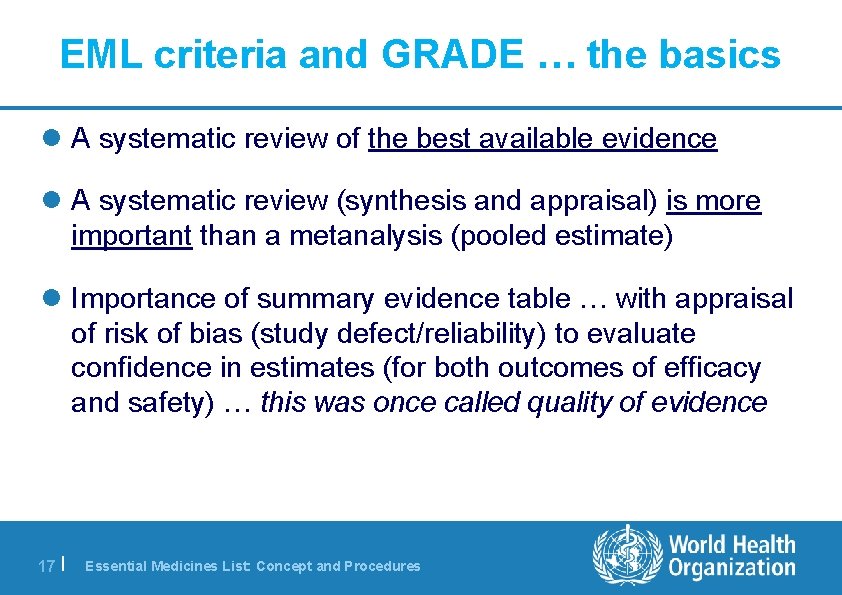
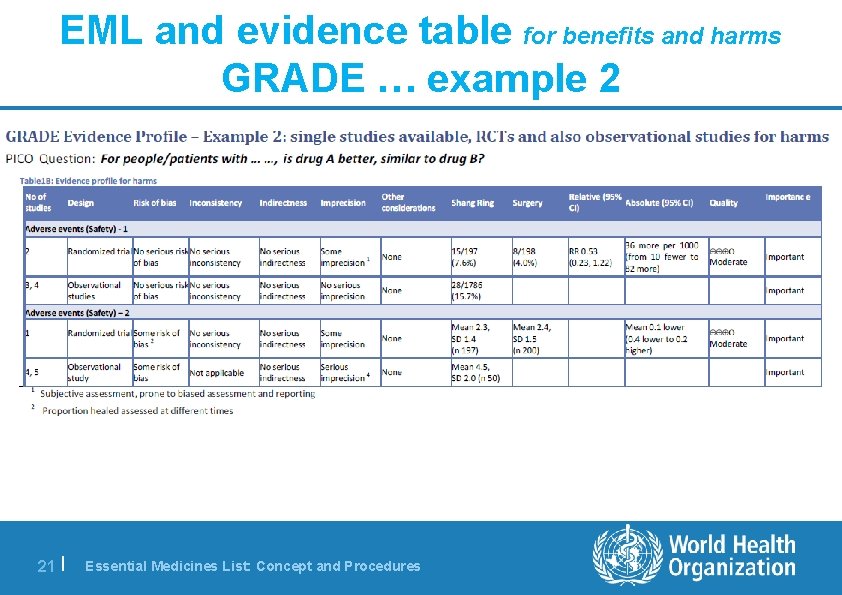
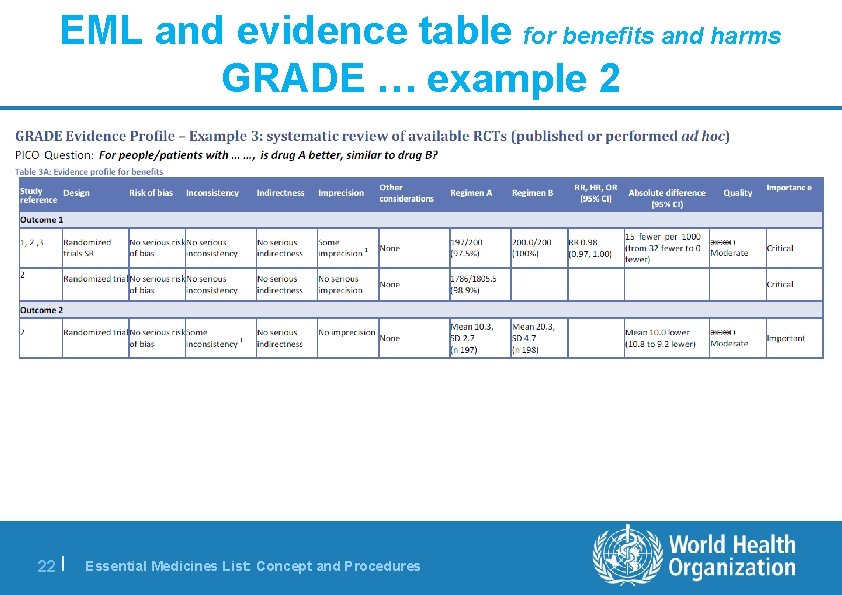
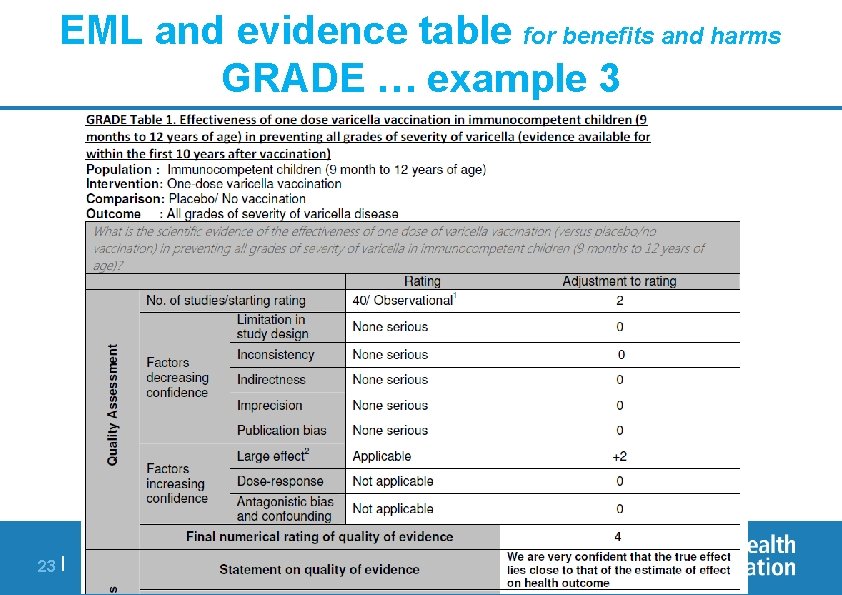
EML criteria and GRADE … the basics l A systematic review of the best available evidence l A systematic review (synthesis and appraisal) is more important than a metanalysis (pooled estimate) l Importance of summary evidence table … with appraisal of risk of bias (study defect/reliability) to evaluate confidence in estimates (for both outcomes of efficacy and safety) … this was once called quality of evidence 17 | Essential Medicines List: Concept and Procedures
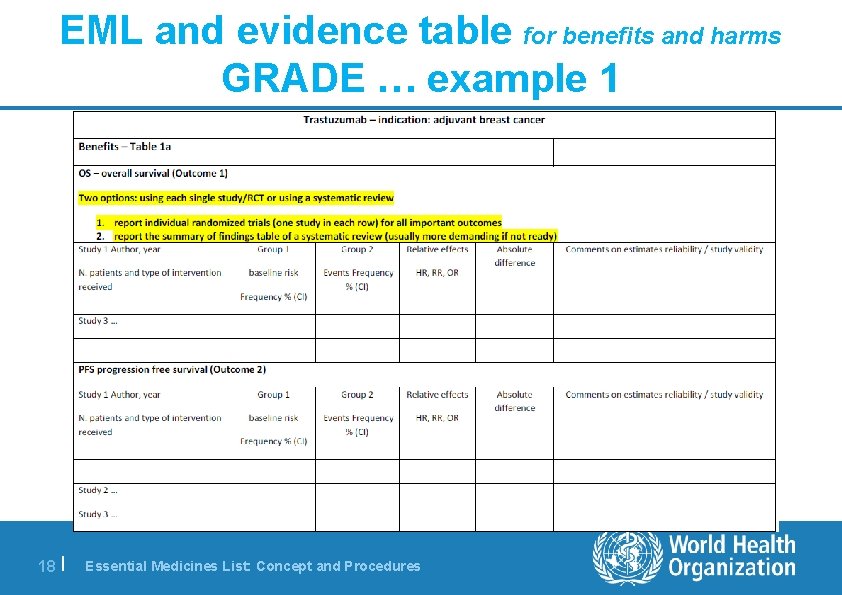
EML and evidence table for benefits and harms GRADE … example 1 18 | Essential Medicines List: Concept and Procedures
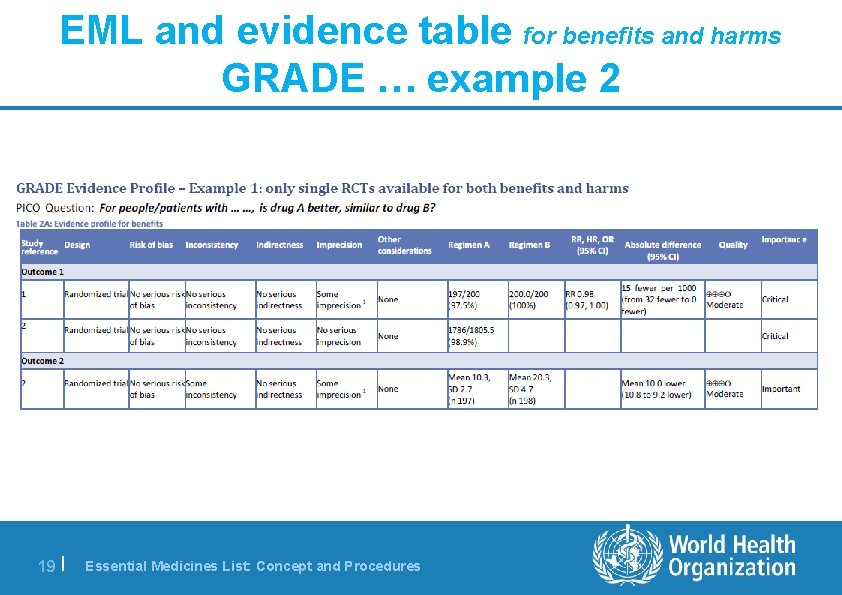
EML and evidence table for benefits and harms GRADE … example 2 19 | Essential Medicines List: Concept and Procedures
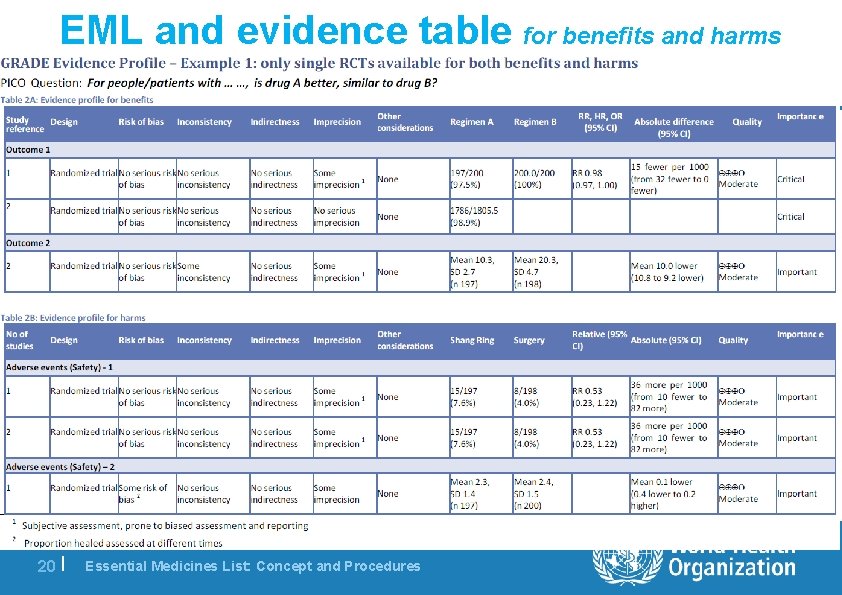
EML and evidence table for benefits and harms GRADE … example 2 20 | Essential Medicines List: Concept and Procedures
EML and evidence table for benefits and harms GRADE … example 2 21 | Essential Medicines List: Concept and Procedures
EML and evidence table for benefits and harms GRADE … example 2 22 | Essential Medicines List: Concept and Procedures
EML and evidence table for benefits and harms GRADE … example 3 23 | Essential Medicines List: Concept and Procedures
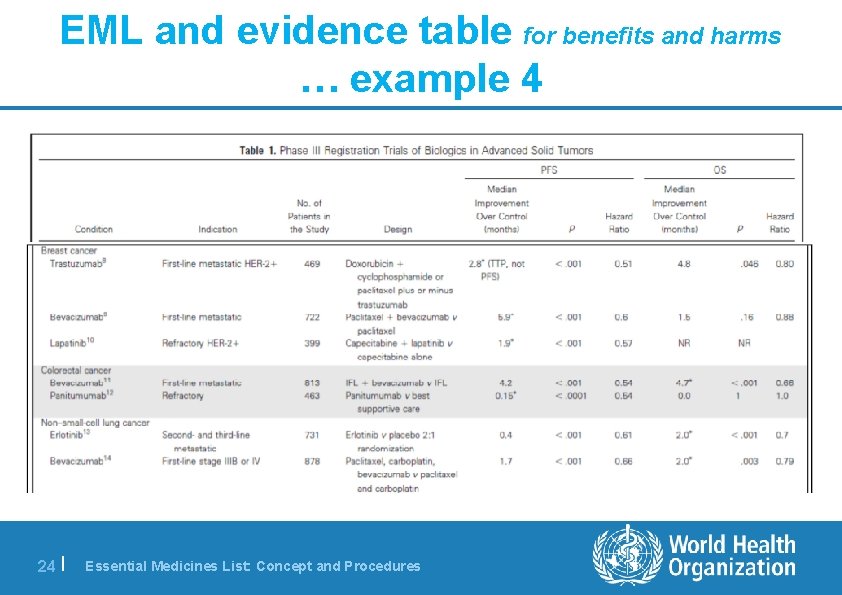
EML and evidence table for benefits and harms … example 4 24 | Essential Medicines List: Concept and Procedures
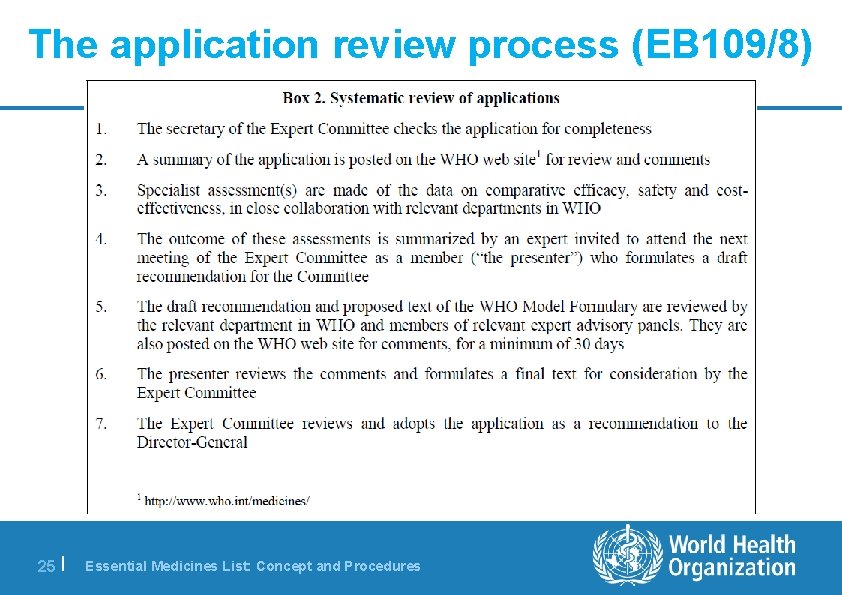
The application review process (EB 109/8) 25 | Essential Medicines List: Concept and Procedures
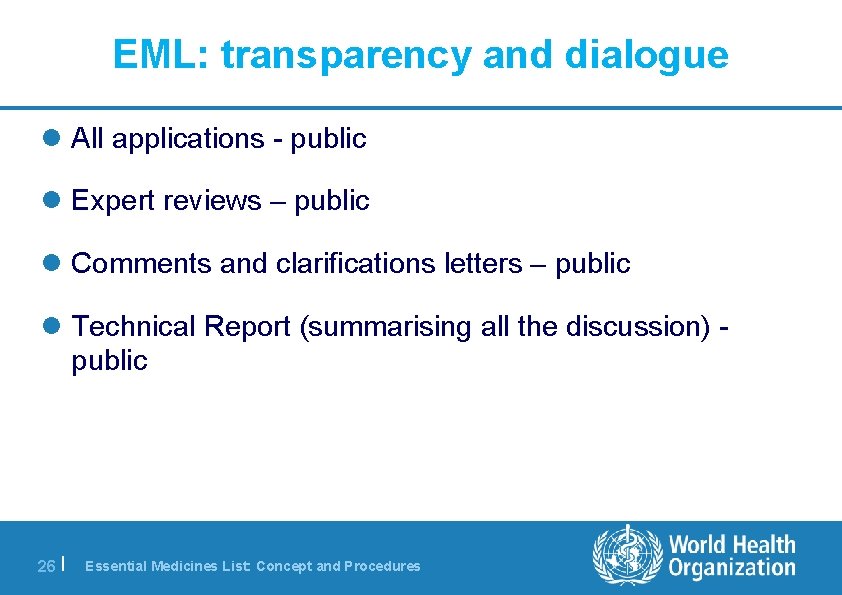
EML: transparency and dialogue l All applications - public l Expert reviews – public l Comments and clarifications letters – public l Technical Report (summarising all the discussion) public 26 | Essential Medicines List: Concept and Procedures
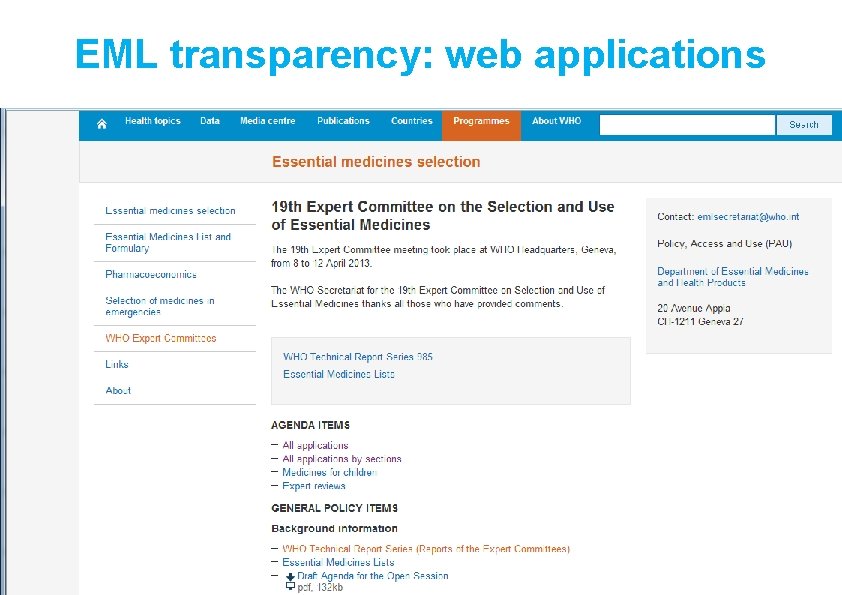
EML transparency: web applications 27 | Essential Medicines List: Concept and Procedures
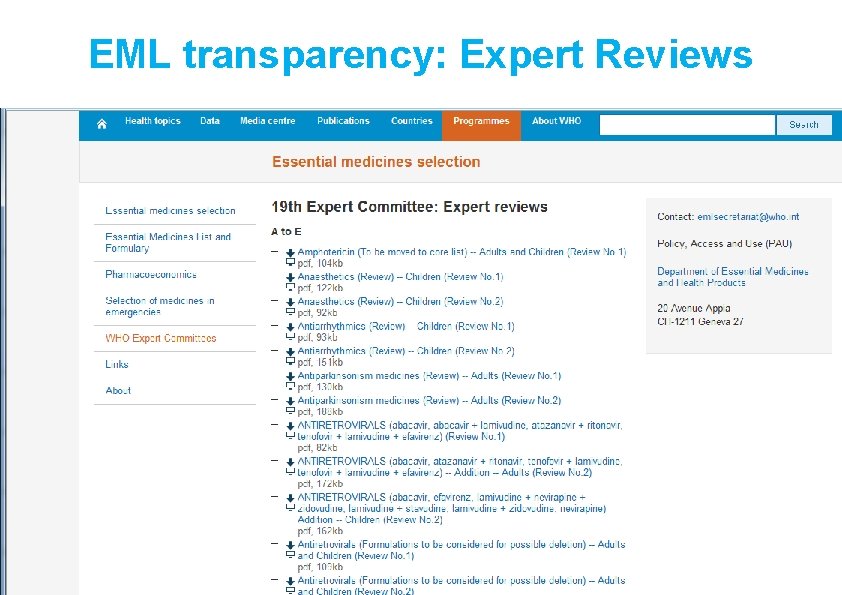
EML transparency: Expert Reviews 28 | Essential Medicines List: Concept and Procedures
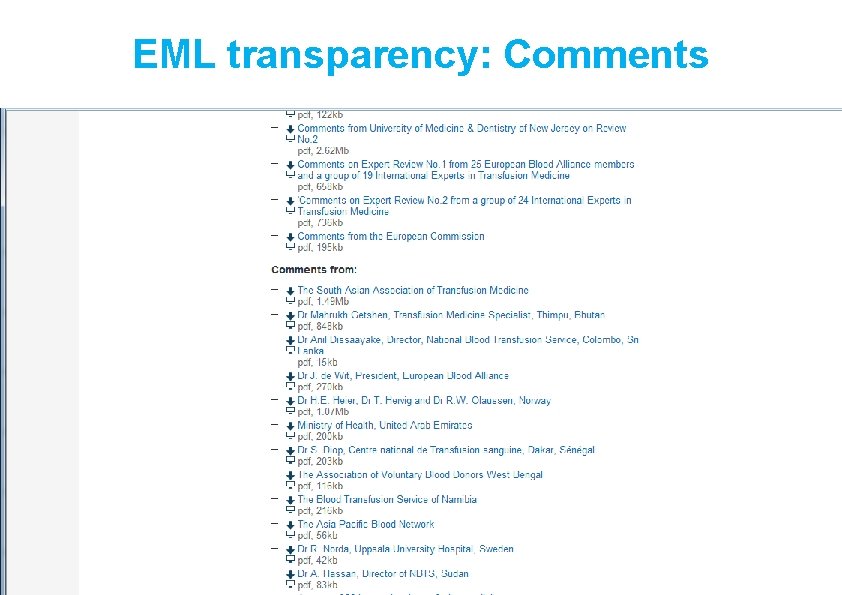
EML transparency: Comments 29 | Essential Medicines List: Concept and Procedures
EML criteria (EB 109/8, 2001) l Disease burden and public health need l Sound adequate data on the efficacy, safety and comparative cost-effectiveness of available treatments – Need for special diagnostic or treatment facilities considered l “Absolute cost of the treatment will not constitute a reason to exclude a medicine from the Model List that otherwise meets the stated selected criteria” 30 | Essential Medicines List: Concept and Procedures
EML 2015 A few big challenges 31 | Essential Medicines List: Concept and Procedures
Opportunity to improve EML updating When highly effective drugs are available l Cancer drugs: how to choose the few highly effective (patented, high cost) medicines (2 discussed in EML 2013: trastuzumab in breast cancer and imatinib in chronic myeloid leukemia). Other medicines: see next table, … l New HCV drugs (new direct antiviral, single agents and combinations, IFN free regimens) l TB large update l New anticoagulants: oral (NAC) and surely LMWH 32 | Essential Medicines List: Concept and Procedures
Opportunity to improve EML updating When highly effective drugs are available l Cancer drugs: how to choose the few highly effective (patented, high cost) medicines (2 discussed in EML 2013: trastuzumab in breast cancer and imatinib in chronic myeloid leukemia). Other medicines: see next table, … l New HCV drugs (new direct antiviral, single agents and combinations, IFN free regimens) l TB large update l New anticoagulants: oral (NAC) and surely LMWH 33 | Essential Medicines List: Concept and Procedures
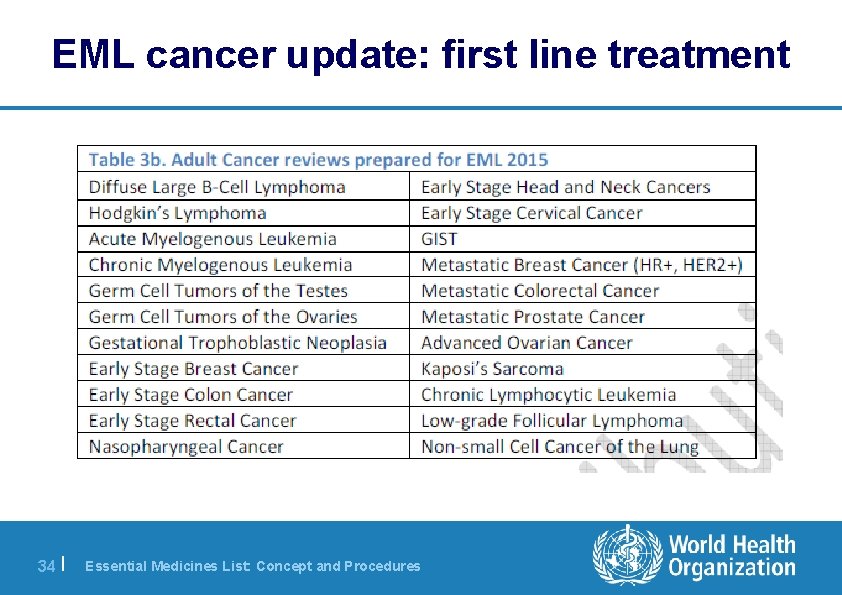
EML cancer update: first line treatment 34 | Essential Medicines List: Concept and Procedures
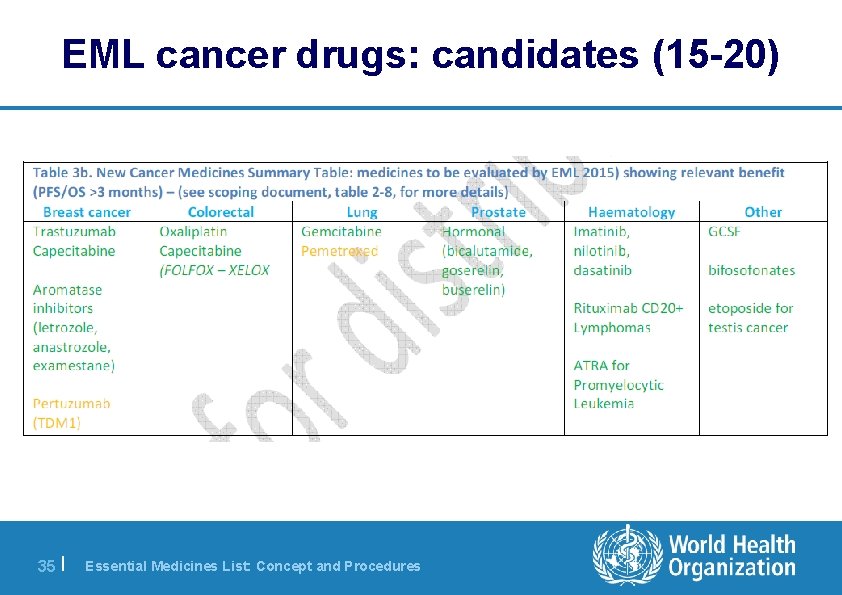
EML cancer drugs: candidates (15 -20) 35 | Essential Medicines List: Concept and Procedures
Opportunity to improve EML updating When highly effective drugs are available l Cancer drugs: how to choose the few highly effective (patented, high cost) medicines (2 discussed in EML 2013: trastuzumab in breast cancer and imatinib in chronic myeloid leukemia). Other medicines: see next table, … l New HCV drugs (new direct antiviral, single agents and combinations, IFN free regimens) l TB large update l New anticoagulants: oral (NAC) and surely LMWH 36 | Essential Medicines List: Concept and Procedures
EML and New Hep. C drugs l Very effective oral drugs (IFN free regimens) l A WHO GL with a strong recommendation l Sofosbuvir and Ledipasvit/sofosbuvir combination (already IN the applications) l What to di with financial implications l What to do with new drugs in the pipeline 37 | Essential Medicines List: Concept and Procedures
Opportunity to improve EML updating When highly effective drugs are available l Cancer drugs: how to choose the few highly effective (patented, high cost) medicines (2 discussed in EML 2013: trastuzumab in breast cancer and imatinib in chronic myeloid leukemia). Other medicines: see next table, … l New highly HCV drugs (new direct antiviral, single agents and combinations, IFN free regimens) l TB large update l New anticoagulants: oral (NAC) and surely LMWH 38 | Essential Medicines List: Concept and Procedures
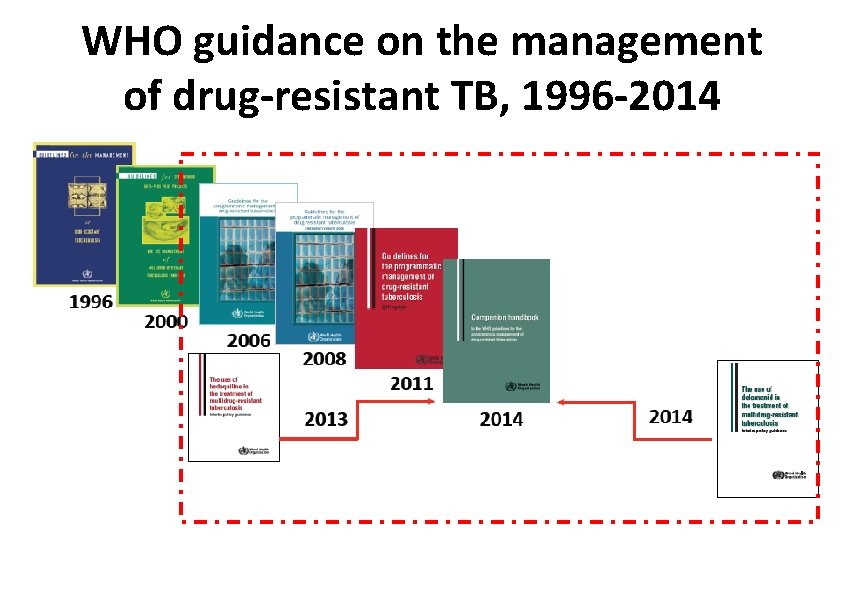
WHO guidance on the management of drug-resistant TB, 1996 -2014
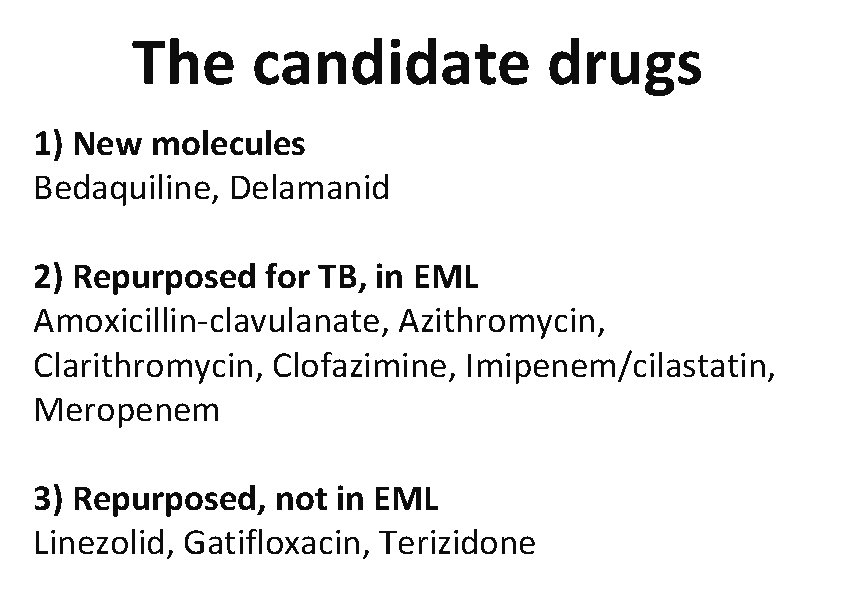
The candidate drugs 1) New molecules Bedaquiline, Delamanid 2) Repurposed for TB, in EML Amoxicillin-clavulanate, Azithromycin, Clarithromycin, Clofazimine, Imipenem/cilastatin, Meropenem 3) Repurposed, not in EML Linezolid, Gatifloxacin, Terizidone
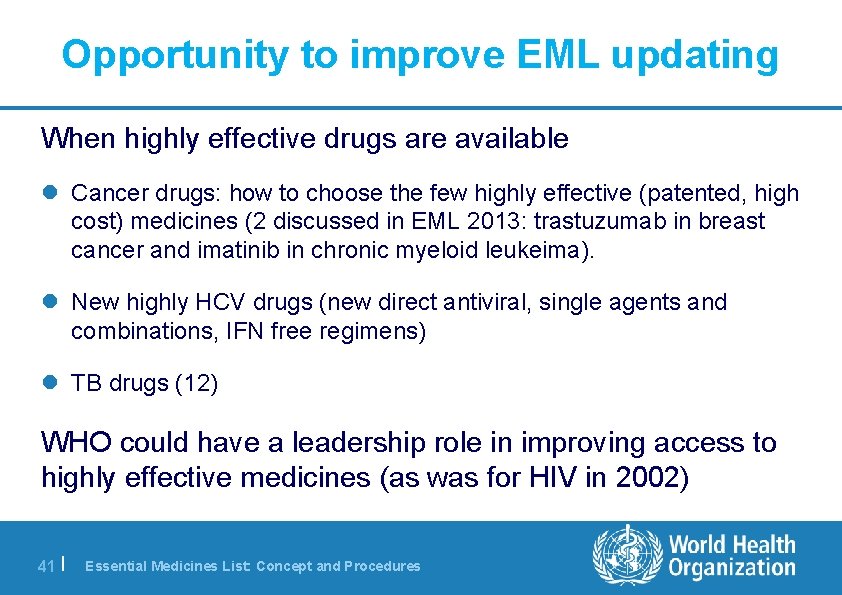
Opportunity to improve EML updating When highly effective drugs are available l Cancer drugs: how to choose the few highly effective (patented, high cost) medicines (2 discussed in EML 2013: trastuzumab in breast cancer and imatinib in chronic myeloid leukeima). l New highly HCV drugs (new direct antiviral, single agents and combinations, IFN free regimens) l TB drugs (12) WHO could have a leadership role in improving access to highly effective medicines (as was for HIV in 2002) 41 | Essential Medicines List: Concept and Procedures
EML timeline 42 | Essential Medicines List: Concept and Procedures
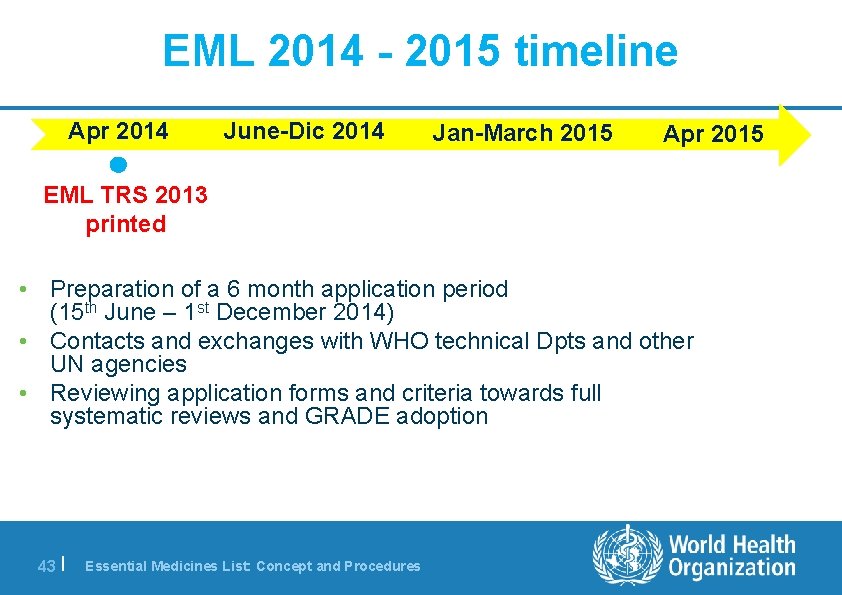
EML 2014 - 2015 timeline Apr 2014 June-Dic 2014 Jan-March 2015 Apr 2015 EML TRS 2013 printed • Preparation of a 6 month application period (15 th June – 1 st December 2014) • Contacts and exchanges with WHO technical Dpts and other UN agencies • Reviewing application forms and criteria towards full systematic reviews and GRADE adoption 43 | Essential Medicines List: Concept and Procedures
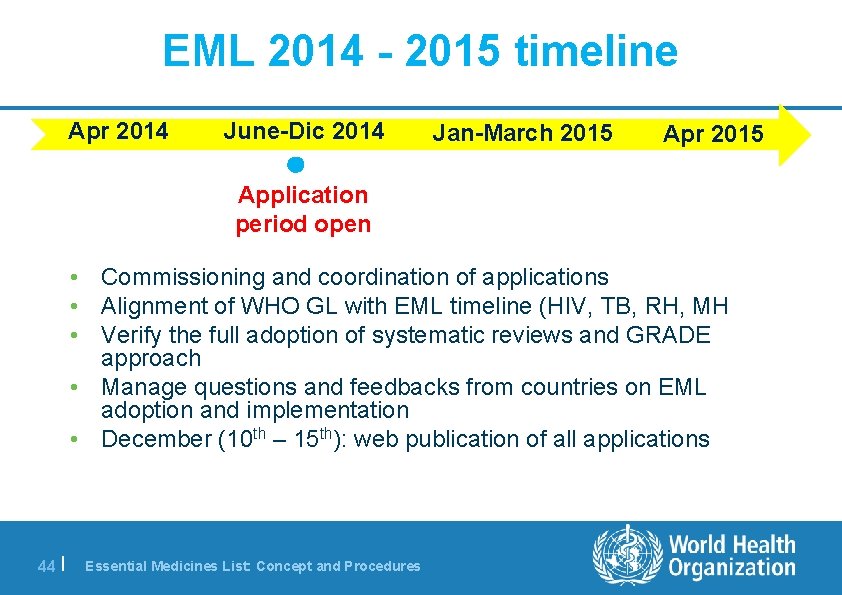
EML 2014 - 2015 timeline Apr 2014 June-Dic 2014 Jan-March 2015 Apr 2015 Application period open • Commissioning and coordination of applications • Alignment of WHO GL with EML timeline (HIV, TB, RH, MH • Verify the full adoption of systematic reviews and GRADE approach • Manage questions and feedbacks from countries on EML adoption and implementation • December (10 th – 15 th): web publication of all applications 44 | Essential Medicines List: Concept and Procedures
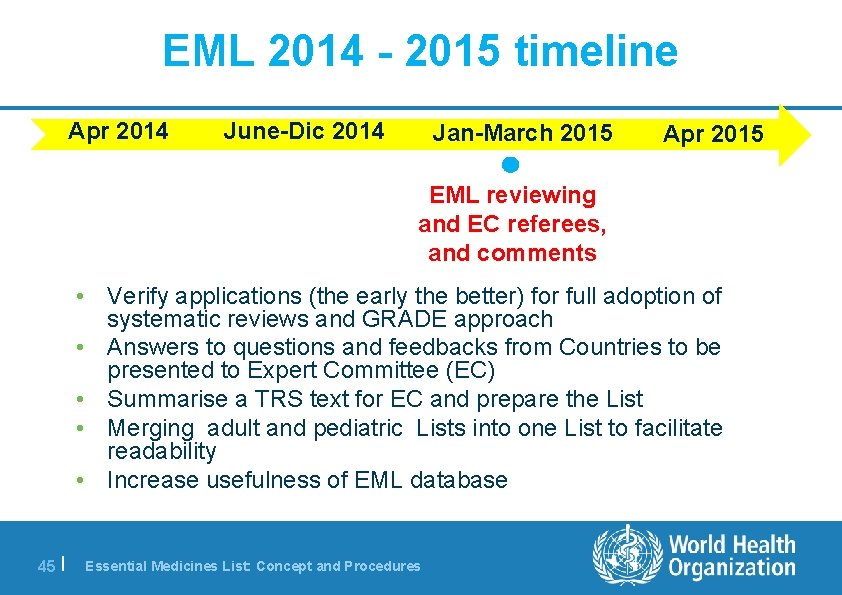
EML 2014 - 2015 timeline Apr 2014 June-Dic 2014 Jan-March 2015 Apr 2015 EML reviewing and EC referees, and comments • Verify applications (the early the better) for full adoption of systematic reviews and GRADE approach • Answers to questions and feedbacks from Countries to be presented to Expert Committee (EC) • Summarise a TRS text for EC and prepare the List • Merging adult and pediatric Lists into one List to facilitate readability • Increase usefulness of EML database 45 | Essential Medicines List: Concept and Procedures
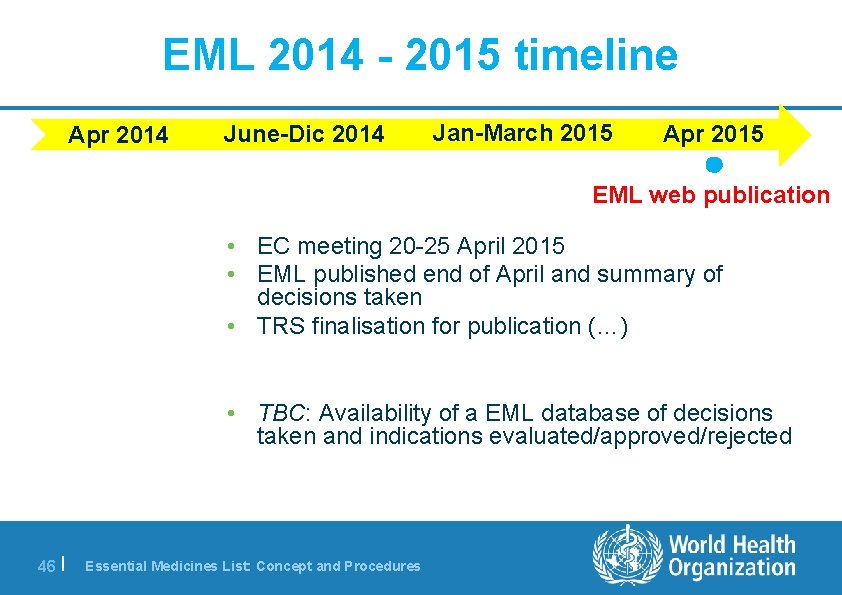
EML 2014 - 2015 timeline Apr 2014 June-Dic 2014 Jan-March 2015 Apr 2015 EML web publication • EC meeting 20 -25 April 2015 • EML published end of April and summary of decisions taken • TRS finalisation for publication (…) • TBC: Availability of a EML database of decisions taken and indications evaluated/approved/rejected 46 | Essential Medicines List: Concept and Procedures
WHAT ABOUT DEVICES IN EML? 47 | Essential Medicines List: Concept and Procedures
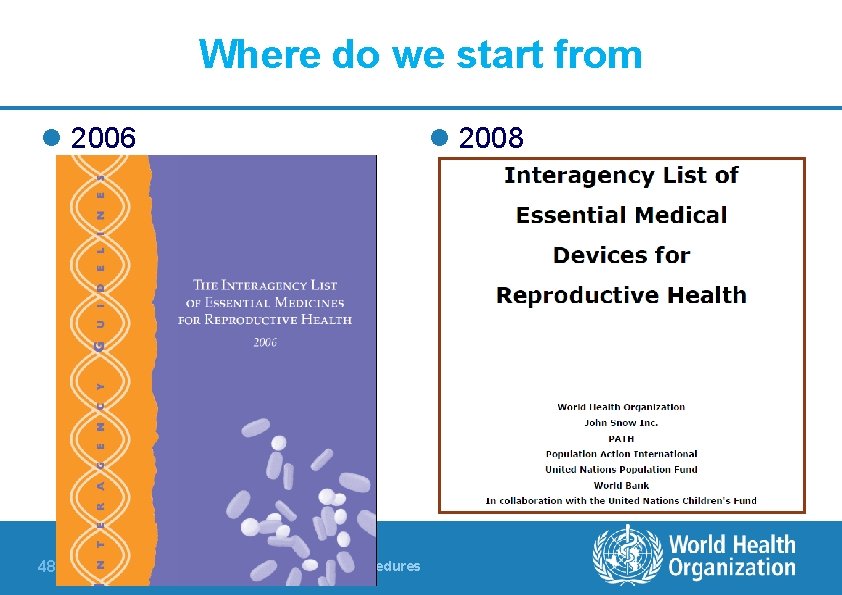
Where do we start from l 2006 48 | Essential Medicines List: Concept and Procedures l 2008
Just few devices are in EML l To strengthen a WHO policy (on contraception) l To be consistent across various WHO GL/documents l If apply, be supported by a WHO technical Dpt l Suggestion: first be in a WHO policy document or GL and then apply to EML (rather than the other way round) 49 | Essential Medicines List: Concept and Procedures
Conclusions l Application for EML will be opened soon and will remain open for 6 months l It is strongly encouraged to make an application connected with a WHO technical department l Frame your proposal within a WHO policy document/GL l Send it early enough to be reviewed l Expert Committee 2015 EML Meeting: April 2015 50 | Essential Medicines List: Concept and Procedures
51 | Essential Medicines List: Concept and Procedures
Rational drug therapy (RDT) Quality use of medicines Appropriate use of medicines Responsible and evidence-based use Access to essential medicines and implementation at country level 52 | Essential Medicines List: Concept and Procedures
Selection process 53 | Essential Medicines List: Concept and Procedures
EML: why a model? l A model for process and transparency l Evidence-based rigorous process: high scrutiny on quality of evidence AND on its applicability at a global level l Management of conflicts of interests l Feed backs from country implementation 54 | Essential Medicines List: Concept and Procedures
Access and appropriate use of medicines: issues and challenges – PUSH MODE l How to give access to the best available evidence – Full access to all available evidence – Understanding: critically appraised, highly scrutinised with multidisciplinary considerations – How? Are TRS report enough? Probably NOT … l Connection and good alignment with WHO guidelines – Examples from: OC, TB, HIV, Hep. C, Mental Health, … 55 | Essential Medicines List: Concept and Procedures
Access and appropriate use of medicines: issues and challenges – PULL MODE New drugs are introduced different from EML l EML in delay … important new drugs – LMWH – Cancer drugs – … l Drugs lacking good enough supporting evidence – Drugs for memory – … 56 | Essential Medicines List: Concept and Procedures
How to support good prescribing 57 | Essential Medicines List: Concept and Procedures
Two different level of action: one supporting the other 1. Access to available evidence – – Retrieval, systematic review, critical appraisal, synthesis and user-friendly presentation Understanding, applicability and relevance, 2. Guidelines and recommendation – 58 | Standard and conditional recommendation and indicators of use Essential Medicines List: Concept and Procedures
The importance of the context l Actual medicines use at local/national level l Access to available evidence l Guidelines and recommendations l Drug utilization data: international comparison, small and large area variability, … 59 | Essential Medicines List: Concept and Procedures
The importance of the context l Actual medicines use at local/national level l Access to available evidence l Guidelines and recommendations l Drug utilization data: international comparison, small and large area variability, … l The need for a comprehensive pharmaceutical policy: 60 | Essential Medicines List: Concept and Procedures
Pharmaceutical policy • By pharmaceutical policy we mean the conscious efforts of national governments to influence the pharmaceutical system
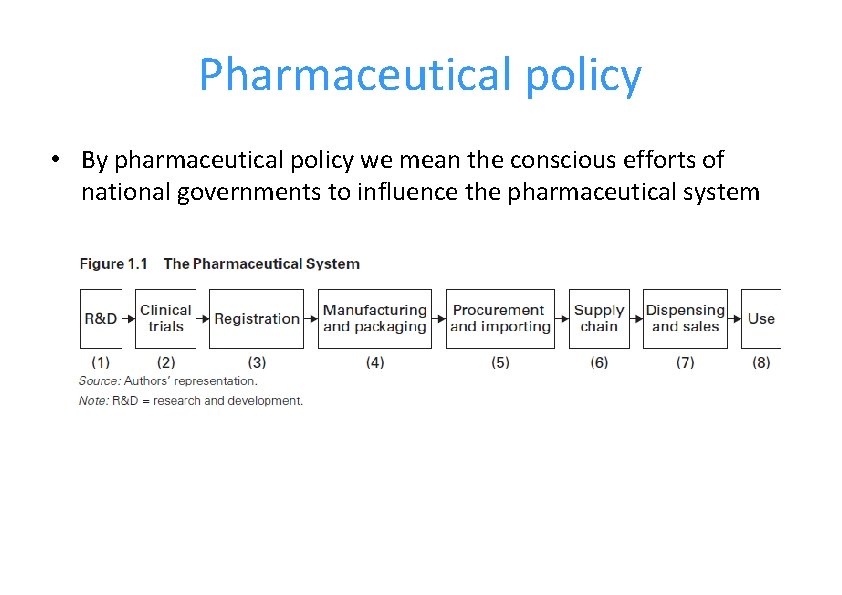
Pharmaceutical policy • By pharmaceutical policy we mean the conscious efforts of national governments to influence the pharmaceutical system
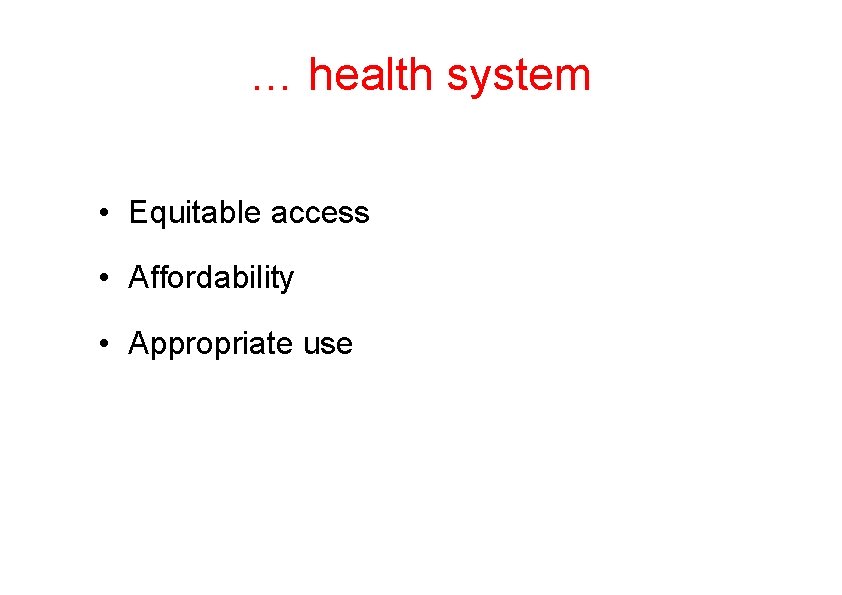
… health system • Equitable access • Affordability • Appropriate use
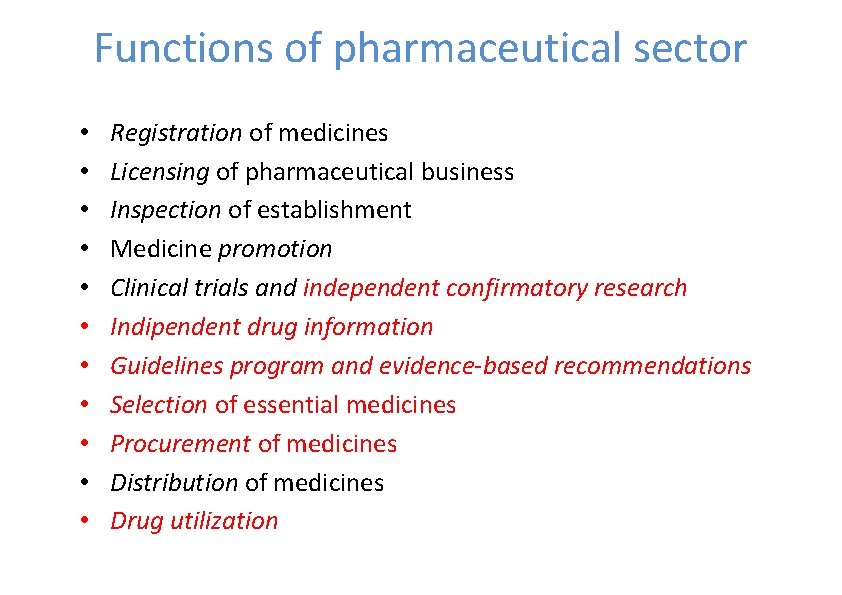
Functions of pharmaceutical sector • • • Registration of medicines Licensing of pharmaceutical business Inspection of establishment Medicine promotion Clinical trials and independent confirmatory research Indipendent drug information Guidelines program and evidence-based recommendations Selection of essential medicines Procurement of medicines Distribution of medicines Drug utilization
There is a difference • Independent drug bulletins • Cochrane reviews • Clinical Evidence • Uptodate • • Guidelines Recommendations Consensus conferences Inappropriate uses