
Who Did What Louis Pasteur Carolus Linnaeus Aristotle
- Slides: 19
Who Did What Louis Pasteur Carolus Linnaeus Aristotle Anton- Van. Leeuwenhoek Robert Hook Edward Jenner James Watson and Francis Crick Franceso Redi Rosalind Franklin Gregor Mendel Charles Darwin Jean Baptiste de Lamarck Matthias Schleiden and Theodor Schwann and Rudolf Virchow Alexander Fleming Zaccharias Janssen Joseph Lister James Lind
Chapter 14, Section 2 The Digestive Process Begins Pg. 486 The digestive system has 3 functions: 1) Breaks down food into molecules 2) Molecules are absorbed into the blood stream 3) Wastes are eliminated from the body
• Digestion is the process that breaks down food into small molecules so that they can be absorbed and moved into the blood. • Absorption is the process which nutrients pass through the wall of your digestive system into your blood.
There are two types of digestion • Mechanical digestion take place when food is chewed, mixed, and churned. • Chemical digestion occurs when chemical reactions occur that break down large molecules into smaller ones.
Organs of the Digestive System pathway of the digestive system • Mouth has both mechanical and chemical ways to help digest food. • Saliva is a chemical that helps break down food. • Teeth and tongue help mix and break down food.
• Enzyme is a type of protein that speeds up the rate of a chemical reactions in your body. • The epiglottis is a flap of tissue that seals off your windpipe.
• Esophagus is a tube that connects mouth to stomach. • Smooth muscles call peristalsis help move food downward with a squeezing action.
• The stomach uses both chemical and mechanical digestion. • The stomach is a muscular pouch located in the abdomen. • Hydrochloric acid is produced in the stomach. • Pepsin chemically digests the proteins in your food.
Section 3 Final Absorption and Digestion • The small intestine is where the absorption of food takes place. • Villi are finger like projections that allow nutrients to move into the blood stream.
• Your liver , gallbladder, and pancreas produce or store enzymes and chemicals that help break down food.
• Liver is the largest organ inside the body. Produces bile. • Bile breaks up fat particles. • Gallbladder stores bile.
• Large intestine - where water is absorbed from the undigested mass. This helps keep large amounts of water in your body and helps maintain homeostasis. • Rectum - at the end of the large intestine; material is compressed into solid form • Anus - muscular opening at the end of the rectum.
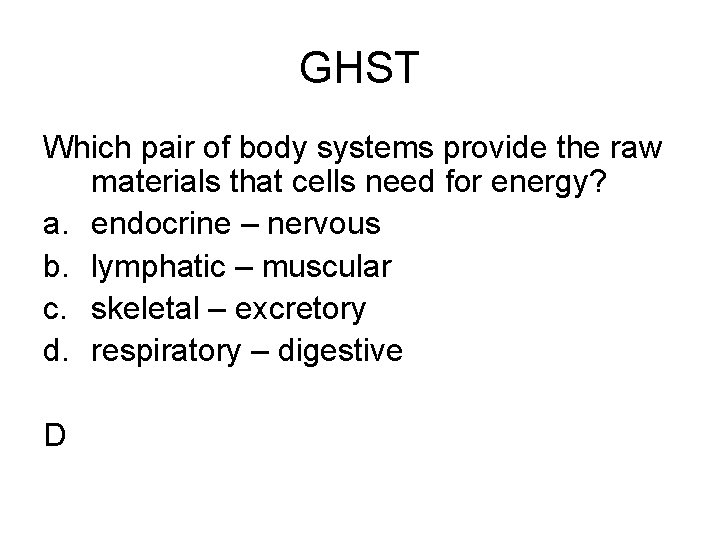
GHST Which pair of body systems provide the raw materials that cells need for energy? a. endocrine – nervous b. lymphatic – muscular c. skeletal – excretory d. respiratory – digestive D
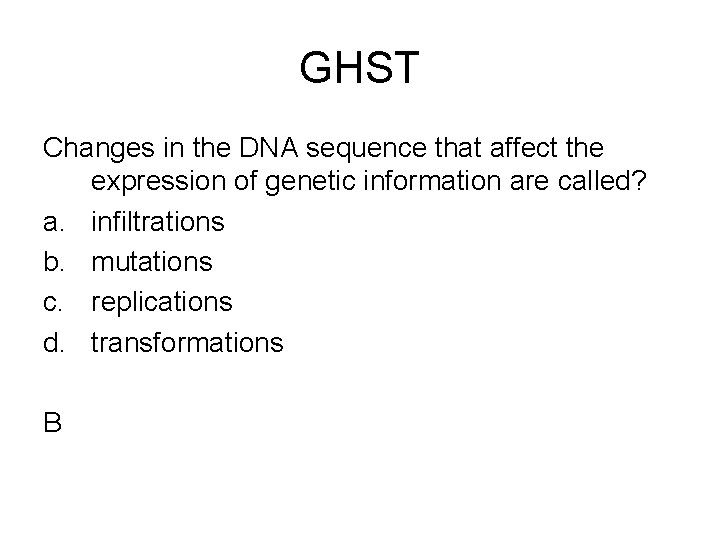
GHST Changes in the DNA sequence that affect the expression of genetic information are called? a. infiltrations b. mutations c. replications d. transformations B
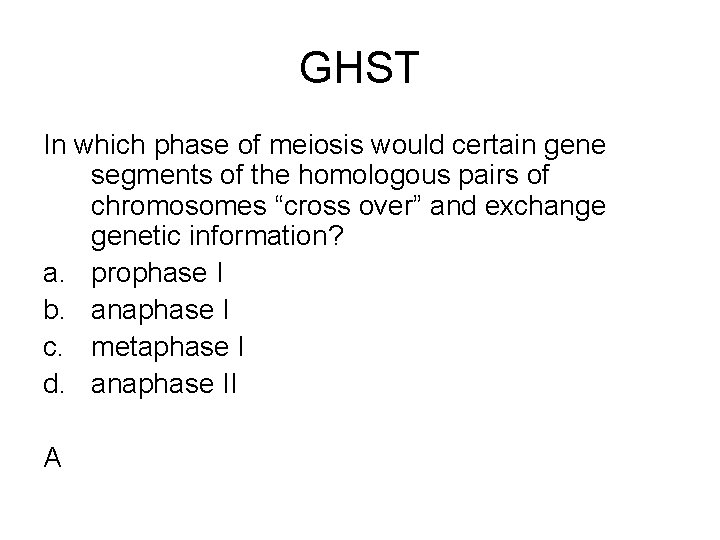
GHST In which phase of meiosis would certain gene segments of the homologous pairs of chromosomes “cross over” and exchange genetic information? a. prophase I b. anaphase I c. metaphase I d. anaphase II A
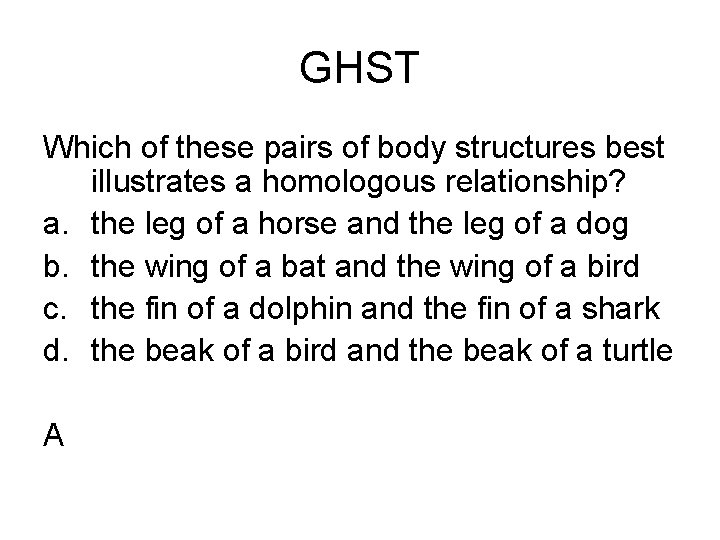
GHST Which of these pairs of body structures best illustrates a homologous relationship? a. the leg of a horse and the leg of a dog b. the wing of a bat and the wing of a bird c. the fin of a dolphin and the fin of a shark d. the beak of a bird and the beak of a turtle A
GHST A milk snake looks similar to the deadly coral snake. This is an example of ? a. warning coloration, adaptive radiation b. cryptic coloration c. mimicry d. warning coloration C
GHST Which nutrient cycle is most affected by the overuse of ammonia fertilizers on commercial farms, as well as by the accumulation of waste on cattle farms and feed lots? a. water b. carbon c. nitrogen d. phosphorus C
GHST Which type of reproduction is most advantageous for the production of a wide variety of different organisms? a. budding b. fragmentation c. binary fission d. sexual reproduction D