
Who buys local food why they buy and
Who buys “local” food, why they buy, and where they shop Farm Fresh Food Boxes USDA Grant 2016 -67023 -24853 June 28, 2019
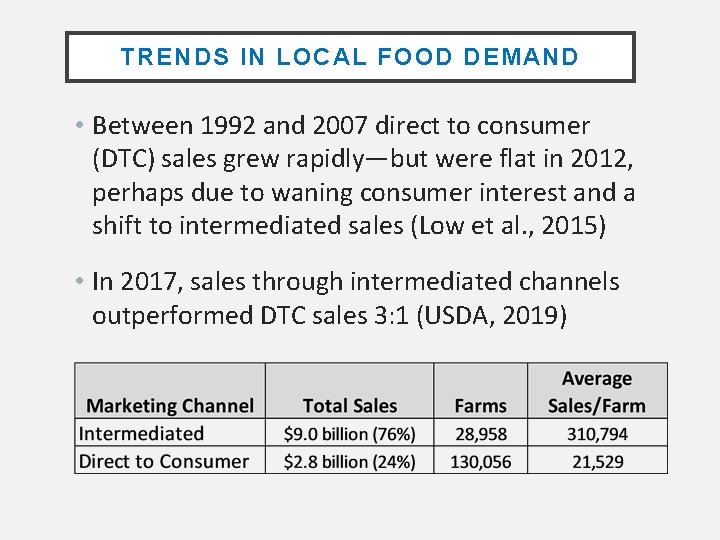
TRENDS IN LOCAL FOOD DEMAND • Between 1992 and 2007 direct to consumer (DTC) sales grew rapidly—but were flat in 2012, perhaps due to waning consumer interest and a shift to intermediated sales (Low et al. , 2015) • In 2017, sales through intermediated channels outperformed DTC sales 3: 1 (USDA, 2019)
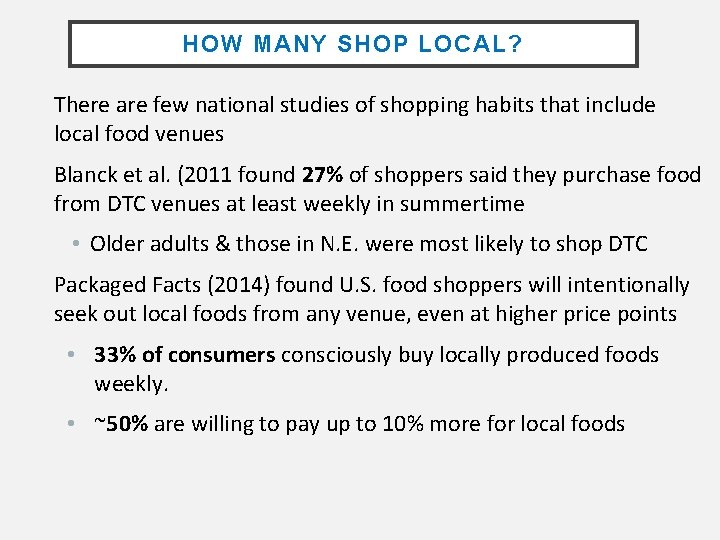
HOW MANY SHOP LOCAL? There are few national studies of shopping habits that include local food venues Blanck et al. (2011 found 27% of shoppers said they purchase food from DTC venues at least weekly in summertime • Older adults & those in N. E. were most likely to shop DTC Packaged Facts (2014) found U. S. food shoppers will intentionally seek out local foods from any venue, even at higher price points • 33% of consumers consciously buy locally produced foods weekly. • ~50% are willing to pay up to 10% more for local foods
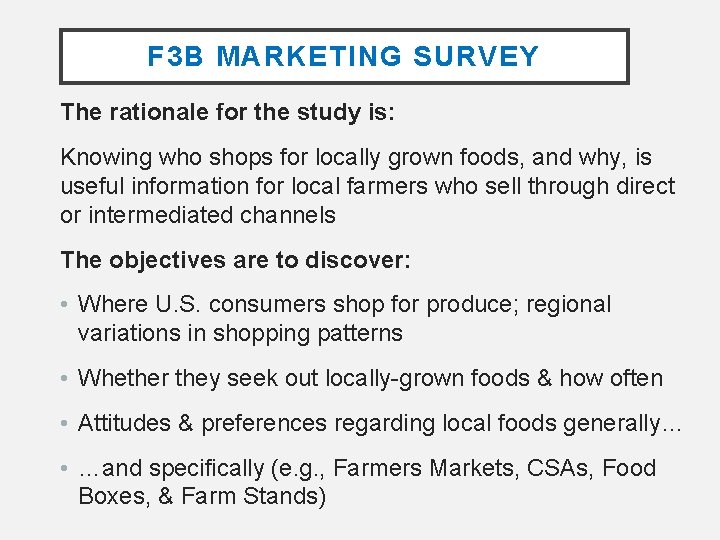
F 3 B MARKETING SURVEY The rationale for the study is: Knowing who shops for locally grown foods, and why, is useful information for local farmers who sell through direct or intermediated channels The objectives are to discover: • Where U. S. consumers shop for produce; regional variations in shopping patterns • Whether they seek out locally-grown foods & how often • Attitudes & preferences regarding local foods generally… • …and specifically (e. g. , Farmers Markets, CSAs, Food Boxes, & Farm Stands)
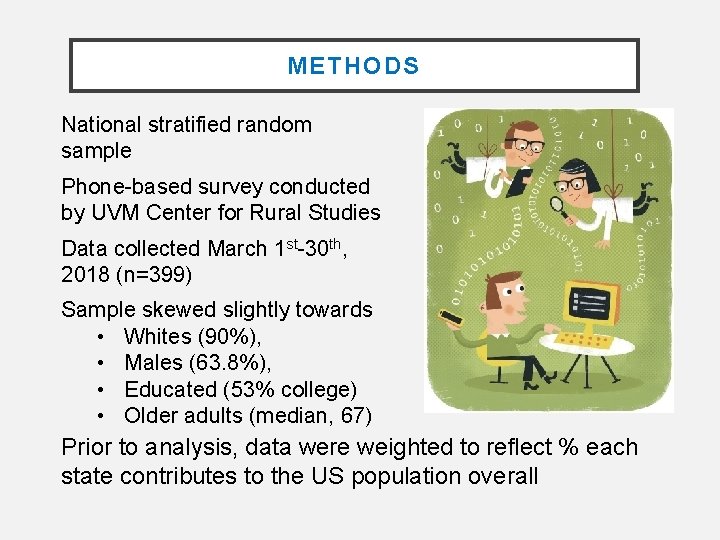
METHODS National stratified random sample Phone-based survey conducted by UVM Center for Rural Studies Data collected March 1 st-30 th, 2018 (n=399) Sample skewed slightly towards • Whites (90%), • Males (63. 8%), • Educated (53% college) • Older adults (median, 67) Prior to analysis, data were weighted to reflect % each state contributes to the US population overall
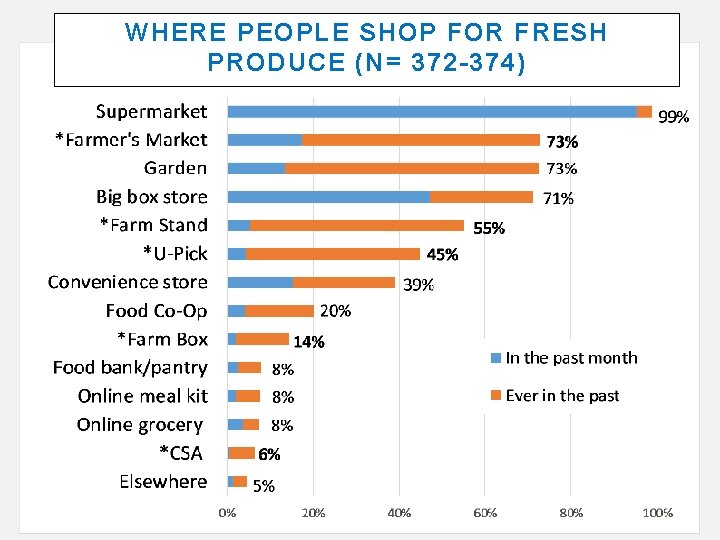
WHERE PEOPLE SHOP FOR FRESH PRODUCE (N= 372 -374)
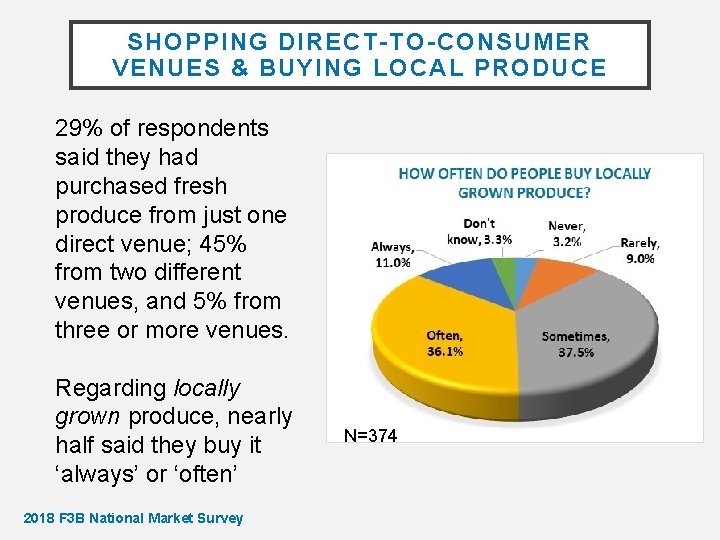
SHOPPING DIRECT-TO-CONSUMER VENUES & BUYING LOCAL PRODUCE 29% of respondents said they had purchased fresh produce from just one direct venue; 45% from two different venues, and 5% from three or more venues. Regarding locally grown produce, nearly half said they buy it ‘always’ or ‘often’ 2018 F 3 B National Market Survey N=374
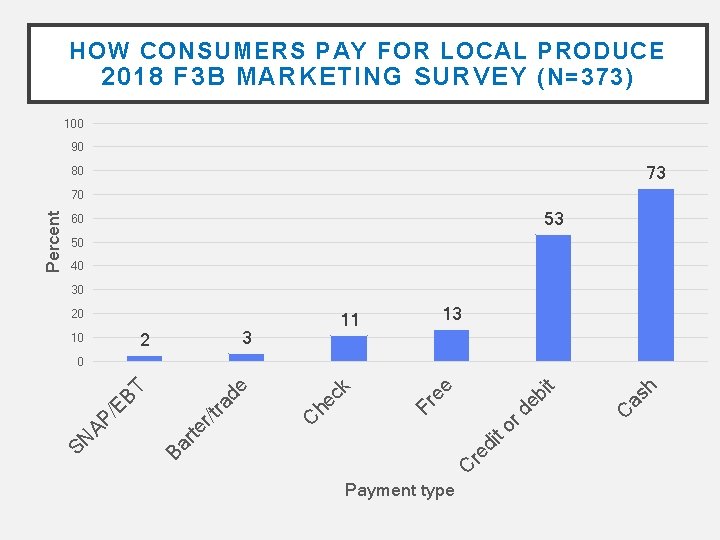
HOW CONSUMERS PAY FOR LOCAL PRODUCE 2018 F 3 B MARKETING SURVEY (N=373) 100 90 73 80 Percent 70 53 60 50 40 30 20 3 2 10 13 11 di t C re Payment type as h C or de b it ee Fr k he c C ra r/t Ba rte SN AP /E B T de 0
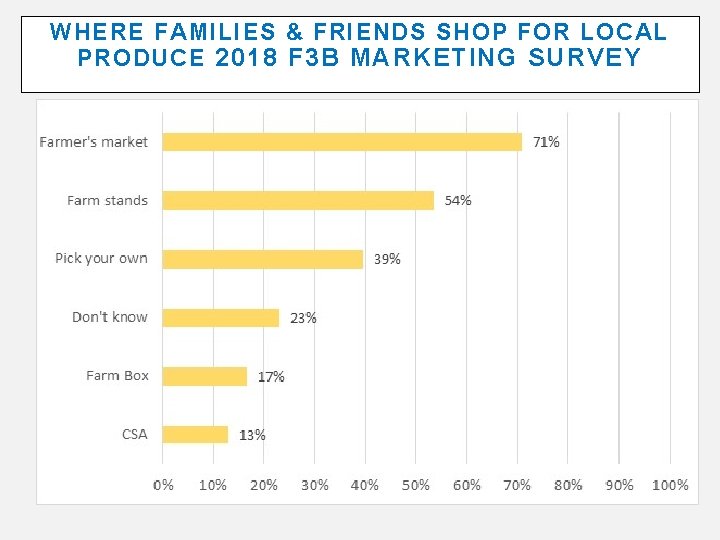
WHERE FAMILIES & FRIENDS SHOP FOR LOCAL PRODUCE 2018 F 3 B MARKETING SURVEY
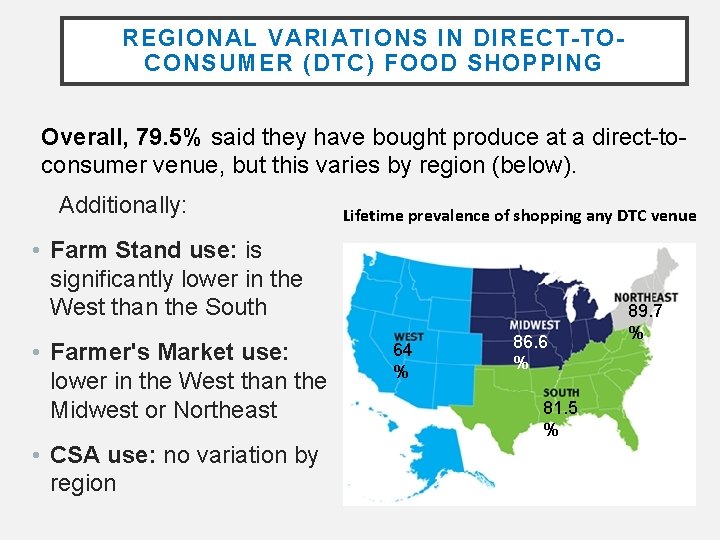
REGIONAL VARIATIONS IN DIRECT-TOCONSUMER (DTC) FOOD SHOPPING Overall, 79. 5% said they have bought produce at a direct-toconsumer venue, but this varies by region (below). Additionally: Lifetime prevalence of shopping any DTC venue • Farm Stand use: is significantly lower in the West than the South • Farmer's Market use: lower in the West than the Midwest or Northeast • CSA use: no variation by region 64 % 86. 6 % 81. 5 % 89. 7 %

REASONS TO BUY LOCAL PRODUCE F 3 B MARKETING SURVEY (N=350) 2018 F 3 B National Market Survey

DRAWBACKS TO BUYING LOCAL PRODUCE F 3 B MARKETING SURVEY (N=350) 2018 F 3 B National Market Survey
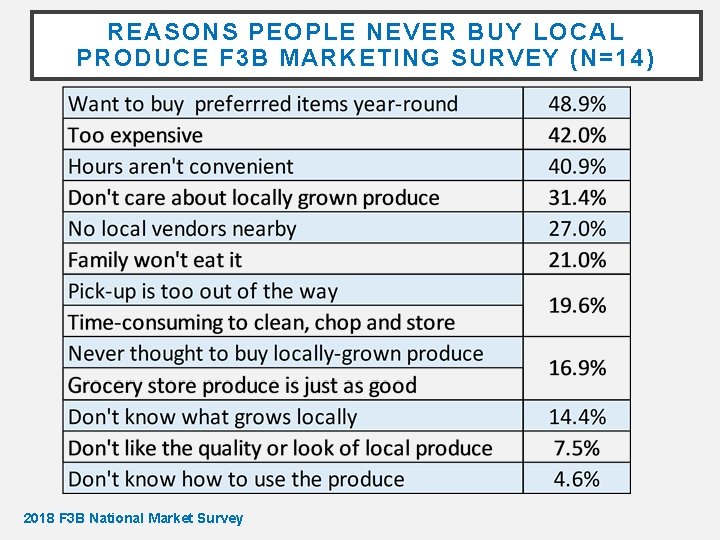
REASONS PEOPLE NEVER BUY LOCAL PRODUCE F 3 B MARKETING SURVEY (N=14) 2018 F 3 B National Market Survey
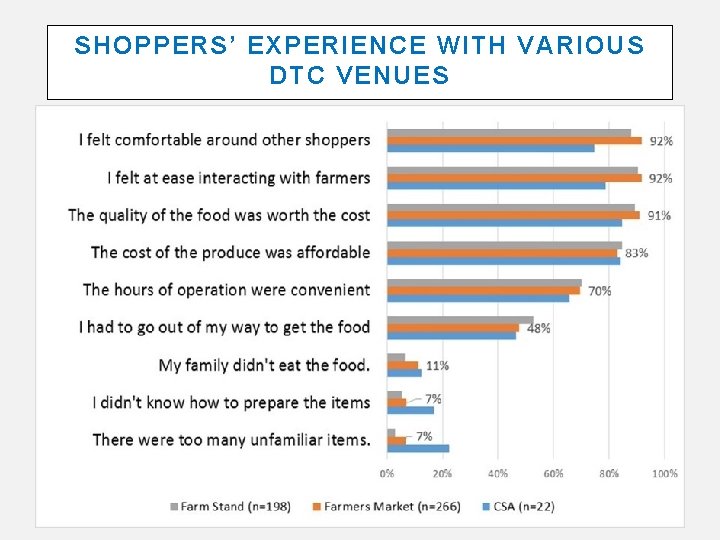
SHOPPERS’ EXPERIENCE WITH VARIOUS DTC VENUES
CONCLUSIONS • To our knowledge, this is the first national survey of U. S. consumers to estimate current and past DTC shopping behaviors by market channel • Lifetime prevalence of DTC shopping overall is high (79. 1%). An 2005 AL statewide survey found similarly high prevalence. • Untapped markets may exist in the Western region, particularly for Farmers Markets and Farm Stands. • Freshness, taste and concern for farmers and local economies are top motivators for shopping DTC markets • Inconvenience and seasonality are barriers to
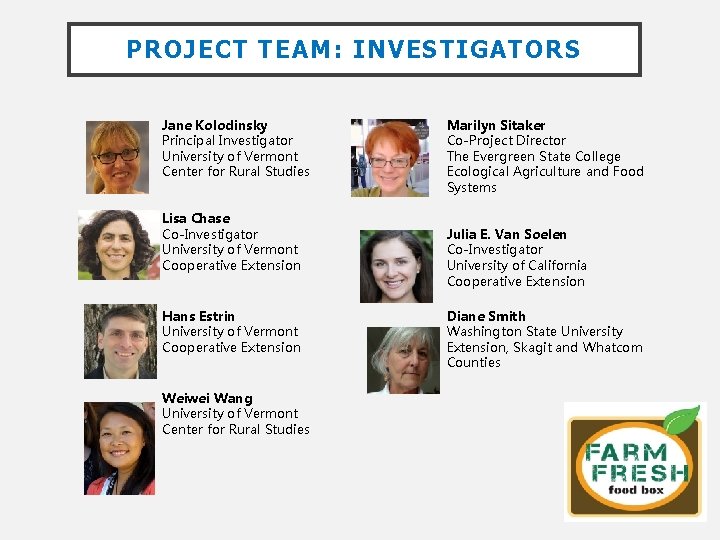
PROJECT TEAM: INVESTIGATORS Jane Kolodinsky Principal Investigator University of Vermont Center for Rural Studies Lisa Chase Co-Investigator University of Vermont Cooperative Extension Hans Estrin University of Vermont Cooperative Extension Marilyn Sitaker Co-Project Director The Evergreen State College Ecological Agriculture and Food Systems Julia E. Van Soelen Co-Investigator University of California Cooperative Extension Diane Smith Washington State University Extension, Skagit and Whatcom Counties Weiwei Wang University of Vermont Center for Rural Studies 1 0
ACKNOWLEDGEMENTS This work is supported by Innovation for Rural Entrepreneurs and Communities project no. VT-0075 CG from the USDA National Institute of Food and Agriculture.
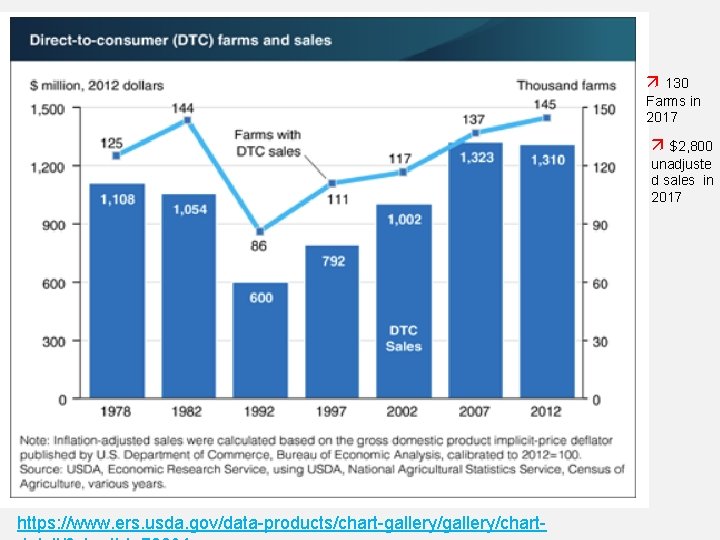
130 Farms in 2017 $2, 800 unadjuste d sales in 2017 https: //www. ers. usda. gov/data-products/chart-gallery/chart-
- Slides: 18