
Who builds stronger than a mason a shipwright

“Who builds stronger than a mason, a shipwright, or a carpenter? ” “A grave-maker”
V, i – the Graveyard Scene Purpose: - chance to have some relief before the last shattering scene - Clown/Gravedigger character is completely detached from other characters/plot lines in the play (last chance at comic relief before the tragic final scene) - Hamlet’s “princely” character revealed for the last time (relaxed, good, generous)
“How the knave jowls it to the ground, as if it were Cain’s jawbone, that did the first murder!” - Echoes back to Genesis reference of Cain and Able (compared with King Hamlet and Claudius…the first murder)
…and how old is Hamlet? Gravedigger, “This skull has lain in the earth three-and-twenty years. ” Hamlet, “Alas, poor Yorick! I knew him, Horatio, a fellow of infinite jest, of most excellent fancy. He hath borne me on his back a thousand times”
“That skull had a tongue in • Hamlet is addressing it, and could sing/ once. death, remembering his How the knave jowls it to childhood mere hours the ground, as if ‘twere/ before his own death – Cain’s jawbone, that did the does this signal that first murder! This might be/ Hamlet knows he is the pate of a politician, doomed? which this ass now o’erreaches; / one that would circumvent God, might it not? ” (5. 1. 71 -75)
• Hamlet, “Why may not imagination trace the noble dust of Alexander till he find it stopping a bunghole? ” • we think ourselves important while we’re alive, be we all wind up in the same place…remember Hamlet talking about the worms eating Polonius? {Death and Decay}
Whose Funeral? • For charitable prayers shards, flints and pebbles should be thrown on her. Yet here she is allowed her virgin crants, her maiden strewments, and the bringing home of bell and burial. Leartes, “Lay her i' th' earth, And from her fair and unpolluted flesh May violets spring!” Violets - Faithfulness
Laertes, “Now pile your dust upon the quick and dead, Till of this flat a mountain you have made, T' o'ertop old Pelion or the skyish head Of blue Olympus. ” (Mt. Olympus - home to the gods, giants piled Mt. Ossa on top of Mt. Pelion to climb to heaven)
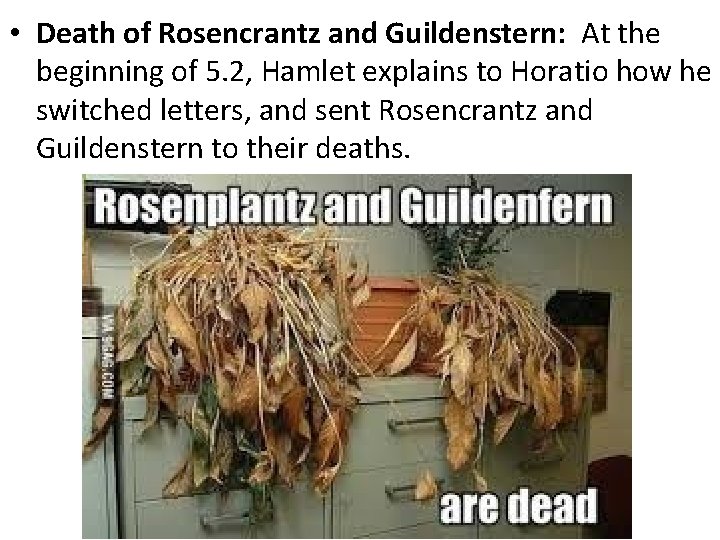
• Death of Rosencrantz and Guildenstern: At the beginning of 5. 2, Hamlet explains to Horatio how he switched letters, and sent Rosencrantz and Guildenstern to their deaths.
• Of his actions, Hamlet says “They are not near my conscience” (5. 2. 58). • Are we to interpret Hamelt as a cold-hearted accomplice to murder here, or are we to see Hamlet as an administrator of “just desserts”? Hamlet himself says “Their defeat/ Does by their own insinuation grow” (5. 2. 58 -59).
V, ii Does it not, think thee, • Killed his father and stand me now upon— married his mother, (old news) but…. He that hath killed my king and whored my mother, • Hamlet outright says Popped in between th' Claudius took the election and my hopes, throne that should have been his.

V, ii “But I am very sorry, good • Hamlet feels remorse Horatio, for acting so erratically when he confronted That to Laertes I forgot Laertes in the cemetery. myself, • Hamlet realizes, in a For by the image of my rational moment of cause I see clarity, that his situation The portraiture of his. I’ll is very similar to court his favors. ” (80 -83) Laertes…he failed to mention he is at fault.
• Multiple Deaths: In a span of 67 lines, beginning at Gertrude’s drink of “the poison’d cup” (5. 2. 282), four key characters die: Gertrude, then Claudius, then Laertes, then Hamlet. • Does this seem rushed or does it seem like quality theatrics? • Why would Shakespeare compress so much action – and so much death – into such a short space? • Is this ‘death scene’ a problem in the play, or the expected result of a complicated plot populated with complicated characters?
Horatio’s Parting Words: When Hamlet dies, Horatio articulates a brief, yet powerful farewell: Now cracks a noble heart. Good night, sweet prince, And flights of angels sing thee to thy rest. (5. 2. 349 -50) • In what ways is the language of sleep an appropriate farewell for Hamlet?
Fortinbras: Fortinbras is a minor character in the play, yet he reappears at the end of the play and his is the final speech of Hamlet. • What does Shakespeare achieve by having this militaristic leader appear at the end of the play? (For example: Is Fortinbras a symbol of stabilization or destabilization in Denmark? )
- Slides: 16