
Who attended the Philadelphia Convention How was it


- Slides: 36
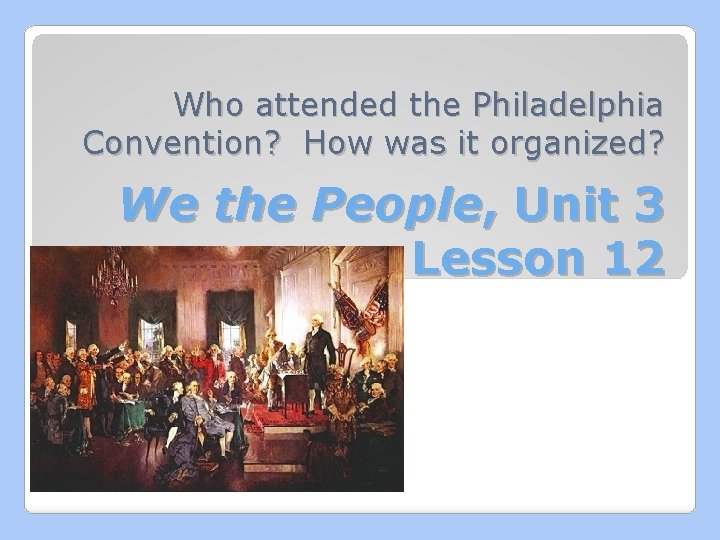
Who attended the Philadelphia Convention? How was it organized? We the People, Unit 3 Lesson 12
�Philadelphia Convention (or, Constitutional Convention): 1787 meeting in Philadelphia at which delegates wrote the Constitution �Framers: The 55 men who attended the Philadelphia Convention & wrote the Constitution ◦ James Madison (“Father of the Constitution”) ◦ George Washington ◦ Benjamin Franklin ◦ Gouverneur Morris Who Attended the Philadelphia Convention?
�Thomas Jefferson (in France) �John Adams (in England) �Patrick Henry (said, “I smell a rat”) �Women �African-Americans or Native Americans �Poor whites �Rhode Island delegates Who Didn’t Attend the Philadelphia Convention?
� 1. Constitutional government (with limits) � 2. Locke’s purpose of government: protect people’s rights & promote common good � 3. A strong national government was needed � 4. Republican (representative) form of government � 5. Separation of powers/checks & balances What ideas of gov’t went into the new constitution?
Why specifically did many feel the Constitution was an improvement over the Articles of Confederation? Why did some oppose it? HOMEWORK
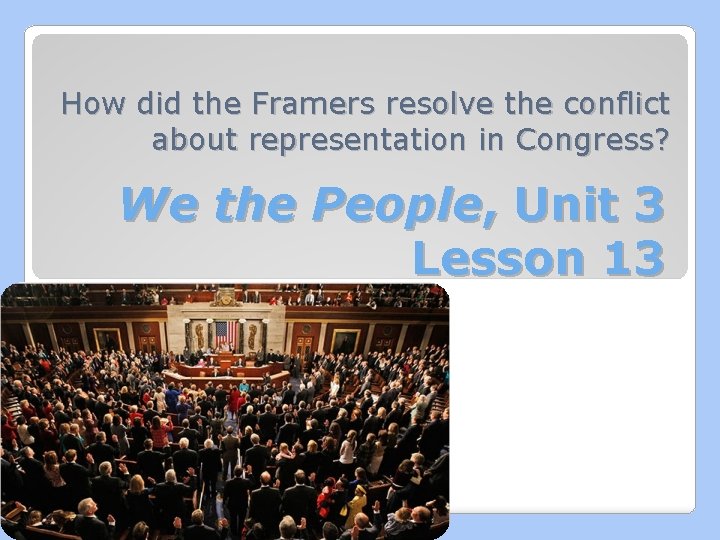
How did the Framers resolve the conflict about representation in Congress? We the People, Unit 3 Lesson 13
�Equal representation: Each state gets an equal number of votes in Congress ◦ Favored by small states �Proportional representation: Each state gets votes based on its population ◦ Favored by large states What conflicts existed about representation?
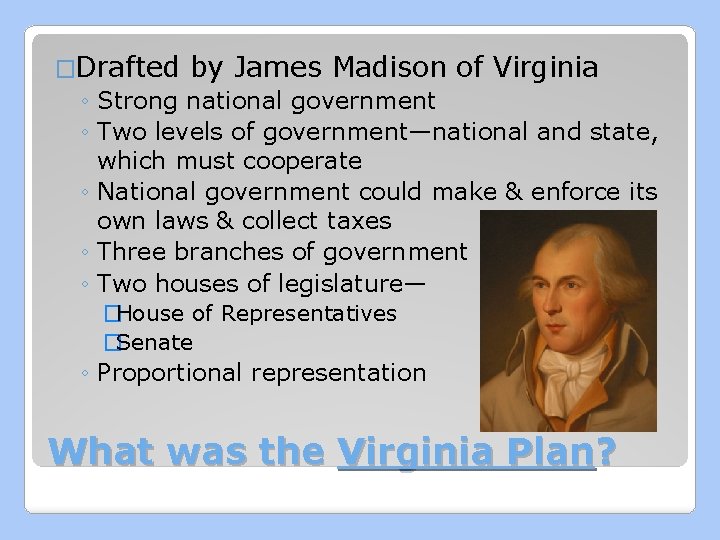
�Drafted by James Madison of Virginia ◦ Strong national government ◦ Two levels of government—national and state, which must cooperate ◦ National government could make & enforce its own laws & collect taxes ◦ Three branches of government ◦ Two houses of legislature— �House of Representatives �Senate ◦ Proportional representation What was the Virginia Plan?
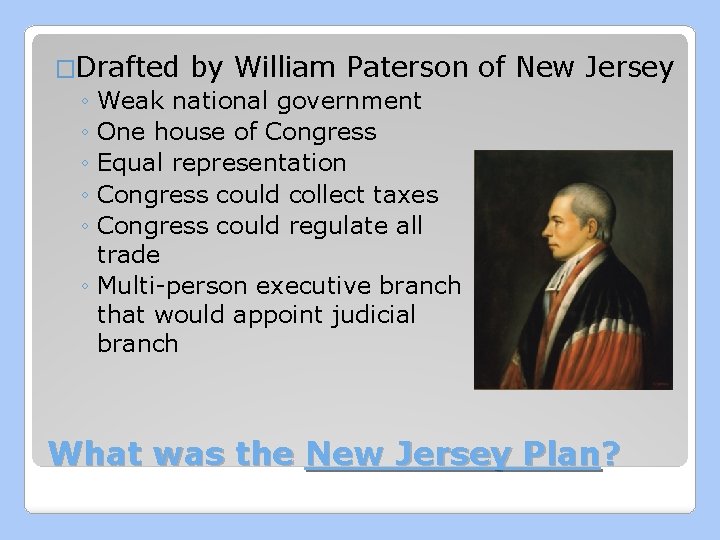
�Drafted by William Paterson ◦ Weak national government ◦ One house of Congress ◦ Equal representation ◦ Congress could collect taxes ◦ Congress could regulate all trade ◦ Multi-person executive branch that would appoint judicial branch of New Jersey What was the New Jersey Plan?
�Great Compromise (or, Connecticut Compromise): ◦ Congress has two houses ◦ House of Representatives membership is based on proportional representation �House comes up with all spending & tax bills ◦ Senate membership based on equal representation �Senate accepts or rejects spending & tax bills Great Compromise
�U. S. Congressional districts �California Congressional districts � 2012 election results
Why did large states want proportional representation? Why did small states want equal representation? How did both get what they wanted? HOMEWORK
How did the Framers resolve the conflict between Northern & Southern states? We the People, Unit 3 Lesson 14
�Tariff: A tax on goods imported from other nations, used to increase the price of foreign goods ◦ Northerners wanted tariffs on British goods so Northern goods would look cheaper ◦ Southerners did not want tariffs; this would increase the cost of foreign goods they needed and might lead to retribution by Britain Tariffs
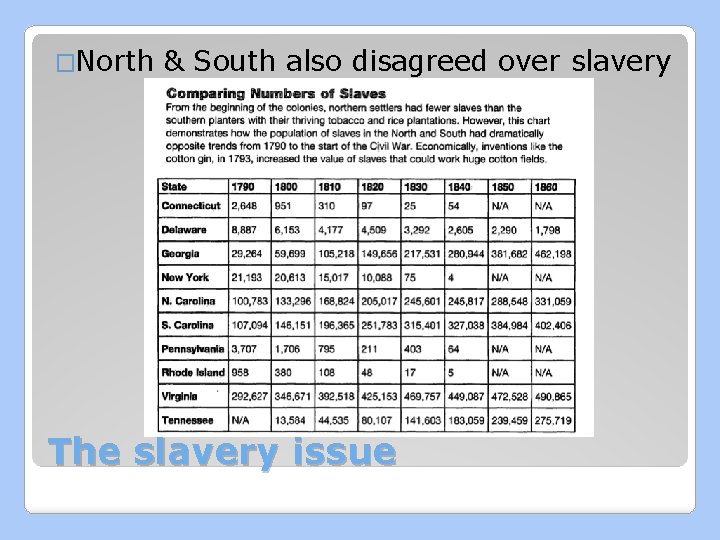
�North & South also disagreed over slavery The slavery issue
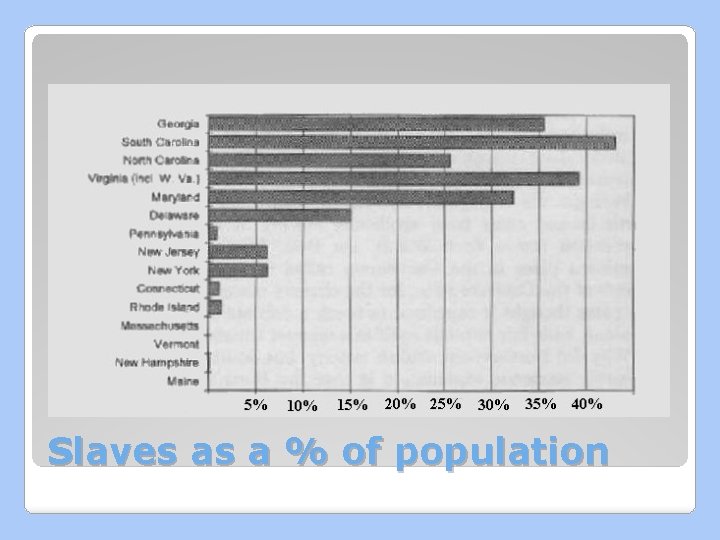
Slaves as a % of population
�FOR THE NORTH: ◦ Congress got the power to place tariffs on foreign goods and to regulate interstate & foreign trade �FOR THE SOUTH: ◦ 1. Congress could not end slave importation before 1808 ◦ 2. Three-fifths clause: Representation in Congress, and taxation, would be based on all free persons, indentured servants, and 3/5 of all slaves ◦ 3. Fugitive slave clause: Runaway slaves must be returned to their masters Compromise on tariffs & slavery
Effect of the 3/5 ths clause on state voting power in Congress
Who do you think “won” the compromise between North & South? Why specifically? HOMEWORK
How did the Framers resolve the conflict about powers of the legislative branch? We the People, Unit 3 Lesson 15
�You attend a camp or retreat. As you enter the camp, you see this sign. Rules: Be a good person. Do what’s right. Don’t do what’s wrong. �Can you think of a problem with this? Imagine this…
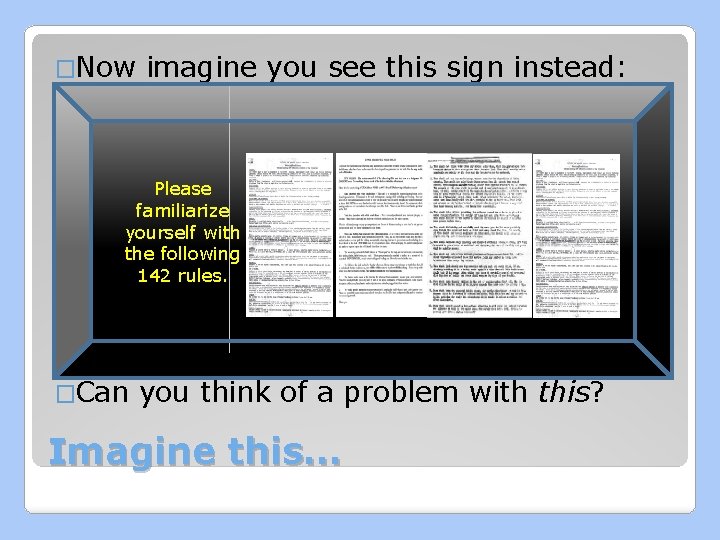
�Now imagine you see this sign instead: Please familiarize yourself with the following 142 rules. �Can you think of a problem with this? Imagine this…
�Key idea: Give Congress enough power to protect the people’s rights, but not enough to endanger their rights. �Enumerated powers: Powers specifically given to Congress by the Constitution— ◦ impose taxes & duties ◦ borrow $$ ◦ regulate (oversee and control) commerce & trade ◦ coin $$ ◦ establish post offices ◦ declare war ◦ raise & support army & navy Giving power to Congress
�Congress also has general powers under Article I, Section 8: ◦ General welfare clause: Congress shall “provide for the common Defense and general Welfare of the United States” ◦ Necessary and proper clause: Congress may “make all Laws which shall be necessary and proper” for carrying out its other powers Giving power to Congress
�Congress may not— ◦ ban the slave trade before 1808 ◦ suspend the writ of habeas corpus (a court order requiring a person to be present before a judge to determine if the detention is lawful) unless in a state of emergency ◦ pass ex post facto laws, laws that make something a crime though it was legal at the time ◦ pass bills of attainder, a legislative act that declares a person guilty & sets punishment without a trial Limiting powers of Congress
�Congress may not— ◦ tax any state exports ◦ take $$ from treasury without passing a law to do so ◦ grant titles of nobility �The Supreme Court may declare a law Congress passed is unconstitutional, not permitted by the Constitution. Limiting powers of Congress
�Uncle Jay Explains Congress
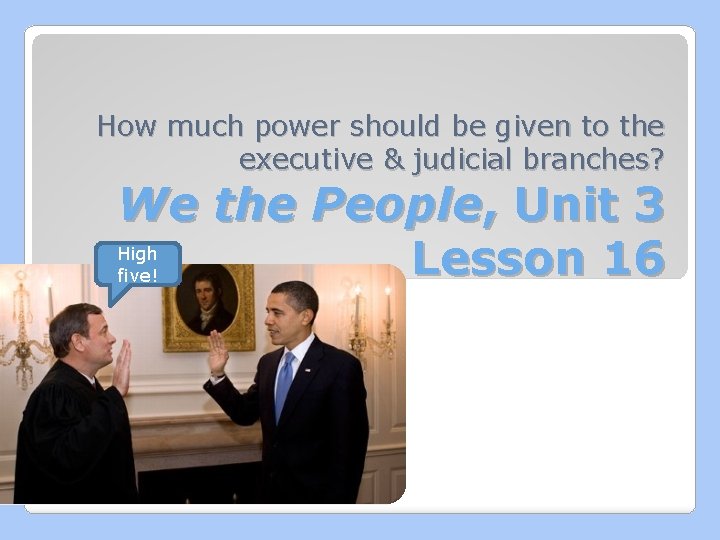
How much power should be given to the executive & judicial branches? We the People, Unit 3 Lesson 16 High five!
�Key idea: Give the executive enough power to carry out his duties, but not enough to overpower the other branches or endanger the people’s rights �The president may— ◦ carry out and enforce Congress’s laws ◦ make treaties with foreign nations ◦ appoint certain government officials ◦ act as commander-in-chief of the armed forces ◦ veto Congress’s laws ◦ send & receive ambassadors ◦ pardon criminals Executive duties/powers (Article II)
�Article II also limits the president. ◦ The president may nominate people for important jobs only with the advice and consent (review & approval) of Senate ◦ Senate may approve or reject the president’s treaties ◦ President may conduct war, but only Congress may declare war or raise $$ for it ◦ Congress may override a president’s veto ◦ President may be impeached (brought to a formal trial) by Congress Executive limitations (Article II)
�Twenty-Second Amendment: 1951 amendment that stated the president could only be reelected once �Electoral college: Group of presidential electors who gather every 4 years to cast votes for president & vice-president ◦ Each state has a number of electors equal to its senators + representatives. �If no candidate gets a majority, the House of Representatives selects the president ◦ This happened twice Selecting the executive
�Electoral �Electoral map map map as of 2014 - 2012 election – 2012, adjusted – 2000 election – 1984 election Electoral maps
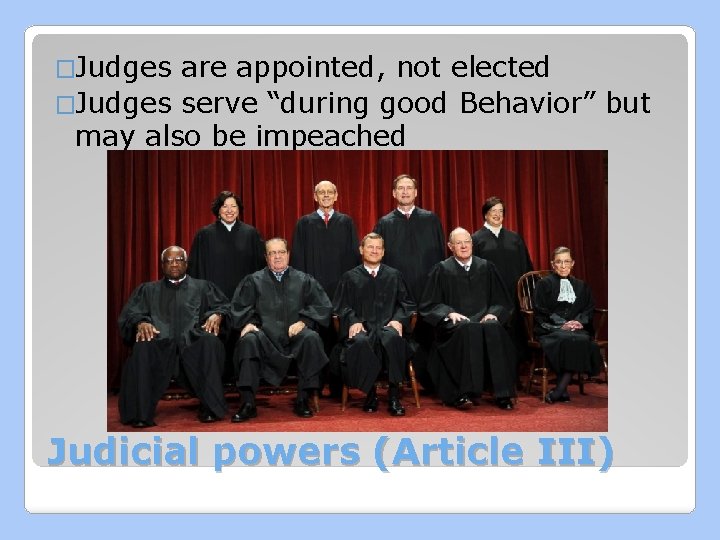
�Judges are appointed, not elected �Judges serve “during good Behavior” but may also be impeached Judicial powers (Article III)
�We have one Supreme Court with two kinds of jurisdiction (power to hear cases and make decisions) ◦ 1. Original jurisdiction means these cases go directly to the Supreme Court: �The Supreme Court has original jurisdiction only in cases involving state governments or a U. S. ambassador ◦ 2. In all other cases, the Supreme Court has appellate jurisdiction (the case is tried in a lower court & then may be appealed up) Judicial powers (Article III)
� 3 Branches of Government
Explain FULLY, to the best of your ability, how the three branches of our government can check and balance each other. Be specific. HOMEWORK