
Who Are Students with the Most Significant Cognitive
- Slides: 23
Who Are Students with the Most Significant Cognitive Disabilities? February 15, 2017
Global Meet Reminders • Participation Options: Chat Box (lower left) - “public” Q&A (upper right) - “private” • Dialogue: – – General in nature Constructive Short and concise Public/recorded
Webinar Overview • • • History of the 1% Rule Every Student Succeeds Act (ESSA) The Most Significant Cognitive Disabilities Implications for Standards and Assessment What Happens Next?
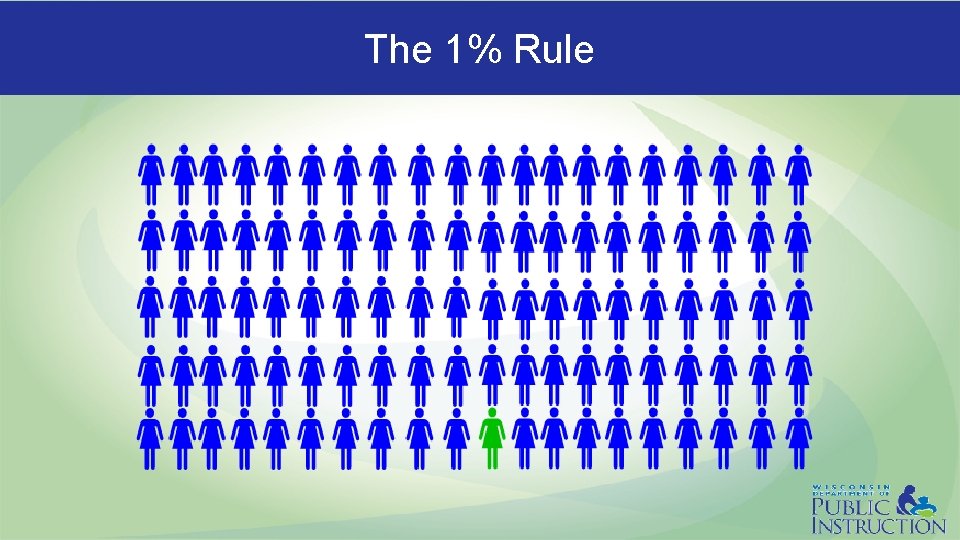
The 1% Rule The 1% Participation Rule
History of the 1% Rule Previous regulations focused on the percent of students who could score proficient/advanced on the alternate assessment and count as such for accountability purposes. Under ESSA, States are now limited to the percentage of students who may participate in an alternate assessment.
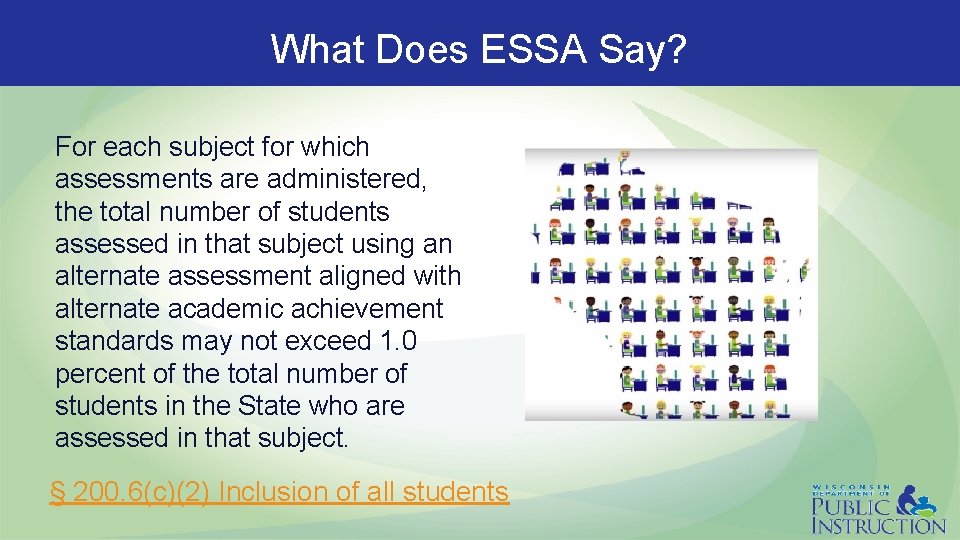
What Does ESSA Say? For each subject for which assessments are administered, the total number of students assessed in that subject using an alternate assessment aligned with alternate academic achievement standards may not exceed 1. 0 percent of the total number of students in the State who are assessed in that subject. § 200. 6(c)(2) Inclusion of all students
What Does ESSA Say? States cannot prohibit an LEA from assessing more than 1. 0 percent 34 CFR § 200. 6(c)(3)(i)
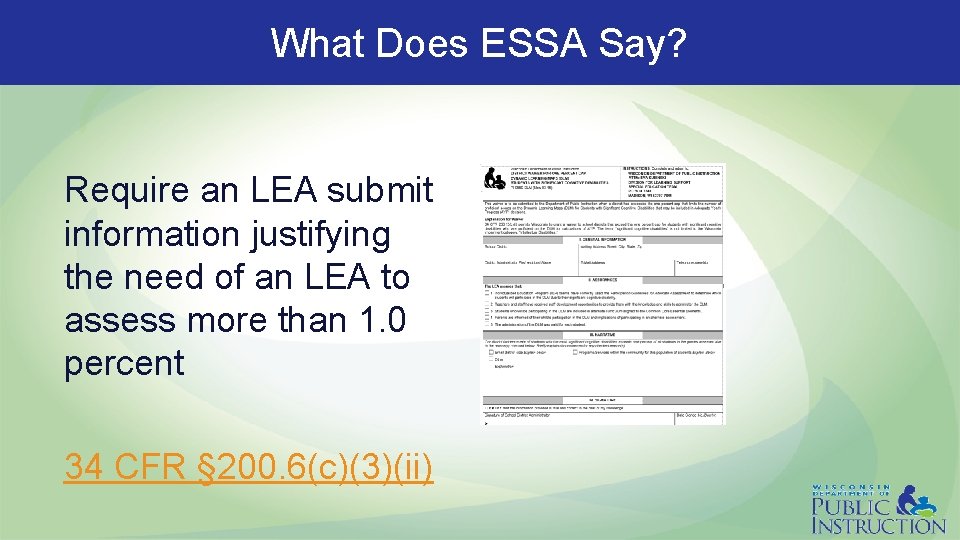
What Does ESSA Say? Require an LEA submit information justifying the need of an LEA to assess more than 1. 0 percent 34 CFR § 200. 6(c)(3)(ii)
What Does ESSA Say? Provide appropriate oversight, as determined by the state of any LEA required to submit a justification 34 CFR § 200. 6(c)(3)(iii)
What Does ESSA Say? Make the information submitted by an LEA publicly available 34 CFR § 200. 6(c)(3)(iv) *may not reveal personally identifiable information about individual students
What Does ESSA Say? States that anticipate exceeding the cap will need to request a waiver from OSEP for one year only. – Need to assure the percentage will not significantly increase from the prior year – Will address any disproportionality in the number and percentage of students in any particular subgroup – Must be submitted 90 days prior to the opening of the testing window 34 CFR § 200. 6(c)(4)
What Does ESSA Say? IEP teams must provide notification to parents regarding their child’s participation in alternate academic achievement standards and how participation in such standards/assessments may delay or otherwise affect the student from completing the requirements for a regular high school diploma. 34 CFR § 200. 6(d)(3)
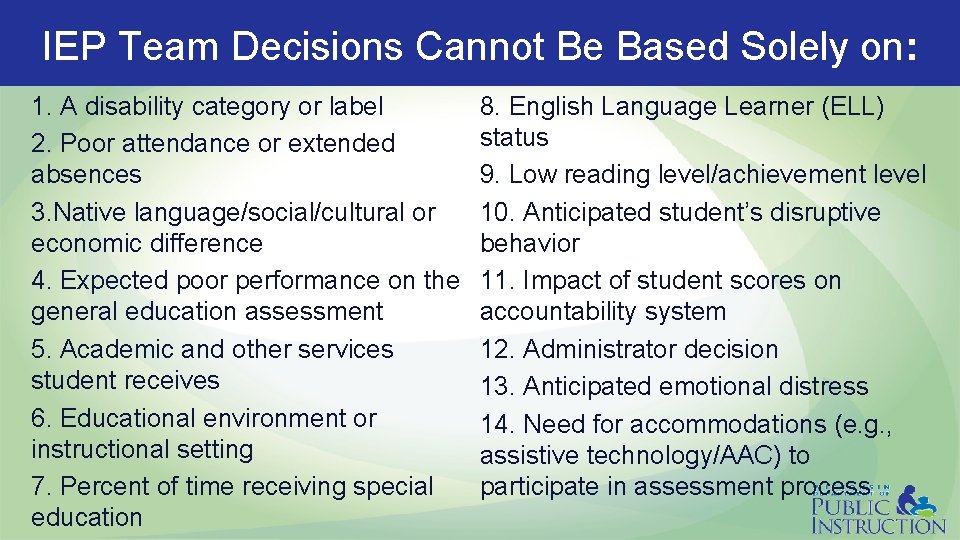
IEP Team Decisions Cannot Be Based Solely on: 1. A disability category or label 2. Poor attendance or extended absences 3. Native language/social/cultural or economic difference 4. Expected poor performance on the general education assessment 5. Academic and other services student receives 6. Educational environment or instructional setting 7. Percent of time receiving special education 8. English Language Learner (ELL) status 9. Low reading level/achievement level 10. Anticipated student’s disruptive behavior 11. Impact of student scores on accountability system 12. Administrator decision 13. Anticipated emotional distress 14. Need for accommodations (e. g. , assistive technology/AAC) to participate in assessment process
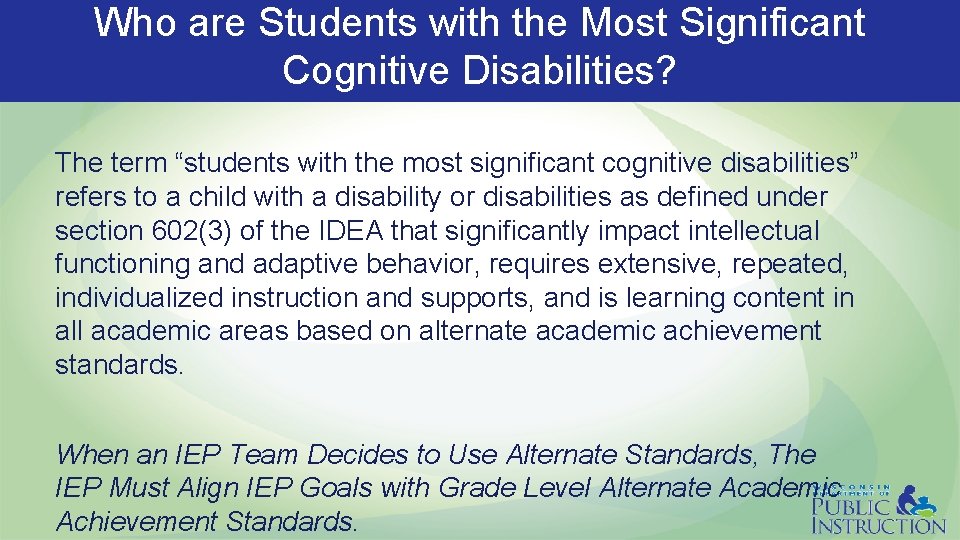
Who are Students with the Most Significant Cognitive Disabilities? The term “students with the most significant cognitive disabilities” refers to a child with a disability or disabilities as defined under section 602(3) of the IDEA that significantly impact intellectual functioning and adaptive behavior, requires extensive, repeated, individualized instruction and supports, and is learning content in all academic areas based on alternate academic achievement standards. When an IEP Team Decides to Use Alternate Standards, The IEP Must Align IEP Goals with Grade Level Alternate Academic Achievement Standards.
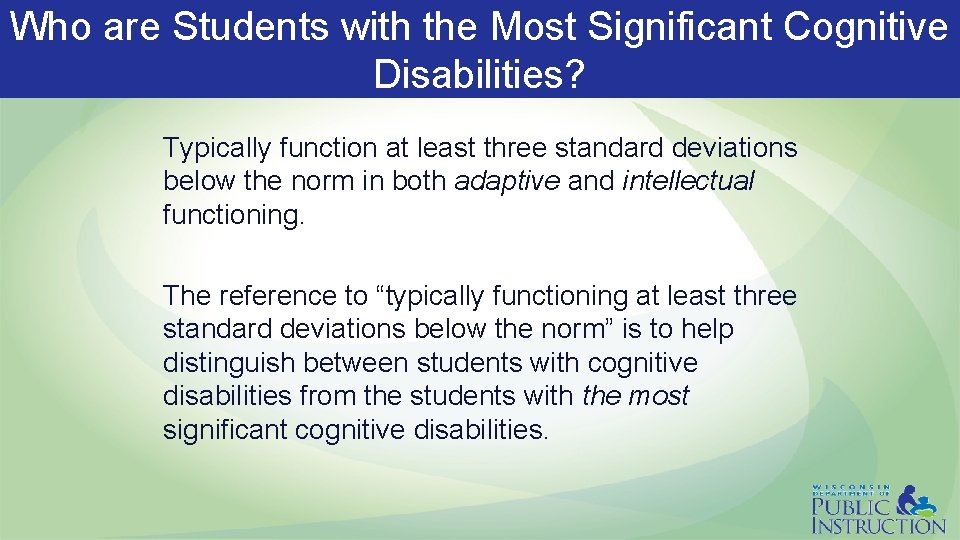
Who are Students with the Most Significant Cognitive Disabilities? Typically function at least three standard deviations below the norm in both adaptive and intellectual functioning. The reference to “typically functioning at least three standard deviations below the norm” is to help distinguish between students with cognitive disabilities from the students with the most significant cognitive disabilities.
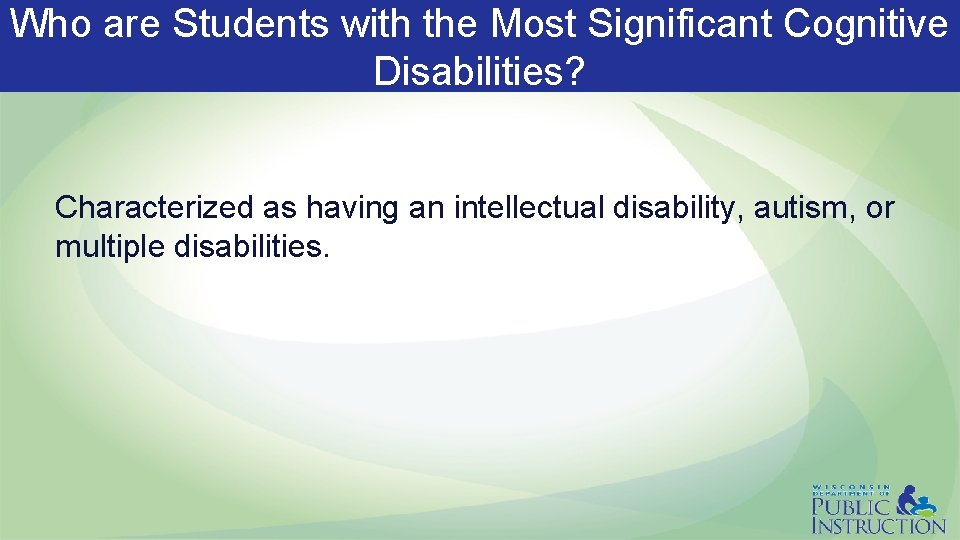
Who are Students with the Most Significant Cognitive Disabilities? Characterized as having an intellectual disability, autism, or multiple disabilities.
Use symbolic expressive and receptive communication, while about 10 -11% use pre-symbolic communication or show no response to stimuli.
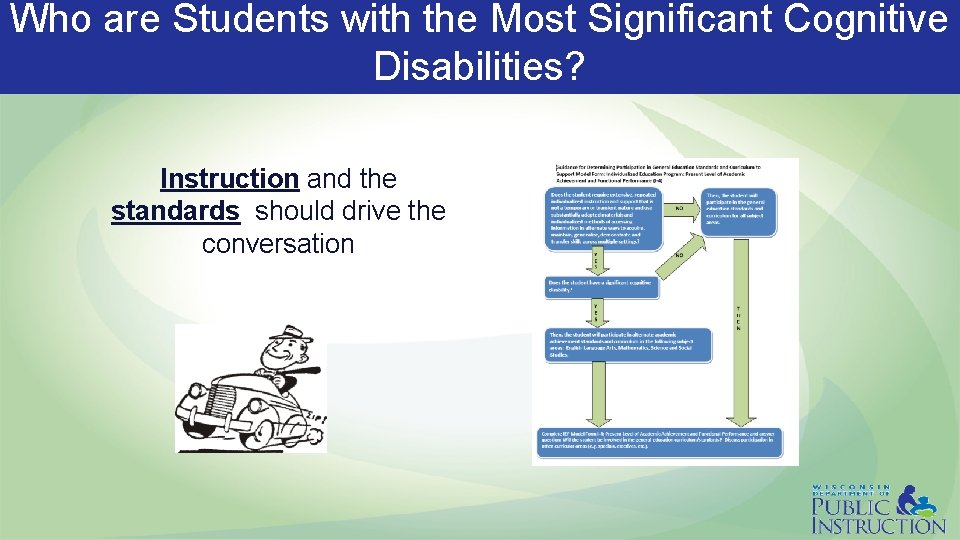
Who are Students with the Most Significant Cognitive Disabilities? Instruction and the standards should drive the conversation
Implications for Standards and Assessment Step One: Consideration of level of instructional support. Does the student demonstrate a need for substantial supports to achieve gains in the grade and age appropriate curriculum? Specially designed instruction requires materials and methods to be substantially adapted or customized in order for a student to acquire, maintain, generalize, demonstrate, and transfer skills across multiple settings?
Implications for Standards and Assessment Step Two: Does the student have the most significant cognitive disability? When determining if a student has the most significant cognitive disabilities, the IEP team must consider: A. Communication Needs B. Significance of Disability
Who are Students with the Most Significant Cognitive Disabilities? Alternate Academic Achievement Standards are ONLY for Students with the MOST SIGNIFICANT Cognitive Disabilities
Discussion and Dialogue
Thank You • Office of Special Education – Molly Bever molly. bever@dpi. wi. gov – 608 -264 -9557 • Office of Student Assessment – Kristen Burton kristen. burton@dpi. wi. gov – 608 -267 -3164