
Whmovement of question words Two kinds of Questions
![Where from? What did you say [ _____ was hit ______ ] gets theta](https://slidetodoc.com/presentation_image/270b314859aa2780ae7b945e29fe4f19/image-5.jpg "Where from? What did you say [ _____ was hit ______ ] gets theta")
![Why? Movement of T to C is motivated by [+Q] Proposal: there is a](https://slidetodoc.com/presentation_image/270b314859aa2780ae7b945e29fe4f19/image-7.jpg "Why? Movement of T to C is motivated by [+Q] Proposal: there is a")
![[+WH] Complementizers Cé a. L bhí sa seomra? Who that-wh was in-the room “Who](https://slidetodoc.com/presentation_image/270b314859aa2780ae7b945e29fe4f19/image-8.jpg "[+WH] Complementizers Cé a. L bhí sa seomra? Who that-wh was in-the room “Who")
- Slides: 13
Wh-movement of question words
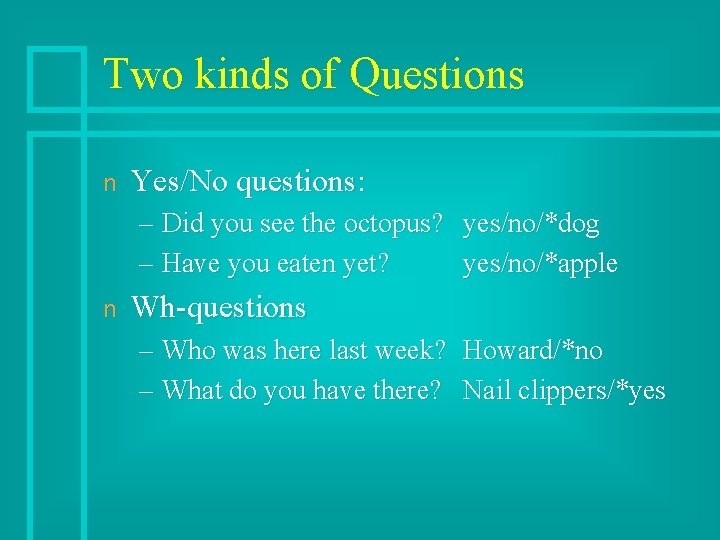
Two kinds of Questions n Yes/No questions: – Did you see the octopus? yes/no/*dog – Have you eaten yet? yes/no/*apple n Wh-questions – Who was here last week? Howard/*no – What do you have there? Nail clippers/*yes
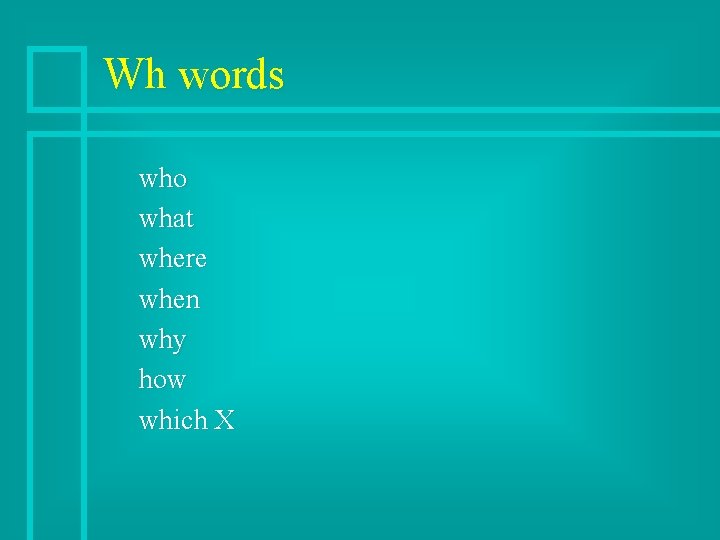
Wh words who what where when why how which X
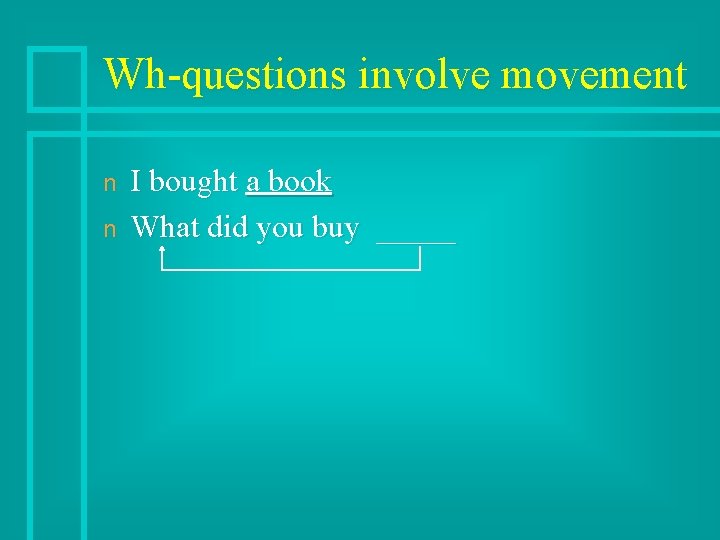
Wh-questions involve movement n n I bought a book What did you buy _____
Where from? What did you say [ _____ was hit ______ ] gets theta role here cf. John hit the ball gets case here cf. the ball was hit Ends up here
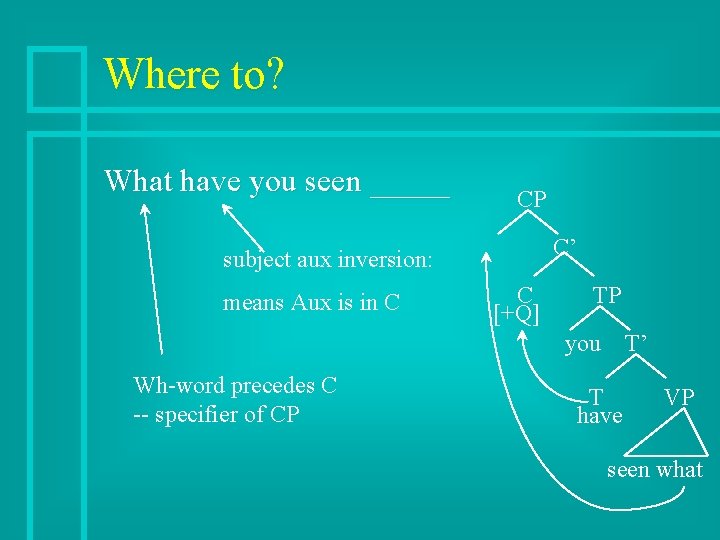
Where to? What have you seen _____ CP C’ subject aux inversion: means Aux is in C C [+Q] TP you Wh-word precedes C -- specifier of CP T’ T have VP seen what
Why? Movement of T to C is motivated by [+Q] Proposal: there is a [+WH] feature in C, the wh-word must get close to it. CP C’ C [+Q, +WH] TP what
[+WH] Complementizers Cé a. L bhí sa seomra? Who that-wh was in-the room “Who was in the room”
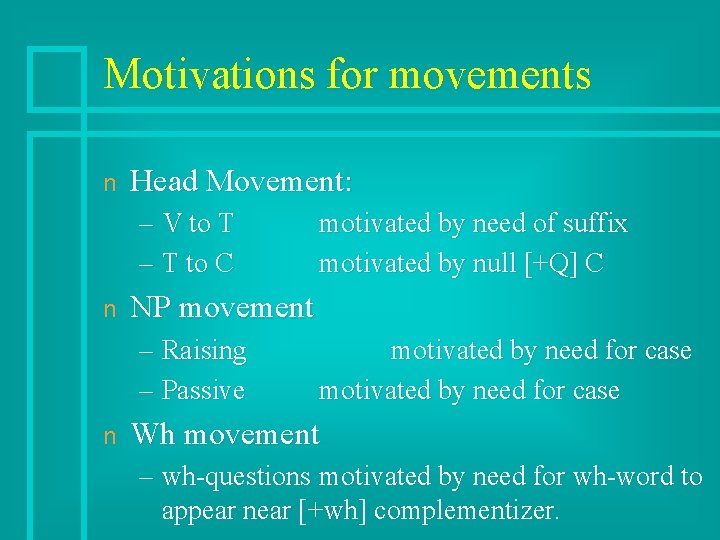
Motivations for movements n Head Movement: – V to T – T to C n NP movement – Raising – Passive n motivated by need of suffix motivated by null [+Q] C motivated by need for case Wh movement – wh-questions motivated by need for wh-word to appear near [+wh] complementizer.
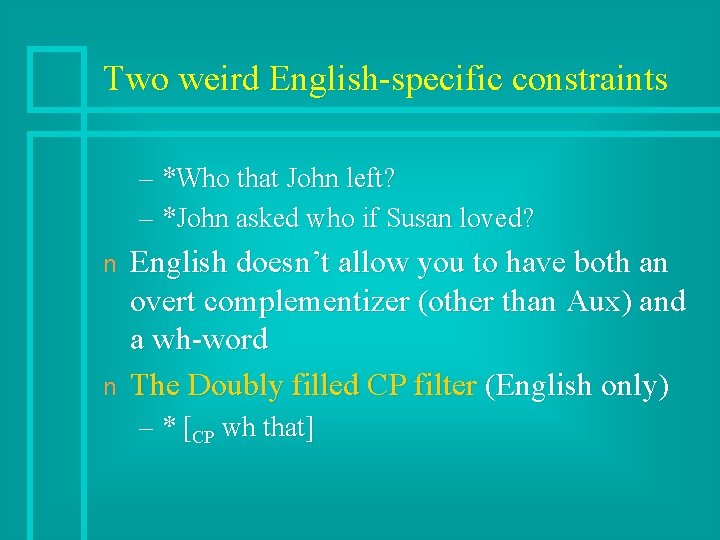
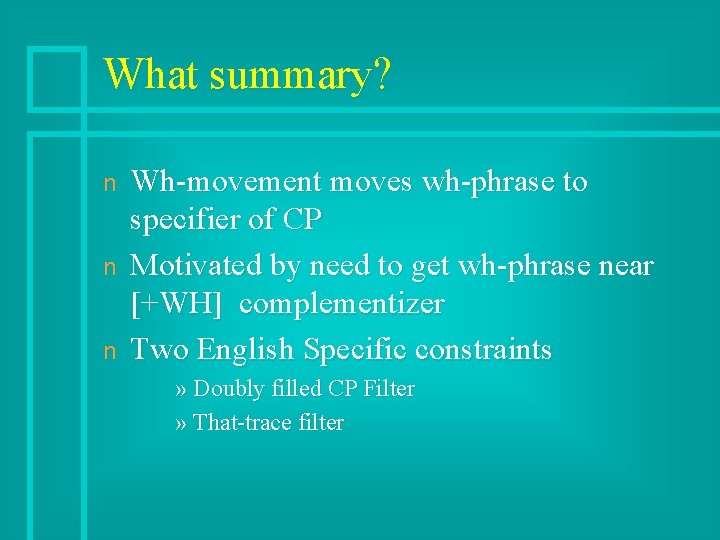
Two weird English-specific constraints – *Who that John left? – *John asked who if Susan loved? n n English doesn’t allow you to have both an overt complementizer (other than Aux) and a wh-word The Doubly filled CP filter (English only) – * [CP wh that]
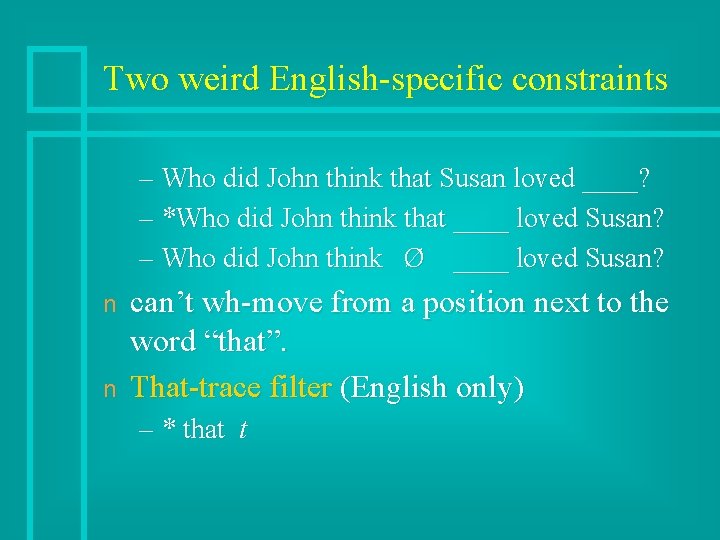
Two weird English-specific constraints – Who did John think that Susan loved ____? – *Who did John think that ____ loved Susan? – Who did John think Ø ____ loved Susan? n n can’t wh-move from a position next to the word “that”. That-trace filter (English only) – * that t
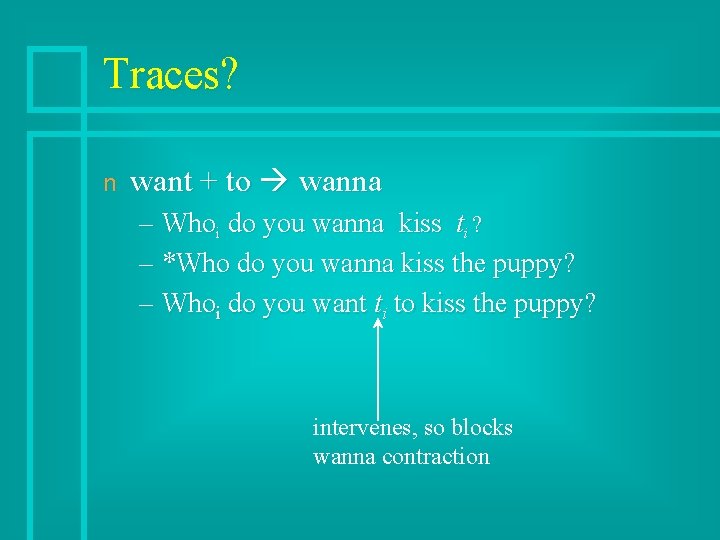
Traces? n want + to wanna – Whoi do you wanna kiss ti ? – *Who do you wanna kiss the puppy? – Whoi do you want ti to kiss the puppy? intervenes, so blocks wanna contraction
What summary? n n n Wh-movement moves wh-phrase to specifier of CP Motivated by need to get wh-phrase near [+WH] complementizer Two English Specific constraints » Doubly filled CP Filter » That-trace filter