
WHMIS FOR DUMMIES David Dai Ashley Danielson Will

- Slides: 33
WHMIS FOR DUMMIES David Dai Ashley Danielson Will Levy Julia Lucht Hector Wong
What is WHMIS? • • The Workplace Hazardous Materials Information System A 3 part system which gives canadian workers the right to know the health and safety hazards of the materials they work with. A standard used across Canada to promote safe lab and chemical handling practices. Developed by Canadian governmental bodies o came into effect on October 31, 1988
Importance of WHMIS to a Worker and a Student 1) Knowledge in WHMIS is crucial in multiple job settings: • • • Scientists Factory Workers: Cleaners/Janitors Retail/Food industry Mechanics Office Workers
Importance of WHMIS to a Worker and a Student 2) Educates students on the importance of lab safety and opens many opportunity 3) Provides steps and procedures to follow in case of emergency 4) Gives workers the right to be aware of the potentially hazardous chemicals they are associating with 5) Creates a safe workplace
Hazardous Products Act
Controlled Products
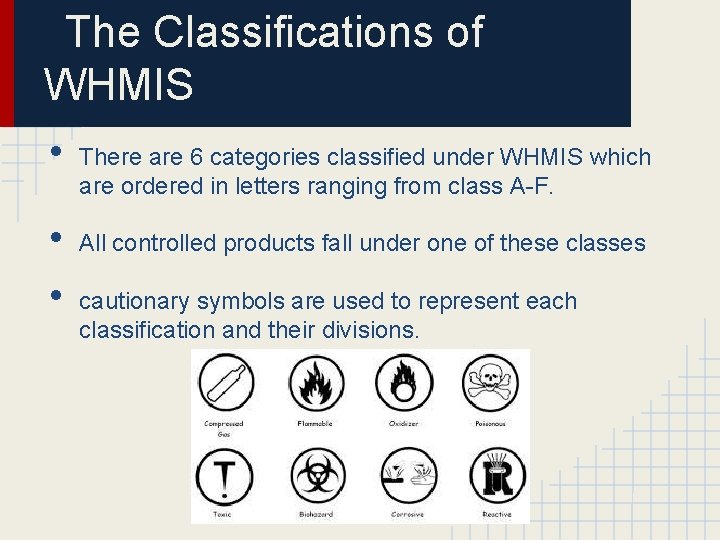
The Classifications of WHMIS • • • There are 6 categories classified under WHMIS which are ordered in letters ranging from class A-F. All controlled products fall under one of these classes cautionary symbols are used to represent each classification and their divisions.
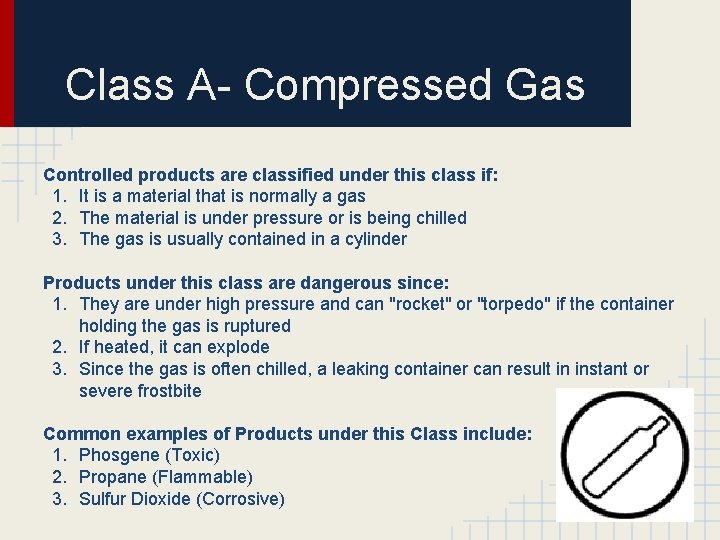
Class A- Compressed Gas Controlled products are classified under this class if: 1. It is a material that is normally a gas 2. The material is under pressure or is being chilled 3. The gas is usually contained in a cylinder Products under this class are dangerous since: 1. They are under high pressure and can "rocket" or "torpedo" if the container holding the gas is ruptured 2. If heated, it can explode 3. Since the gas is often chilled, a leaking container can result in instant or severe frostbite Common examples of Products under this Class include: 1. Phosgene (Toxic) 2. Propane (Flammable) 3. Sulfur Dioxide (Corrosive)
Safety Precautions • • Secure in a contained Cylinder Avoid Heat and Ignition Sources Transport and Handle Carefully Store in a cool ventilated area
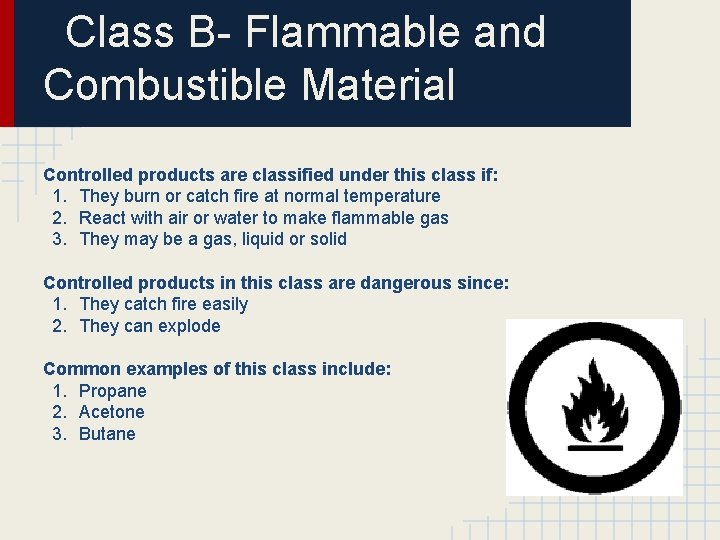
Class B- Flammable and Combustible Material Controlled products are classified under this class if: 1. They burn or catch fire at normal temperature 2. React with air or water to make flammable gas 3. They may be a gas, liquid or solid Controlled products in this class are dangerous since: 1. They catch fire easily 2. They can explode Common examples of this class include: 1. Propane 2. Acetone 3. Butane
Safety Precautions • • Handle far away from flames or ignition sources Store with cap tightened since the discharged fumes are more flammable than liquid • Avoid Inhalation and skin contact
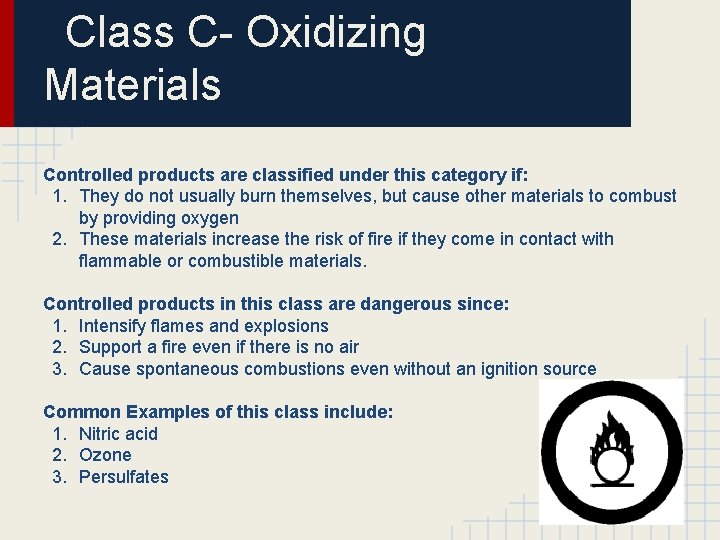
Class C- Oxidizing Materials Controlled products are classified under this category if: 1. They do not usually burn themselves, but cause other materials to combust by providing oxygen 2. These materials increase the risk of fire if they come in contact with flammable or combustible materials. Controlled products in this class are dangerous since: 1. Intensify flames and explosions 2. Support a fire even if there is no air 3. Cause spontaneous combustions even without an ignition source Common Examples of this class include: 1. Nitric acid 2. Ozone 3. Persulfates
Safety Precautions • • Wear protective clothing Avoid personal contact Store away from heat and flammable materials Contain in durable containers
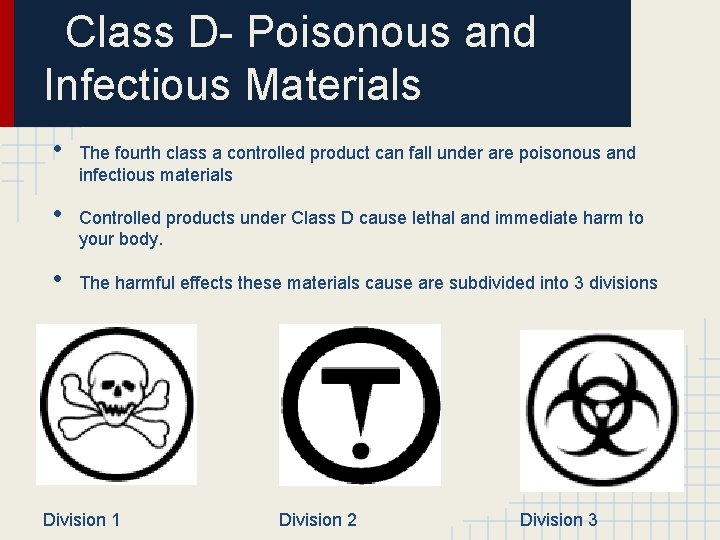
Class D- Poisonous and Infectious Materials • • • The fourth class a controlled product can fall under are poisonous and infectious materials Controlled products under Class D cause lethal and immediate harm to your body. The harmful effects these materials cause are subdivided into 3 divisions Division 1 Division 2 Division 3
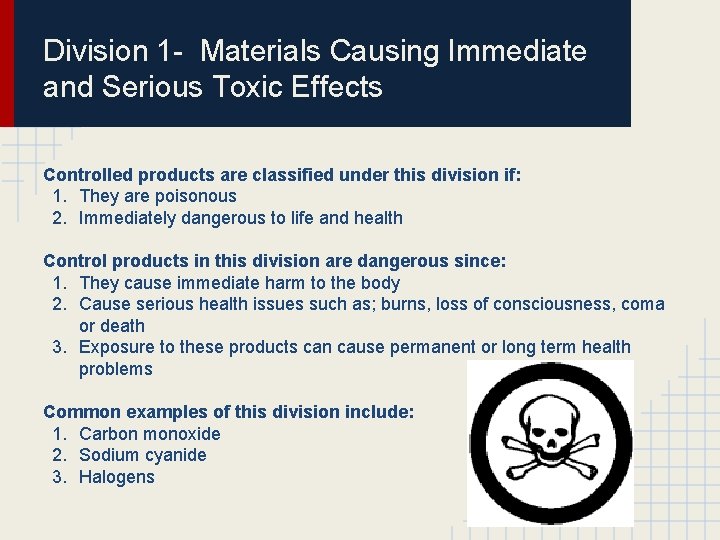
Division 1 - Materials Causing Immediate and Serious Toxic Effects Controlled products are classified under this division if: 1. They are poisonous 2. Immediately dangerous to life and health Control products in this division are dangerous since: 1. They cause immediate harm to the body 2. Cause serious health issues such as; burns, loss of consciousness, coma or death 3. Exposure to these products can cause permanent or long term health problems Common examples of this division include: 1. Carbon monoxide 2. Sodium cyanide 3. Halogens
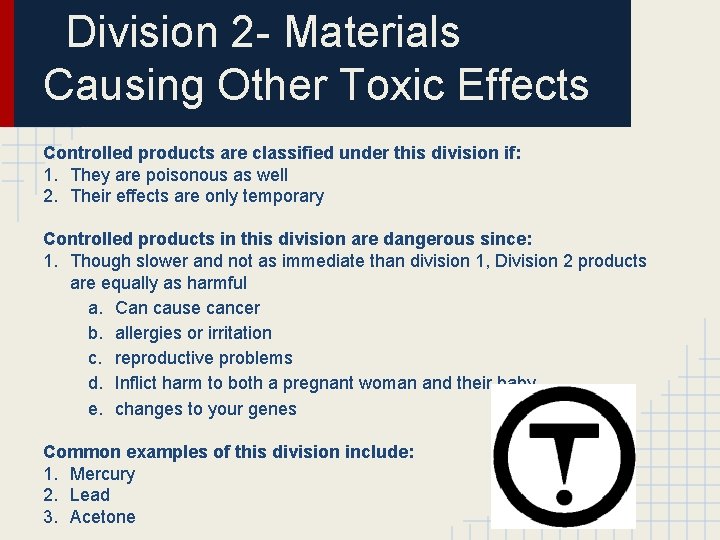
Division 2 - Materials Causing Other Toxic Effects Controlled products are classified under this division if: 1. They are poisonous as well 2. Their effects are only temporary Controlled products in this division are dangerous since: 1. Though slower and not as immediate than division 1, Division 2 products are equally as harmful a. Can cause cancer b. allergies or irritation c. reproductive problems d. Inflict harm to both a pregnant woman and their baby e. changes to your genes Common examples of this division include: 1. Mercury 2. Lead 3. Acetone
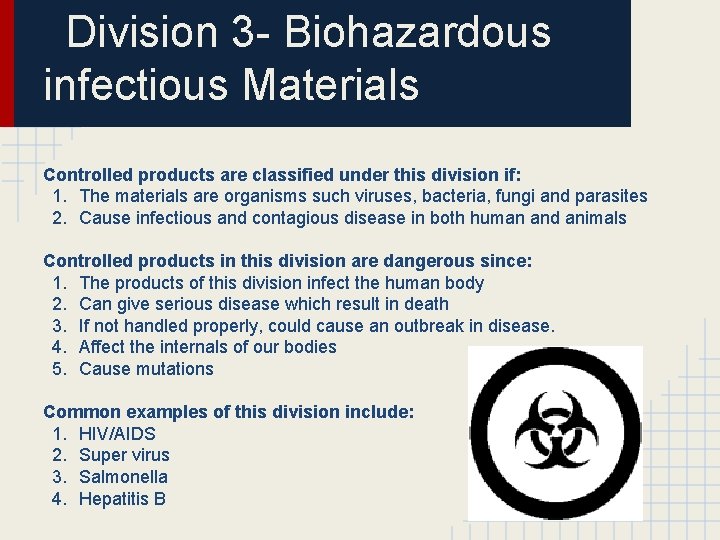
Division 3 - Biohazardous infectious Materials Controlled products are classified under this division if: 1. The materials are organisms such viruses, bacteria, fungi and parasites 2. Cause infectious and contagious disease in both human and animals Controlled products in this division are dangerous since: 1. The products of this division infect the human body 2. Can give serious disease which result in death 3. If not handled properly, could cause an outbreak in disease. 4. Affect the internals of our bodies 5. Cause mutations Common examples of this division include: 1. HIV/AIDS 2. Super virus 3. Salmonella 4. Hepatitis B
Safety Precautions • • • Avoid any physical contact or inhalation Handle in proper equipment, such as WHMIS regulated lab coats or overcoats and fume blocking masks Avoid use of these chemicals if possible Research extensively before use Work away from windows to not spread fumes through breezes Handle away from other chemicals.
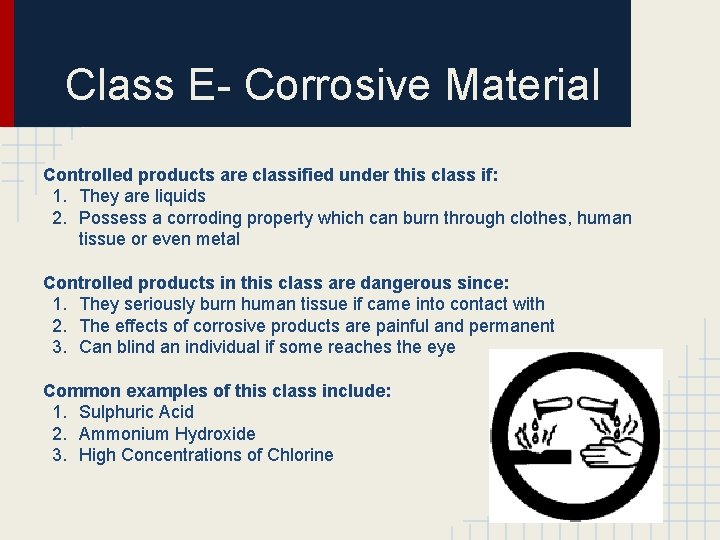
Class E- Corrosive Material Controlled products are classified under this class if: 1. They are liquids 2. Possess a corroding property which can burn through clothes, human tissue or even metal Controlled products in this class are dangerous since: 1. They seriously burn human tissue if came into contact with 2. The effects of corrosive products are painful and permanent 3. Can blind an individual if some reaches the eye Common examples of this class include: 1. Sulphuric Acid 2. Ammonium Hydroxide 3. High Concentrations of Chlorine
Safety Precautions • Do not bring near Human Tissue • Keep away from Metals • Do not allow fumes to escape
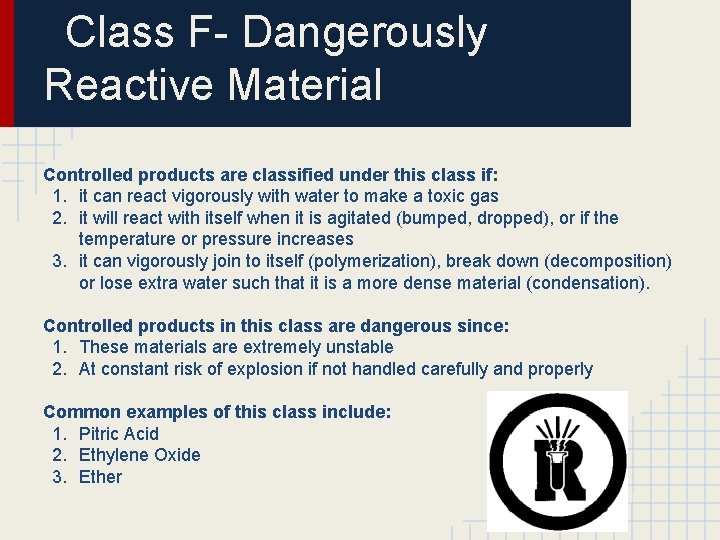
Class F- Dangerously Reactive Material Controlled products are classified under this class if: 1. it can react vigorously with water to make a toxic gas 2. it will react with itself when it is agitated (bumped, dropped), or if the temperature or pressure increases 3. it can vigorously join to itself (polymerization), break down (decomposition) or lose extra water such that it is a more dense material (condensation). Controlled products in this class are dangerous since: 1. These materials are extremely unstable 2. At constant risk of explosion if not handled carefully and properly Common examples of this class include: 1. Pitric Acid 2. Ethylene Oxide 3. Ether
Safety Precautions • • • Avoid Use if possible Keep away from potential reactions Do not mix with other chemicals
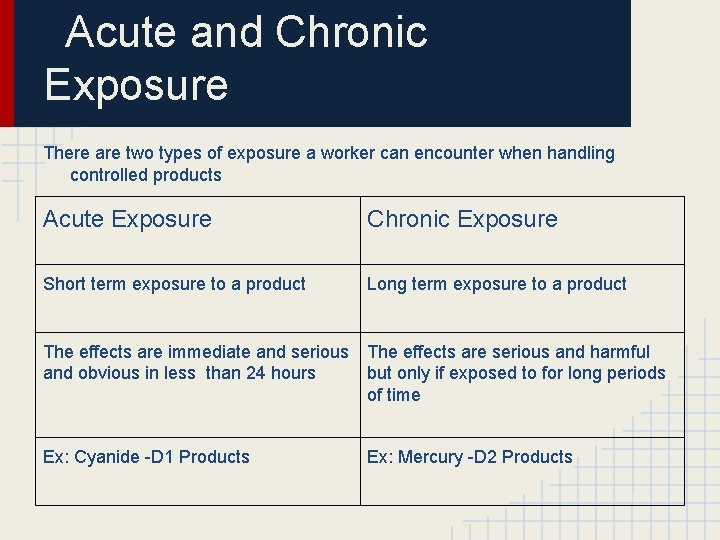
Acute and Chronic Exposure There are two types of exposure a worker can encounter when handling controlled products Acute Exposure Chronic Exposure Short term exposure to a product Long term exposure to a product The effects are immediate and serious and obvious in less than 24 hours The effects are serious and harmful but only if exposed to for long periods of time Ex: Cyanide -D 1 Products Ex: Mercury -D 2 Products
The Key Elements of WHMIS 1. Supplier Label 2. MSDS 3. Education and Training
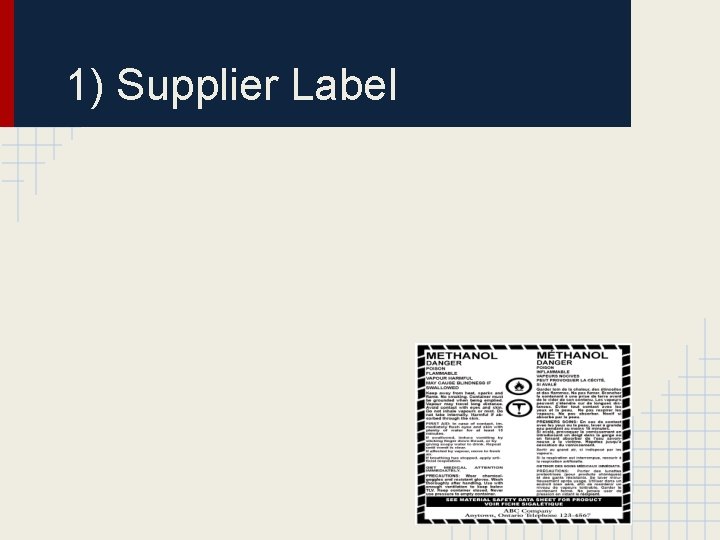
1) Supplier Label
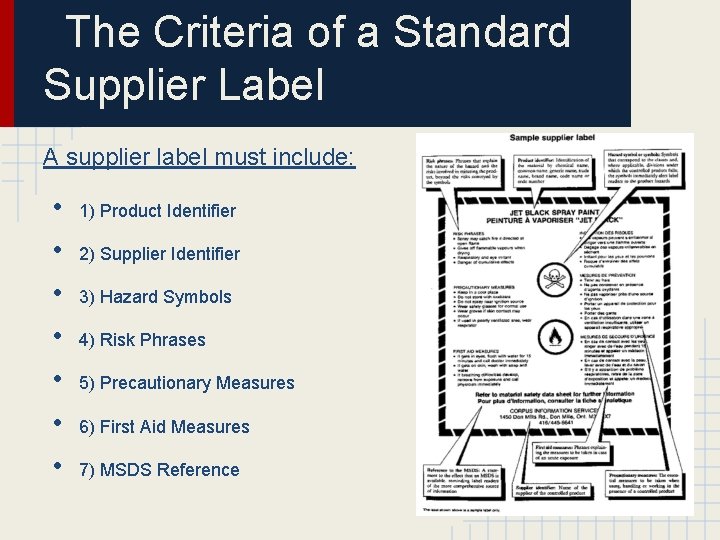
The Criteria of a Standard Supplier Label A supplier label must include: • • 1) Product Identifier 2) Supplier Identifier 3) Hazard Symbols 4) Risk Phrases 5) Precautionary Measures 6) First Aid Measures 7) MSDS Reference
2) MSDS
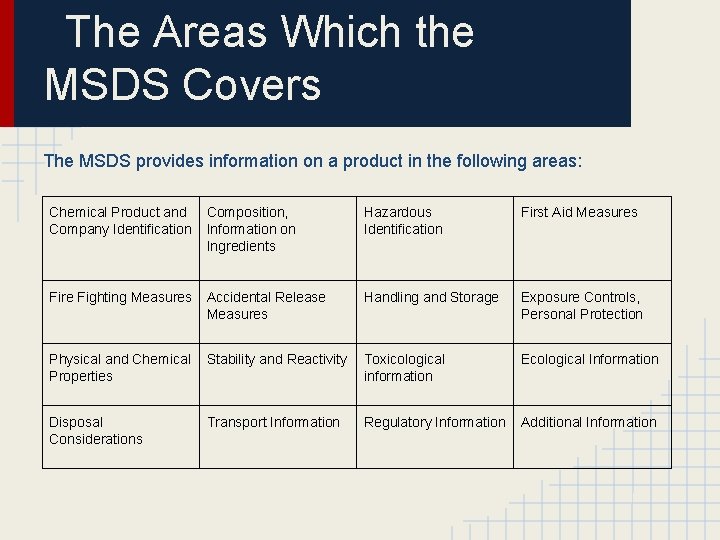
The Areas Which the MSDS Covers The MSDS provides information on a product in the following areas: Chemical Product and Company Identification Composition, Information on Ingredients Hazardous Identification First Aid Measures Fire Fighting Measures Accidental Release Measures Handling and Storage Exposure Controls, Personal Protection Physical and Chemical Properties Stability and Reactivity Toxicological information Ecological Information Disposal Considerations Transport Information Regulatory Information Additional Information
3) Education and Training • • Employers must provide instruction to each worker on how to use WHMIS Universities and Companies offer online and real life courses Courses are subject to revision and check up every 2 -3 years WHMIS courses vary in terms of information depending on the profession o Ex: an office worker will not receive the same WHMIS training an industrial worker would.
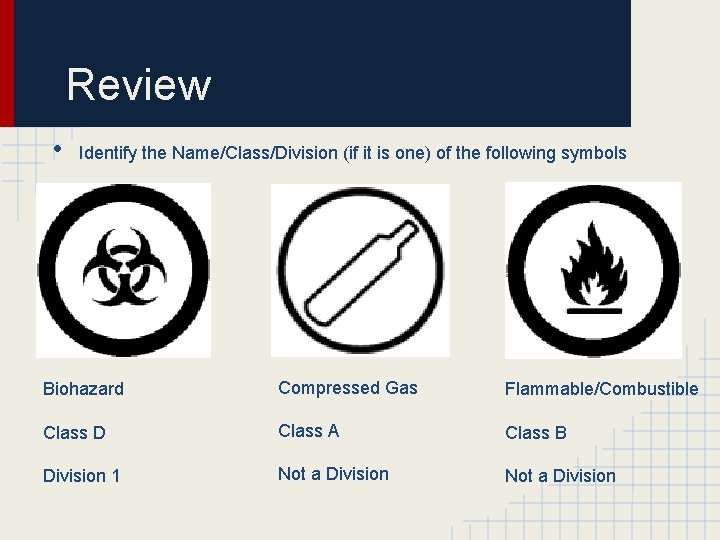
Review • Identify the Name/Class/Division (if it is one) of the following symbols Biohazard Compressed Gas Flammable/Combustible Class D Class A Class B Division 1 Not a Division
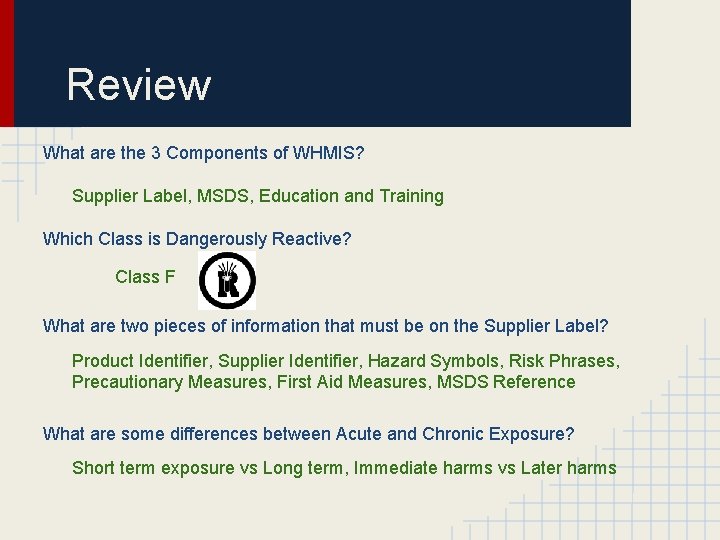
Review What are the 3 Components of WHMIS? Supplier Label, MSDS, Education and Training Which Class is Dangerously Reactive? Class F What are two pieces of information that must be on the Supplier Label? Product Identifier, Supplier Identifier, Hazard Symbols, Risk Phrases, Precautionary Measures, First Aid Measures, MSDS Reference What are some differences between Acute and Chronic Exposure? Short term exposure vs Long term, Immediate harms vs Later harms
In Conclusion. . .
Bibliography "Supplier Label. "Canadian Centre for Occupational Health and Safety. Canadian Centre for Health and Workplace Safety, 19 Jan. 2006. Web. 1 April. 2013. <http: //www. ccohs. ca/oshanswers/legisl/msdss. html>. "Hazards"Canadian Centre for Occupational Health and Safety, 12 July 2001. Web. 1 April. 2013. <http: //www. ccohs. ca/oshanswers/legisl/msds_lab. html>. "WHMIS. "Health Canada. Government of Canada, 18 Jan. 2008. Web. 1 April. 2013. <http: //www. hcsc. gc. ca/ewh-semt/occup-travail/whmis-simdut/work-travail-eng. php>. “Workplace Hazardous Materials Information System. ” Health Canada. Government of Canada, 10 June 2010. Web. 1 April. 2013. <http: //www. hc-sc. gc. ca/ewh-semt/occup-travail/whmissimdut/index-eng. php>. "Introduction to WHMIS. " Work Safe BC. Workers’ Compensation Board of BC, 2012. Web. 25 April. 2013. <http: //www 2. worksafebc. com/topics/whmis/Introduction. asp>.