
Whitmans Desire for the Womb Introduction to Graduate
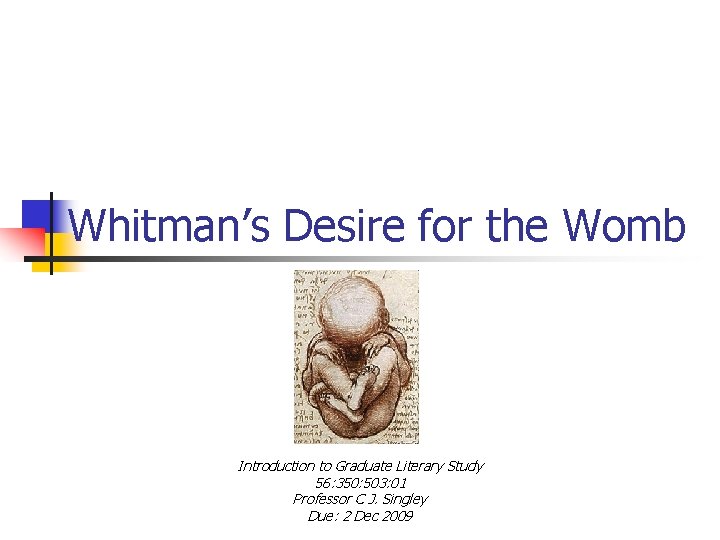
Whitman’s Desire for the Womb Introduction to Graduate Literary Study 56: 350: 503: 01 Professor C J. Singley Due: 2 Dec 2009
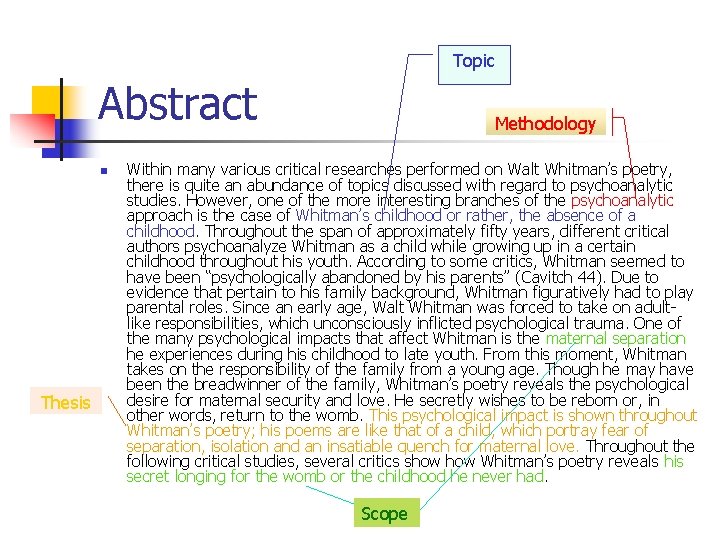
Topic Abstract n Thesis Methodology Within many various critical researches performed on Walt Whitman’s poetry, there is quite an abundance of topics discussed with regard to psychoanalytic studies. However, one of the more interesting branches of the psychoanalytic approach is the case of Whitman’s childhood or rather, the absence of a childhood. Throughout the span of approximately fifty years, different critical authors psychoanalyze Whitman as a child while growing up in a certain childhood throughout his youth. According to some critics, Whitman seemed to have been “psychologically abandoned by his parents” (Cavitch 44). Due to evidence that pertain to his family background, Whitman figuratively had to play parental roles. Since an early age, Walt Whitman was forced to take on adultlike responsibilities, which unconsciously inflicted psychological trauma. One of the many psychological impacts that affect Whitman is the maternal separation he experiences during his childhood to late youth. From this moment, Whitman takes on the responsibility of the family from a young age. Though he may have been the breadwinner of the family, Whitman’s poetry reveals the psychological desire for maternal security and love. He secretly wishes to be reborn or, in other words, return to the womb. This psychological impact is shown throughout Whitman’s poetry; his poems are like that of a child, which portray fear of separation, isolation and an insatiable quench for maternal love. Throughout the following critical studies, several critics show Whitman’s poetry reveals his secret longing for the womb or the childhood he never had. Scope
Possible studies to incorporate n Whitman’s Childhood/ Family Background: n n n n Katherine Molinoff’s “Some Notes on Whitman’s Family: Mary Elizabeth Whitman, Edward Whitman, Andrew and Jesse Whitman, Hannah Louisa Whitman ” David Cavitch’s “My Soul and I: The Inner Life of Walt Whitman” Vivian Pollak’s “The Erotic Whitman” “Letters from the Battlefield to Louisa Whitman. ” David S. Reynolds’s Walt Whitman’s America: A Cultural Biography Cleveland Rodgers’s "The Good Gray House Builder” William White "Mrs. Walter Whitman, Sr. , Writes to Her Son” Response in Writing (Leaves of Grass): n n n n Charles C. Walcutt’s “Whitman’s ‘Out of the Cradle Endlessly Rocking” Moder, Donna. “Gender Bipolarity and the Metaphorical Dimensions of Creativity in Walt Whitman’s Poetry: A Psychobiographical Study. ” Edwin Miller’s “Walt Whitman’s Poetry: A Psychological Journey” Stephen A. Black’s “Radical Utterances from the Soul’s Abysms: Toward a New Sense of Whitman” Tracey R. Miller’s essay, “The Boy, the Bird and the Sea: An Archetypal Reading of ‘Out of the Cradle’” Barbara Schapiro’s essay, “Shelley’s Alastor and Whitman’s Out of the Cradle: The Ambivalent Mother” Stanley T. Gutman’s “Conflations in Walt Whitman’s ‘Out of the Cradle’” Beth Jensen’s “‘The low and delicious word death’: The Acquisition of Language in ‘Out of the Cradle Endlessly Rocking”

Poems to analyze n n n “As I Ebb’d with the Ocean of Life” “There Was a Child Went Forth” “Out of the Cradle Endlessly Rocking”
Any Feedback will be GREATLY appreciated n n n Is my thesis and scope clear enough? Are there any missing pieces/gaps that I should cover for my paper? Should I consider incorporating psychological studies? (Such as what happens in the aftereffects of a maternal separation in the study of rats…)
- Slides: 5