
WhiteNose Syndrome A Deadly Bat Disease Why are
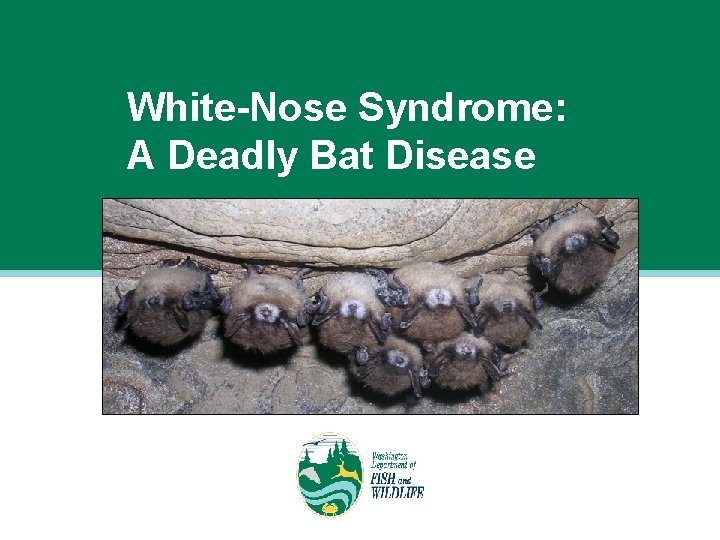
White-Nose Syndrome: A Deadly Bat Disease
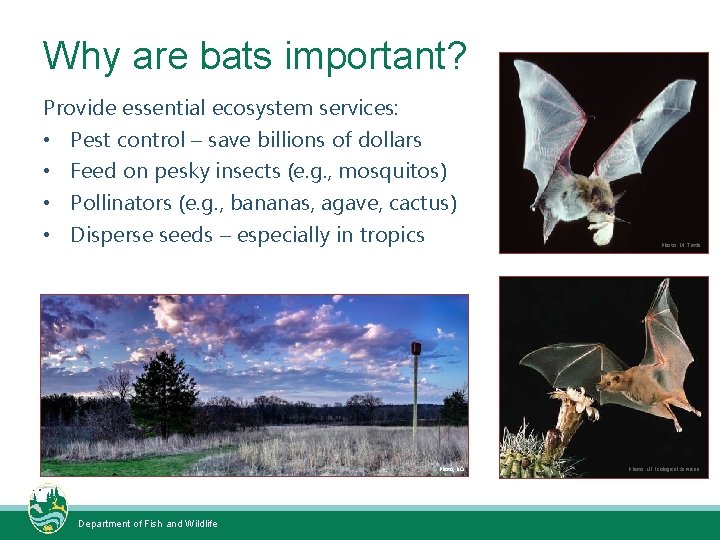
Why are bats important? Provide essential ecosystem services: • Pest control – save billions of dollars • Feed on pesky insects (e. g. , mosquitos) • Pollinators (e. g. , bananas, agave, cactus) • Disperse seeds – especially in tropics Photo; BCI Department of Fish and Wildlife Photo: M. Tuttle Photo: NE Ecological Services
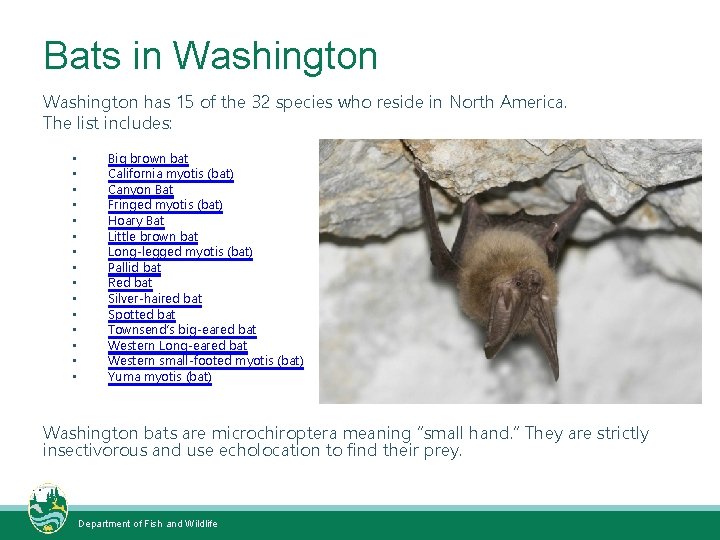
Bats in Washington has 15 of the 32 species who reside in North America. The list includes: • • • • Big brown bat California myotis (bat) Canyon Bat Fringed myotis (bat) Hoary Bat Little brown bat Long-legged myotis (bat) Pallid bat Red bat Silver-haired bat Spotted bat Townsend’s big-eared bat Western Long-eared bat Western small-footed myotis (bat) Yuma myotis (bat) Washington bats are microchiroptera meaning “small hand. ” They are strictly insectivorous and use echolocation to find their prey. Photo; BCI Department of Fish and Wildlife
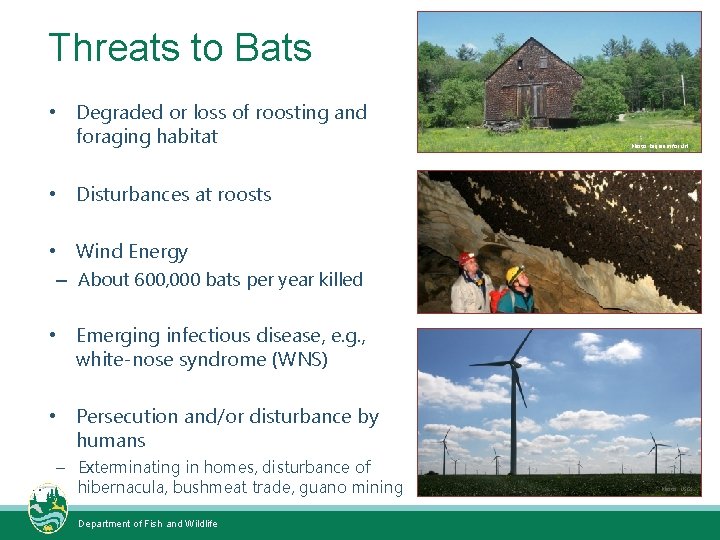
Threats to Bats • Degraded or loss of roosting and foraging habitat Photo: Requiem for NH • Disturbances at roosts • Wind Energy – About 600, 000 bats per year killed • Emerging infectious disease, e. g. , white-nose syndrome (WNS) • Persecution and/or disturbance by humans – Exterminating in homes, disturbance of hibernacula, bushmeat trade, guano mining Department of Fish and Wildlife Photo; BCI Photo: USGS
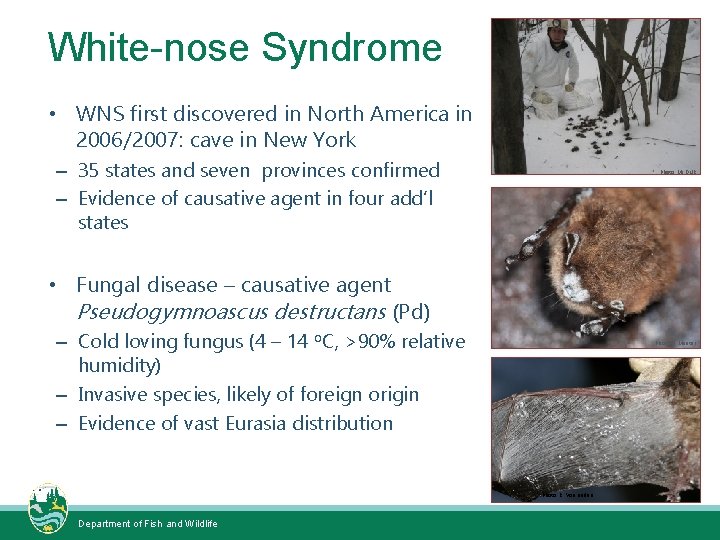
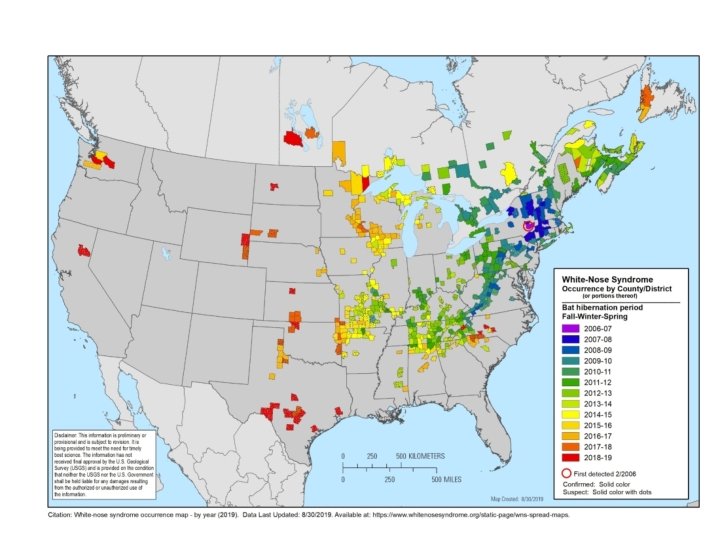
White-nose Syndrome • WNS first discovered in North America in 2006/2007: cave in New York Photo: Requiem for NH – 35 states and seven provinces confirmed – Evidence of causative agent in four add’l states Photo: MI DNR • Fungal disease – causative agent Pseudogymnoascus destructans (Pd) – Cold loving fungus (4 – 14 o. C, >90% relative humidity) – Invasive species, likely of foreign origin – Evidence of vast Eurasia distribution Photo: L. Master Photo; BCI Photo: R. Von Linden Department of Fish and Wildlife Photo: USGS
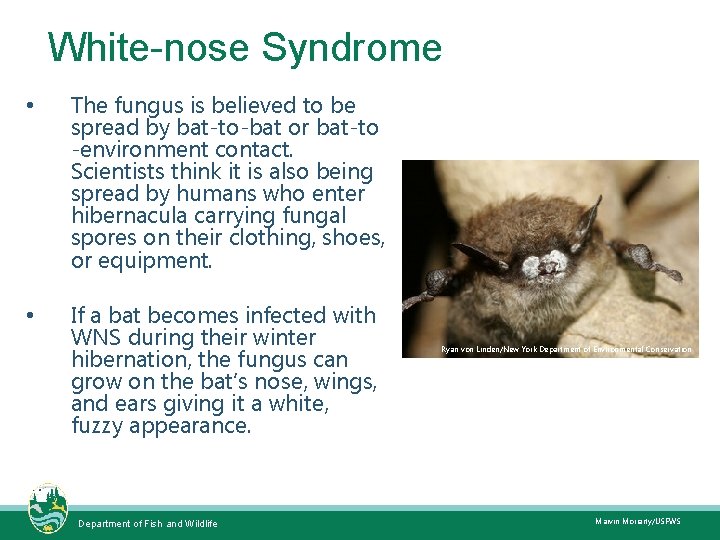
White-nose Syndrome • • The fungus is believed to be spread by bat-to-bat or bat-to -environment contact. Scientists think it is also being spread by humans who enter hibernacula carrying fungal spores on their clothing, shoes, or equipment. If a bat becomes infected with WNS during their winter hibernation, the fungus can grow on the bat’s nose, wings, and ears giving it a white, fuzzy appearance. Photo: Requiem for NH Ryan von Linden/New York Department of Environmental Conservation Photo; BCI Department of Fish and Wildlife Marvin Moriarty/USFWS
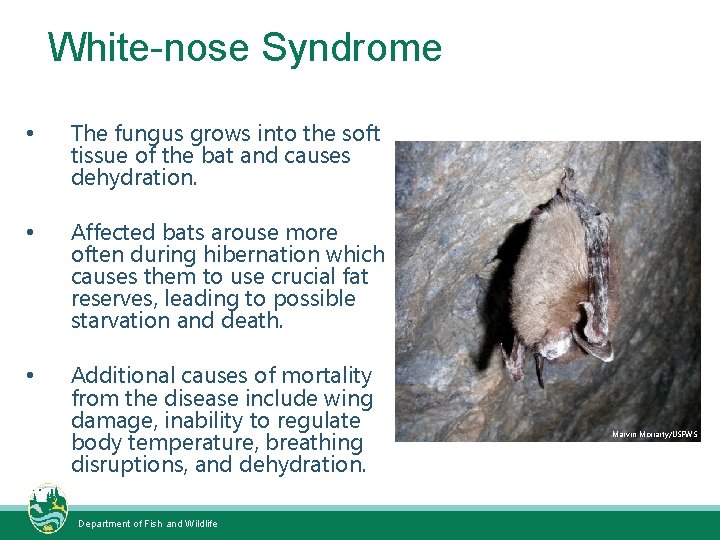
White-nose Syndrome • The fungus grows into the soft tissue of the bat and causes dehydration. • Affected bats arouse more often during hibernation which causes them to use crucial fat reserves, leading to possible starvation and death. • Additional causes of mortality from the disease include wing damage, inability to regulate body temperature, breathing disruptions, and dehydration. Department of Fish and Wildlife Photo: Requiem for NH Ryan von Linden/New York Department of Environmental Conservation Marvin Moriarty/USFWS Photo; BCI
Department of Fish and Wildlife
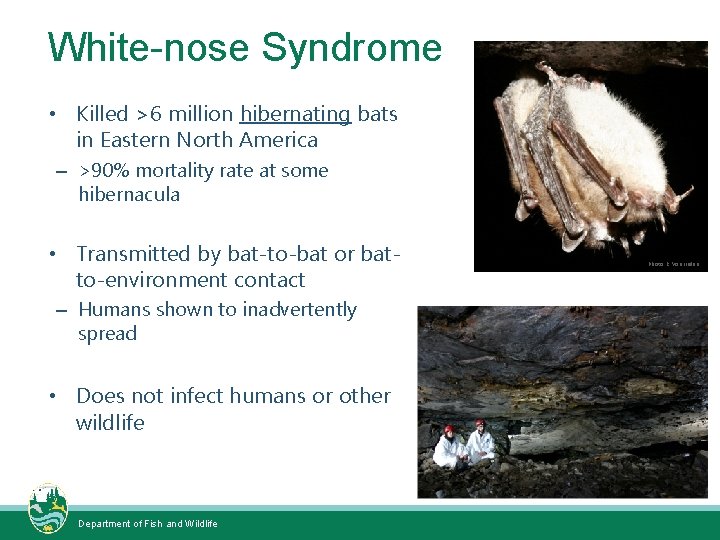
White-nose Syndrome • Killed >6 million hibernating bats in Eastern North America Photo: Requiem for NH – >90% mortality rate at some hibernacula • Transmitted by bat-to-bat or batto-environment contact Photo: R. Von Linden – Humans shown to inadvertently spread • Does not infect humans or other wildlife Photo; BCI Department of Fish and Wildlife
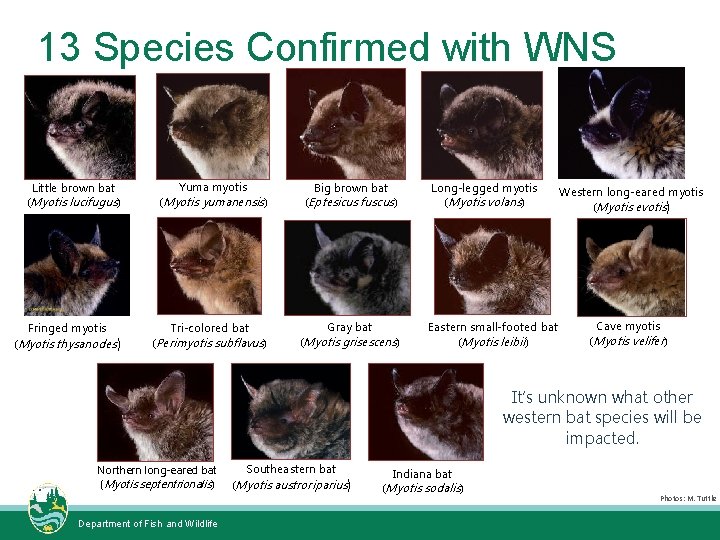
13 Species Confirmed with WNS Photo: Requiem for NH Little brown bat (Myotis lucifugus) Fringed myotis (Myotis thysanodes) Yuma myotis (Myotis yumanensis) Tri-colored bat (Perimyotis subflavus) Big brown bat (Eptesicus fuscus) Gray bat (Myotis grisescens) Long-legged myotis (Myotis volans) Eastern small-footed bat (Myotis leibii) Western long-eared myotis (Myotis evotis) Cave myotis (Myotis velifer) It’s unknown what other western bat species will be impacted. Northern long-eared bat (Myotis septentrionalis) Department of Fish and Wildlife Southeastern bat (Myotis austroriparius) Indiana bat (Myotis sodalis) Photos: M. Tuttle
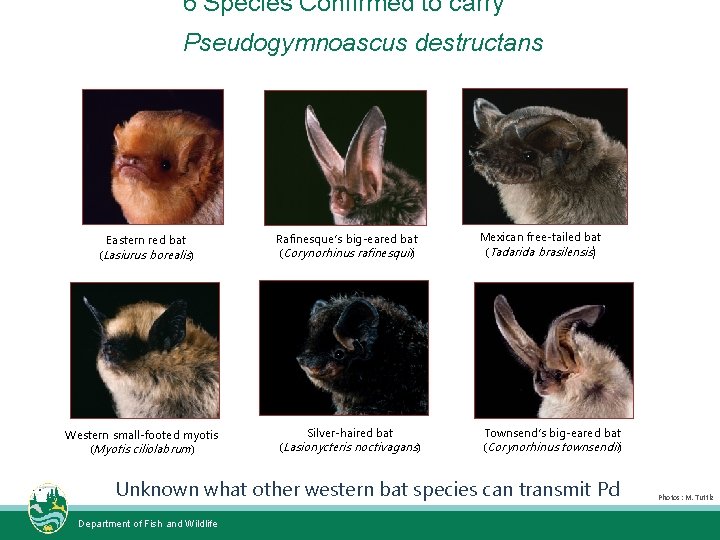
6 Species Confirmed to carry Pseudogymnoascus destructans Eastern red bat (Lasiurus borealis) Western small-footed myotis (Myotis ciliolabrum) Rafinesque’s big-eared bat (Corynorhinus rafinesquii) Silver-haired bat (Lasionycteris noctivagans) Mexican free-tailed bat (Tadarida brasilensis) Townsend’s big-eared bat (Corynorhinus townsendii) Unknown what other western bat species can transmit Pd Department of Fish and Wildlife Photos: M. Tuttle
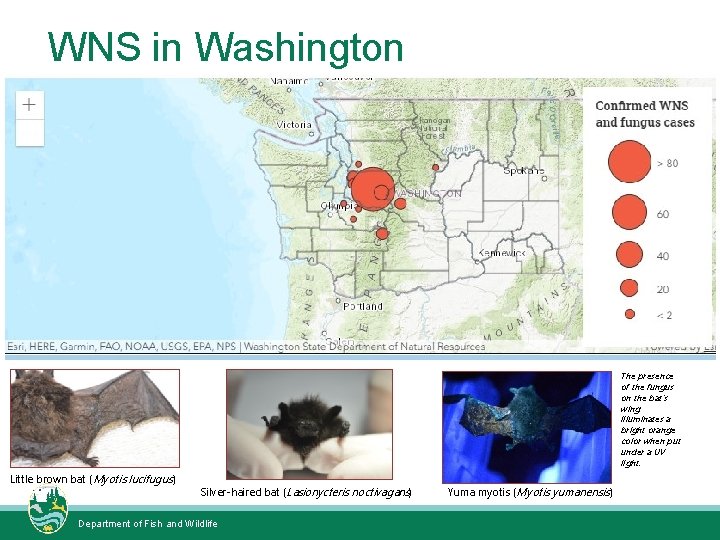
WNS in Washington Photo: Requiem for NH Little brown bat ( Myotis lucifugus) Photo; BCI Silver-haired bat (Lasionycteris noctivagans ) Department of Fish and Wildlife Yuma myotis (Myotis yumanensis) The presence of the fungus on the bat's wing illuminates a bright orange color when put under a UV light.
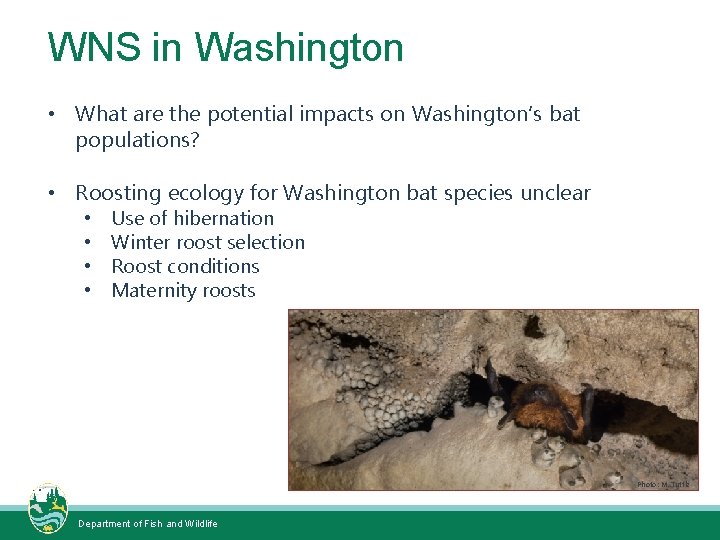
WNS in Washington • What are the potential impacts on Washington’s bat populations? • Roosting ecology for Washington bat species unclear • • Use of hibernation Winter roost selection Roost conditions Maternity roosts Photo; BCI Photo: M. Tuttle Department of Fish and Wildlife
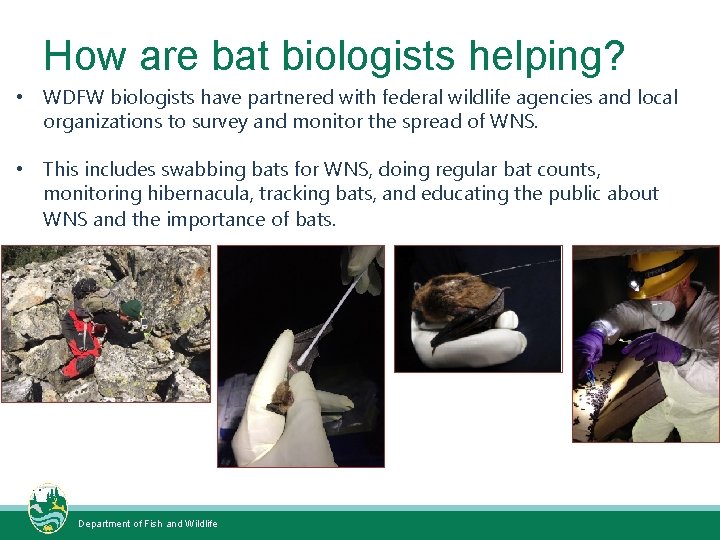
How are bat biologists helping? • WDFW biologists have partnered with federal wildlife agencies and local organizations to survey and monitor the spread of WNS. • This includes swabbing bats for WNS, doing regular bat counts, monitoring hibernacula, tracking bats, and educating the public about WNS and the importance of bats. Department of Fish and Wildlife
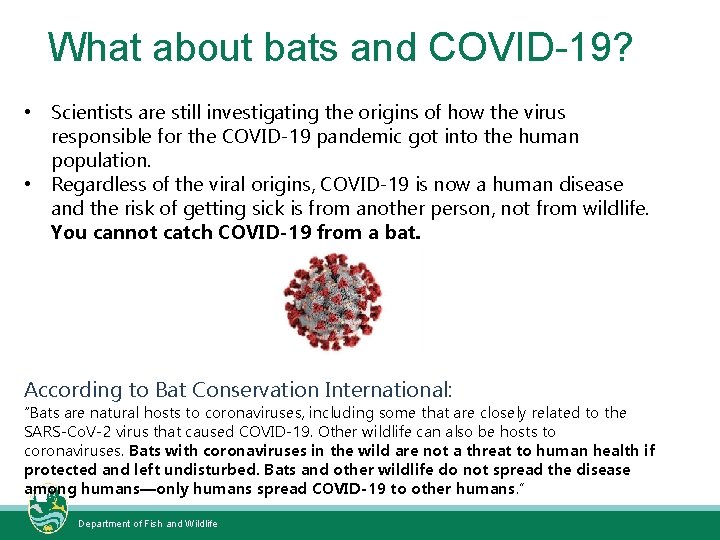
What about bats and COVID-19? • Scientists are still investigating the origins of how the virus responsible for the COVID-19 pandemic got into the human population. • Regardless of the viral origins, COVID-19 is now a human disease and the risk of getting sick is from another person, not from wildlife. You cannot catch COVID-19 from a bat. According to Bat Conservation International: “Bats are natural hosts to coronaviruses, including some that are closely related to the SARS-Co. V-2 virus that caused COVID-19. Other wildlife can also be hosts to coronaviruses. Bats with coronaviruses in the wild are not a threat to human health if protected and left undisturbed. Bats and other wildlife do not spread the disease among humans—only humans spread COVID-19 to other humans. ” Photo; BCI Department of Fish and Wildlife
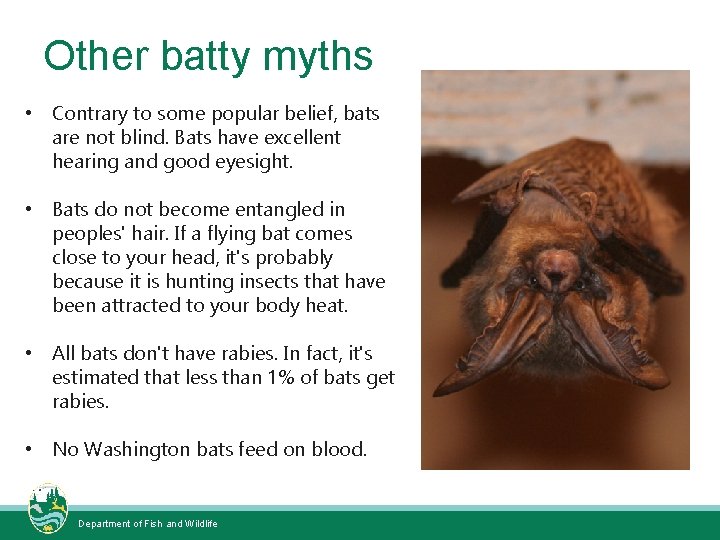
Other batty myths • Contrary to some popular belief, bats are not blind. Bats have excellent hearing and good eyesight. • Bats do not become entangled in peoples' hair. If a flying bat comes close to your head, it's probably because it is hunting insects that have been attracted to your body heat. • All bats don't have rabies. In fact, it's estimated that less than 1% of bats get rabies. • No Washington bats feed on blood. Department of Fish and Wildlife
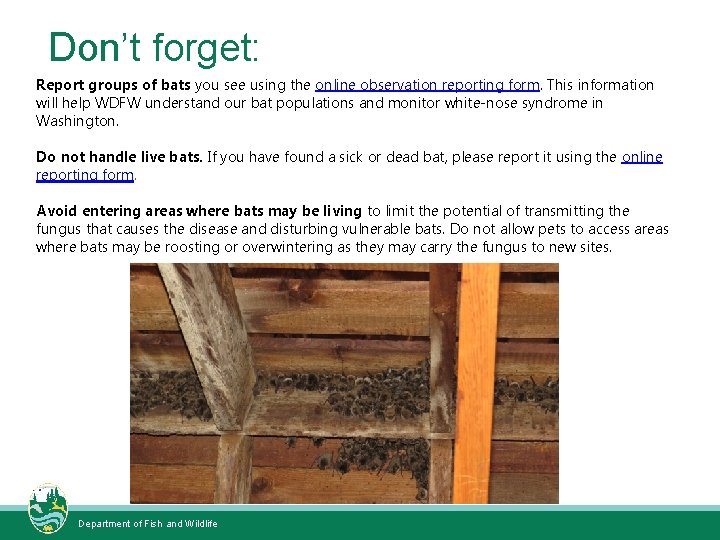
Don’t forget: Report groups of bats you see using the online observation reporting form. This information will help WDFW understand our bat populations and monitor white-nose syndrome in Washington. Do not handle live bats. If you have found a sick or dead bat, please report it using the online reporting form. Avoid entering areas where bats may be living to limit the potential of transmitting the fungus that causes the disease and disturbing vulnerable bats. Do not allow pets to access areas where bats may be roosting or overwintering as they may carry the fungus to new sites. Department of Fish and Wildlife
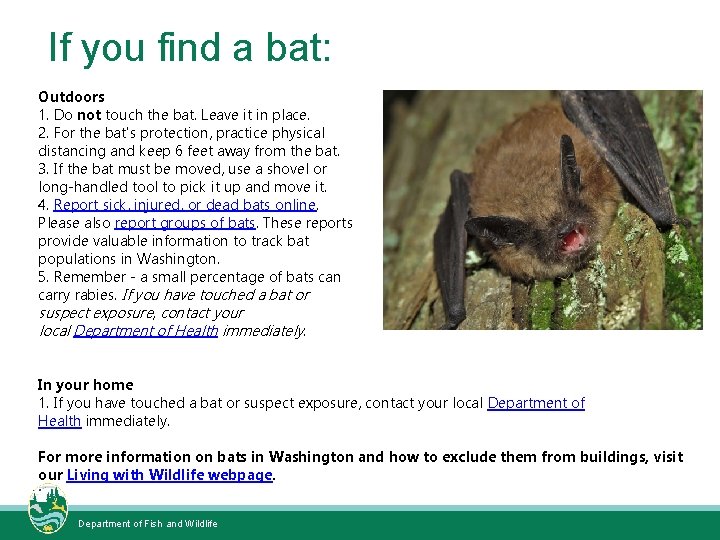
If you find a bat: Outdoors 1. Do not touch the bat. Leave it in place. 2. For the bat's protection, practice physical distancing and keep 6 feet away from the bat. 3. If the bat must be moved, use a shovel or long-handled tool to pick it up and move it. 4. Report sick, injured, or dead bats online. Please also report groups of bats. These reports provide valuable information to track bat populations in Washington. 5. Remember - a small percentage of bats can carry rabies. If you have touched a bat or suspect exposure, contact your local Department of Health immediately. In your home 1. If you have touched a bat or suspect exposure, contact your local Department of Health immediately. For more information on bats in Washington and how to exclude them from buildings, visit our Living with Wildlife webpage. Department of Fish and Wildlife
- Slides: 18