
WhiteBox Testing Statement coverage Branch coverage Path coverage
White-Box Testing • • • Statement coverage Branch coverage Path coverage Condition coverage Mutation testing Data flow-based testing
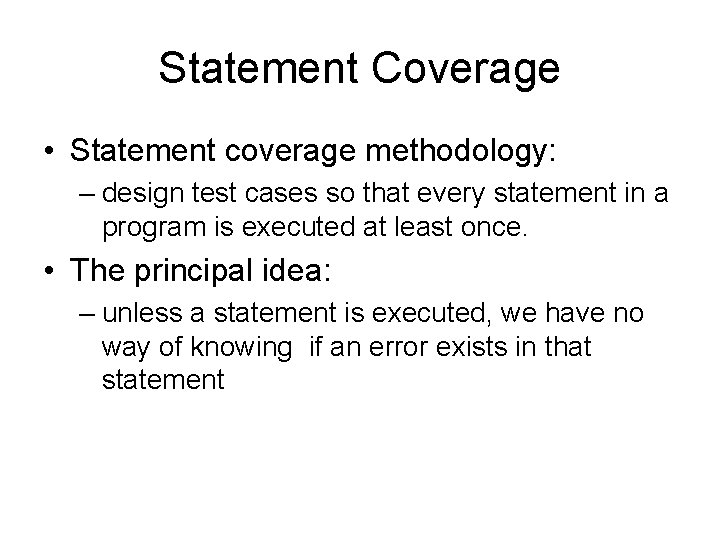
Statement Coverage • Statement coverage methodology: – design test cases so that every statement in a program is executed at least once. • The principal idea: – unless a statement is executed, we have no way of knowing if an error exists in that statement
Statement coverage criterion • Observing that a statement behaves properly for one input value: – no guarantee that it will behave correctly for all input values.
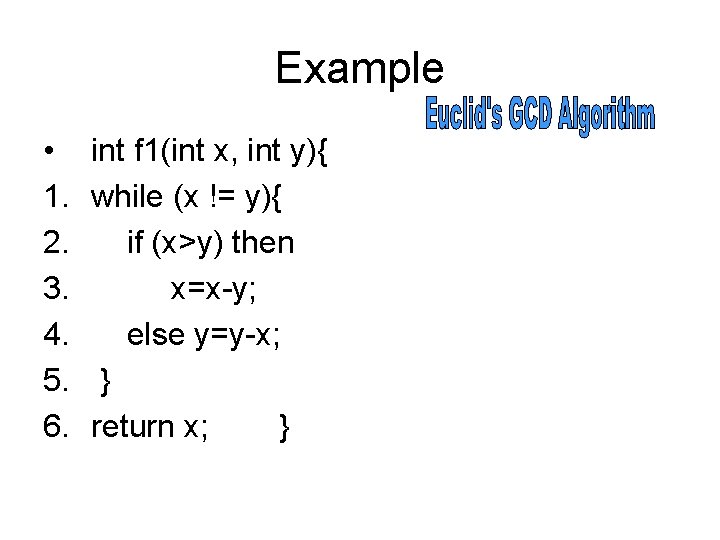
Example • 1. 2. 3. 4. 5. 6. int f 1(int x, int y){ while (x != y){ if (x>y) then x=x-y; else y=y-x; } return x; }
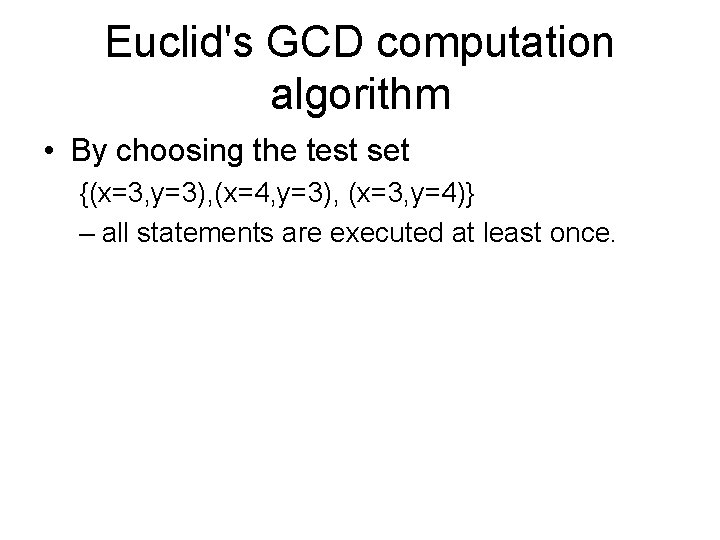
Euclid's GCD computation algorithm • By choosing the test set {(x=3, y=3), (x=4, y=3), (x=3, y=4)} – all statements are executed at least once.
Branch Coverage • Test cases are designed such that: – different branch conditions is given true and false values in turn. • Branch testing guarantees statement coverage: – a stronger testing compared to the statement coverage-based testing.
Example • Test cases for branch coverage can be: {(x=3, y=3), (x=4, y=3), (x=3, y=4)}
Condition Coverage • Test cases are designed such that: – each component of a composite conditional expression given both true and false values. • Example – Consider the conditional expression ((c 1. and. c 2). or. c 3): – Each of c 1, c 2, and c 3 are exercised at least once i. e. given true and false values.

Branch testing • Branch testing is the simplest condition testing strategy • compound conditions appearing in different branch statements are given true and false values.
Branch testing • Condition testing – stronger testing than branch testing: • Branch testing – stronger than statement coverage testing.
Condition coverage • Consider a Boolean expression having n components: – for condition coverage we require 2 n test cases. • practical only if n (the number of component conditions) is small.
Path Coverage • Design test cases such that: – all linearly independent paths in the program are executed at least once. • Defined in terms of – control flow graph (CFG) of a program.
Control flow graph (CFG) • A control flow graph (CFG) describes: – the sequence in which different instructions of a program get executed. – the way control flows through the program.
How to draw Control flow graph? • Number all the statements of a program. • Numbered statements: – represent nodes of the control flow graph. • An edge from one node to another node exists: – if execution of the statement representing the first node can result in transfer of control to the other node.
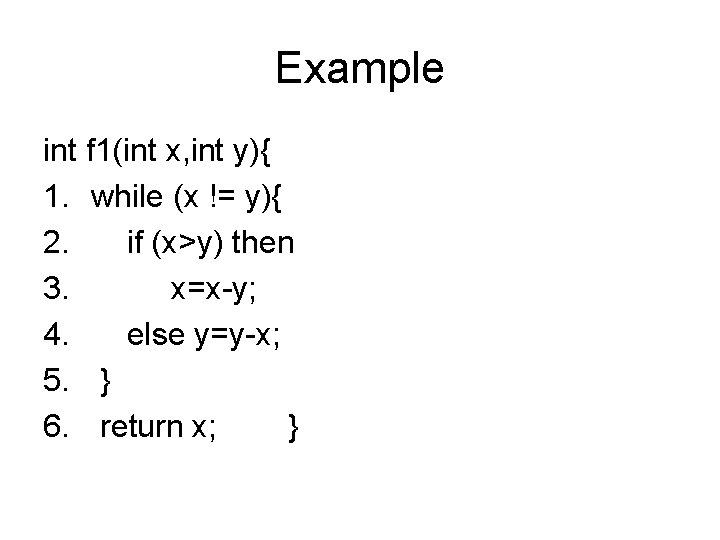
Example int f 1(int x, int y){ 1. while (x != y){ 2. if (x>y) then 3. x=x-y; 4. else y=y-x; 5. } 6. return x; }
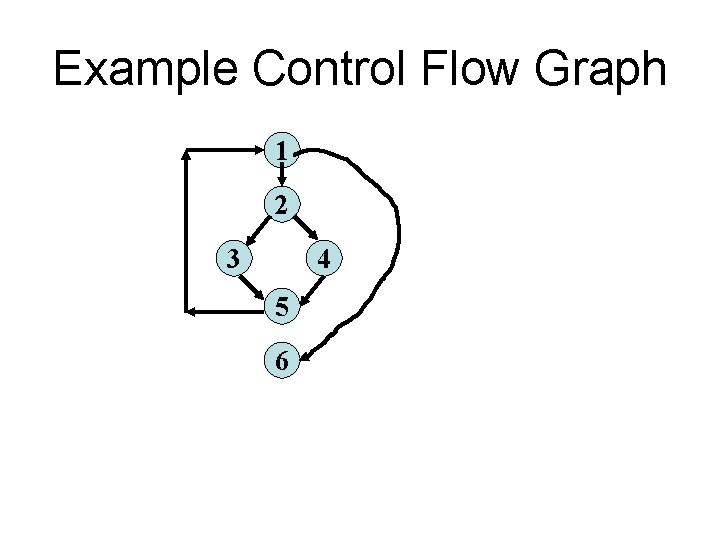
Example Control Flow Graph 1 2 3 4 5 6
Path • A path through a program: – A node and edge sequence from the starting node to a terminal node of the control flow graph. – There may be several terminal nodes for program.
Independent path • Any path through the program: – introducing at least one new node that is not included in any other independent paths. • It may be straight forward to identify linearly independent paths of simple programs. However For complicated programs it is not so easy to determine the number of independent paths.
- Slides: 18