
White Parents Racial Socialization ARE THEY DOING AS
- Slides: 1
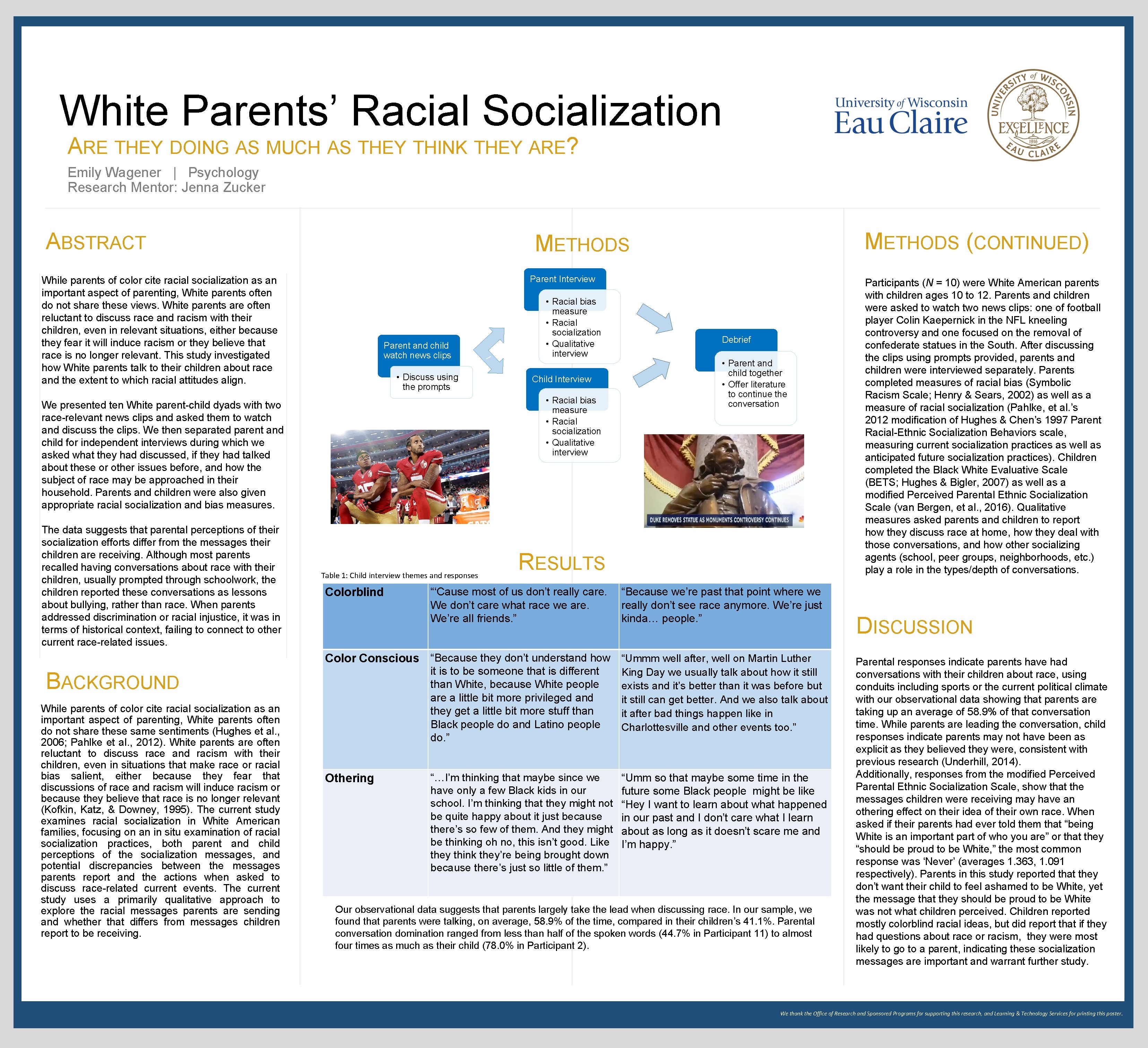
White Parents’ Racial Socialization ARE THEY DOING AS MUCH AS THEY THINK THEY ARE? Emily Wagener | Psychology Research Mentor: Jenna Zucker ABSTRACT Parent Interview Parent and child watch news clips • Discuss using the prompts • Racial bias measure • Racial socialization • Qualitative interview / While parents of color cite racial socialization as an important aspect of parenting, White parents often do not share these views. White parents are often reluctant to discuss race and racism with their children, even in relevant situations, either because they fear it will induce racism or they believe that race is no longer relevant. This study investigated how White parents talk to their children about race and the extent to which racial attitudes align. Child Interview • Racial bias measure • Racial socialization • Qualitative interview We presented ten White parent-child dyads with two race-relevant news clips and asked them to watch and discuss the clips. We then separated parent and child for independent interviews during which we asked what they had discussed, if they had talked about these or other issues before, and how the subject of race may be approached in their household. Parents and children were also given appropriate racial socialization and bias measures. The data suggests that parental perceptions of their socialization efforts differ from the messages their children are receiving. Although most parents recalled having conversations about race with their children, usually prompted through schoolwork, the children reported these conversations as lessons about bullying, rather than race. When parents addressed discrimination or racial injustice, it was in terms of historical context, failing to connect to other current race-related issues. METHODS (CONTINUED) METHODS Table 1: Child interview themes and responses Colorblind Debrief • Parent and child together • Offer literature to continue the conversation RESULTS “‘Cause most of us don’t really care. We don’t care what race we are. We’re all friends. ” “Because we’re past that point where we really don’t see race anymore. We’re just kinda… people. ” Color Conscious “Because they don’t understand how “Ummm well after, well on Martin Luther BACKGROUND While parents of color cite racial socialization as an important aspect of parenting, White parents often do not share these same sentiments (Hughes et al. , 2006; Pahlke et al. , 2012). White parents are often reluctant to discuss race and racism with their children, even in situations that make race or racial bias salient, either because they fear that discussions of race and racism will induce racism or because they believe that race is no longer relevant (Kofkin, Katz, & Downey, 1995). The current study examines racial socialization in White American families, focusing on an in situ examination of racial socialization practices, both parent and child perceptions of the socialization messages, and potential discrepancies between the messages parents report and the actions when asked to discuss race-related current events. The current study uses a primarily qualitative approach to explore the racial messages parents are sending and whether that differs from messages children report to be receiving. Othering it is to be someone that is different than White, because White people are a little bit more privileged and they get a little bit more stuff than Black people do and Latino people do. ” King Day we usually talk about how it still exists and it’s better than it was before but it still can get better. And we also talk about it after bad things happen like in Charlottesville and other events too. ” “…I’m thinking that maybe since we have only a few Black kids in our school. I’m thinking that they might not be quite happy about it just because there’s so few of them. And they might be thinking oh no, this isn’t good. Like they think they’re being brought down because there’s just so little of them. ” “Umm so that maybe some time in the future some Black people might be like “Hey I want to learn about what happened in our past and I don’t care what I learn about as long as it doesn’t scare me and I’m happy. ” Our observational data suggests that parents largely take the lead when discussing race. In our sample, we found that parents were talking, on average, 58. 9% of the time, compared in their children’s 41. 1%. Parental conversation domination ranged from less than half of the spoken words (44. 7% in Participant 11) to almost four times as much as their child (78. 0% in Participant 2). Participants (N = 10) were White American parents with children ages 10 to 12. Parents and children were asked to watch two news clips: one of football player Colin Kaepernick in the NFL kneeling controversy and one focused on the removal of confederate statues in the South. After discussing the clips using prompts provided, parents and children were interviewed separately. Parents completed measures of racial bias (Symbolic Racism Scale; Henry & Sears, 2002) as well as a measure of racial socialization (Pahlke, et al. ’s 2012 modification of Hughes & Chen’s 1997 Parent Racial-Ethnic Socialization Behaviors scale, measuring current socialization practices as well as anticipated future socialization practices). Children completed the Black White Evaluative Scale (BETS; Hughes & Bigler, 2007) as well as a modified Perceived Parental Ethnic Socialization Scale (van Bergen, et al. , 2016). Qualitative measures asked parents and children to report how they discuss race at home, how they deal with those conversations, and how other socializing agents (school, peer groups, neighborhoods, etc. ) play a role in the types/depth of conversations. DISCUSSION Parental responses indicate parents have had conversations with their children about race, using conduits including sports or the current political climate with our observational data showing that parents are taking up an average of 58. 9% of that conversation time. While parents are leading the conversation, child responses indicate parents may not have been as explicit as they believed they were, consistent with previous research (Underhill, 2014). Additionally, responses from the modified Perceived Parental Ethnic Socialization Scale, show that the messages children were receiving may have an othering effect on their idea of their own race. When asked if their parents had ever told them that “being White is an important part of who you are” or that they “should be proud to be White, ” the most common response was ‘Never’ (averages 1. 363, 1. 091 respectively). Parents in this study reported that they don’t want their child to feel ashamed to be White, yet the message that they should be proud to be White was not what children perceived. Children reported mostly colorblind racial ideas, but did report that if they had questions about race or racism, they were most likely to go to a parent, indicating these socialization messages are important and warrant further study. We thank the Office of Research and Sponsored Programs for supporting this research, and Learning & Technology Services for printing this poster.