
Which part of a culture defines it the
- Slides: 34
Which part of a culture defines it the most? A. Religion B. Education C. Family roles A. A B. B C. C
Chapter 4 Growth of the Thirteen Colonies (1607 -1770) Section 2 Government, Religion, Culture
In what ways was an American culture developing during the colonial period?
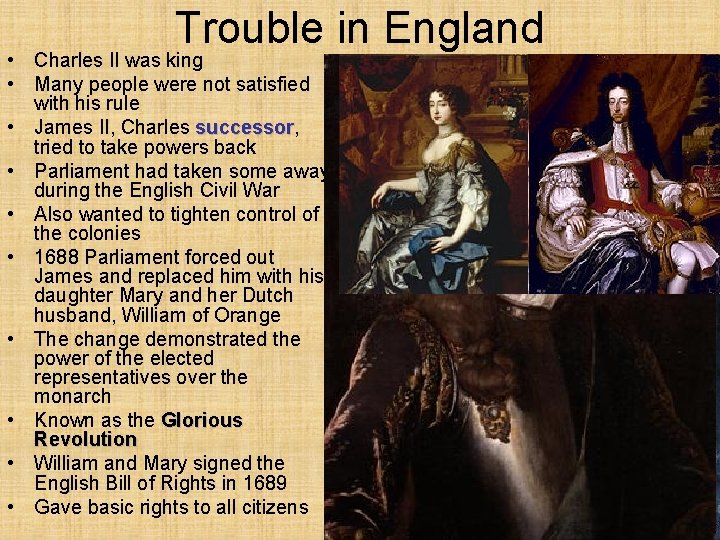
Trouble in England • Charles II was king • Many people were not satisfied with his rule • James II, Charles successor, successor tried to take powers back • Parliament had taken some away during the English Civil War • Also wanted to tighten control of the colonies • 1688 Parliament forced out James and replaced him with his daughter Mary and her Dutch husband, William of Orange • The change demonstrated the power of the elected representatives over the monarch • Known as the Glorious Revolution • William and Mary signed the English Bill of Rights in 1689 • Gave basic rights to all citizens
What did William and Mary do in order to guarantee basic rights to all citizens in England? A. Wrote a constitution B. Enacted a peace treaty C. Signed a bill of rights D. Imprisoned James II A. A B. B C. C D. D
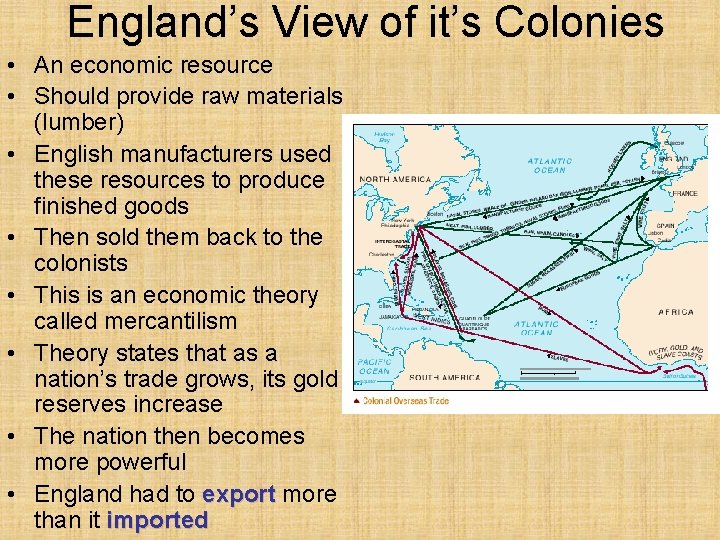
England’s View of it’s Colonies • An economic resource • Should provide raw materials (lumber) • English manufacturers used these resources to produce finished goods • Then sold them back to the colonists • This is an economic theory called mercantilism • Theory states that as a nation’s trade grows, its gold reserves increase • The nation then becomes more powerful • England had to export more than it imported
To Ensure England Benefited • From trade in the Colonies • Parliament passed several laws from 1651 -1673 • Navigation Acts directed trade between England the Colonies • Made colonists use ships made in England or the Colonies • Prevented Colonists from shipping certain products (tobacco and sugar) outside of England’s empire • Colonists accepted these laws • Later they resented these restrictions • Wanted to make and sell their own manufactured goods where they could get higher prices • Colonists ignored these laws and began smuggling with other nations
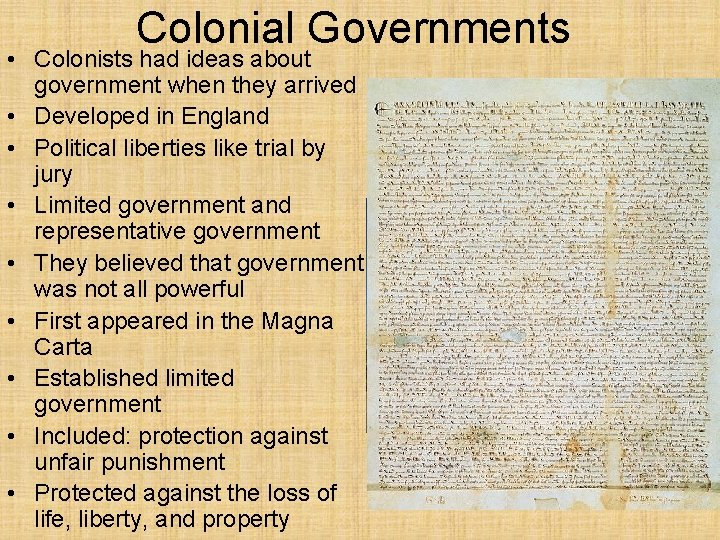
Colonial Governments • Colonists had ideas about government when they arrived • Developed in England • Political liberties like trial by jury • Limited government and representative government • They believed that government was not all powerful • First appeared in the Magna Carta • Established limited government • Included: protection against unfair punishment • Protected against the loss of life, liberty, and property
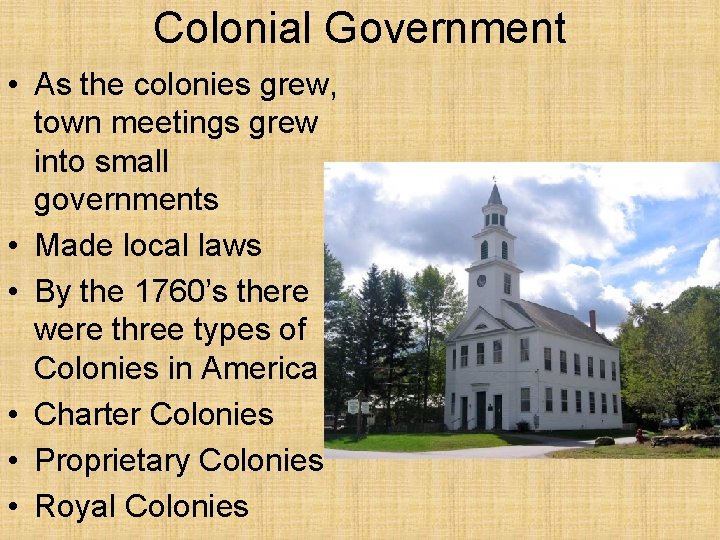
Colonial Government • As the colonies grew, town meetings grew into small governments • Made local laws • By the 1760’s there were three types of Colonies in America • Charter Colonies • Proprietary Colonies • Royal Colonies
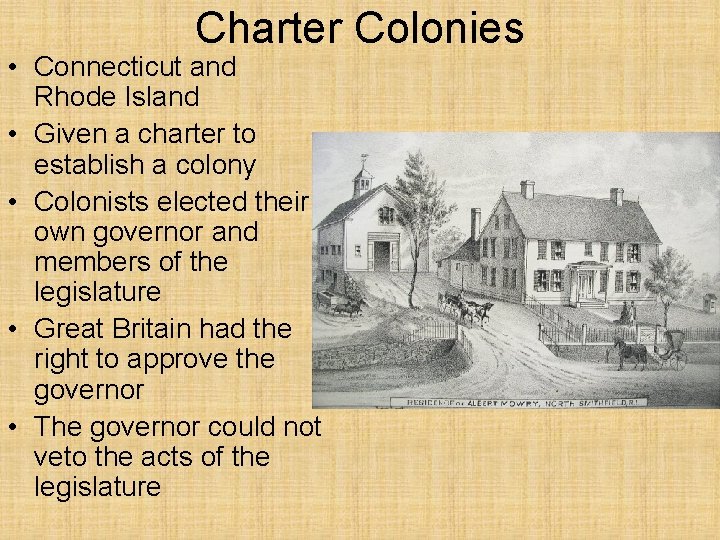
Charter Colonies • Connecticut and Rhode Island • Given a charter to establish a colony • Colonists elected their own governor and members of the legislature • Great Britain had the right to approve the governor • The governor could not veto the acts of the legislature
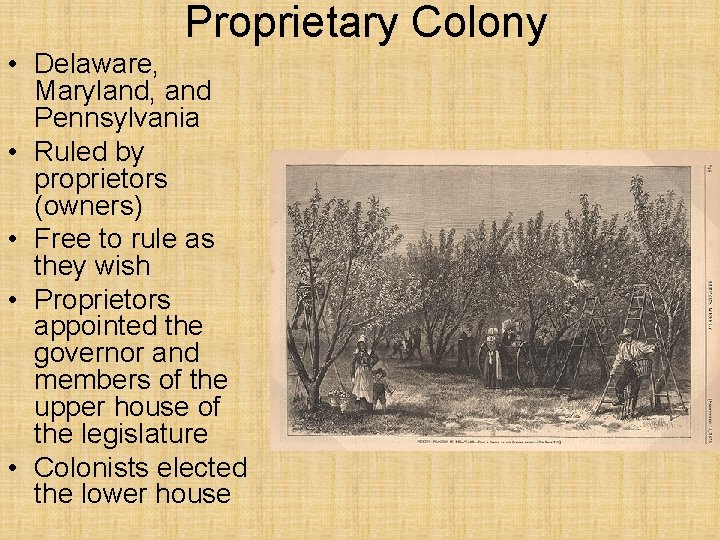
Proprietary Colony • Delaware, Maryland, and Pennsylvania • Ruled by proprietors (owners) • Free to rule as they wish • Proprietors appointed the governor and members of the upper house of the legislature • Colonists elected the lower house
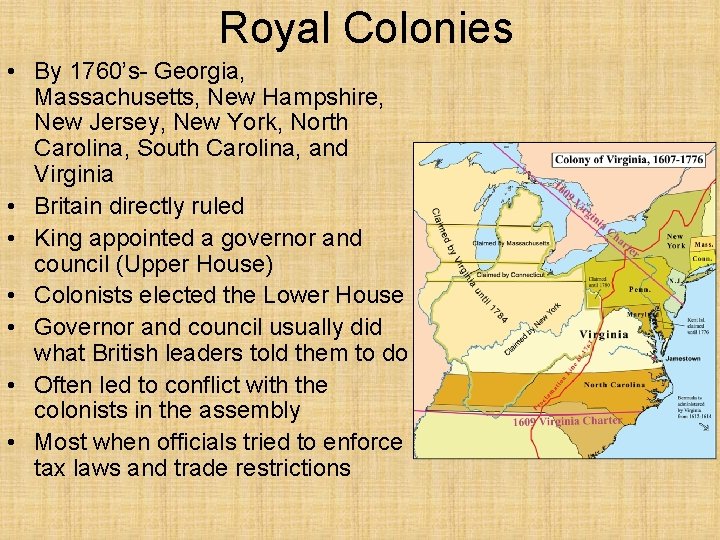
Royal Colonies • By 1760’s- Georgia, Massachusetts, New Hampshire, New Jersey, New York, North Carolina, South Carolina, and Virginia • Britain directly ruled • King appointed a governor and council (Upper House) • Colonists elected the Lower House • Governor and council usually did what British leaders told them to do • Often led to conflict with the colonists in the assembly • Most when officials tried to enforce tax laws and trade restrictions
Which type of colony was ruled by individuals or groups to whom Britain granted land? A. Charter B. Proprietary C. Royal A. A B. B C. C
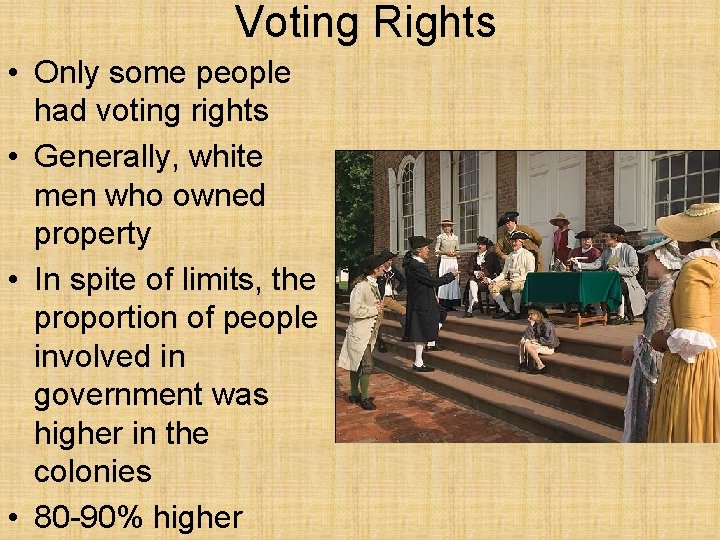
Voting Rights • Only some people had voting rights • Generally, white men who owned property • In spite of limits, the proportion of people involved in government was higher in the colonies • 80 -90% higher
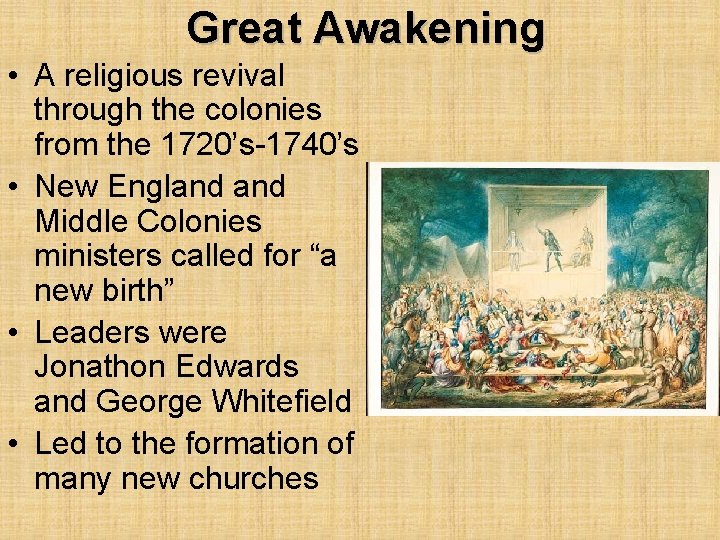
Great Awakening • A religious revival through the colonies from the 1720’s-1740’s • New England Middle Colonies ministers called for “a new birth” • Leaders were Jonathon Edwards and George Whitefield • Led to the formation of many new churches
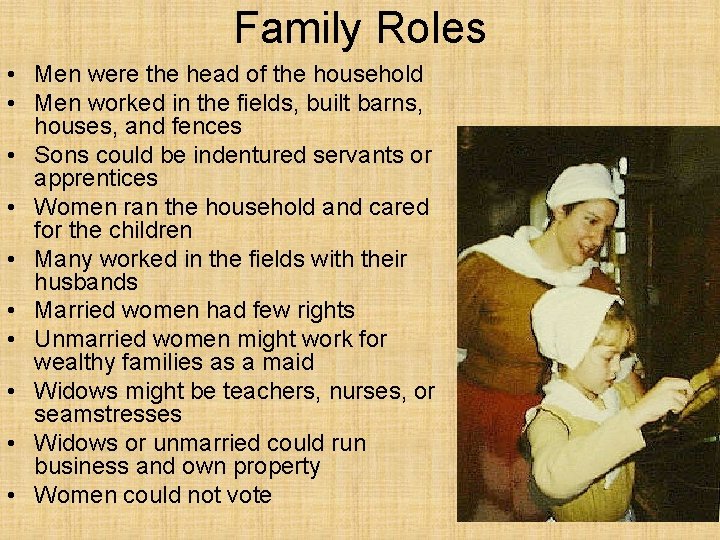
Family Roles • Men were the head of the household • Men worked in the fields, built barns, houses, and fences • Sons could be indentured servants or apprentices • Women ran the household and cared for the children • Many worked in the fields with their husbands • Married women had few rights • Unmarried women might work for wealthy families as a maid • Widows might be teachers, nurses, or seamstresses • Widows or unmarried could run business and own property • Women could not vote
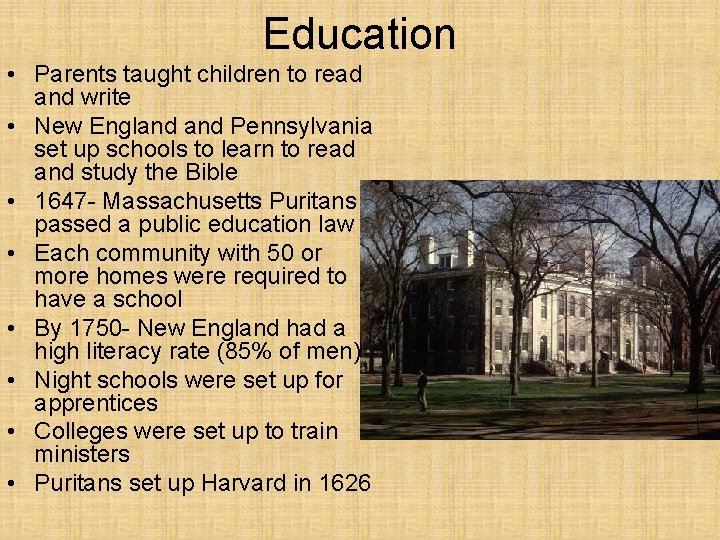
Education • Parents taught children to read and write • New England Pennsylvania set up schools to learn to read and study the Bible • 1647 - Massachusetts Puritans passed a public education law • Each community with 50 or more homes were required to have a school • By 1750 - New England had a high literacy rate (85% of men) • Night schools were set up for apprentices • Colleges were set up to train ministers • Puritans set up Harvard in 1626
Which was the first college in North America? A. William and Mary B. Princeton C. Harvard D. University of Virginia A. A B. B C. C D. D
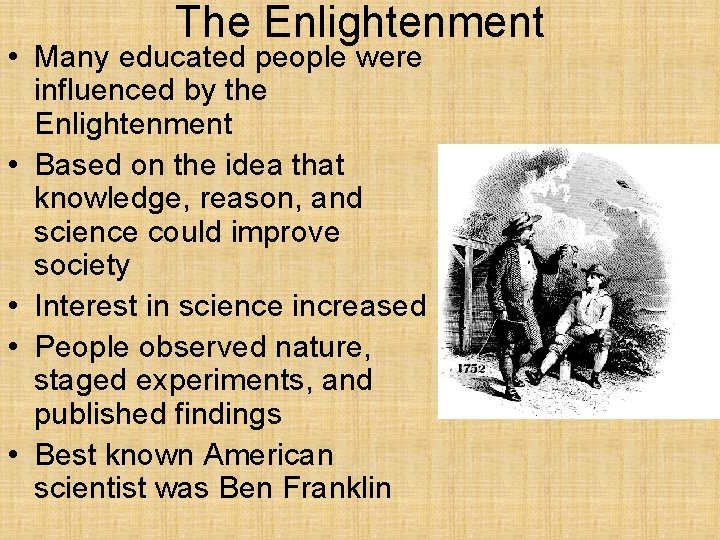
The Enlightenment • Many educated people were influenced by the Enlightenment • Based on the idea that knowledge, reason, and science could improve society • Interest in science increased • People observed nature, staged experiments, and published findings • Best known American scientist was Ben Franklin
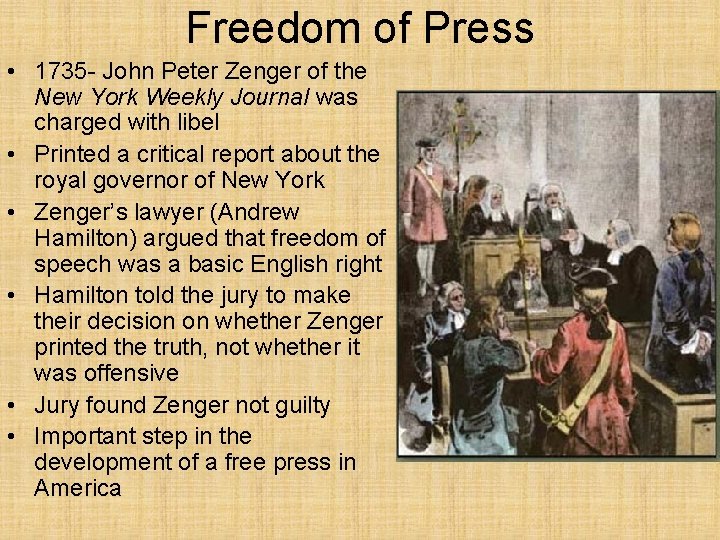
Freedom of Press • 1735 - John Peter Zenger of the New York Weekly Journal was charged with libel • Printed a critical report about the royal governor of New York • Zenger’s lawyer (Andrew Hamilton) argued that freedom of speech was a basic English right • Hamilton told the jury to make their decision on whether Zenger printed the truth, not whether it was offensive • Jury found Zenger not guilty • Important step in the development of a free press in America
In what ways was an American culture developing during the colonial period? - The colonists adopted ideas of limited government and representative government. - Distinct religious and educational ideas contributed to the culture - Family was the basis of society - Interest in science and invention grew - Freedom of press was defended
Chapter 4 Section 2 Quiz
During the Glorious Revolution, the British monarchy gained more power at the expense of Parliament. A. True B. False
After the Navigation Acts were passed, colonial merchants could not use foreign ships to send their goods. A. True B. False
Most colonists placed a high value on education. A. True B. False
The Enlightenment was a religious movement. A. True B. False
The case involving John Peter Zenger was an important step in establishing free press in America. A. True B. False
Which laws directed the flow of goods between England the colonies? A. Navigation Acts B. Merchant's Pledge C. Colonists Rights Law D. Colonies' Charter
Which of the following is not a type of American colony? A. B. C. D. charter colony compact colony proprietary colony royal colony
The only people who could vote in the colonies were A. indentured servants. B. landless white men. C. white female property owners. D. white male property owners.
What is the name of the first college founded in North America? A. B. C. D. Harvard Cambridge William and Mary Yale
The American who best exemplified the Enlightenment way of thinking was A. Jonathan Edwards. B. Benjamin Franklin. C. George Whitefield. D. William Penn.
Participant Scores 0 0 Participant 1 Participant 2 Participant 3 Participant 4 0 Participant 5
Team Scores 0 0 Team 1 Team 2 Team 3 Team 4 0 Team 5