
Which of the following practices would have the


- Slides: 104
Which of the following practices would have the biggest impact on achieving global sustainability? A. Recycling aluminum cans B. Using fuel-efficient vehicles C. Replanting deforested areas D. Reducing human population size E. Developing ecotourism venues
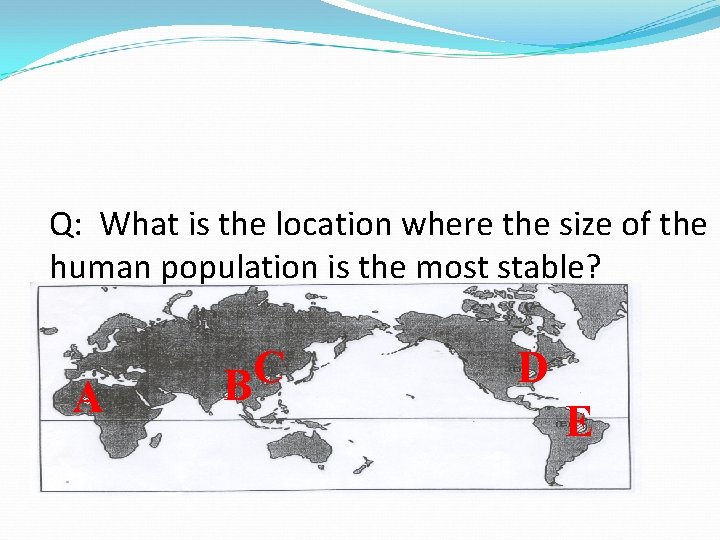
Q: What is the location where the size of the human population is the most stable? A C B D E
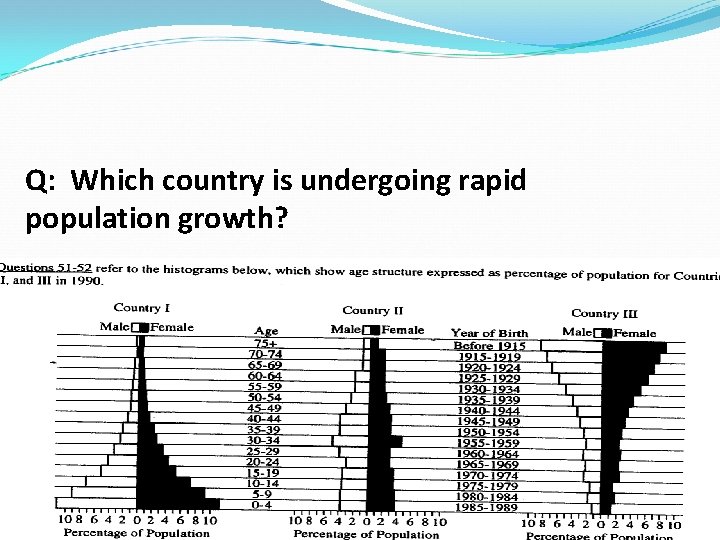
Q: Which country is undergoing rapid population growth?
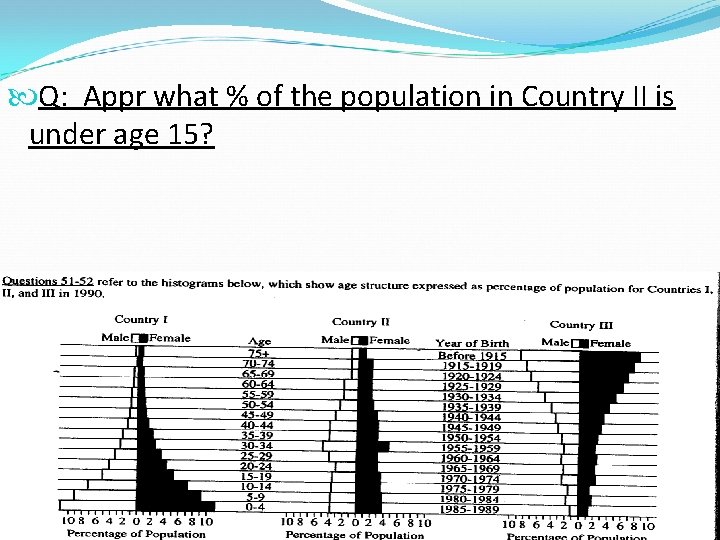
Q: Appr what % of the population in Country II is under age 15?
Q: In a human population undergoing the demographic transition, which of the following generally decreases first? a. birth rate b. Death rate c. Avg. family size d. Life expectancy e. level of education
Q: Compared with people in developing countries, people in industrialized countries are more likely to eat: a. Beans b. Beef c. Corn d. Rice e. Wheat
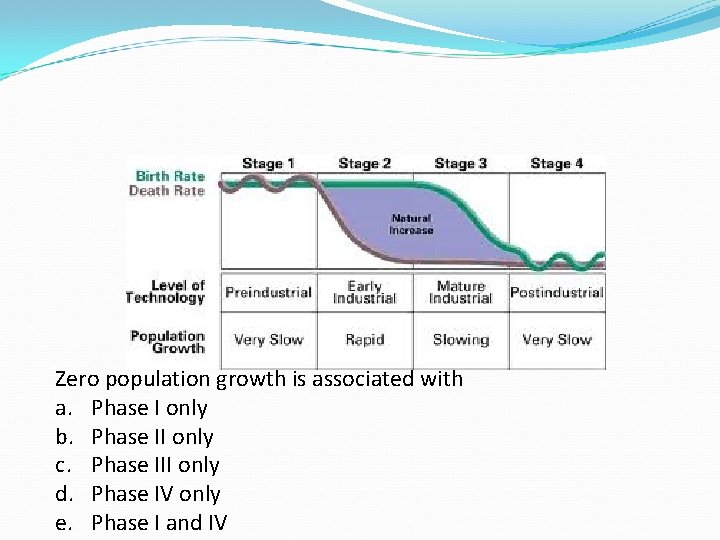
Zero population growth is associated with a. Phase I only b. Phase II only c. Phase III only d. Phase IV only e. Phase I and IV
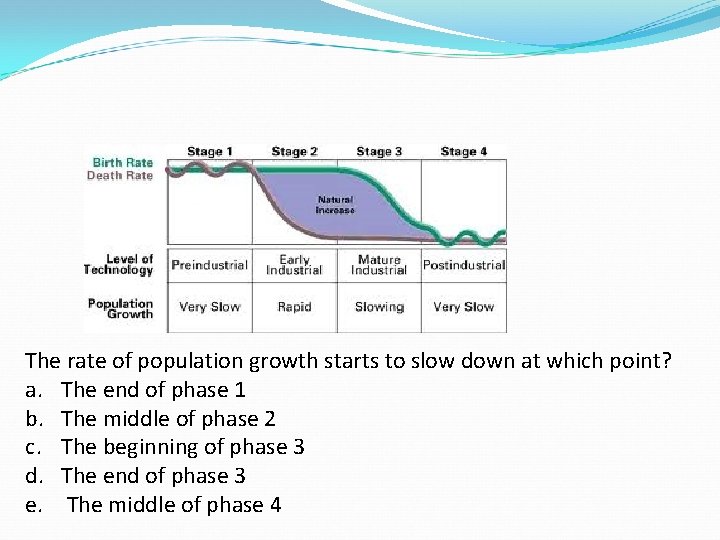
The rate of population growth starts to slow down at which point? a. The end of phase 1 b. The middle of phase 2 c. The beginning of phase 3 d. The end of phase 3 e. The middle of phase 4
1. Count Duckweed 2. The Material World Which of the following would most likely have the greatest positive impact on the quality of the natural environment worldwide? A. Discovery of new reserves of fossil fuels in coastal areas B. Increased agricultural production on marginal desert lands C. Increased life expectancy in more developed nations D. Increased reliance on food from ocean ecosystems E. Stabilization or reduction of the size of the human population
A country currently has a population of 100 million and an annual growth rate of 3. 5 percent. If the growth rate remains constant, what will be the population of this country in 40 years? (a) 150 million (b) 200 million (c) 300 million (d) 400 million (e) 800 million
The crude birth rate is the number of births per _____ people per year. A. 50 B. 100 C. 500 D. 1000 E. 10, 000
If a country’s population grows at a yearly rate of 5%, in how many years will the population double? A. 5 B. 12 C. 14 D. 20 E. 50
Developed countries A. have a large replacement level fertility B. sizes are found by subtracting the number of immigrants from emigrants C. tend to consume less meat than developing countries D. generate the majority of the world’s pollution and waste E. have high infant mortality rates
What organism would occupy the lowest trophic level on the pyramid? a. Spider b. Deer c. Lion d. Hawk e. Snake
Matter is A. Anything with mass that takes up space B. Anything with the ability to do work C. Made up of atoms D. Two or more different kinds of atoms bonded together E. Anything with the ability to be changed in form or shape
If you travel from Canada to Costa Rica, you would pass through many biomes. This change in biomes is mainly the result of A. altitude B. human factors C. increase in temperature and precipitation D. ocean currents E. succession
The best example of a tertiary consumer would be a/an a. mouse b. grasshopper c. sheep d. cactus e. coyote
Which letter corresponds to the carrying capacity?
What would be an example of a parasite? a. Ticks feeding on a deer b. Startlings displacing bluebirds from nesting sites c. Bees consuming nectar and carrying pollen from one flower to another d. Moss growing on a tree trunk
What is the most abundant gas in the Earth’s atmosphere? A. carbon dioxide B. oxygen C. carbon monoxide D. nitrogen E. neon
Which of the following is the best example of a keystone species? a. Sea otter b. Sea urchin c. Spotted owl d. Snail darter e. E. Condor
Why do introduced species often become pests? a. They displace native species b. They increase biodiversity c. They do not adapt well to local habitats d. They contribute to habitat fragmentation e. They have low biotic potential
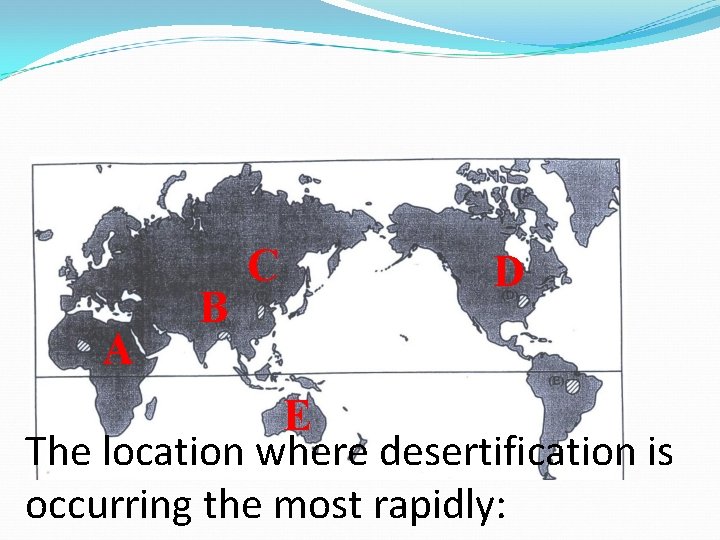
A B C D E The location where desertification is occurring the most rapidly:
Which biome would be most affected by a large decrease in precipitation? a. desert b. tundra c. coniferous forest d. temperate forest e. grassland
All of the following are examples of abiotic factors except a. temperature b. p. H c. wind d. salinity e. vegetation
All forms of water make up the a. lithosphere b. atmosphere c. hydrosphere d. tranosphere e. biosphere
The major biological source of dissolved oxygen in the ocean comes from A. Decomposition of organic sediments on the ocean floor B. Metabolic processes of coral in reefs C. Oxidation of sulfur by bacteria in ocean vent communities D. Photosynthesis by phytoplankton E. Respiration by zooplankton
Q: What would most likely result from destruction of wetlands surrounding a river? a. A decreased sediment load in the river b. A decreased level of pollutants such as nitrates in the river c. An increased diversity of aquatic species in the river d. An increased level of oxygen in the river e. An increased frequency of flooding of the river valley
Q: The presence of high levels of fecal coliform bacteria in a water source indicates what about the water? a. It is safe to drink b. It is safe to swim in c. Contains too little oxygen to support fish life d. Has been recently chlorinated at a sewage treatment plant e. Has been contaminated by untreated human or animal waste
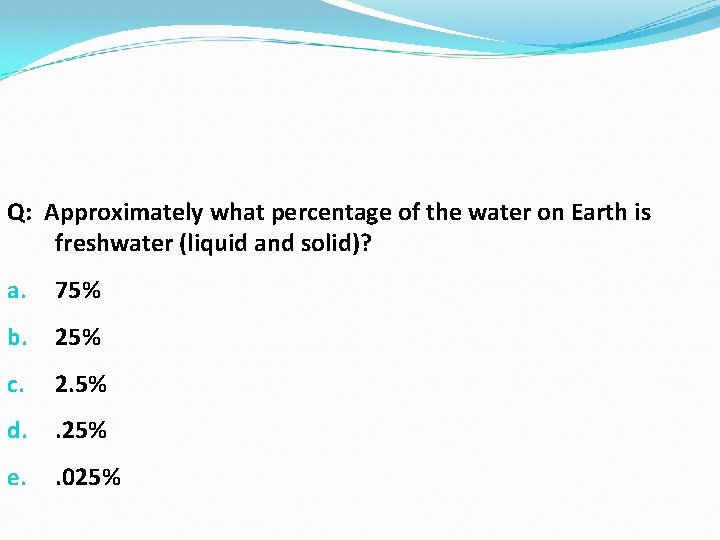
Q: Approximately what percentage of the water on Earth is freshwater (liquid and solid)? a. 75% b. 25% c. 2. 5% d. . 25% e. . 025%
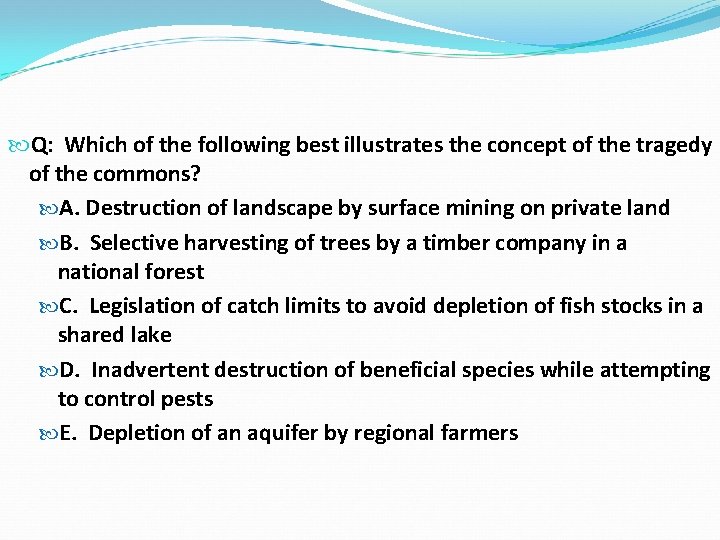
Q: Which of the following best illustrates the concept of the tragedy of the commons? A. Destruction of landscape by surface mining on private land B. Selective harvesting of trees by a timber company in a national forest C. Legislation of catch limits to avoid depletion of fish stocks in a shared lake D. Inadvertent destruction of beneficial species while attempting to control pests E. Depletion of an aquifer by regional farmers
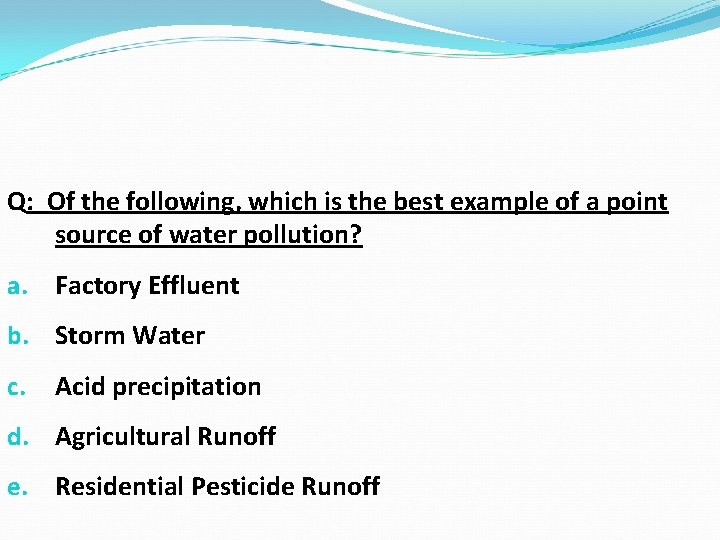
Q: Of the following, which is the best example of a point source of water pollution? a. Factory Effluent b. Storm Water c. Acid precipitation d. Agricultural Runoff e. Residential Pesticide Runoff
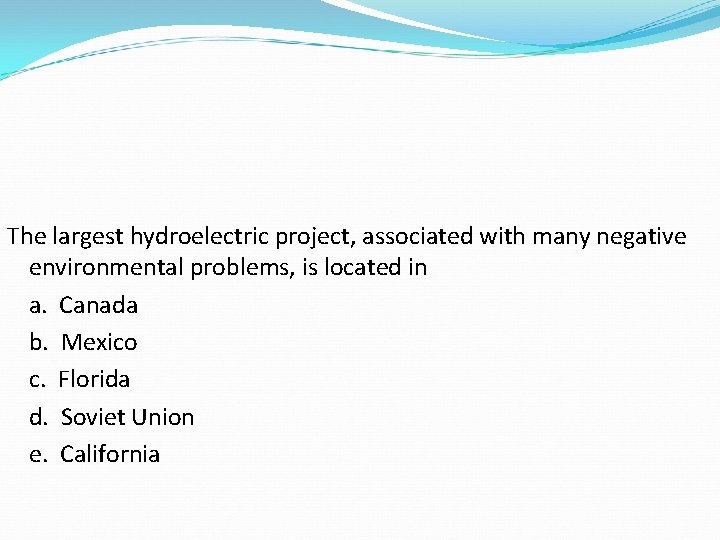
The largest hydroelectric project, associated with many negative environmental problems, is located in a. Canada b. Mexico c. Florida d. Soviet Union e. California
The major biological source of dissolved oxygen in the ocean comes from A. Decomposition of organic sediments on the ocean floor B. Metabolic processes of coral in reefs C. Oxidation of sulfur by bacteria in ocean vent communities D. Photosynthesis by phytoplankton E. Respiration by zooplankton
Q: What causes accelerated eutrophication when introduced into streams, lakes and bays? A. Bacteria B. Pesticides C. Herbicides D. Phosphates E. Acid waste & salts
The largest use of freshwater around the world is a. watering people’s yards b. doing laundry, showering and other cleaning processes c. drinking water d. irrigating crops e. operating power plants
Which of the following elements is most likely to limit primary production in freshwater lakes? A. Oxygen B. Calcium C. Phosphorus D. Carbon E. Iron
Q: Exemplified by starlings displacing bluebirds from nesting sites. a. Commensalism b. Parasitism c. Mutualism d. Predation e. Competition
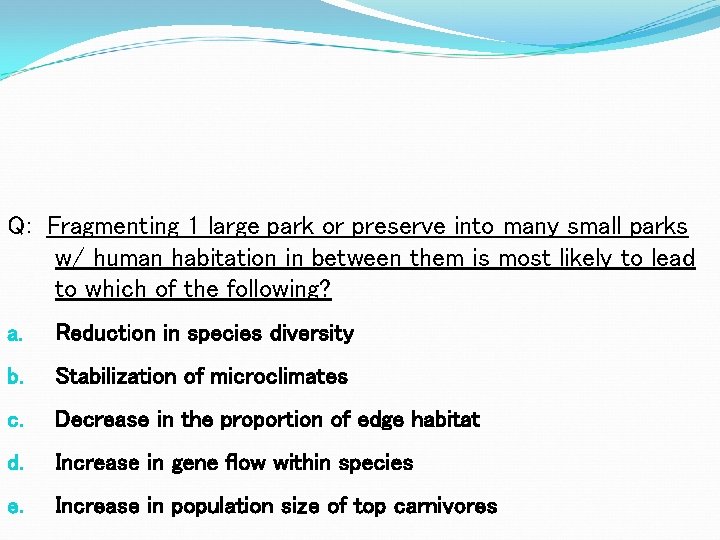
Q: Fragmenting 1 large park or preserve into many small parks w/ human habitation in between them is most likely to lead to which of the following? a. Reduction in species diversity b. Stabilization of microclimates c. Decrease in the proportion of edge habitat d. Increase in gene flow within species e. Increase in population size of top carnivores
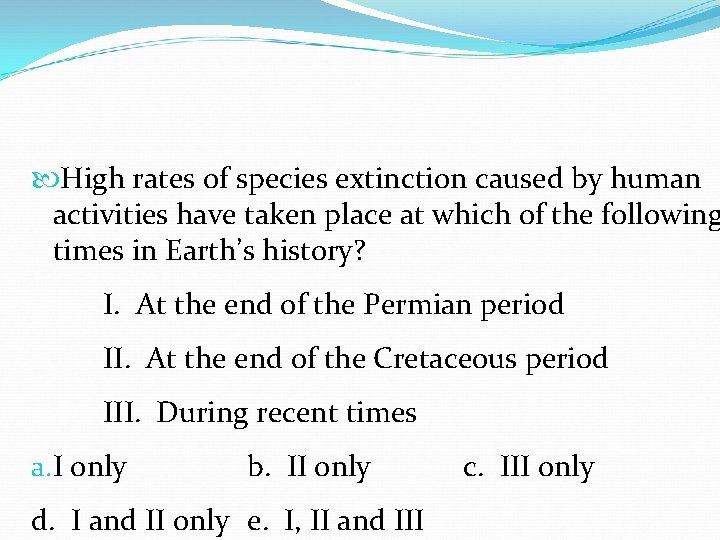
High rates of species extinction caused by human activities have taken place at which of the following times in Earth’s history? I. At the end of the Permian period II. At the end of the Cretaceous period III. During recent times a. I only b. II only d. I and II only e. I, II and III c. III only
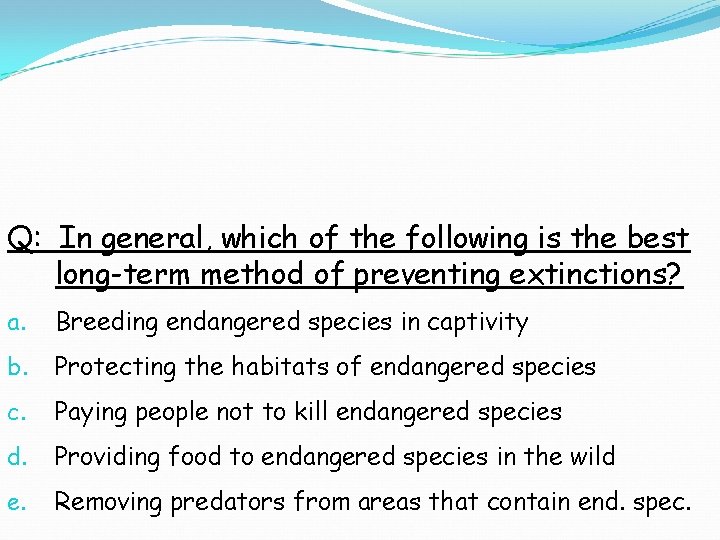
Q: In general, which of the following is the best long-term method of preventing extinctions? a. Breeding endangered species in captivity b. Protecting the habitats of endangered species c. Paying people not to kill endangered species d. Providing food to endangered species in the wild e. Removing predators from areas that contain end. spec.
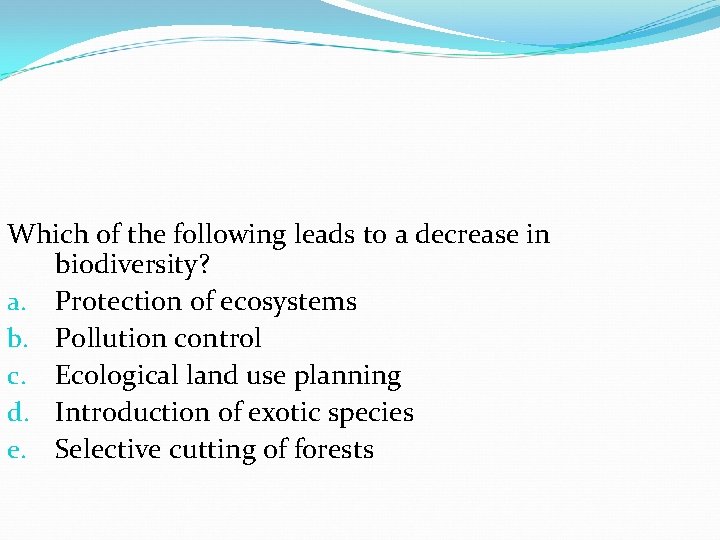
Which of the following leads to a decrease in biodiversity? a. Protection of ecosystems b. Pollution control c. Ecological land use planning d. Introduction of exotic species e. Selective cutting of forests
Q: Environmentalists oppose the mining of Antarctic mineral resources because a. Territorial claims to Antarctica are unresolved b. The existence of valuable mineral deposits in the Antarctic environment is unlikely c. The Antarctic environment is fragile & extremely vulnerable to the disturbance that would accompany development d. currently known world reserves of important metals and oil are considered inexhaustible e. the demand for minerals is expected to decline as the world’s nations become more industrialized
Which of the following best shows the process of evolution? A. A lizard’s color becomes brown as it sits on a log. B. A bear goes into hibernation C. A plant loses its leaves in a drought D. A population of mosquitoes develops resistance to a pesticide E. A population of foxes increases as more prey becomes available
Which of the following is a commercially used method for harvesting trees and is most likely to lead to a fragmented landscape with serious impacts on biodiversity? A. Selective cutting B. Clear-cutting C. Shelter-wood cutting D. Slash and burn clearing E. Gleaning
The largest area of old-growth forest in the U. S. is in A. Alaska B. Montana C. California D. North Carolina E. Michigan
Illegal hunting for profit is called A. Subsistence hunting B. Sport hunting C. Poaching D. Commercial hunting E. Partial hunting
Most volcanism in the world is associated w/ a. Plate boundaries b. Mid-continental hot spots c. Faulting d. Aquifer depletion e. desertification
Which of the following has the largest proven coal reserves? A. South America B. The United States C. Australia D. Indonesia E. Africa
Q: Which of the following metals is considered an energy source? a. Uranium d. Copper b. Cobalt e. Palladium c. Mercury
Q: There are various stages in the formation of coal as heat and pressure are increased and moisture content is decreased. These stages, in order, are A. Bituminous, peat, lignite, anthracite B. Peat, lignite, bituminous, anthracite C. Peat, lignite, anthracite, bituminous D. Lignite, bituminous, anthracite, peat E. Anthracite, bituminous, peat, lignite
Which of the following is the most abundant element in Earth’s crust? A. Oxygen B. Aluminum C. Iron D. Nitrogen E. Argon
A sample of radioactive waste has a half-life of 10 years and an activity level of 2 curies. After how many years will the activity level of this sample be 0. 25 curie? a. 10 years b. 20 years d. 40 years d. 80 years c. 30 years
Of the following sources, which supplies the most commercial energy in the world today? A. Solar B. Oil C. Biomass D. Nuclear E. hydroelectric
Q: Choose from the following: Biomass, wind, tidal, nuclear, sunlight 1. Produces hazardous waste 2. Photovoltaic cells 3. Deforestation 4. Not renewable
The majority of atmospheric mercury is produced by a. b. c. d. e. Medical waste incinerators volatilization of lead-based paint Coal-burning power plants Runoff from thermometer factories Municipal waste incinerators
Q: Choose from the following: Biomass, wind, tidal, nuclear, sunlight 1. Produces hazardous waste 2. Photovoltaic cells 3. Deforestation 4. Not renewable
Q: Which of the following best describes soils in many tropical rainforests? a. They lack soil horizons b. They are quickly depleted of nutrients when the forest is removed c. They are similar to soils in grasslands d. They are well suited for growing a wide variety of crops e. They are deep and well drained
Q: The amount of sediment deposited at the mouth of a river system is likely to be increased by the presence upstream of which of the following? i. Artificial levees and embankments ii. Dams iii. Extensive natural wetlands a. I only d. I and II b. II only c. III only e. II and III
Q: Which of the following procedures would be best for remediating the effects of soil salinization? a. Application of broad-spectrum biocides to kill microorganisms b. Application of superphosphate to increase soil fertility c. Addition of clay to increase soil water-holding capacity d. Addition of large amounts of water to leach out salts e. Addition of lime to raise soil p. H
Q: Reasons that human populations historically have settled in floodplains include which of the following? I. The soil in floodplains is usually fertile II. The terrain in floodplains tends to be flat III. Floodplains are close to rivers for transportation a. I only b. II only c. I and II only d. II and III only e. I, II and III
The process by which a soil nutrient is reduced and released to the atmosphere as a gas is called A. Photosynthesis B. Eutrophication C. Denitrification D. Decomposition E. Transpiration
Which of the following is the correct order of soil particles in order of increasing size? A. Clay-sand-silt B. Clay- silt- sand C. Sand- clay- silt D. Sand-silt-clay E. Silt-clay-sand
Which of the following is likely to MINIMIZE soil erosion? A. High- yield crops B. Deforestation C. Herbicide use D. Annual plowing E. No-till agriculture
Q: Which of the following is the best illustration of the pesticide treadmill? a. Sequence of several pesticides used by farmers to maximize effectiveness b. Increased use of pesticides to eradicate genetically resistant pests c. Biomagnification of pesticides in the fatty tissue of primary consumers d. Movement of pesticides following their percolation into the groundwater e. Process that is used to manufacture pesticides
Q: For a certain insecticide, the LD-50 dosage level for rats is determined to be 250 milligrams per kilogram of body mass. On the basis of this information what is the best prediction? a. 50% of any rat pop. Would be sickened b. 50% of the pop of any warm-blooded animal would die c. 50% of any pop. Of mosquitoes would die d. 500 out of every 1000 people would be effected e. 500 out of every 1000 rats would die
Which of the following statements about genetic diversity is true? a. Genetic uniformity of a crop increases the crop’s overall resistance to pests and disease b. Genetic resistance to pests and diseases can be increased by crossing a crop plant with ancestral varieties c. Genetic engineering technology is used to increase genetic diversity by creating new species with synthetic genes d. Genetic diversity within populations of common crop species such as corn is typically high e. Genetic diversity is usually high in endangered species
If two chemical pesticides are used together, that by themselves are considered safe, but together cause extensive fish kills, this is an example of a. Homeostasis b. Synergism c. Commensalism d. Bioaccumulation e. Antagonism
What is the threshold level of toxicity? a. The level where 50% of the test organisms are killed b. The level where all of the test organisms are killed c. The level where no significant amount of the test organisms are killed d. The amount of pesticide you added to the experiment e. The amount of organisms you added to the experiment
Which of the following is most likely to be the direct result of lack of genetic diversity in a food crop such as corn? A. Decreased kernel size B. Decreased potential yield C. Decreased dependence on chemical fertilizers D. Increased susceptibility to plant disease E. Increased resistance to pests
Some toxic compounds are ingested and retained in the tissues. These pollutants pose special risks to humans and other organisms high on the food chain because of which process? A. Synergism B. Compound contamination C. Biomagnification D. Threshold effect E. Carcinogenesis
Which of the following factors is fundamentally responsible for seasons on Earth? a. The varying distance of Earth from the Sun b. The tilt of Earth’s axis of rotation c. The latitudinal variation in temperature and precipitation d. The tidal pull of the Sun and Moon e. The anthropogenic greenhouse effect
The polar regions radiate away more heat energy than they receive from the Sun in the course of a year. However, they are prevented from becoming progressively colder each year primarily by the a. Absorption of UV radiation by snow b. Transport of heat through the atmosphere and oceans c. Concentration of Earth’s magnetic field lines at the poles d. Release of latent heat to the atmosphere when the polar ice caps melt e. Generation of heat by glacial movement
Traveling southward from the Arctic regions of Canada to the tropics of Panama, one passes through several biomes- tundra, coniferous forest, temperate deciduous forest, and tropical rain forest. This pattern of change in vegetation is primarily the result of a. Primary and secondary succession b. The invasion of exotic species c. An increase in mean annual temperature and a decrease in mean annual precipitation d. An increase in both mean annual temperature and mean annual precipitation e. An increase in the total annual hours of sunlight
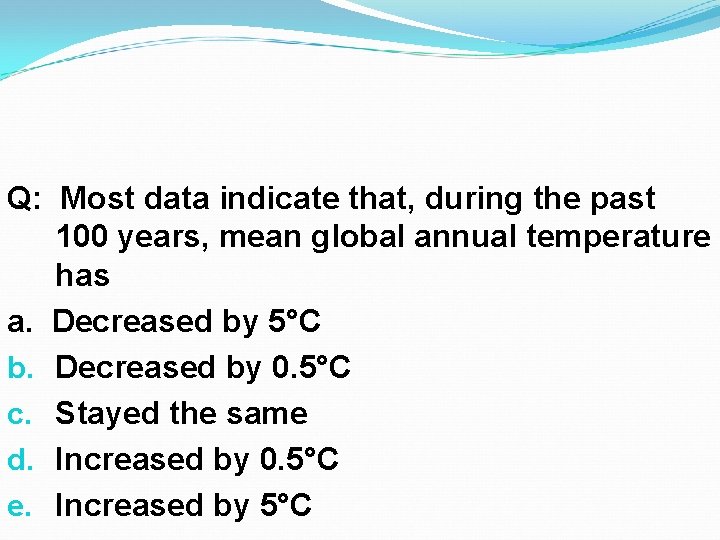
Q: Most data indicate that, during the past 100 years, mean global annual temperature has a. Decreased by 5°C b. Decreased by 0. 5°C c. Stayed the same d. Increased by 0. 5°C e. Increased by 5°C
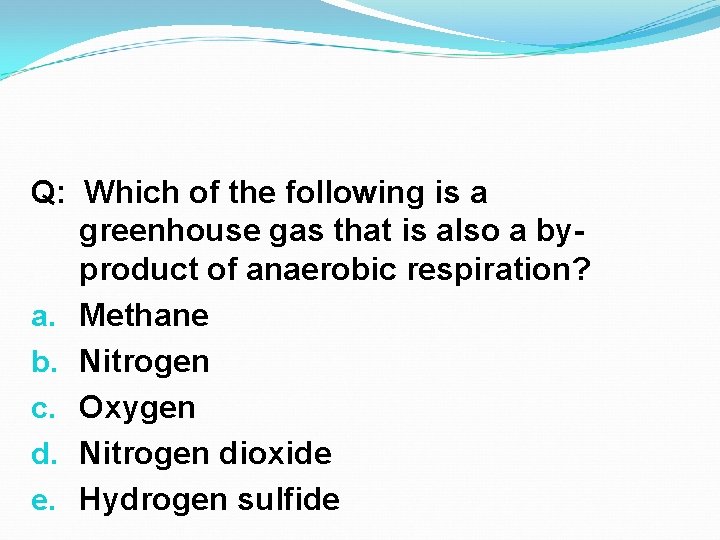
Q: Which of the following is a greenhouse gas that is also a byproduct of anaerobic respiration? a. Methane b. Nitrogen c. Oxygen d. Nitrogen dioxide e. Hydrogen sulfide
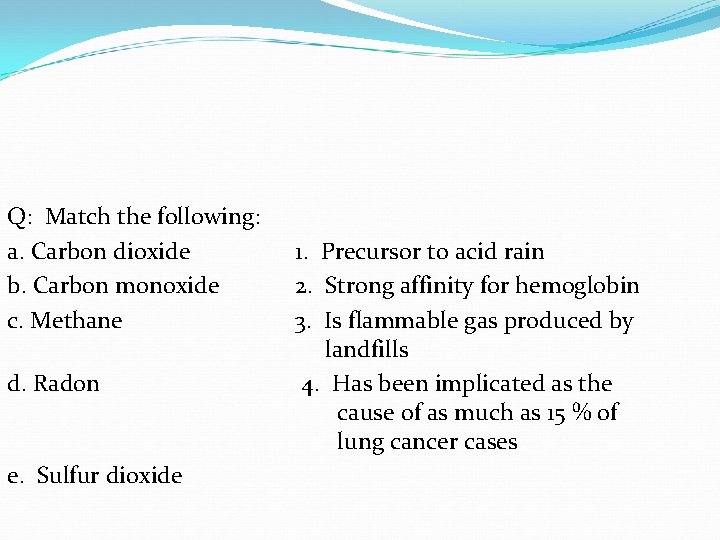
Q: Match the following: a. Carbon dioxide b. Carbon monoxide c. Methane d. Radon e. Sulfur dioxide 1. Precursor to acid rain 2. Strong affinity for hemoglobin 3. Is flammable gas produced by landfills 4. Has been implicated as the cause of as much as 15 % of lung cancer cases
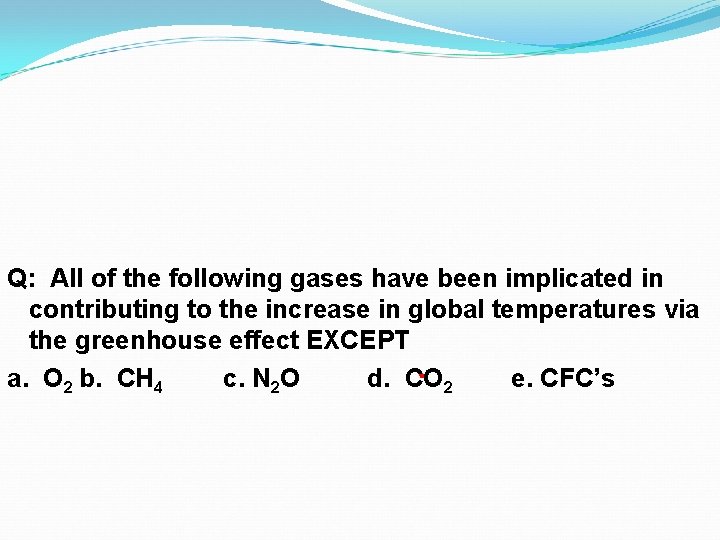
Q: All of the following gases have been implicated in contributing to the increase in global temperatures via the greenhouse effect EXCEPT a. O 2 b. CH 4 c. N 2 O d. CO 2 e. CFC’s
Q: Which of the following substances is released by CFC’s and catalyzes a chain reaction that breaks down ozone in the upper atmosphere? a. Carbon monoxide b. Carbon dioxide c. Chlorine d. Sulfur dioxide e. Methane
Which of the following will occur if the trend of global temperature increase continues? a. Night temperatures will decrease as day temperature increase. b. Tropical areas will become cooler than they currently are c. Sea levels will drop due to increased evaporation d. The incidence of insect-borne diseases will decrease e. The troposphere will contain more water vapor
Q: Ozone in the stratosphere is most important to life at Earth’s surface because it absorbs a. Gamma rays b. Microwaves c. Ultraviolet light d. Visible light e. X-rays
The phenomenon causing global warming occurs primarily in this region of the atmosphere. A. Thermosphere B. Exosphere C. Troposphere D. Mesosphere E. Stratosphere
The beneficial ozone layer is in this region of the atmosphere. A. Thermosphere B. Exosphere C. Troposphere D. Mesosphere E. Stratosphere
Possible effects of a warmer atmosphere include which of the following? I. Expanded ranges of tropical diseases II. More intense hurricanes and typhoons III. Increased crop damage from pests and diseases a. I only b. II only c. I and III only d. II and III only e. I, II and III
One solution for reducing the amount of atmospheric carbon dioxide would be to A. Increase oceanic temperatures to enhance carbon dioxide uptake B. Increase the rate of removal of tropical rain forests C. Decrease the total area of rice paddies D. Decrease the use of fossil fuels E. Decrease the production of chlorfluorocarbons
The major source of radon in houses in the US is A. Furniture and carpets B. The underlying bedrock C. The troposphere D. Nuclear power plants E. Fossil-fuel combustion
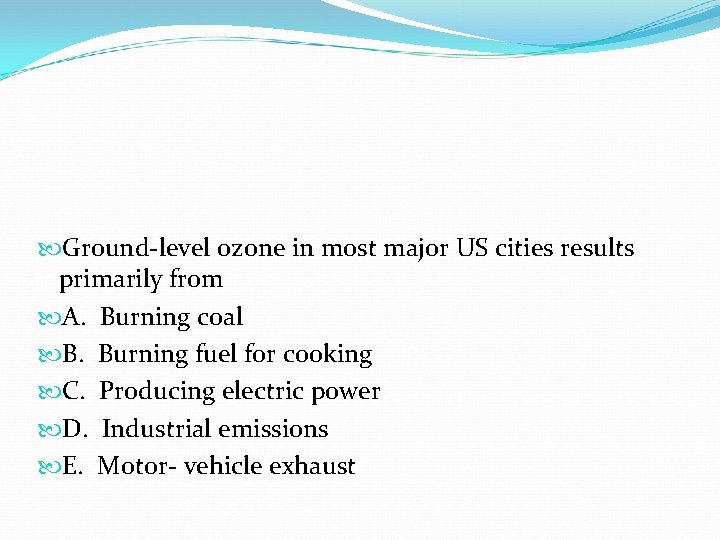
Ground-level ozone in most major US cities results primarily from A. Burning coal B. Burning fuel for cooking C. Producing electric power D. Industrial emissions E. Motor- vehicle exhaust
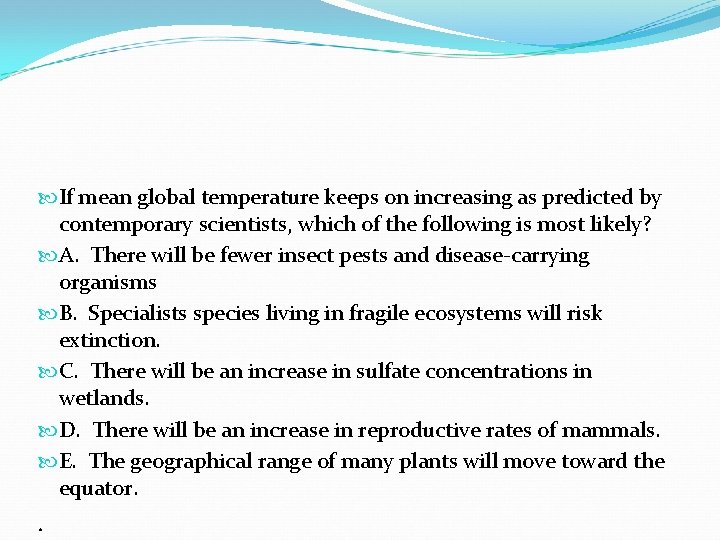
If mean global temperature keeps on increasing as predicted by contemporary scientists, which of the following is most likely? A. There will be fewer insect pests and disease-carrying organisms B. Specialists species living in fragile ecosystems will risk extinction. C. There will be an increase in sulfate concentrations in wetlands. D. There will be an increase in reproductive rates of mammals. E. The geographical range of many plants will move toward the equator. .
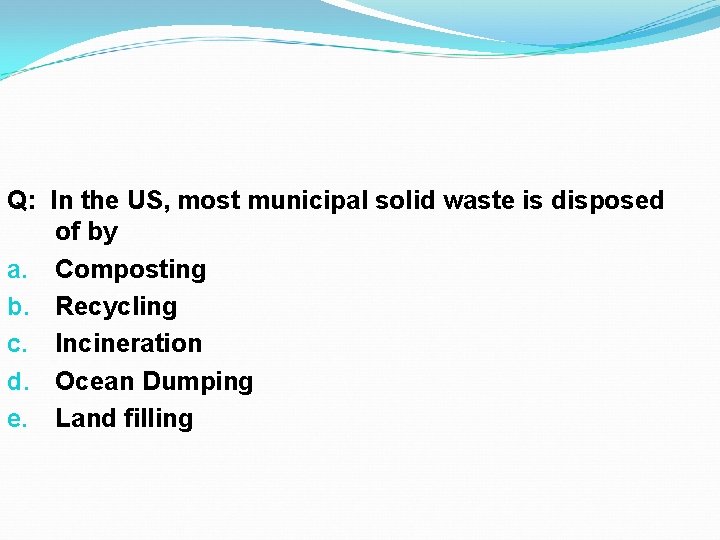
Q: In the US, most municipal solid waste is disposed of by a. Composting b. Recycling c. Incineration d. Ocean Dumping e. Land filling
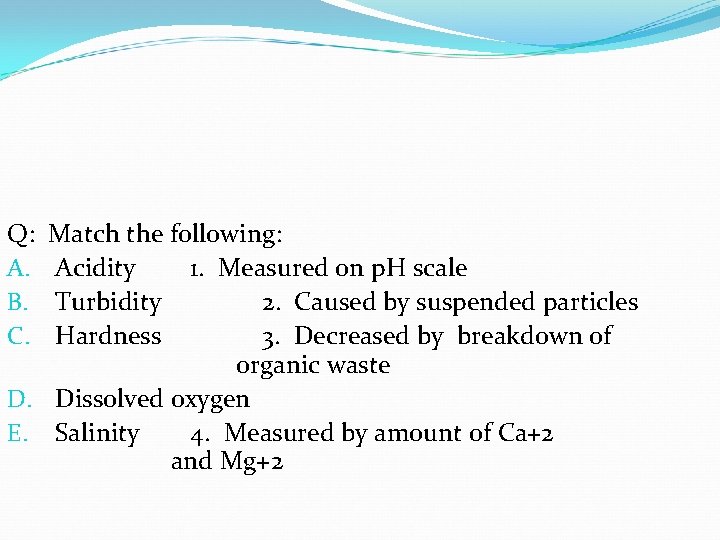
Q: A. B. C. Match the following: Acidity 1. Measured on p. H scale Turbidity 2. Caused by suspended particles Hardness 3. Decreased by breakdown of organic waste D. Dissolved oxygen E. Salinity 4. Measured by amount of Ca+2 and Mg+2
Q: The presence of high levels of fecal coliform bacteria in a water source indicates that the water a. Is safe to drink b. Is safe to swim in c. Contains too little oxygen to support fish life d. Has been recently chlorinated at a sewage treatment plant e. Has been contaminated by untreated human or animal waste
Q: In the removal of a pollutant from wastewater, which of the following is true of the cost per unit of pollutant removed? a. It decreases as the toxicity of the pollutant increases b. It decreases as the time passed before remediation increases c. It increases as the concentration of the pollutant decreases d. It increases as the volume of the wastewater decreases
Q: Which treatment introduces microorganisms to break down hazardous organic compounds? a. Sanitary landfill b. Incineration c. Discharge to sewers, streams and rivers d. Chemical treatment e. Biological treatment
Q: Which method would be best suited for neutralizing the acidic components of waste? a. Sanitary landfill b. Incineration c. Discharge to sewers, streams and rivers d. Chemical treatment e. Biological treatment
Q: The major cause for the decline in the worldwide catch of fish since 1990 is a. Acid deposition b. Escalating price of fuel c. Competition from aquaculture d. Overfishing e. Decline in the market price
Which of the following would be the strongest evidence in support of a scientist’s contention that a local area was experiencing acid deposition? a. A sudden die-off of all the fish in a local stream b. A gradual increase in the temp. of a local lake c. An increase in the rate of photosynthesis of aquatic plants in a local lake d. A long-term increase in the p. H of a local pond e. An increase in the concentrations of soluble heavy metals in a local pond
Which of the following is the usual cause of cultural eutrophication in surface waters of both developed and developing countries? a. Lack of proper filtration devices for power plant effluents b. Introduction of cyanobacteria to streams and rivers c. Runoff of metal ions in bodies of water d. Runoff of nitration compounds into bodies of water e. Runoff of herbicides into bodies of water
Q: Critics of incineration of municipal solid waste suggest that it may not be the best solution for the future. Why? a. Incineration produces ash that increases landfill volume b. Incineration generates methane c. Incineration involves advanced technology d. Incineration contributes to air pollution e. Incineration requires large energy input
Which method is used most frequently in the United States today? a. Sanitary landfill b. Incineration c. Discharge to sewers, streams and rivers d. Chemical treatment e. Biological treatment
All of the following are considered toxic metal pollutants EXCEPT a. Cadmium b. Chromium c. Lead d. Mercury e. Potassium
Of the following, which is the most serious immediate problem associated with sanitary landfills? a. Generation of CO 2 gas b. Leachate contamination of groundwater c. Release of disease organisms d. Incomplete degradation of wastes e. Compaction and settling
Q: An advantage of recycling aluminum rather than disposing of it in landfills is that aluminum can be a. Produced from recycled metal using much less energy than is required for its production from aluminum ore b. Produced from ore that is chemically reactive and dangerous to transport, store and process c. Produced from ore that is scarce and found primarily in remote, inhospitable regions at high latitudes d. Absorbed by plants and then biomagnified in both terrestrial and aquatic food chains e. Leached from landfills in the form of AL +3 ions that could increase the p. H of lakes and streams
Q: Integrated waste management employs all of the following EXCEPT: a. Using refillable soft-drink bottles b. Using disposable diapers instead of cloth diapers c. Using reusable canvas bags instead of plastic or paper bags d. Using tires for the construction of artificial reefs e. Redesigning automobiles to replace steel parts with aluminum and plastic parts
Q: Regulations that deal directly with the disposal of hazardous materials in the US include which of the following? I. RCRA II. Clean Water Act III. Clean Air Act