
Which layer of Earth do scientists believe is
Which layer of Earth do scientists believe is most likely made of solid metals? • • A B C D crust mantle outer core inner core
Which layer of Earth is the thinnest? • • A B C D crust mantle outer core inner core
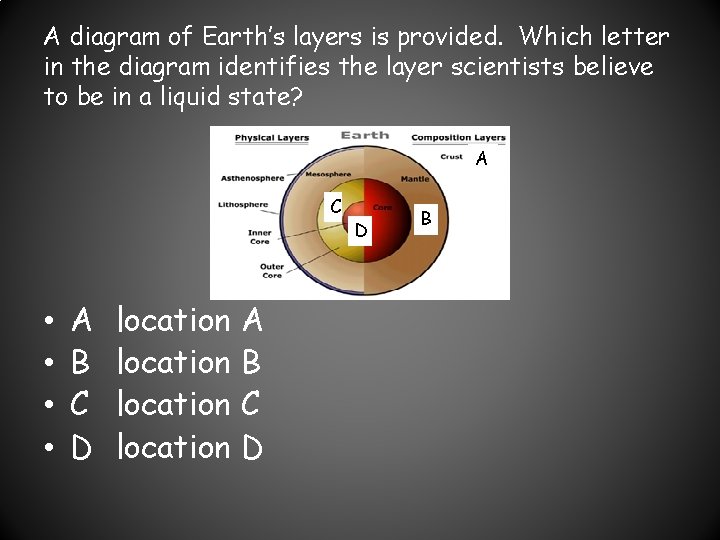
A diagram of Earth’s layers is provided. Which letter in the diagram identifies the layer scientists believe to be in a liquid state? A C • • A B C D location A location B location C location D D B
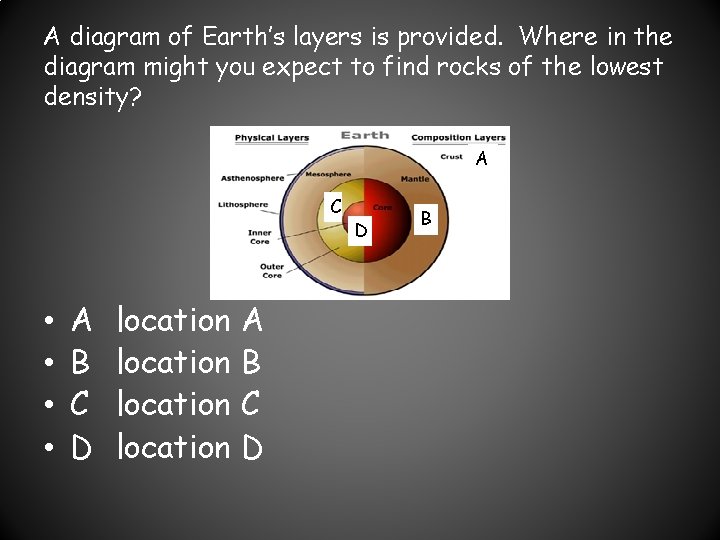
A diagram of Earth’s layers is provided. Where in the diagram might you expect to find rocks of the lowest density? A C • • A B C D location A location B location C location D D B
Which of the following events led to the formation of the layers of the Earth? • • A B C D a slow deposition a large impact a constant cooling a spinning rotation
According to scientific data, which layer of Earth is the thickest? • • A B C D crust inner core mantle outer core
What layer of the earth is composed of material of the highest density? • • A B C D outer core inner core crust mantle
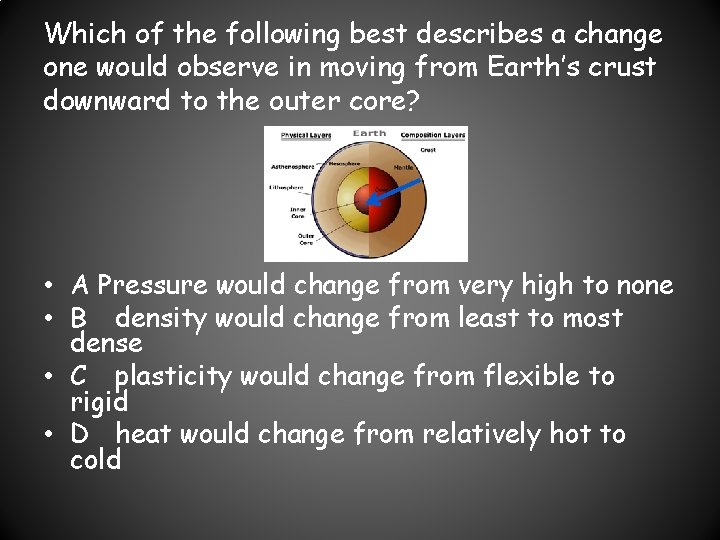
Which of the following best describes a change one would observe in moving from Earth’s crust downward to the outer core? • A Pressure would change from very high to none • B density would change from least to most dense • C plasticity would change from flexible to rigid • D heat would change from relatively hot to cold
Which layer of Earth is composed of liquid rock? • • A B C D Crust Inner Core Lithosphere Outer Core
Which is the best description of the characteristics of the asthenosphere? • • A B C D solid, but flowing liquid, but dense hot, but solid metal brittle, but shifting
The lithosphere is composed of rock that can be described as being - • • A B C D liquid solid dense flowing
The lithosphere consists of the - • • A B C D upper mantle and the crust lower mantle and the outer core inner and outer core crust and the entire mantle
Which of the following models would best represent the inner and outer core of Earth, based on the physical characteristics of each layer? • A a metal ball bearing (solid) suspended in oil (liquid) • B gelatin (red semi-solid) on top os a cracker (brittle solid) • C a ball of clay (solid) filled with water (liquid) • D rubber ball (flexible solid) painted red (thin solid covering)
Which layer of Earth contains liquid material? • • A B C D outer core mantle inner core crust
Which of the following would be an accurate feature to include in a model of Earth? • A A crust that is the thickest layer • B an inner core that contains oceans • C a thin mantle in the center of the model • D a liquid outer core below the mantle
Which of the following best describes Earth’s asthenosphere? • A liquid rock that can reach the surface • B solid rock that is broken into plates • C dense rock that moves the crust • D metal rock at the center of the Earth
A student constructs a clay model of Earth to show its layers. What property is the model able to share with the real Earth? The model will have layers that are the same • • A B C D temperatures as the real Earth positions as the real Earth state of matter as the real Earth thickness as the real Earth
The layer of Earth that is found directly below the lithosphere is called the – • • A B C D crust asthenosphere inner core outer core
Which layer of Earth is broken up into giant moving plates? • • A B C D Asthenosphere Lithosphere Inner Core Outer Core
Which of the following accurately describes how a particular layer of Earth changes from top to bottom? • A The mantle acts like a solid near the top, but begins to flow lower down as pressure increases • B The crust is solid rock anywhere it rises above sea level, but is liquid anywhere it sits under water • C The inner core is composed of metals at its surface, but contains less metals towards its center • D The outer core is liquid rock moving rapidly near the top , but slows down close to the inner core
Earth’s layers are evidence that , over time, Earth has gradually - • • A B C D spun more quickly grown in size cooled into a solid broken into parts
Which of Earth’s layers would be best modeled as a metallic sphere? • • A B C D mantle outer core crust inner core
Earth’s crust would be best modeled by using a material that is - • • A B C D liquid and hot dense and smooth soft and flexible thin and solid
The materials available to make a model of Earth are described – To make the most accurate model, which of the materials would best represent the asthenosphere? • A modeling clay – dense, flexible solid • B ping pong ball (half) – thin, hollow, light, solid • C Ball bearing – metallic, dense, solid • D Water - liquid
Which of Earth’s layers has the lowest density? • • A B C D Crust Inner Core Mantle Outer Core
The mantle does not behave the same throughout. In places where the mantle flows like a liquid, it does so because it - • • A B C D is being moved by plates is under more pressure has melted completely has existed for longer
Earth’s crust is riding on top of the - • • A B C D lithosphere mantle inner core outer core
What is the primary process that turns sediments into sedimentary rocks? • A organisms walking on layers of sediment, pressing particles together tightly • B minerals within sediment, absorbing water, and undergoing a chemical reaction • C upper layers of sediment, pressing down on lower layers of deposited sediment • D magma cooling under the surface of Earth, crystallizing to form rock
The interlocking crystals of an igneous rock help to classify it since these crystals are evidence of how the rock formed. The crystals are a result of - • • A B C D quartz coming out of solution particles forming layers Chemical reactions of minerals melted rock that cooled
Metamorphic rocks are different from igneous and sedimentary rocks in that metamorphic rocks form - • A when liquid rock freezes into a solid • B by magma rising from Earth’s core • C from existing rock that has been changed • D by layering minerals of different sizes
Which of the following processes is one of the early steps in the formation of sedimentary rock? • • A B C D weathering of existing rock crystallization of molten minerals melting of rock in volcanoes chemical reactions that produce heat
Igneous rock can be changed into sedimentary rock when igneous rocks - • A that form mountains get pushed together • B are weathered and the fragments deposited • C melt to form layers of different minerals • D put out by volcanoes create new land
Igneous rocks and metamorphic rocks have similar formation in that they both - • • A B C D require extreme heat always form from sediments cool to form distinct layers often contain fossil organisms
In order for a rock to be classified as igneous, what must have happened during its formation? • A solid rock changing under pressure • B liquid rock changing its physical state • C small rocks becoming cemented together • D layered rock breaking into smaller pieces
Sedimentary rock can be changed into igneous rock if sediments are - • • A B C D compacted deposited weathered melted
Igneous and sedimentary rocks could each be changed into metamorphic rock if they are changed by - • • A B C D weathering organisms pressure cementation
Which of the following processes might be one of the first steps in the formation of sedimentary rock • • A B C D glaciers breaking down rock liquid magma cooling and hardening rock melting deep underground minerals changing due to pressure
Geologists might recognize a metamorphic rock by distorted, wavy layers because they were caused by - • • A B C D compaction and cementation melting and crystallizing erosion and depostion pressure and heat
Sedimentary rock can contain evidence of life because of all the following are properties of sedimentary rock EXCEPT – • • A B C D it can be made from mud it is created under the ocean it is formed by melted rock it can contain organic material
Sedimentary rocks often contain horizontal layers because they are formed by the - • • A B C D deposition of sediment movement of tectonic plates heating of organisms cooling of melted rock
Sedimentary rock can be changed into metamorphic rock if it is - • A weathered and eroded by ocean waves • B movement of tectonic plates • C heating of organisms • D cooling of melted rock
All of the following processes are the ones that lead directly to the formation of sedimentary rock EXCEPT • • A deposition of rock fragments B freezing of water in cracks in rock C melting of rock deep underground D movement of wind that carries earth material
Igneous rock forms in regions where - • A rock is heated to melting point then cooled to a solid • B metallic minerals are put under extreme pressure • C a river deposits sand mud over a long period of time • D evidence of organisms is becoming fossilized
Sedimentary rocks will most likely form an environment where - • A two land masses are colliding • B liquid rock is hardening into a solid • C minerals are being created under pressure • D particles of rocks are accumulating
Which of the following processes produce metamorphic rocks? • • A rapid burial B gradual cooling C regular deposition D extreme pressure
Scientists classify igneous, metamorphic, and sedimentary rocks based on their - • • A B C D shape color formation usefulness
Which of the following best describes the processes that form igneous rocks? • • A B C D deposition and cementation heating and extreme pressure crystallization and solidification erosion and compaction
Which of the following features of a rock would classify it as definitely and igneous rock? • A began it formation process millions of years in the past • B created through slow, naturally occurring processes • C formed when minerals were heated, then cooled • D resulted from liquid rock being ejected from a volcano
Rocks are classified by - • • A B C D how they were formed when they were formed where they were formed their color when formed
In order to be classified as metamorphic, rock must have - • • A B C D magma cooling underground changed with heat and pressure compacted sediment into layers formed in less than 100 years
Sedimentary rocks can have layers of different colors. This occurs when - • A molten rock seeps into large cracks underground • B extreme pressure causes minerals to separate • C different minerals are deposited at different times • D seasonal patterns change the rate of erosion
Which of the following is one of the final processes in the formation of sedimentary rock? • • A B C D Melting Cementation Flowing Separation
The presence of igneous rocks might be evidence of - • • A organisms B deposition C coal D volcanoes
Metamorphic rock forms where any kind of rock - • A is crystalized after being liquid rock • B Contains fossils of marine organisms • C is changed by the extreme heat and pressure
Where tectonic plates pull away from each other, which of the following geologic features is most likely to result • • A B C D Ridge Plateau Mountain Beach
Which of the following geologic events would most likely occur where two continental plates converge? • • A Tsunami B Earthquake C Mountain formation D Trench formation
The interaction of tectonic plate boundaries is associated with which of the following events? • • A B C D Hurricanes Tropical storms Earthquakes Tornados
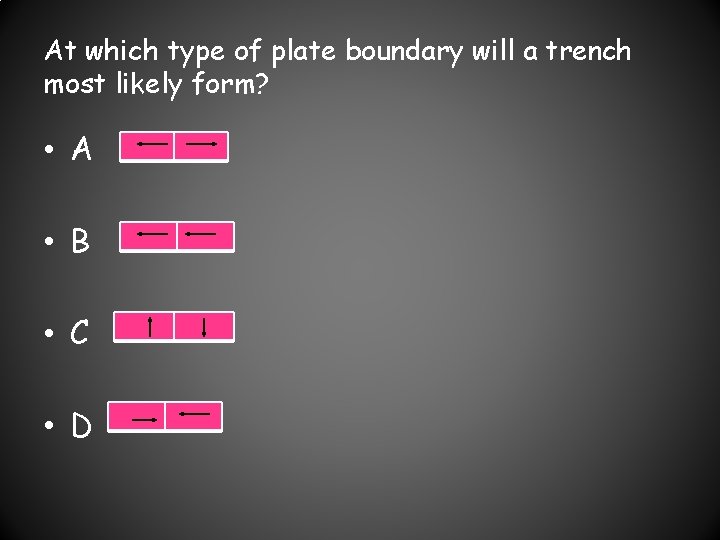
At which type of plate boundary will a trench most likely form? • A • B • C • D
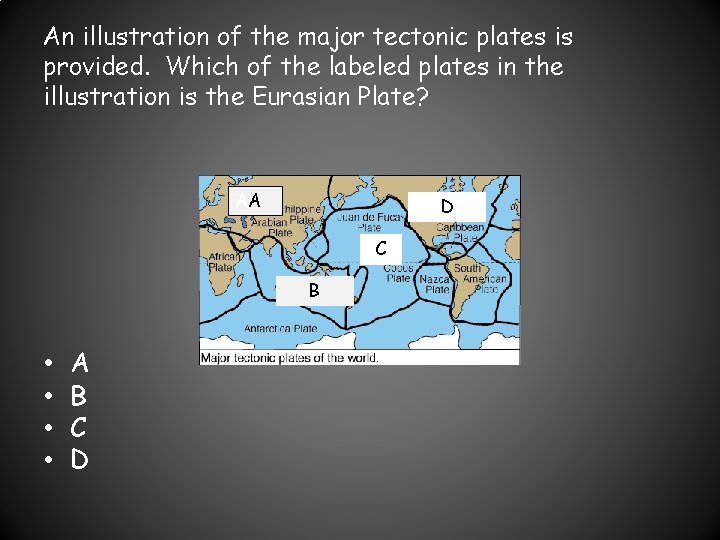
An illustration of the major tectonic plates is provided. Which of the labeled plates in the illustration is the Eurasian Plate? AA D C B • • A B C D
Where plates diverge, what land form will most likely result? • • A B C D Mountain Coral reef River Rift Valley
An ocean basin will form in what location relative to the major tectonic plates? • A at plate boundaries where friction occurs • B in the center of the largest plates • C on a plate pushed up by another plate • D where two plates pull apart
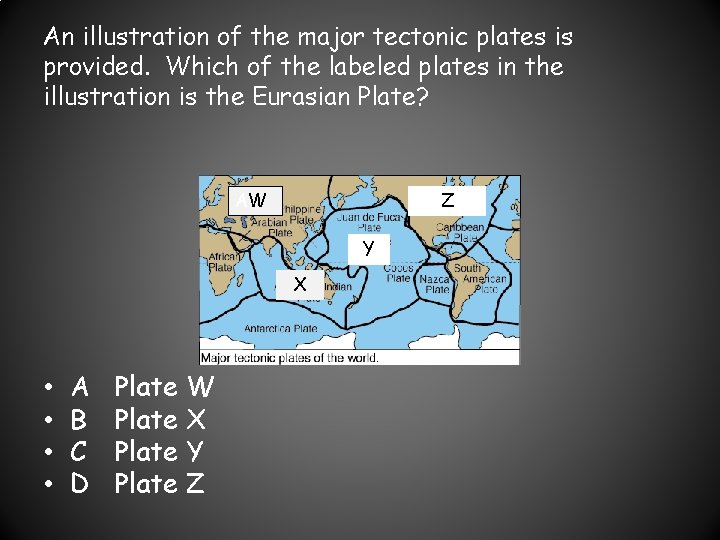
An illustration of the major tectonic plates is provided. Which of the labeled plates in the illustration is the Eurasian Plate? AW Z Y X • • A B C D Plate W Plate X Plate Y Plate Z
Movement between the Pacific plate and the North American plate create the San Andreas Fault in California. What type of motion is occurring? • • A B C D Convergent Divergent Transform Subduction
The interaction of two plate boundaries can cause which of the following? • • A B C D Hurricanes and tornadoes Earthquakes and volcanoes High winds and drought Tsunamis and tropical storms
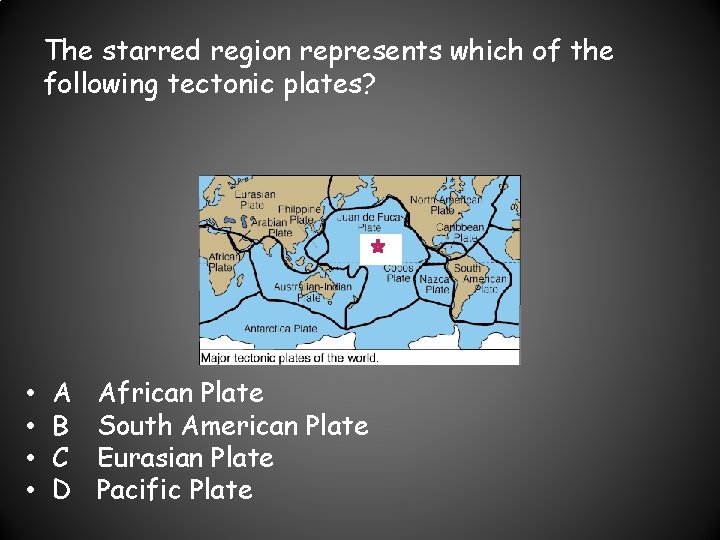
The starred region represents which of the following tectonic plates? • • A B C D African Plate South American Plate Eurasian Plate Pacific Plate
When two continental plates diverge, there is a valley in between these two plates that forms as the continental crust widens. What geological event is a result of this interaction? • • A B C D Hurricanes Volcanoes Tsunamis Earthquakes
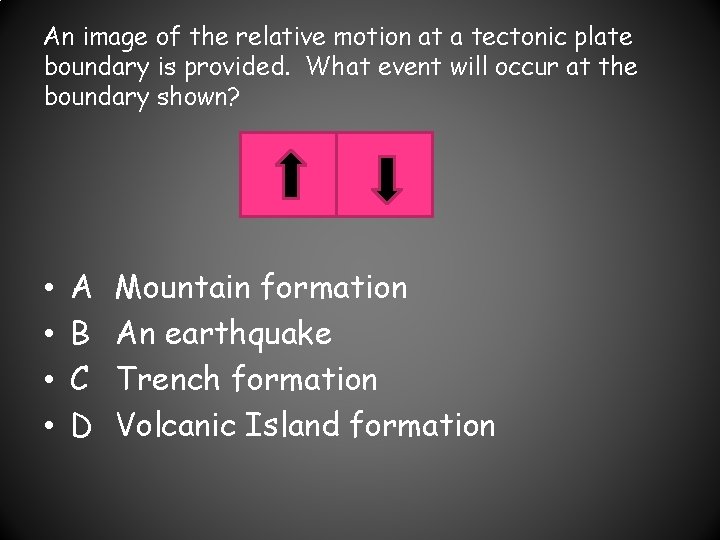
An image of the relative motion at a tectonic plate boundary is provided. What event will occur at the boundary shown? • • A B C D Mountain formation An earthquake Trench formation Volcanic Island formation
What event will most likely occur at a divergent plate boundary? • A The plates will form a mountain chain • B One plate will subduct under the other • C The plate will create an ocean basin • D A fault line will form, and earthquakes will result
Where two tectonic plates converge and move toward each other, which of the following is likely to result? • • A B C D Rift valley mountain range arid desert Tropical rainforest
The boundary between the Pacific Plate and the Australian Plate is a transform boundary. What event is likely to occur at this boundary? • • A Mountain formation B Earthquakes C Hurricanes D Volcanic eruptions
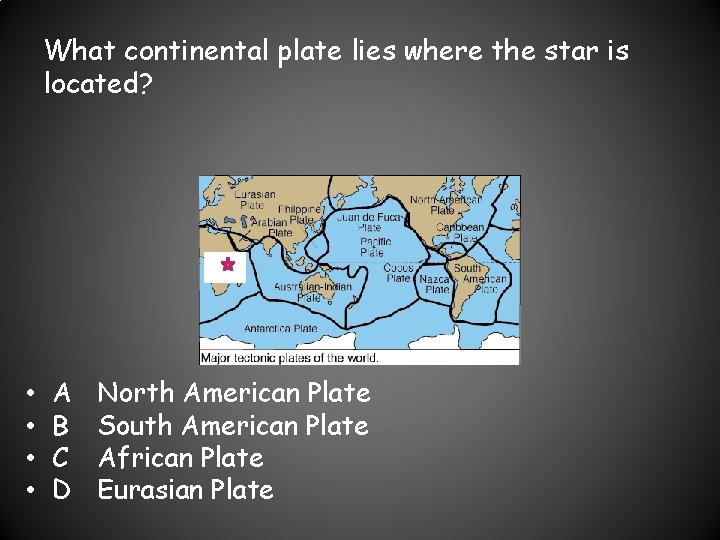
What continental plate lies where the star is located? • • A B C D North American Plate South American Plate African Plate Eurasian Plate
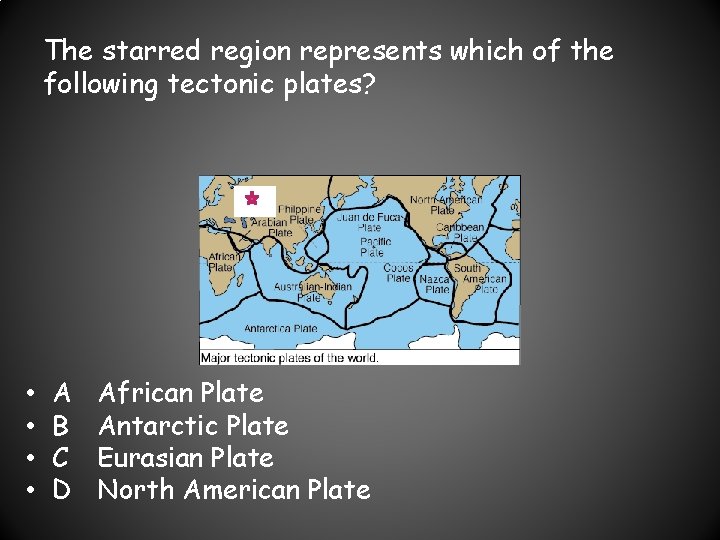
The starred region represents which of the following tectonic plates? • • A B C D African Plate Antarctic Plate Eurasian Plate North American Plate
When two tectonic plates converge, the land above sea level in this area often generates - • • A B C D mountain ranges landslides hurricanes tsunamis
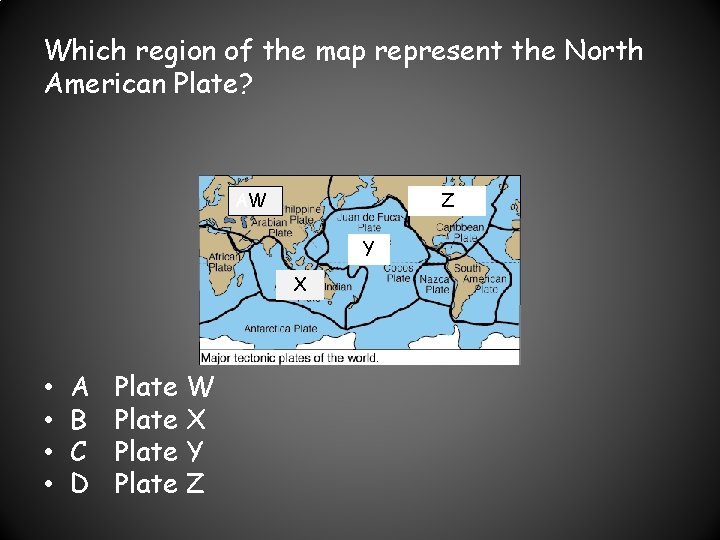
Which region of the map represent the North American Plate? AW Z Y X • • A B C D Plate W Plate X Plate Y Plate Z
- Slides: 74