
Which Filtration Material Leads to the Best Drinking
Which Filtration Material Leads to the Best Drinking Water? By Navaneeth Vasantha
Purpose Do you filter your tap water before drinking? Many commercials claim these filters make your drinking water cleaner and safer. But what, exactly, are these filters doing and is the water really cleaner afterwards? The cleaning power comes from their filling material, called activated carbon. It exists in all kinds of forms: powder, granules, foams, and blocks. Does it matter what type of activated carbon is inside the filter? I’m going to be doing this experiment to answer this question.

How do Activated Carbon Filters Work? The carbon is effective mostly due to its incredible surface area. Physical adsorption is the main way in which activated carbon filters out a given substance. As liquid or air comes into contact with activated carbon, intermolecular forces draw molecules into the millions of pores and pockets on the surface of activated carbon. Beyond physical adsorption, activated carbon also facilitates chemical reactions. A common example involves chlorine molecules. When chlorine comes into contact with activated carbon, both molecules react to form chloride ions, effectively removing chlorine from water. The amount of contamination that activated carbon removes from the air or water depends on many different factors, including the type and amount of pollution, the acidity and temperature of the water or air, and how long the water or air spends in contact with the activated carbon. The specific type of activated carbon also determines the level of filtration provided. Carbon molecules with large holes trap big and heavy molecules such as the ones found in organic chemicals. Small, fine pores pick up smaller and lighter contaminants. Manufacturers of activated carbon often label their products by their adsorption potential. While activated carbon is safe to ingest, no trace of carbon is left in drinking water after it has been properly and thoroughly treated.
Hypothesis My hypothesis states that powdered activated carbon (PAC) will be more effective in filtering out the contaminant (food coloring) than the granulated activated carbon (GAC). I think this because PAC has a smaller particle size than GAC and would probably be more efficient at removing a wide range of impurities from the water.
Materials - Granulated activated charcoal Powdered activated charcoal Plastic cups (no lids necessary), transparent 20 oz (around 50) Food color (green, blue or red work well) Spoon Tap water Coffee filters (bleached or unbleached), size 4 for 20 oz cups (72) Rubber bands (18) Measuring cup Timer Paper towels Scale that can measure in 0. 1 g increments. Permanent marker
Procedure: Preparing Your Samples and Filters 1. First, prepare the water samples that you’re going to filter. You will use food color as the model contaminant that needs to be removed from the water. a) With a permanent marker, label three cups, one for each dye concentration: 0 drops per cup of liquid, 2 drops per cup of liquid and 5 drops per cup of liquid. b) Measure 2 cups (about 500 m. L) of tap water into each plastic cup using the measuring cup. c) You will only add food color to two of the three cups as shown in the picture on the next slide. The first cup (0 drops per cup of liquid ) will remain colorless. As you have 2 cups of liquid in each of your cups, you have to add 4 drops of food color to the cup that you labeled with 2 drops per cup of liquid and 10 drops of food color to the cup that you labeled 5 drops per cup of liquid. d) Stir each of the solutions with a clean spoon to disperse the food color evenly.

These will be the cups you compare the filtered solutions to after the experiment.
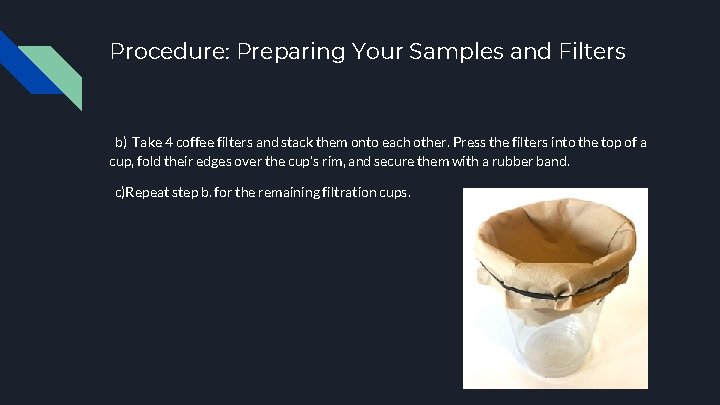
Procedure: Preparing Your Samples and Filters b) Take 4 coffee filters and stack them onto each other. Press the filters into the top of a cup, fold their edges over the cup's rim, and secure them with a rubber band. c)Repeat step b. for the remaining filtration cups.
Procedure: Preparing Your Samples and Filters 2. Next prepare 9 cups with granulated activated carbon and 9 cups with powdered activated carbon. a) Use a scale to weigh out 3 grams of granular activated carbon into each cup that you labeled with granular carbon. Then add 3 grams of powdered activated carbon into each cup you labeled with powdered carbon. 3. Next, you will set up filters for the different forms of activated carbon and dye concentrations. a) Label 18 cups in total, one for each testing condition. Make sure that your label is specific to the type of activated carbon and the dye concentration that you are going to test.
Procedure: Filtering Your Samples 1. 2. 3. 4. 5. 6. Now take 18 more cups and pour 500 m. L of water into each one. After that, put 10 drops of food color into 6 of the 18 cups, 4 drops into another 6, and then 0 drops into the last 6. Take the cups with granulated and powdered carbon and pour each one into one of the 18 cups prepared above, such that 3 of the cups with 10 drops have GAC in them, the other 3 with 10 drops have PAC in them, and 3 of the cups with 4 drops have GAC in them, etc. Now, before you do all this, record the color rating , from 1 to 10, before the treatment (the filtration process). 0 drops would be 0, 4 drops would 7, and 10 drops would be 10. After the treatment, record the color rating again to see if it changed, and if it’s different between the two carbons. Now, continue with the filtration. Pour the carbon into the samples with food color and stir it quickly. Set the timer to 10 minutes and wait. After 10 minutes has passed, pour the solution through the filter cups and wait for the water to soak through. Repeat this process with all of the solutions. After you have finished, record the color rating after filtration.
Variables Independent Variables The independent variable in my experiment would be the type of carbon, since I’m testing out which of the 2 types of carbon works best. This is the only thing that I need to change each time and is my independent variable. Dependent Variables The dependent variables in my experiment would be how much of the contaminant in the water was removed or changed, since it changes if the independent variable (type of carbon) changes. This makes it the dependent variable. Controlled variables The controlled variables in my experiment are the cups, filters, the water since it’s the same amount each time, and the food color also because it’s the same amount each time. These all stay the same every trial making them the controlled variables.
Observations (qualitative) - - The cups with the 10 drops of food color in them took about 1 -2 minutes longer than the ones with 4 drops of food color to filter for both PAC and GAC (more noticeable for PAC) The GAC was much quicker than the PAC to filter PAC added in a little bit of greyish color to the water PAC also had a stronger smell then GAC
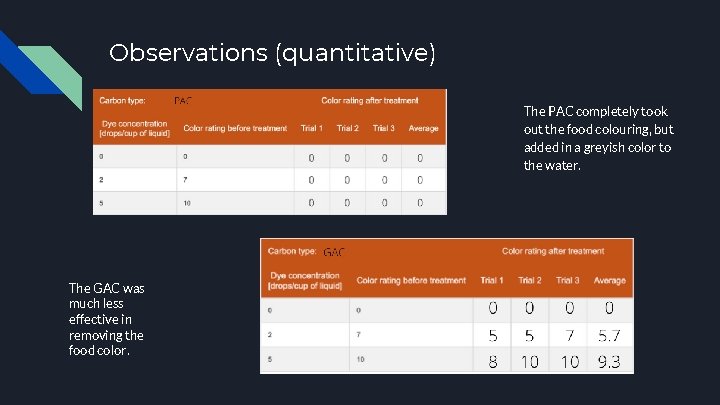
Observations (quantitative) The PAC completely took out the food colouring, but added in a greyish color to the water. The GAC was much less effective in removing the food color.
Results
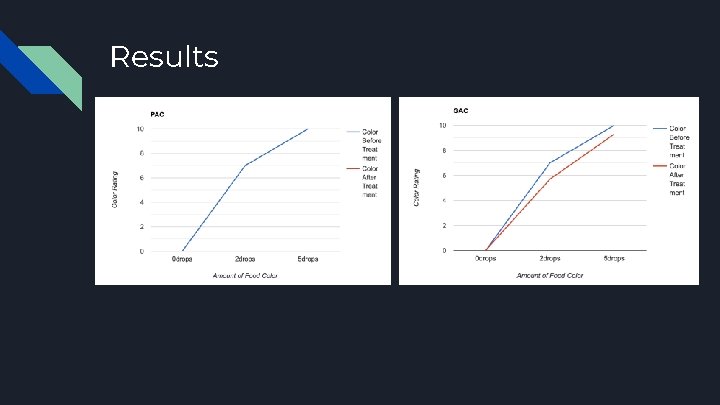
Conclusion In the end, PAC, even though it added its own greyish color into the water, it removed all of the food color. Meanwhile, the GAC hasn’t removed much of it at all. This supports my hypothesis that PAC will be more effective in filtering the water than GAC will.
Bibliography https: //www. sciencebuddies. org/science-fair-projects/projectideas/Chem_p 108/chemistry/which-filtration-material-leads-to-the-best-drinkingwater#summary https: //www. carbonblocktech. com/the-science-behind-activated-carbon-water-filters/ https: //molekule. science/activated-carbon-airfilter/#: ~: text=Carbon%20 air%20 filters%20 are%20 the, released%20 from%20 common%20 hou sehold%20 products https: //en. wikipedia. org/wiki/Carbon_filtering https: //www. freshwatersystems. com/blogs/blog/activated-carbon-filters-101
- Slides: 16