
Where we The physical properties of porous media
- Slides: 24
Where we? The physical properties of porous media ðThe three phases ðBasic parameter set (porosity, density) Where are we going today? ðHydrostatics in porous media! 1
Hydrostatics in Porous Media Where we are going with hydrostatics ðSource of liquid-solid attraction ðPressure (negative; positive; units) ðSurface tension ðCurved interfaces ðThermodynamic description of interfaces ðVapor pressure ðPressure-Water Content relationships ðHysteresis 2
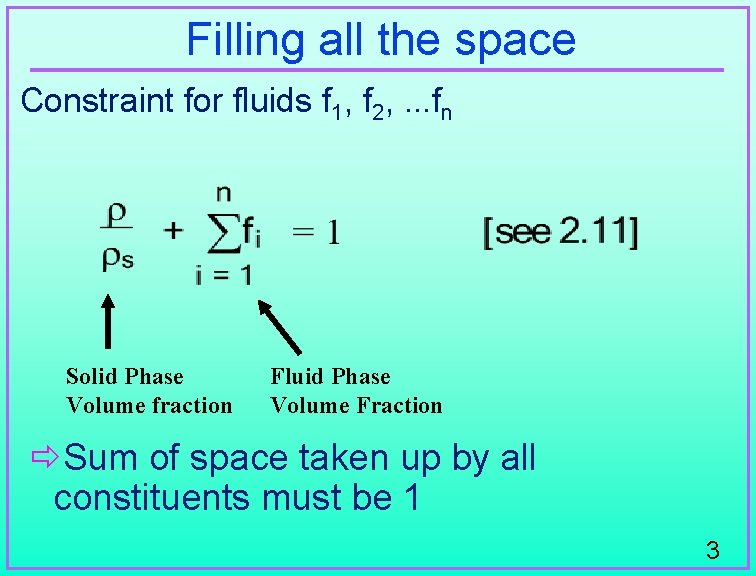
Filling all the space Constraint for fluids f 1, f 2, . . . fn Solid Phase Volume fraction Fluid Phase Volume Fraction ðSum of space taken up by all constituents must be 1 3
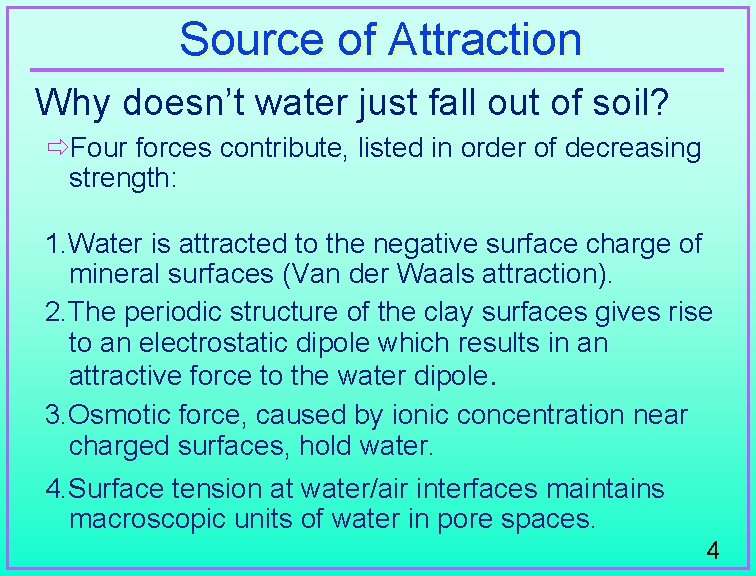
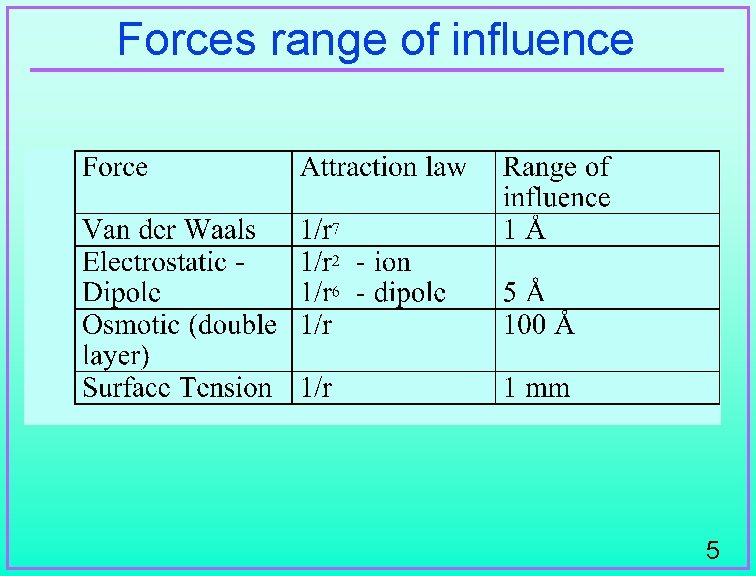
Source of Attraction Why doesn’t water just fall out of soil? ðFour forces contribute, listed in order of decreasing strength: 1. Water is attracted to the negative surface charge of mineral surfaces (Van der Waals attraction). 2. The periodic structure of the clay surfaces gives rise to an electrostatic dipole which results in an attractive force to the water dipole. 3. Osmotic force, caused by ionic concentration near charged surfaces, hold water. 4. Surface tension at water/air interfaces maintains macroscopic units of water in pore spaces. 4
Forces range of influence 5
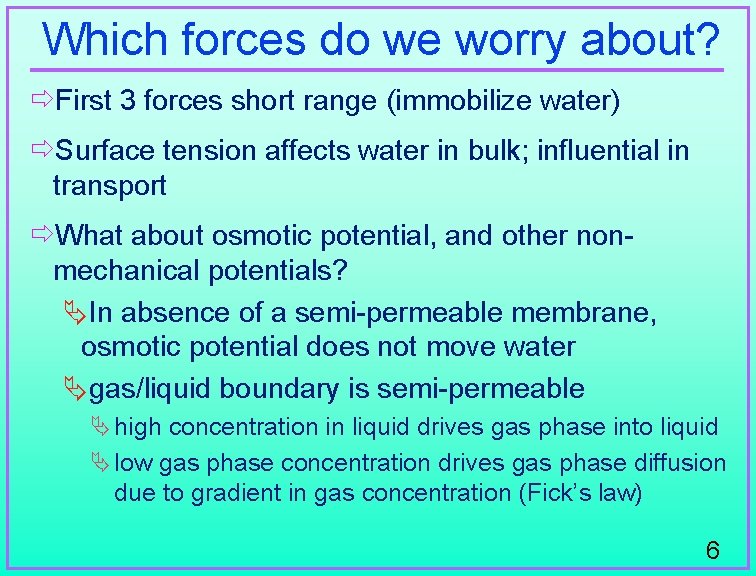
Which forces do we worry about? ðFirst 3 forces short range (immobilize water) ðSurface tension affects water in bulk; influential in transport ðWhat about osmotic potential, and other nonmechanical potentials? ÄIn absence of a semi-permeable membrane, osmotic potential does not move water Ägas/liquid boundary is semi-permeable Ä high concentration in liquid drives gas phase into liquid Ä low gas phase concentration drives gas phase diffusion due to gradient in gas concentration (Fick’s law) 6
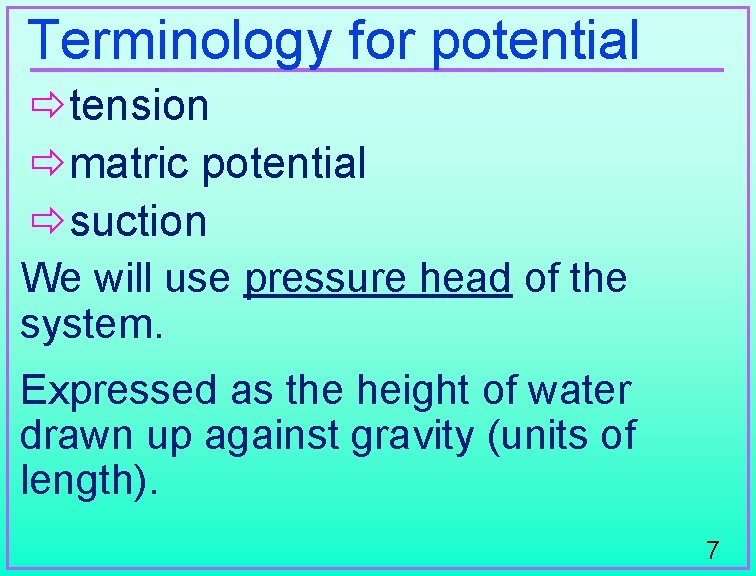
Terminology for potential ðtension ðmatric potential ðsuction We will use pressure head of the system. Expressed as the height of water drawn up against gravity (units of length). 7
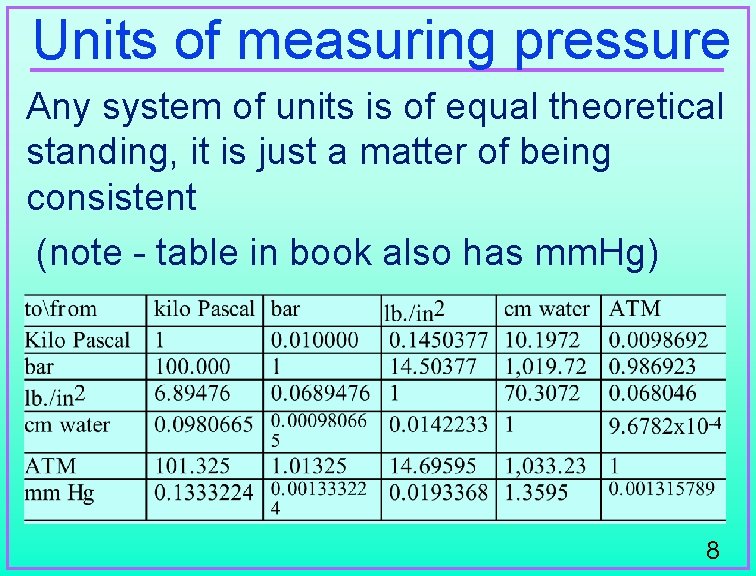
Units of measuring pressure Any system of units is of equal theoretical standing, it is just a matter of being consistent (note - table in book also has mm. Hg) 8
What about big negative pressures? Pressures more negative than -1 Bar? Non-physical? NO. ðLiquid water can sustain negative pressures of up to 150 Bars before vaporizing. Thus: ðNegative pressures exceeding -1 bar arise commonly in porous media ðIt is not unreasonable to consider the fluiddynamic behavior of water at pressures greater than -1 bar. 9
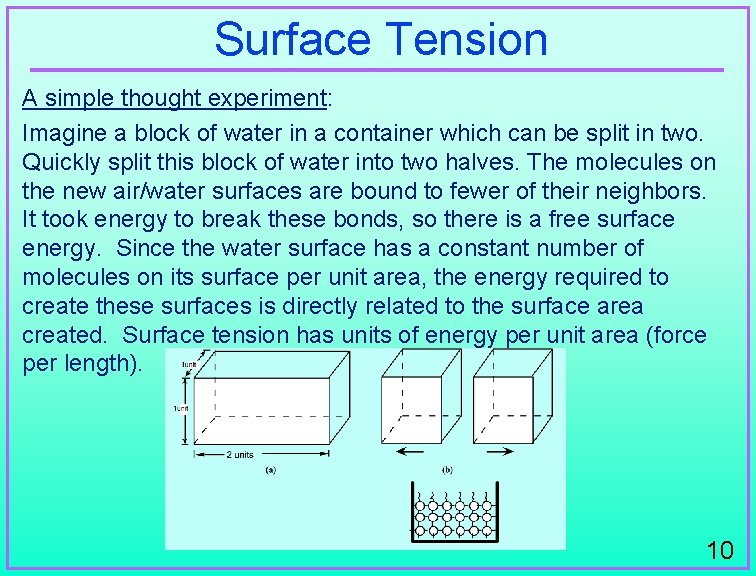
Surface Tension A simple thought experiment: Imagine a block of water in a container which can be split in two. Quickly split this block of water into two halves. The molecules on the new air/water surfaces are bound to fewer of their neighbors. It took energy to break these bonds, so there is a free surface energy. Since the water surface has a constant number of molecules on its surface per unit area, the energy required to create these surfaces is directly related to the surface area created. Surface tension has units of energy per unit area (force per length). 10
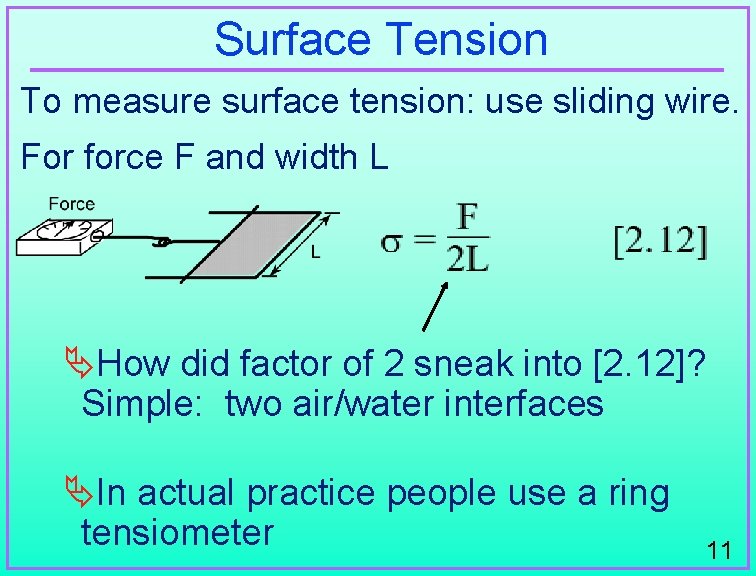
Surface Tension To measure surface tension: use sliding wire. For force F and width L ÄHow did factor of 2 sneak into [2. 12]? Simple: two air/water interfaces ÄIn actual practice people use a ring tensiometer 11
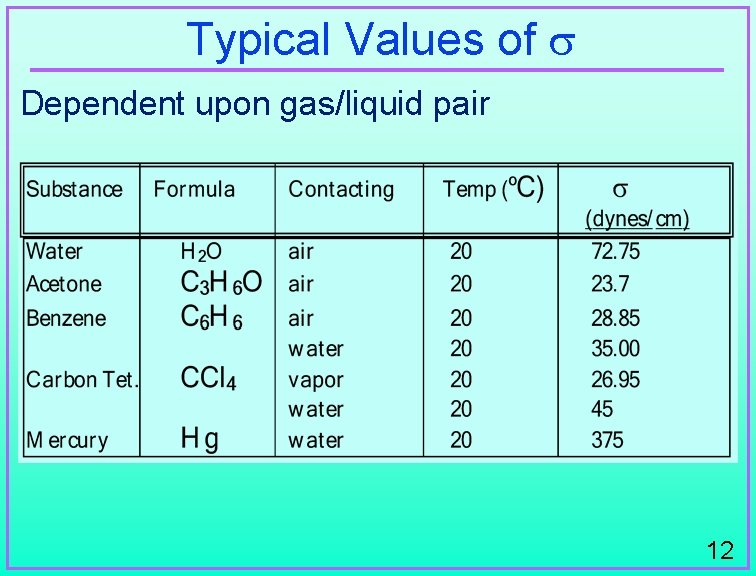
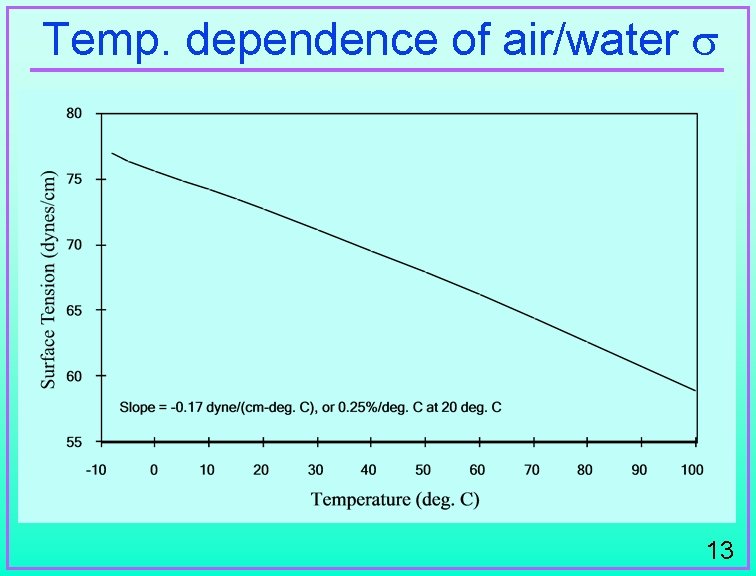
Typical Values of Dependent upon gas/liquid pair 12
Temp. dependence of air/water 13
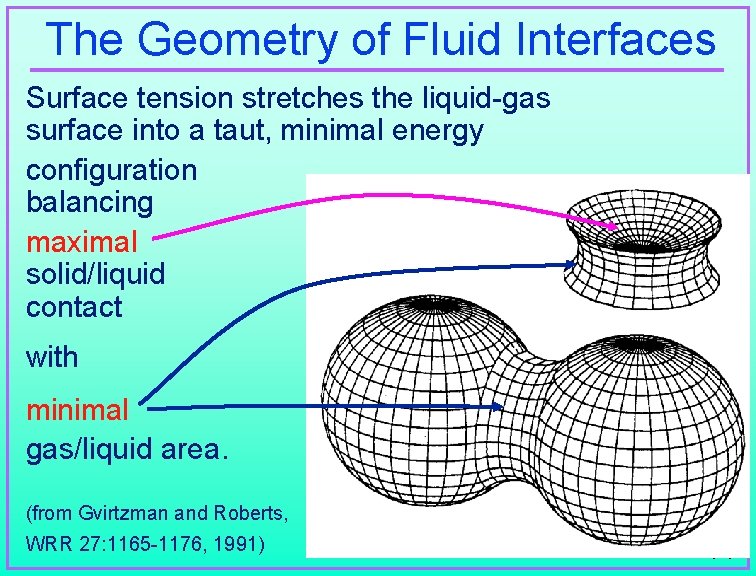
The Geometry of Fluid Interfaces Surface tension stretches the liquid-gas surface into a taut, minimal energy configuration balancing maximal solid/liquid contact with minimal gas/liquid area. (from Gvirtzman and Roberts, WRR 27: 1165 -1176, 1991) 14
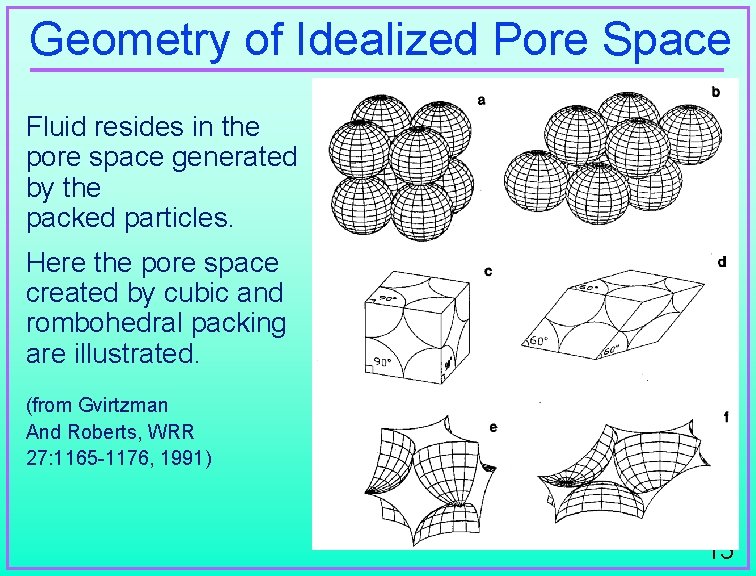
Geometry of Idealized Pore Space Fluid resides in the pore space generated by the packed particles. Here the pore space created by cubic and rombohedral packing are illustrated. (from Gvirtzman And Roberts, WRR 27: 1165 -1176, 1991) 15
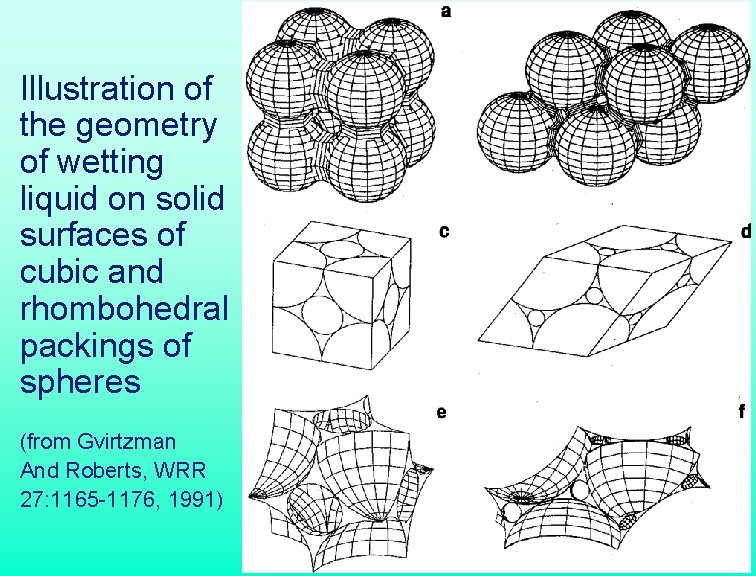
Illustration of the geometry of wetting liquid on solid surfaces of cubic and rhombohedral packings of spheres (from Gvirtzman And Roberts, WRR 27: 1165 -1176, 1991)
Let’s get quantitative We seek and expression which describes the relationship between the surface energies, system geometry, and fluid pressure. Let’s take a close look at the shape of the surface and see what we find. 17
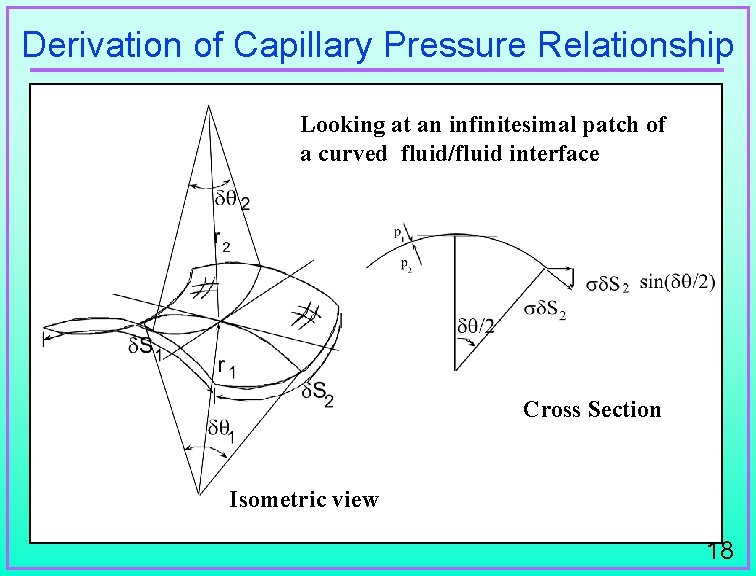
Derivation of Capillary Pressure Relationship Looking at an infinitesimal patch of a curved fluid/fluid interface Cross Section Isometric view 18
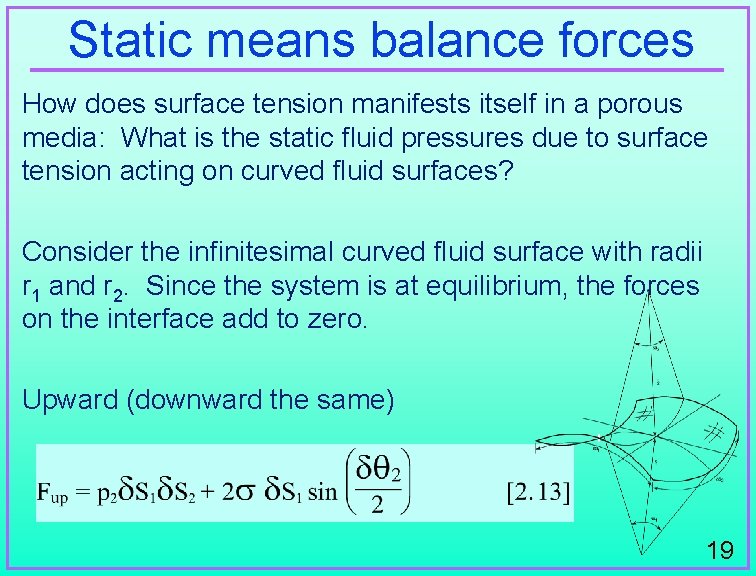
Static means balance forces How does surface tension manifests itself in a porous media: What is the static fluid pressures due to surface tension acting on curved fluid surfaces? Consider the infinitesimal curved fluid surface with radii r 1 and r 2. Since the system is at equilibrium, the forces on the interface add to zero. Upward (downward the same) 19
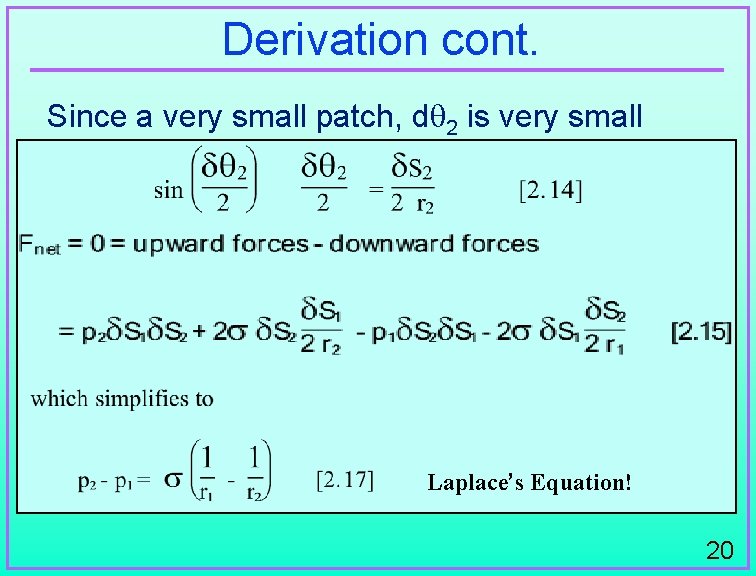
Derivation cont. Since a very small patch, d 2 is very small Laplace’s Equation! 20
Where we were… • Looked at “saddle point” or “anticlastic” surface and computed the pressure across it • Came up with an equation for pressure as a function of the radii of curvature 21
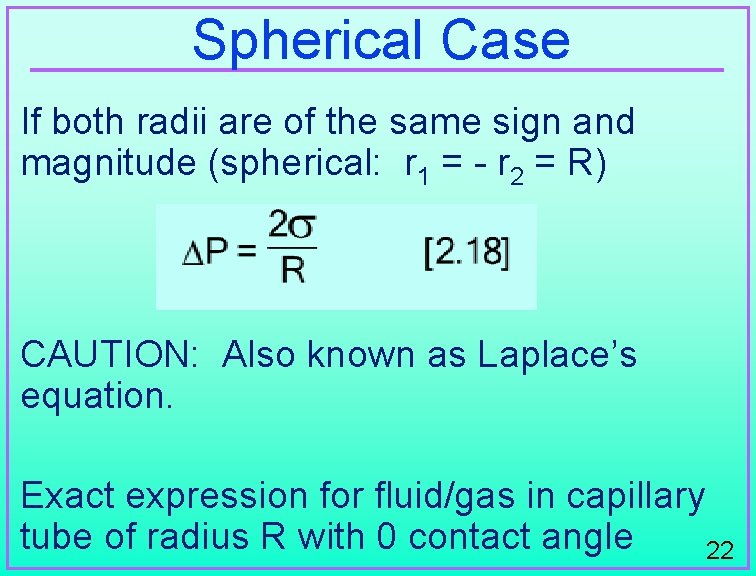
Spherical Case If both radii are of the same sign and magnitude (spherical: r 1 = - r 2 = R) CAUTION: Also known as Laplace’s equation. Exact expression for fluid/gas in capillary tube of radius R with 0 contact angle 22
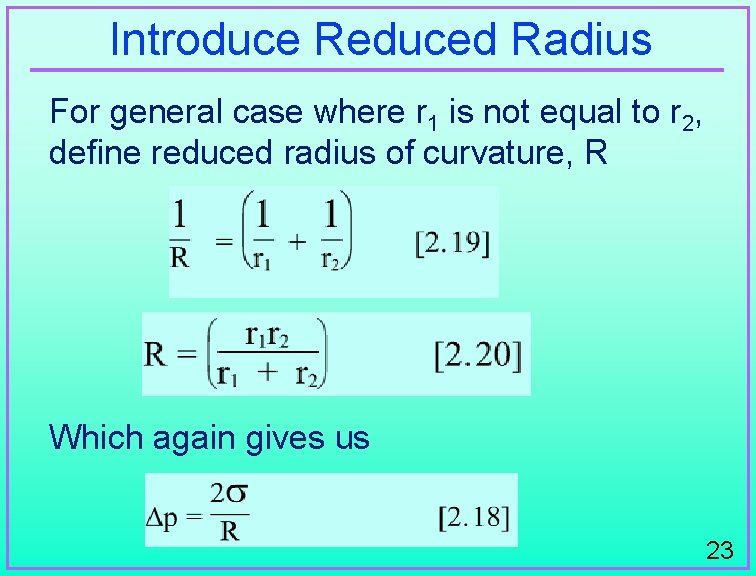
Introduce Reduced Radius For general case where r 1 is not equal to r 2, define reduced radius of curvature, R Which again gives us 23
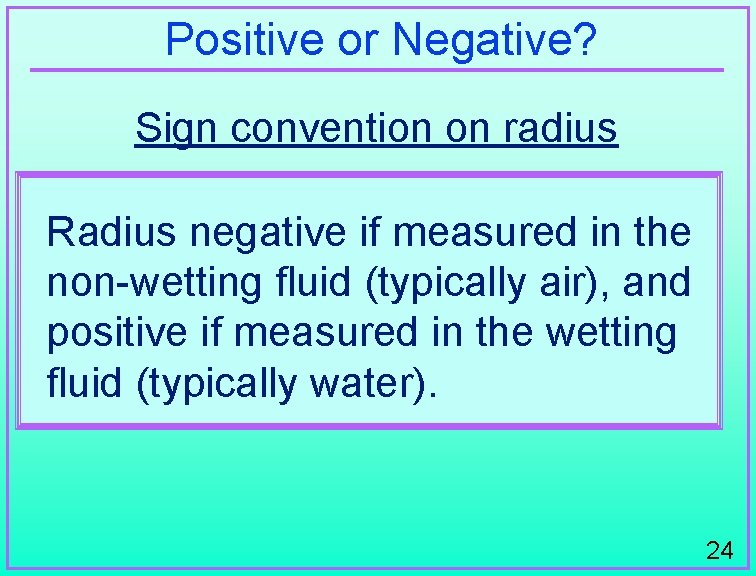
Positive or Negative? Sign convention on radius Radius negative if measured in the non-wetting fluid (typically air), and positive if measured in the wetting fluid (typically water). 24