
Where We Are and Where We Should Go
![County-Specific Responses to Accepted Reports in 2016 Reports Accepted: [Local] Assigned to Family Assessment](https://slidetodoc.com/presentation_image_h2/b433614d10cf86972ecd12e062ff90da/image-12.jpg "County-Specific Responses to Accepted Reports in 2016 Reports Accepted: [Local] Assigned to Family Assessment")
![Changes in Child Abuse in [Local], 201416 County 2014 Pop 0 -17 2014 2015](https://slidetodoc.com/presentation_image_h2/b433614d10cf86972ecd12e062ff90da/image-13.jpg "Changes in Child Abuse in [Local], 201416 County 2014 Pop 0 -17 2014 2015")
![Number of Types of Child Abuse in [Local], 2016 Types of Abuse Number Percent](https://slidetodoc.com/presentation_image_h2/b433614d10cf86972ecd12e062ff90da/image-16.jpg "Number of Types of Child Abuse in [Local], 2016 Types of Abuse Number Percent")
![Number of Types of Child Abuse [Local], 2016 Physical Injury County STATE TOTALS Sexual](https://slidetodoc.com/presentation_image_h2/b433614d10cf86972ecd12e062ff90da/image-17.jpg "Number of Types of Child Abuse [Local], 2016 Physical Injury County STATE TOTALS Sexual")
- Slides: 23
Where We Are and Where We Should Go So Our Children Are Safe from Abuse PRESENTED BY: Scott Advocacy and Consulting, LLC www. scottadvconsult. com © Stephen Scott, 2017
Overview of Child Abuse: DEFINITIONS, PROCESS, AND STATEWIDE DATA
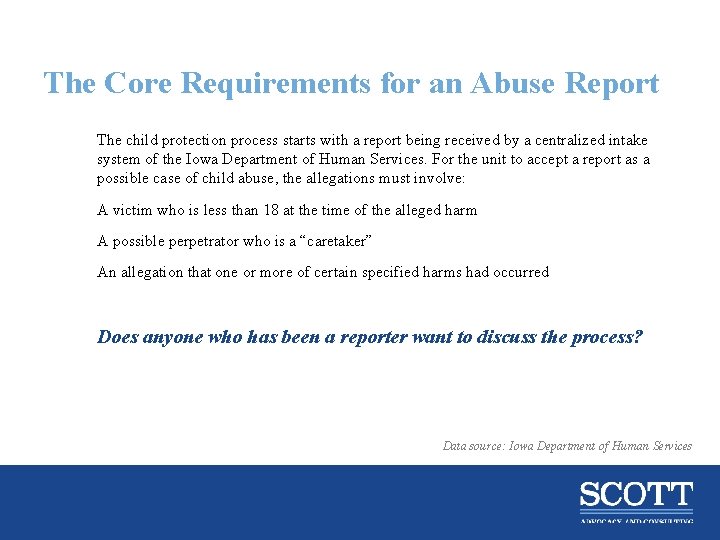
The Core Requirements for an Abuse Report The child protection process starts with a report being received by a centralized intake system of the Iowa Department of Human Services. For the unit to accept a report as a possible case of child abuse, the allegations must involve: A victim who is less than 18 at the time of the alleged harm A possible perpetrator who is a “caretaker” An allegation that one or more of certain specified harms had occurred Does anyone who has been a reporter want to discuss the process? Data source: Iowa Department of Human Services
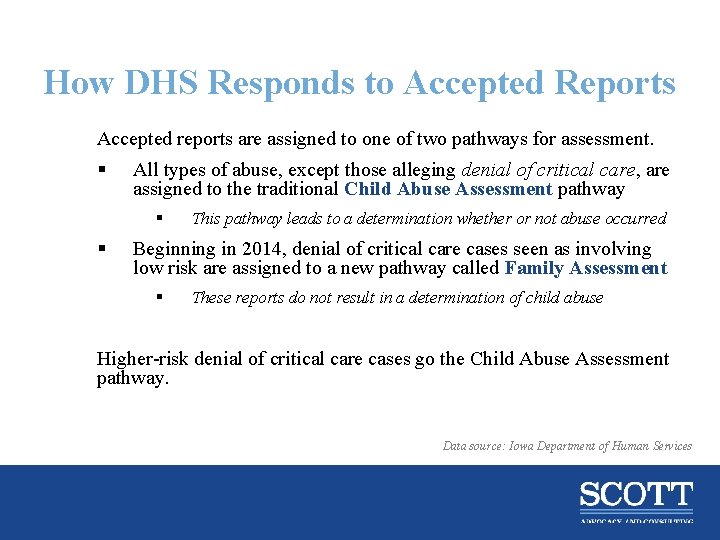
How DHS Responds to Accepted Reports Accepted reports are assigned to one of two pathways for assessment. § All types of abuse, except those alleging denial of critical care, are assigned to the traditional Child Abuse Assessment pathway § § This pathway leads to a determination whether or not abuse occurred Beginning in 2014, denial of critical care cases seen as involving low risk are assigned to a new pathway called Family Assessment § These reports do not result in a determination of child abuse Higher-risk denial of critical care cases go the Child Abuse Assessment pathway. Data source: Iowa Department of Human Services
Categories of Abuse Iowa’s child abuse law contains four categories of abuse common to every state: 1. 2. 3. 4. Neglect (denial of critical care) Intentional physical injury Sexual abuse Mental injury Iowa law has several other distinctive categories related to drugrelated activities, sex offenders, child prostitution, pornography, and sex trafficking. Data source: Iowa Department of Human Services
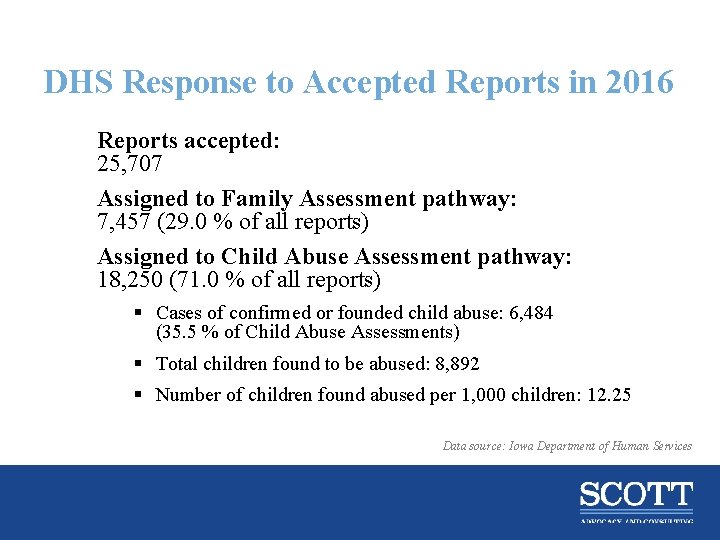
DHS Response to Accepted Reports in 2016 Reports accepted: 25, 707 Assigned to Family Assessment pathway: 7, 457 (29. 0 % of all reports) Assigned to Child Abuse Assessment pathway: 18, 250 (71. 0 % of all reports) § Cases of confirmed or founded child abuse: 6, 484 (35. 5 % of Child Abuse Assessments) § Total children found to be abused: 8, 892 § Number of children found abused per 1, 000 children: 12. 25 Data source: Iowa Department of Human Services
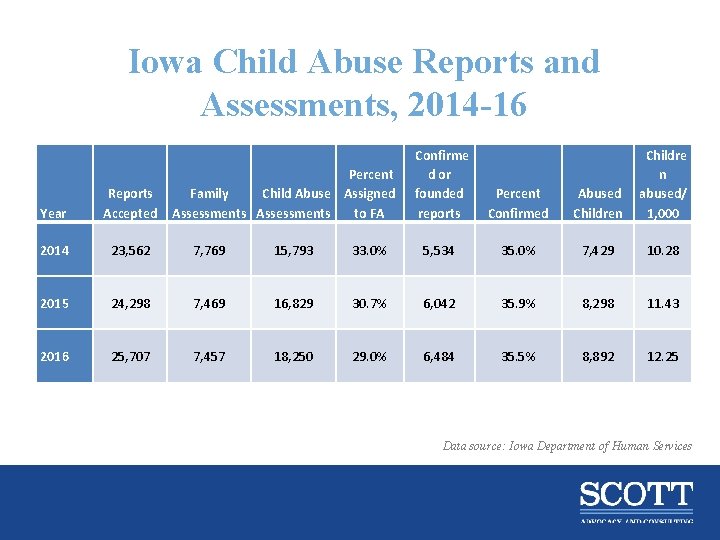
Iowa Child Abuse Reports and Assessments, 2014 -16 Percent Family Child Abuse Assigned Assessments to FA Confirme d or founded reports Percent Confirmed Abused Children Childre n abused/ 1, 000 Year Reports Accepted 2014 23, 562 7, 769 15, 793 33. 0% 5, 534 35. 0% 7, 429 10. 28 2015 24, 298 7, 469 16, 829 30. 7% 6, 042 35. 9% 8, 298 11. 43 2016 25, 707 7, 457 18, 250 29. 0% 6, 484 35. 5% 8, 892 12. 25 Data source: Iowa Department of Human Services
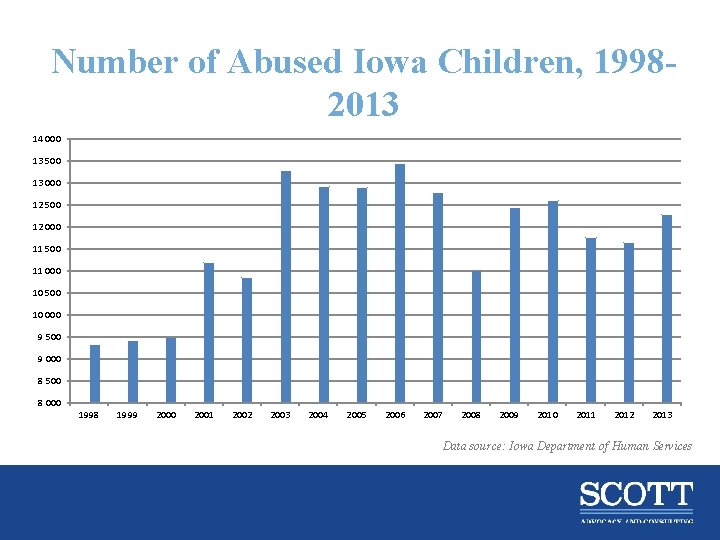
Number of Abused Iowa Children, 19982013 14 000 13 500 13 000 12 500 12 000 11 500 11 000 10 500 10 000 9 500 9 000 8 500 8 000 1998 1999 2000 2001 2002 2003 2004 2005 2006 2007 2008 2009 2010 2011 2012 2013 Data source: Iowa Department of Human Services
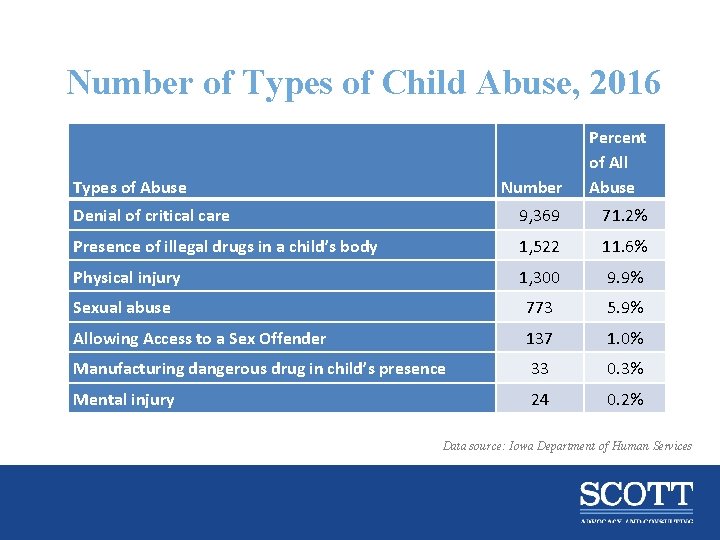
Number of Types of Child Abuse, 2016 Number Percent of All Abuse Denial of critical care 9, 369 71. 2% Presence of illegal drugs in a child’s body 1, 522 11. 6% Physical injury 1, 300 9. 9% Sexual abuse 773 5. 9% Allowing Access to a Sex Offender 137 1. 0% Manufacturing dangerous drug in child’s presence 33 0. 3% Mental injury 24 0. 2% Types of Abuse Data source: Iowa Department of Human Services
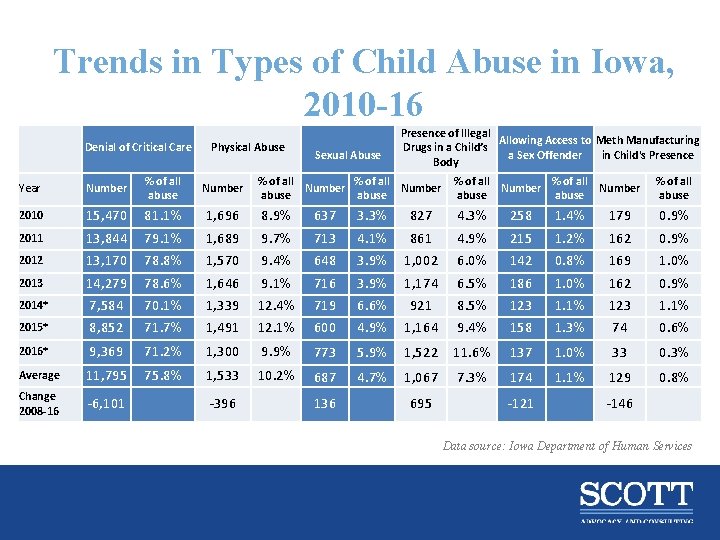
Trends in Types of Child Abuse in Iowa, 2010 -16 Denial of Critical Care Physical Abuse Sexual Abuse Presence of Illegal Allowing Access to Meth Manufacturing Drugs in a Child’s a Sex Offender in Child's Presence Body Year Number % of all abuse Number % of all Number abuse % of all abuse 2010 2015* 15, 470 13, 844 13, 170 14, 279 7, 584 8, 852 81. 1% 79. 1% 78. 8% 78. 6% 70. 1% 71. 7% 1, 696 1, 689 1, 570 1, 646 1, 339 1, 491 8. 9% 9. 7% 9. 4% 9. 1% 12. 4% 12. 1% 637 713 648 716 719 600 3. 3% 4. 1% 3. 9% 6. 6% 4. 9% 827 861 1, 002 1, 174 921 1, 164 4. 3% 4. 9% 6. 0% 6. 5% 8. 5% 9. 4% 258 215 142 186 123 158 1. 4% 1. 2% 0. 8% 1. 0% 1. 1% 1. 3% 179 162 169 162 123 74 0. 9% 1. 0% 0. 9% 1. 1% 0. 6% 2016* 9, 369 71. 2% 1, 300 9. 9% 773 5. 9% 1, 522 11. 6% 137 1. 0% 33 0. 3% Average 11, 795 75. 8% 1, 533 10. 2% 687 4. 7% 1, 067 7. 3% 174 1. 1% 129 0. 8% Change 2008 -16 -6, 101 2012 2013 2014* -396 136 695 -121 -146 Data source: Iowa Department of Human Services
Answers and Questions: A LOOK AT OUR CHILD ABUSE DATA
County-Specific Responses to Accepted Reports in 2016 Reports Accepted: [Local] Assigned to Family Assessment pathway: [Local] (state: 29. 0%) Assigned to Child Abuse Assessment pathway: [Local](state: 71. 0%) § Cases of confirmed or founded child abuse: [Local] (35. 5 % of Child Abuse Assessments) § Total children found to be abused: [Local] § Number of children found abused per 1, 000 children: [Local](12. 25 for state) Where do our community’s figures differ from the state’s? Why might these figures differ? Data source: Iowa Department of Human Services
Changes in Child Abuse in [Local], 201416 County 2014 Pop 0 -17 2014 2015 2016 Change in no. 2014 - Change in 16 % 2014 -16 Avg. no. abused 2014 -16 Avg. abused/ Rank in 1, 000 2014 - abuse rate, 16 2014 -16 Do we see any changes? Do any changes fit with what you have been seeing? Data source: Iowa Department of Human Services
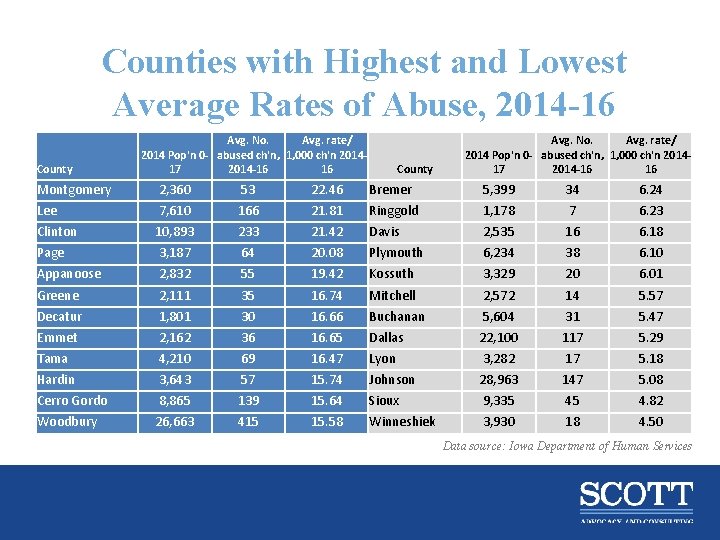
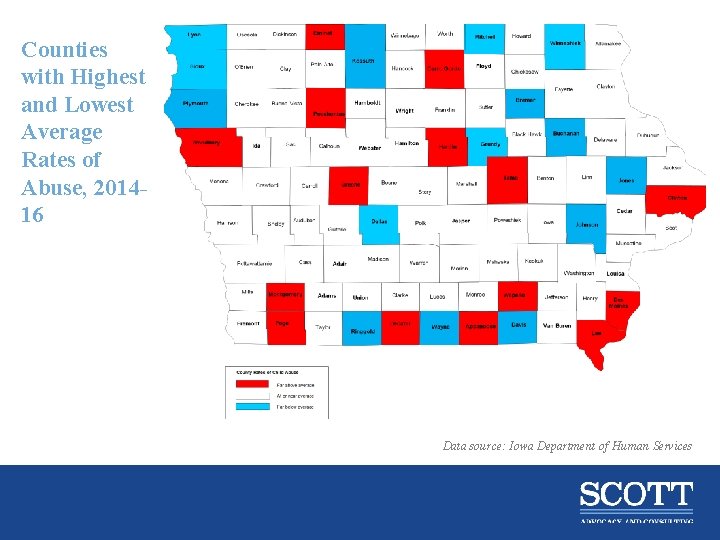
Counties with Highest and Lowest Average Rates of Abuse, 2014 -16 County Avg. No. Avg. rate/ 2014 Pop'n 0 - abused ch'n, 1, 000 ch'n 201417 2014 -16 16 Montgomery 2, 360 53 22. 46 Bremer 5, 399 34 6. 24 Lee 7, 610 166 21. 81 Ringgold 1, 178 7 6. 23 Clinton 10, 893 233 21. 42 Davis 2, 535 16 6. 18 Page 3, 187 64 20. 08 Plymouth 6, 234 38 6. 10 Appanoose 2, 832 55 19. 42 Kossuth 3, 329 20 6. 01 Greene 2, 111 35 16. 74 Mitchell 2, 572 14 5. 57 Decatur 1, 801 30 16. 66 Buchanan 5, 604 31 5. 47 Emmet 2, 162 36 16. 65 Dallas 22, 100 117 5. 29 Tama 4, 210 69 16. 47 Lyon 3, 282 17 5. 18 Hardin 3, 643 57 15. 74 Johnson 28, 963 147 5. 08 Cerro Gordo 8, 865 139 15. 64 Sioux 9, 335 45 4. 82 Woodbury 26, 663 415 15. 58 Winneshiek 3, 930 18 4. 50 Data source: Iowa Department of Human Services
Counties with Highest and Lowest Average Rates of Abuse, 201416 Data source: Iowa Department of Human Services
Number of Types of Child Abuse in [Local], 2016 Types of Abuse Number Percent Denial of critical care Presence of illegal drugs in a child’s body Physical injury Sexual abuse Allowing Access to a Sex Offender Manufacturing dangerous drug in child’s presence Mental injury Data source: Iowa Department of Human Services
Number of Types of Child Abuse [Local], 2016 Physical Injury County STATE TOTALS Sexual Abuse Presence of Illegal Drugs Denial of Critical Care Avg. rate/ Rank 2014 - 1, 000 in avg. Pop 0 -17 16 ch'n. rate 725, 984 1, 348 1. 9 697 1. 0 1, 202 1. 7 9, 273 12. 83 Data source: Iowa Department of Human Services
OUR COMMUNITY’S RESPONSE TO ABUSE
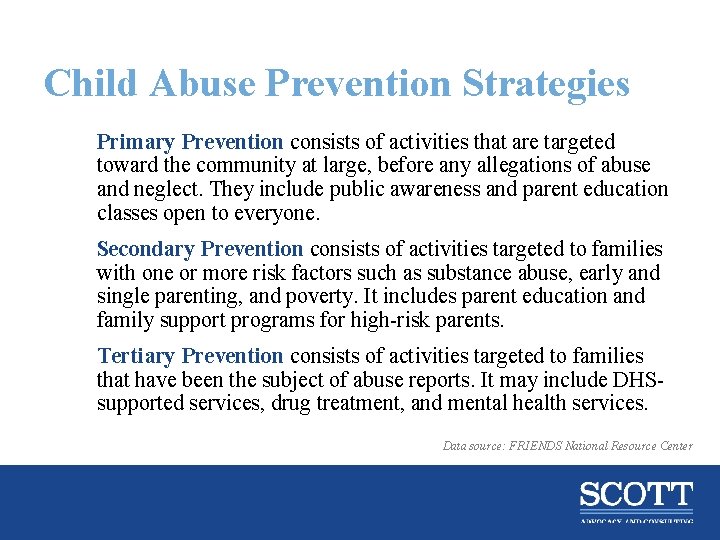
Child Abuse Prevention Strategies Primary Prevention consists of activities that are targeted toward the community at large, before any allegations of abuse and neglect. They include public awareness and parent education classes open to everyone. Secondary Prevention consists of activities targeted to families with one or more risk factors such as substance abuse, early and single parenting, and poverty. It includes parent education and family support programs for high-risk parents. Tertiary Prevention consists of activities targeted to families that have been the subject of abuse reports. It may include DHSsupported services, drug treatment, and mental health services. Data source: FRIENDS National Resource Center
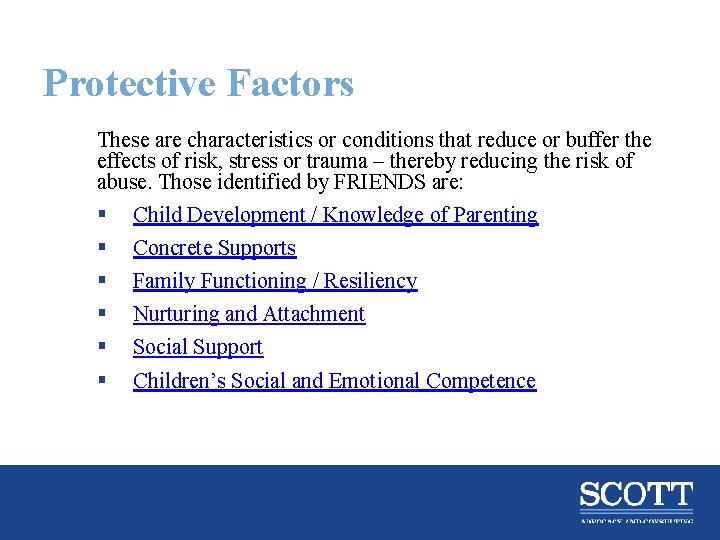
Protective Factors These are characteristics or conditions that reduce or buffer the effects of risk, stress or trauma – thereby reducing the risk of abuse. Those identified by FRIENDS are: § § § Child Development / Knowledge of Parenting Concrete Supports Family Functioning / Resiliency Nurturing and Attachment Social Support Children’s Social and Emotional Competence
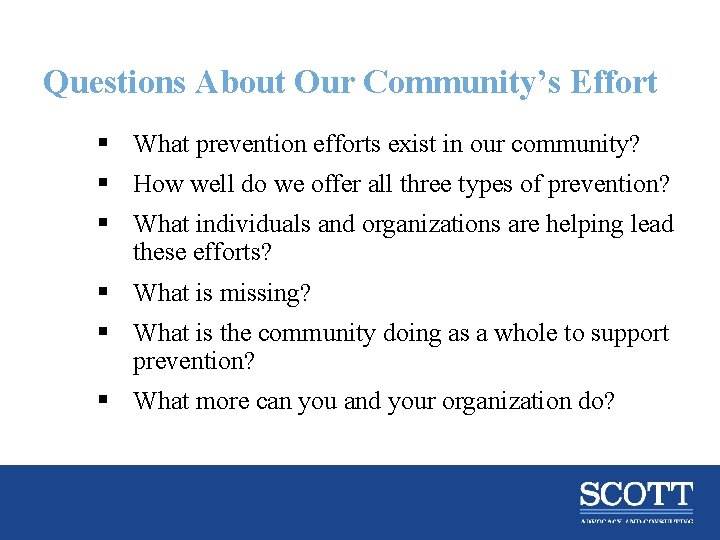
Questions About Our Community’s Effort § What prevention efforts exist in our community? § How well do we offer all three types of prevention? § What individuals and organizations are helping lead these efforts? § What is missing? § What is the community doing as a whole to support prevention? § What more can you and your organization do?
Local Resources
The End PREPARED BY: Stephen Scott, Scott Advocacy and Consulting, LLC www. scottadvconsult. com steve@scottadvconsult. com || 515 -274 -3705