
WHERE TO NOW Mohan Dhall 2020 OVERVIEW What


- Slides: 20
WHERE TO NOW…? © Mohan Dhall 2020
OVERVIEW • What happened? • Impact on school • Impact on tutoring • Reports • Grattan Institute • OECD • Government responses • During • Economic recovery • Where to now. . ? © Mohan Dhall 2020 2
COVID-19 AND SHUTDOWNS • Covid-19 was unexpected but with some thought the effects could have been anticipated • Whether we like it or not opportunities may have forever changed • There has been a discontinuity in education – particularly in the private shadow market • We need to be very aware of changes and of emerging possibilities whilst maintaining educational standards © Mohan Dhall 2020 3
LOCKDOWN AND SCHOOL CLOSURES: LEARNING LOSS – ACTUAL OR IMAGINED? • The notion of learning loss is premised on: • Students learn at school • There has been a discontinuity. This point must be understood. What worked prior cannot be taken for granted from now on. • That school shutdowns have led to a discontinuity creating gaps in learning • But… did shutdowns really create gaps in learning? • If so, for whom is it real? • Primary students? • Those who have no real access to learning at home, including limited online access? © Mohan Dhall 2020 4
LEARNING LOSS • The reports • Grattan Institute • https: //grattan. edu. au/report/covid-catch-up/ • https: //grattan. edu. au/news/why-australia-needs-a-1 b-six-month-tutoringblitz-for-disadvantaged-students • https: //grattan. edu. au/news/money-for-tutors-why-other-states-should-follow -victorias-lead/ • OECD • https: //www. oecd. org/education/the-impact-of-covid-19 -on-educationinsights-education-at-a-glance-2020. pdf © Mohan Dhall 2020 5
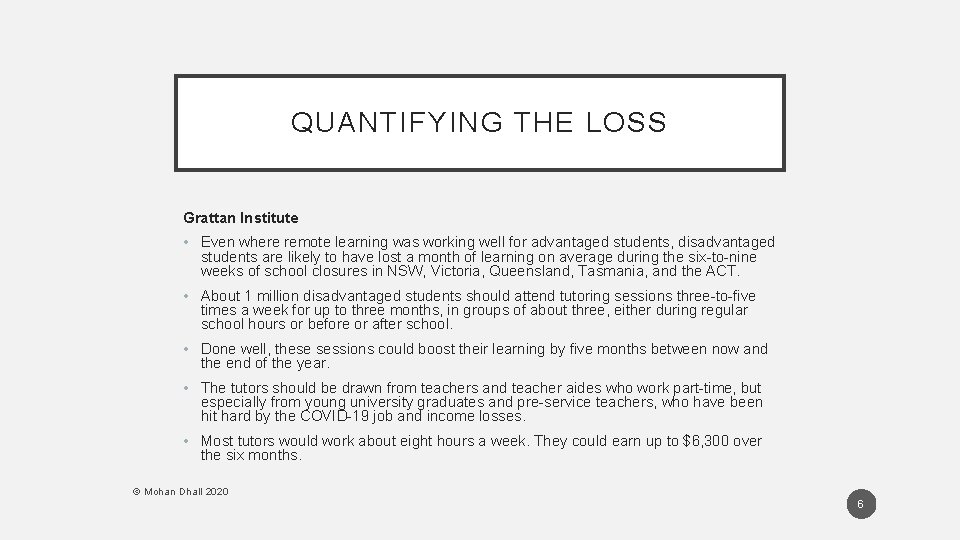
QUANTIFYING THE LOSS Grattan Institute • Even where remote learning was working well for advantaged students, disadvantaged students are likely to have lost a month of learning on average during the six-to-nine weeks of school closures in NSW, Victoria, Queensland, Tasmania, and the ACT. • About 1 million disadvantaged students should attend tutoring sessions three-to-five times a week for up to three months, in groups of about three, either during regular school hours or before or after school. • Done well, these sessions could boost their learning by five months between now and the end of the year. • The tutors should be drawn from teachers and teacher aides who work part-time, but especially from young university graduates and pre-service teachers, who have been hit hard by the COVID-19 job and income losses. • Most tutors would work about eight hours a week. They could earn up to $6, 300 over the six months. © Mohan Dhall 2020 6
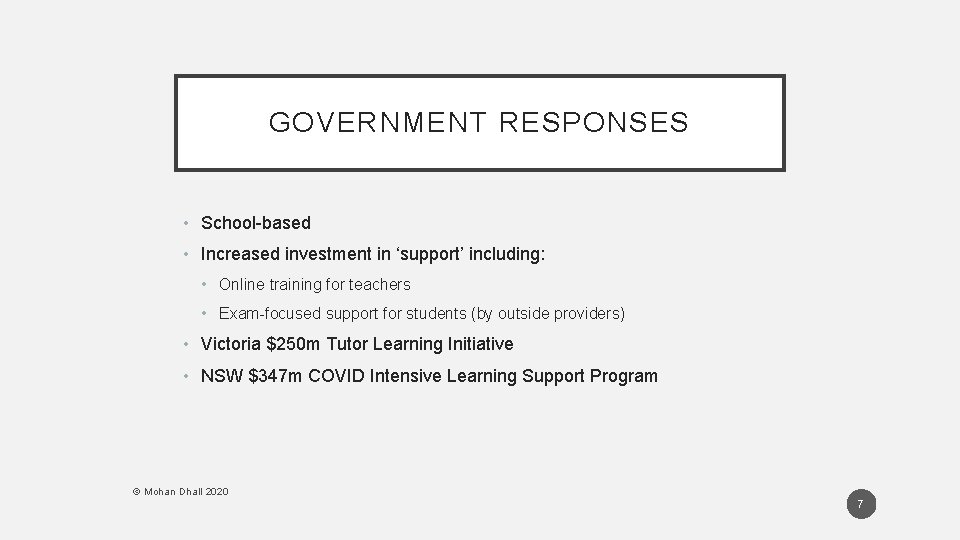
GOVERNMENT RESPONSES • School-based • Increased investment in ‘support’ including: • Online training for teachers • Exam-focused support for students (by outside providers) • Victoria $250 m Tutor Learning Initiative • NSW $347 m COVID Intensive Learning Support Program © Mohan Dhall 2020 7
VICTORIAN GOVERNMENT The Victorian government announced it would spend $250 million to put 4100 tutors in every government school and some non-government schools next year. The Andrews government is calling on final-year teaching students, teachers on leave and casual and retired teachers to work in small groups with the students who have been most disadvantaged by school closures. It expects more than 200, 000 students – about a fifth of Victoria's student population – to take up the tutoring, particularly those with low levels of English or whose home environment was not conducive to remote learning. Grattan Institute acting program director of school education Julie Sonnemann said the program would make a big difference. "$250 million is about the right size given the size of the learning losses from remote learning, " she said. "Our review of the evidence found that tutoring can provide an additional three to five months of learning over the course of a term when done well. Source: M Heffernan, 13 October 2020 from: https: //www. theage. com. au/national/victoria/no-student-left-behind-victorian-governmentto-deploy-thousands-of-tutors-20201013 -p 564 l 0. html © Mohan Dhall 2020 8
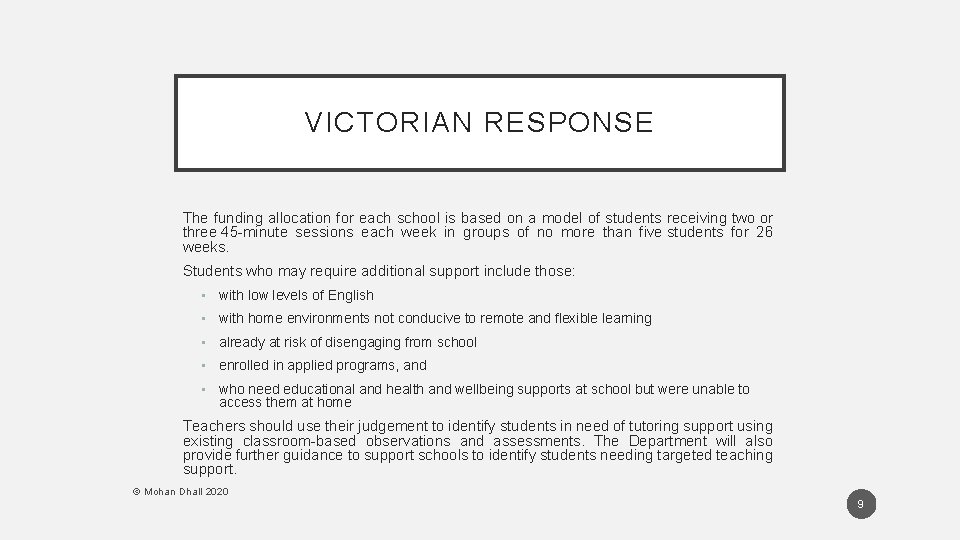
VICTORIAN RESPONSE The funding allocation for each school is based on a model of students receiving two or three 45 -minute sessions each week in groups of no more than five students for 26 weeks. Students who may require additional support include those: • with low levels of English • with home environments not conducive to remote and flexible learning • already at risk of disengaging from school • enrolled in applied programs, and • who need educational and health and wellbeing supports at school but were unable to access them at home Teachers should use their judgement to identify students in need of tutoring support using existing classroom-based observations and assessments. The Department will also provide further guidance to support schools to identify students needing targeted teaching support. © Mohan Dhall 2020 9
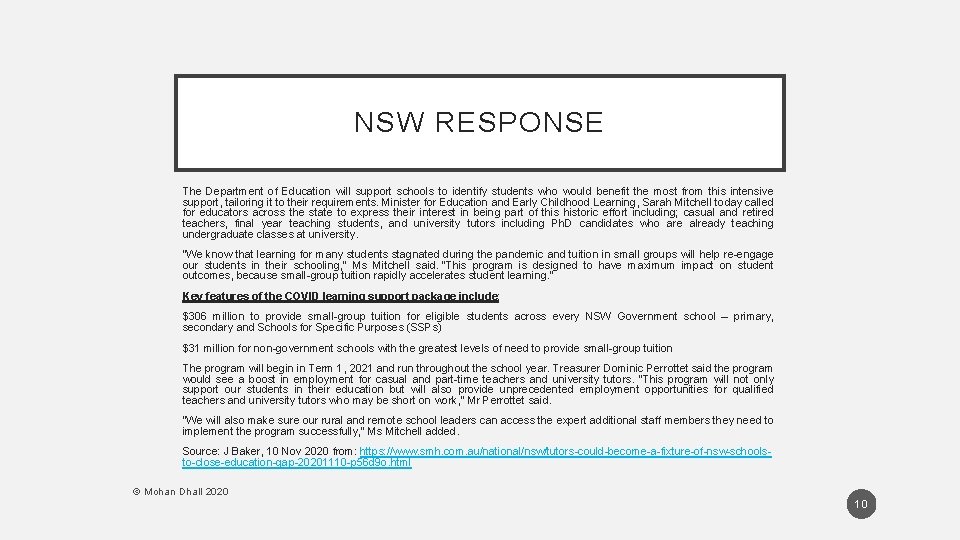
NSW RESPONSE The Department of Education will support schools to identify students who would benefit the most from this intensive support, tailoring it to their requirements. Minister for Education and Early Childhood Learning, Sarah Mitchell today called for educators across the state to express their interest in being part of this historic effort including; casual and retired teachers, final year teaching students, and university tutors including Ph. D candidates who are already teaching undergraduate classes at university. “We know that learning for many students stagnated during the pandemic and tuition in small groups will help re-engage our students in their schooling, ” Ms Mitchell said. “This program is designed to have maximum impact on student outcomes, because small-group tuition rapidly accelerates student learning. ” Key features of the COVID learning support package include: $306 million to provide small-group tuition for eligible students across every NSW Government school – primary, secondary and Schools for Specific Purposes (SSPs) $31 million for non-government schools with the greatest levels of need to provide small-group tuition The program will begin in Term 1, 2021 and run throughout the school year. Treasurer Dominic Perrottet said the program would see a boost in employment for casual and part-time teachers and university tutors. “This program will not only support our students in their education but will also provide unprecedented employment opportunities for qualified teachers and university tutors who may be short on work, ” Mr Perrottet said. “We will also make sure our rural and remote school leaders can access the expert additional staff members they need to implement the program successfully, ” Ms Mitchell added. Source: J Baker, 10 Nov 2020 from: https: //www. smh. com. au/national/nsw/tutors-could-become-a-fixture-of-nsw-schoolsto-close-education-gap-20201110 -p 56 d 9 o. html © Mohan Dhall 2020 10
NSW RESPONSE • Retired teachers, casuals and university education students can apply for about 5500 tutoring jobs from this week and will be paid according to their experience. • The $337 million, 12 -month scheme, which is funded in the state budget, will equate to an average of $130, 000 and 1700 tutoring hours per school. • The Department of Education will consult teachers and use the results of school assessments such as the check-in tests held this year and NAPLAN in 2021 to determine which schools and students need the most help. Source: J Baker, 10 Nov 2020 from: https: //www. smh. com. au/national/nsw/tutors-could-become-afixture-of-nsw-schools-to-close-education-gap-20201110 -p 56 d 9 o. html © Mohan Dhall 2020 11
NSW RESPONSE • Learning gaps were already significant before the pandemic, and have long been one of the biggest challenges facing schools. By year 3, disadvantaged students are 10 months behind those from advantaged backgrounds. • But modelling suggests the gap may have widened by up to five weeks due to seven weeks of remote learning earlier this year. • When asked if the program could continue after its allocated 12 months if it succeeded in reducing the gap, NSW Education Minister Sarah Mitchell said she would be closely monitoring its effectiveness. Source: J Baker, 10 Nov 2020 from: https: //www. smh. com. au/national/nsw/tutors-could-become-afixture-of-nsw-schools-to-close-education-gap-20201110 -p 56 d 9 o. html © Mohan Dhall 2020 12
REGISTERING FOR THESE SCHEMES Tutor learning initiative (Victoria): • https: //www. education. vic. gov. au/about/careers/teacher/Pages/tutors. as px • https: //www. teach. nsw. edu. au/find-teaching-jobs/covid-learning-supportprogram © Mohan Dhall 2020 13
IMPLICATIONS FOR THE ATA • Our preference is for a choice-based model. We have written to both State Education Ministers putting this option. If accepted, this would mean a portion of the funds would be ‘discretionary’ and could be allocated to the private market (but working closely with schools) • In addition, we believe the targeted students generally have particular needs, and thus there is a need for specialised training • We have suggested that the government work with us to settle a training/qualification standard for tutors used in these programs • We do not generally believe that there will be direct negative impacts on the private tutoring market. Why? • Teacher trained tutors in affected states can register to be providers in these programs • It is highly likely MOST affected students come from families who would not have accessed the private tutoring market © Mohan Dhall 2020 14
THE TUTORING SECTOR IN AUSTRALIA: IMPLICATIONS OF SEMIPOST COVID What we have seen: • Very large initial loss of work due to lockdowns and stay at home orders • Shift to online modes of learning led to: • Some tutors adapting successfully • Some tutoring businesses adjusting • New tutors entering the sector • There has been some restoration, but in reality only those businesses that are wholly online and known for that have suggested they have grown. • Face-to-face models have only grown if they offer viable online programs (as there are physical restrictions) © Mohan Dhall 2020 15
FUTURE OPPORTUNITIES: SEMI-POST PANDEMIC What we know: • Parents have been exposed to ‘teachers’ in their homes through schoolbased online learning • This has made parents more focused and interested. At the minimum they have a point of comparison. • The market has become surprisingly crowded. The level of apparent choice has grown, and it is harder to be seen as a tutor. This is because of opportunism (from both new and established entrants) but parents are less trustful and more wary. © Mohan Dhall 2020 16
SEMI-POST-PANDEMIC OPPORTUNITIES • Implications • Covid safe plan will ALL its elements including contact tracing, distancing, sanitation • Tutors MUST have an online presence – this is necessary for several reasons: • Being findable • Demonstrating an awareness of how students learn and how parents have had to navigate the Covid period • Understanding the nature of physical movement and time • There is therefore a need for tutors to integrate and understand the whole online learning space • You can give away materials without charge – giving prospective clients a sense of you • You will need good systems and processes – ad hoc arrangements will be seen as unprofessional © Mohan Dhall 2020 17
ARTICULATING EDUCATIONAL UNDERSTANDING • In an age of wariness and weariness, coupled with some economic uncertainty, tutors must consider CPD • Tutors must also understand how to bring ‘certainty’ and higher levels of accountability to students and their parents • Expect threats so understand exactly what you offer, refine it and create value around it • Do not generally manipulate prices (discount) as the only means of attracting students © Mohan Dhall 2020 18
OTHER OPPORTUNITIES • Curriculum changes • ATAR • Actual subject by subject changes postponed this year (Vic and NSW) • Transfer test changes • Selective schools (NSW) • UCAT • Scholarship • NAPLAN changes © Mohan Dhall 2020 19
REFERENCES Additional readings • https: //www. smh. com. au/national/nsw/tutors-could-become-a-fixture-ofnsw-schools-to-close-education-gap-20201110 -p 56 d 9 o. html © Mohan Dhall 2020 20