
Where is from The amniotic fluid initially is


- Slides: 22
Where is from? • The amniotic fluid initially is secreted by the amnion, but by 10 th week it is mainly a transudate of the fetal serum via the skin and umbilical cord. From 16 week’s gestation, the fetal skin becomes impermeable to water and net increase in amniotic fluid is through the imbalance between the contributions of fluid through the kidneys and lungs fluids and removal by fetal swallowing
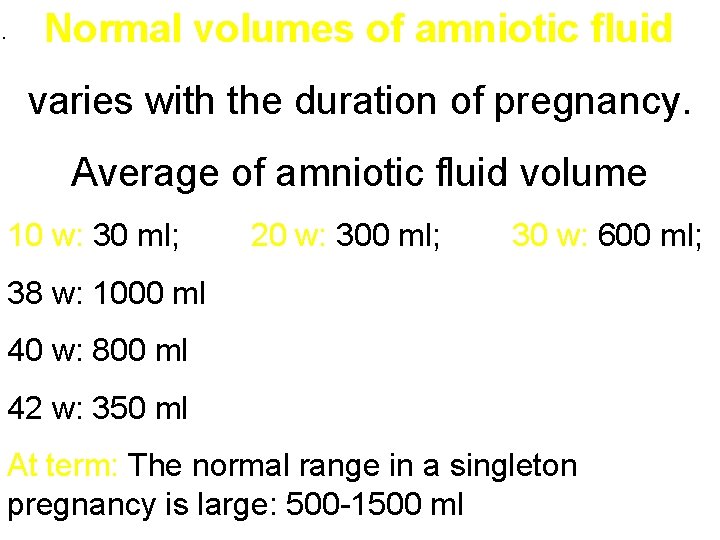
. Normal volumes of amniotic fluid varies with the duration of pregnancy. Average of amniotic fluid volume 10 w: 30 ml; 20 w: 300 ml; 30 w: 600 ml; 38 w: 1000 ml 40 w: 800 ml 42 w: 350 ml At term: The normal range in a singleton pregnancy is large: 500 -1500 ml
The function of the AF: • Protect the fetus from mechanical injury • Permit movement of the fetus • Prevent adhesions between fetus and amnion • Permit fetal lung development
Polyhydramnios, Definition . Amniotic fluid volume (AFV) >2 L. Incidence 1: 25 pregnancies. Types 1. Chronic: Excess fluid accumulates gradually & it is only noticed after the 30 th w of pregnancy. It is 10 times more common than acute PH. 2. Acute: Excess fluid accumulates more quickly & it occurs earlier in pregnancy. It is usually associated with uniovular twin pregnancy
Causes . A. Fetal: 1. Multiple pregnancy. { In monozygotic twin one fetus usurps the greater part of the circulation common to both twins & develops cardiac hypertrophy which in turn results in increased urine output} 2. Hydrops fetalis
. 3. Fetal anomalies: a. Anencephaly. {. Increased transudation of fluid from the exposed meninges into the amniotic cavity . Excessive urination caused either by stimulation of cerebrospinal centers deprived of their protective covering or lack of antidiuretic effects of impaired arginine vasopressin secretion} b. Duodenal atresia. { Fetal swallowing is by no means the only mechanism for preventing PH. } c. Thoraco-oesophageal fistula d. Spina bifida. {Increased transudation of fluid from the exposed meninges into the amniotic cavity}
. B. Maternal: 1. Diabetes mellitus {Maternal hyperglycemia results in osmotic diuresis}. AFV reflects recent glycemic status. 2. Pre-eclampsia 3. Heart or renal failure C. Idiopathic
Clinical picture . Symptoms 1. Unusually enlarged abdomen & less felt fetal movements 2. Abdominal discomfort. 3. dyspnea, dyspepsia, leg oedema Signs 1. Uterus: larger than the period of pregnancy, tense, fluid thrill 2. Fetus: unstable position, parts may not be felt, FHS are muffled
U/S: . a. Confirm diagnosis: Vertical pocket >8 cm or AFI >24 cm. AFI > 3 standard deviations or the 97. 5 percentile for gestational age (Moise, 1991) b. Detect the degree: Vertical pocket: 8 -11 cm (mild); 12 -15 (Moderate) & >16 (severe) c. Detect the cause:
. Differential diagnosis 1. Twins 2. Ovarian cyst 3. Full bladder 4. Hydatiform mole All are resolved by U/S
. Complications During pregnancy: Malpresentation PROM: cord prolapse, placental abruption During labor: postpartum hemorrhage Perinatal mortality: high { pretem labor, congenital malformation,
. Treatment Minor degree • Additional rest in semireclining position • Sedation
. Major degree: 1. Hospitalization: If there is dyspnea or abdominal pain or ambulation is difficult. Bed rest rarely has any effect & diuretics & water & salt restriction are likewise ineffective. 2. Amniocentesis: To relief maternal distress. Technique: 1500 is removed gradually ( 500 ml /hr) through drainage or rapidly (50 ml/min) through suction
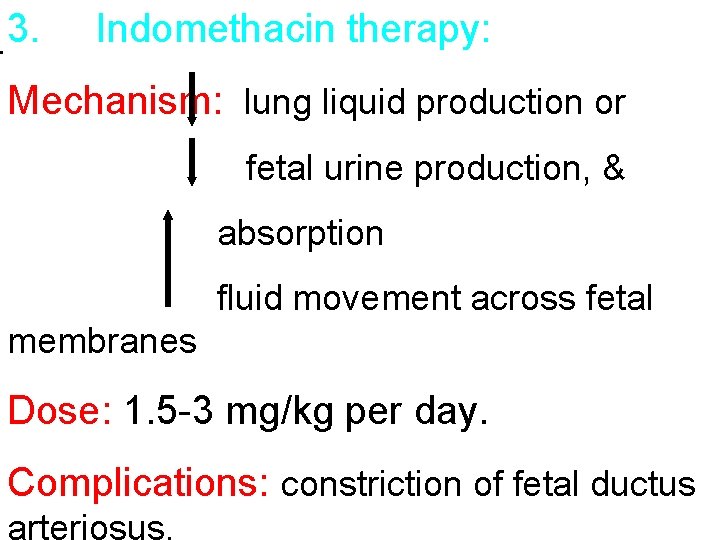
. 3. Indomethacin therapy: Mechanism: lung liquid production or fetal urine production, & absorption fluid movement across fetal membranes Dose: 1. 5 -3 mg/kg per day. Complications: constriction of fetal ductus
Definition Marked deficiency of the amniotic fluid volume below the normal limits Incidence 0. 5 -5% of all pregnancies
Causes A. Fetal: 1. Spontaneous rupture of the membranes 2. IUGR: 60% 3. Post-term pregnancy 4. Congenital anomalies of the urinary tract: obstructive lesions or agenesis 5. Twin-twin transfusion
B. Maternal: 1. Uteroplacental insufficiency 2. Drugs: Prostaglandin synthetase inhibitors, Angiotensin converting enzyme inhibitors 3. Placental abruption C. Idiopathic
Complications During pregnancy 1. Fetal hypoxia: {cord compression} 2. Persistent position of the foetus 3. Limb deformities: talipes (clubfoot) & ankylosis of joins {pressure or amniotoic bands} 4. Pulmonary hypoplasia: {failure to retain amniotic fluid or increased outflow with impaired lung development & growth} During labor 1. increased variable deceleration}
Clinical picture 1. Uterus is small for date 2. Fetus: a. easily felt & immobile b. FHS: easily heared 3. U/S: Vertical pocket <1 cm or <2 cm; AFI <5 cm
Management of Olygohydramnios: • • Confirm the diagnosis To rule out fetal abnormalities Assess the fetal grown Assess the fetal wellbeing
Treatment Amnioinfusion: Infusion of saline into the uterine cavity through the abdominal wall by a spinal needle To increase the AFV &