
Where in Los Angeles is Carmen Sandiego Matthew

- Slides: 18
Where in Los Angeles is Carmen Sandiego? Matthew Weirick Johnson, MSLS UCLA Library 11 January 2019 academic. mattweirick. com
Introduction • Bachelor of English in Literature & Language; Virginia Tech, Blacksburg, VA • Master of Science in Library Science; University of North Carolina, Chapel Hill, NC • Graduate Certificates: SILS Diversity Advocate, Interdisciplinary Health Communication, Interdisciplinary Health Disparities • Community Workshop Series Coordinator • Duke University Medical Center Library, Research & Education Intern • Miriam Braverman Memorial Prize, Progressive Librarians Guild
Agenda • Course Information (Considerations, Assumptions, Overview) • In-Class Activity • Assessment (Pre- & Post-) • Questions
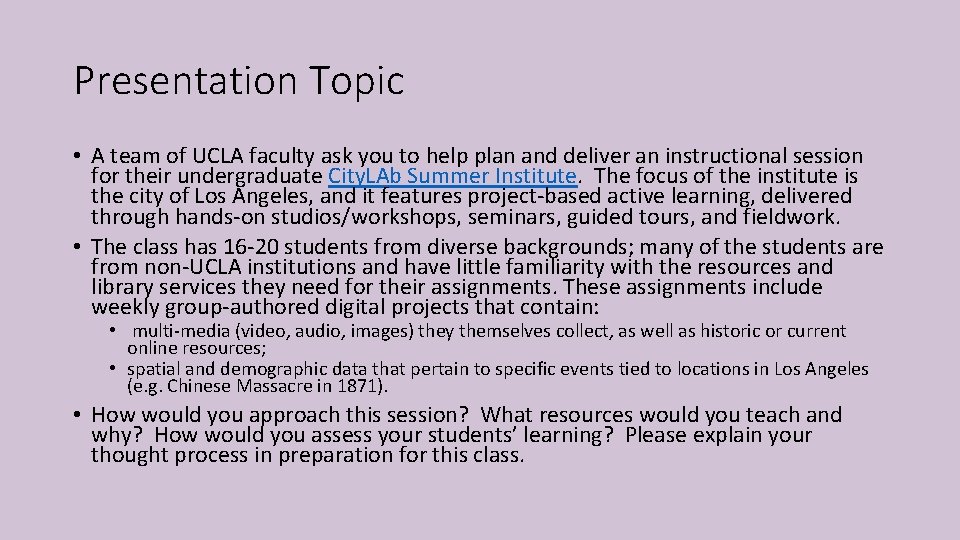
Presentation Topic • A team of UCLA faculty ask you to help plan and deliver an instructional session for their undergraduate City. LAb Summer Institute. The focus of the institute is the city of Los Angeles, and it features project-based active learning, delivered through hands-on studios/workshops, seminars, guided tours, and fieldwork. • The class has 16 -20 students from diverse backgrounds; many of the students are from non-UCLA institutions and have little familiarity with the resources and library services they need for their assignments. These assignments include weekly group-authored digital projects that contain: • multi-media (video, audio, images) they themselves collect, as well as historic or current online resources; • spatial and demographic data that pertain to specific events tied to locations in Los Angeles (e. g. Chinese Massacre in 1871). • How would you approach this session? What resources would you teach and why? How would you assess your students’ learning? Please explain your thought process in preparation for this class.
Course Objectives • Learn to use and critically assess a suite of digital tools, spatial datasets, and mapping/ visualization technologies for studying urbanism in Los Angeles. • Analyze Los Angeles’s built environment through perspectives informed by urban history, cultural studies, architecture, ethnographic fieldwork, and speculations about the future. • Understand how the history of Los Angeles is intimately and unevenly linked with the history of technologies; lean how this is manifest in built spaces and urban infrastructures. • Combine urban, architectural, digital, and humanist perspectives to understand interrelations between various racial, economic, social, and/or cultural narratives in the city. • Learn transferable skills through action-oriented, collaborative, and project-based research, while engaging in multidisciplinary inquiry. • Learn to work in research teams in order to conceptualize, design, carry out, and deliver persuasive arguments through writing, mapping, and visual media.
Considerations • Introduction to the course relies on students’ existing knowledge (adult learning theory) • Course heavily incorporates collaboration, group work, and inter/multidisciplinarity • No prior experience or coursework necessary (only a high school diploma is required) • Many students are likely new to UCLA
Assignments • Project 1. 1: Basic Digital Map in Google Earth • Google My Maps, Google Earth, Social Explorer, ESRI Storymaps • Project 1. 2: Thick Mapping • Fieldwork, LA spatial datasets, Google Earth, Presentation • Project 2. 1: Final Project Draft • Storyboard, film segment • Project 2. 2: Final Film • 6 -10 minute film, original scripting/acting, archival and ethnographic work, found footage • Final Cut Pro, Premiere • Project 3: Digital Online Portfolio • Illustrator, Photoshop, In. Design • Focus on finding data, maps, and scholarly sources instead of learning technological tools
Teaching Philosophy • Adult Learning Theory • Experiential Learning • Inquiry-Based Learning
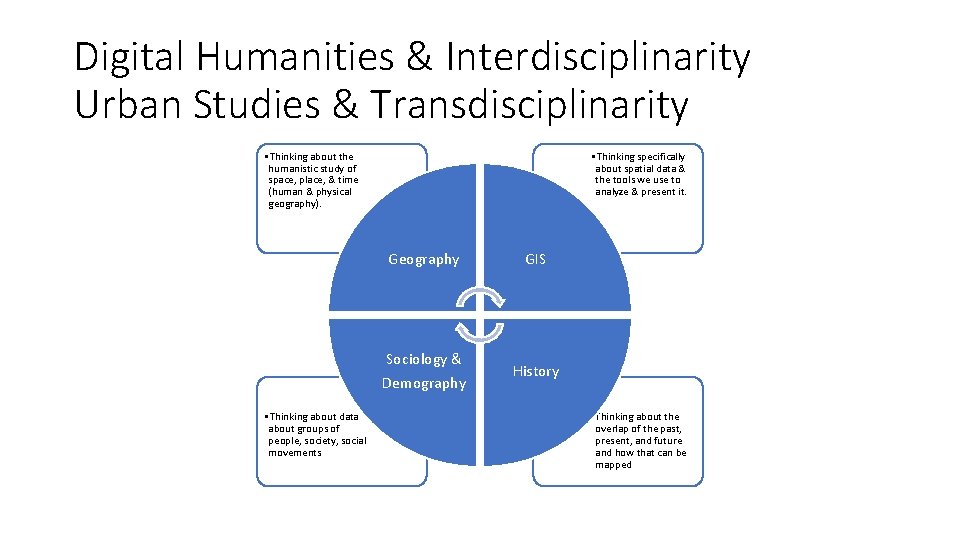
Digital Humanities & Interdisciplinarity Urban Studies & Transdisciplinarity • Thinking about the humanistic study of space, place, & time (human & physical geography). • Thinking about data about groups of people, society, social movements • Thinking specifically about spatial data & the tools we use to analyze & present it. Geography GIS Sociology & Demography History • Thinking about the overlap of the past, present, and future and how that can be mapped
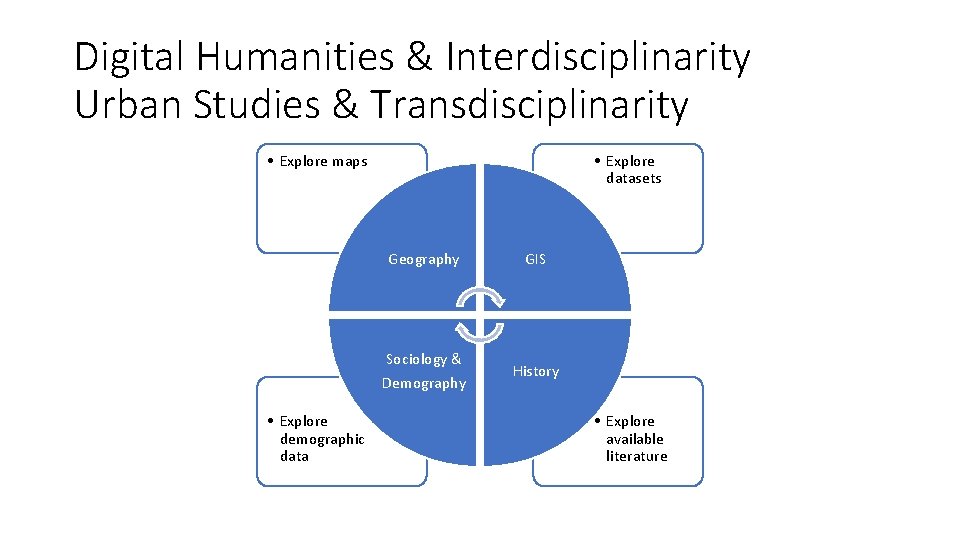
Digital Humanities & Interdisciplinarity Urban Studies & Transdisciplinarity • Explore maps • Explore demographic data • Explore datasets Geography GIS Sociology & Demography History • Explore available literature
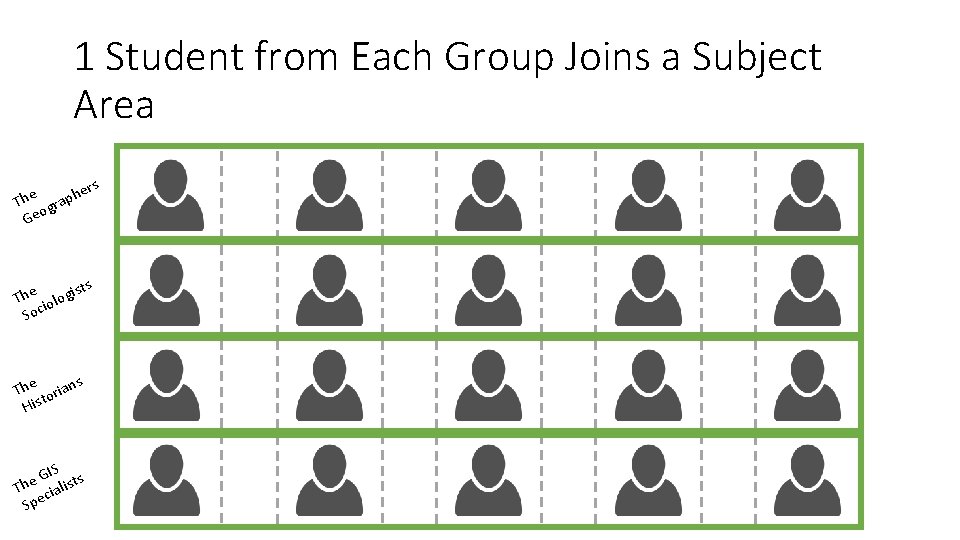
20 Students
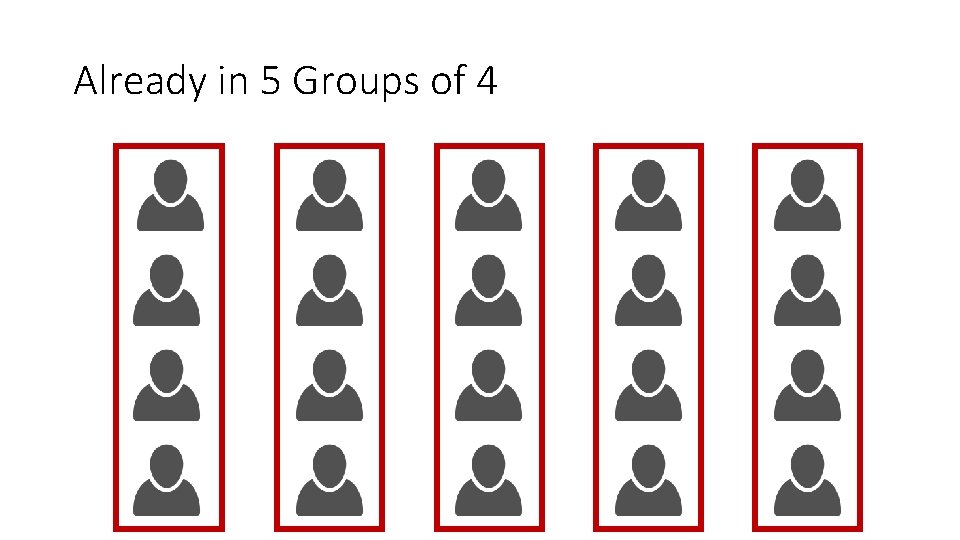
Already in 5 Groups of 4
1 Student from Each Group Joins a Subject Area rs e h e p Th gra o Ge sts The iologi Soc s The orian t His IS s G The cialist Spe
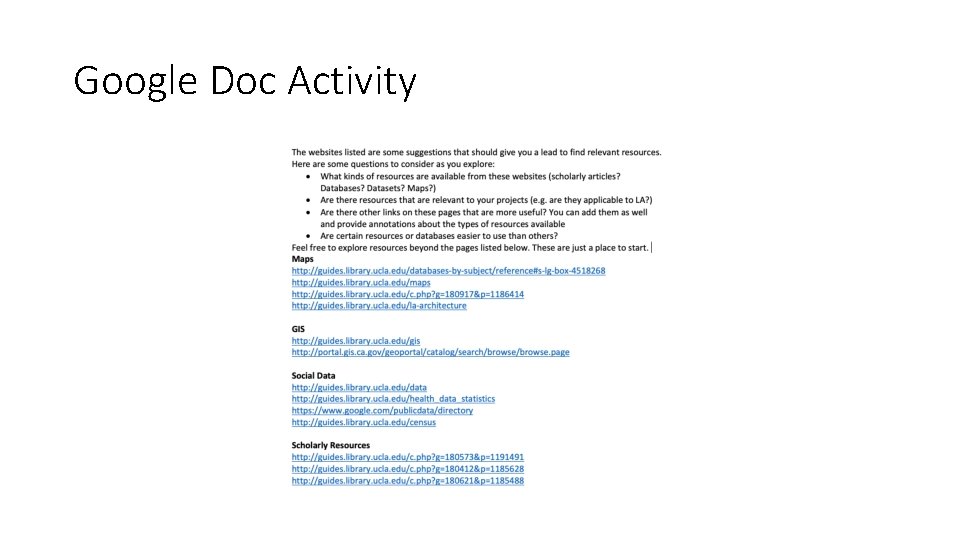
Google Doc Activity
Pre-Assessment • Online learning object created using Google Forms & Instructional Videos embedded in a website • The learning object will take students through the basics of searching from the library website, including required responses • Learning object will feed into the beginning of class
Post-Assessment • A Google Docs assignment sheet to complete • Students will identify data sets and resources that are relevant for their projects. • There should be room for variance in terms of how far along students are (i. e. some students might have data sets, topics, and articles and others might still be looking at databases and search terms) • Faculty members and instructor will provide feedback on this assignment to help direct students
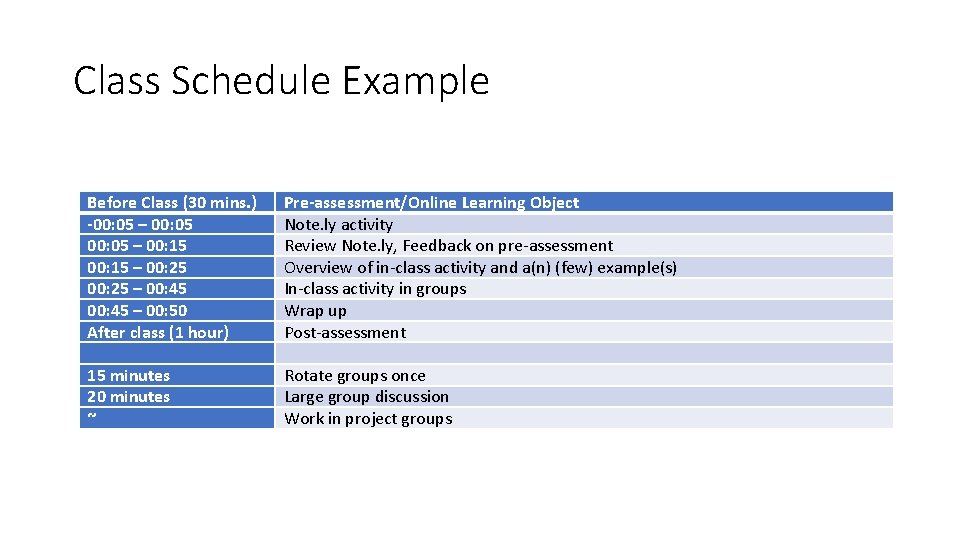
Class Schedule Example Before Class (30 mins. ) -00: 05 – 00: 15 – 00: 25 – 00: 45 – 00: 50 After class (1 hour) 15 minutes 20 minutes ~ Pre-assessment/Online Learning Object Note. ly activity Review Note. ly, Feedback on pre-assessment Overview of in-class activity and a(n) (few) example(s) In-class activity in groups Wrap up Post-assessment Rotate groups once Large group discussion Work in project groups
Matthew Weirick Johnson academic. mattweirick. com matt@mattweirick. com academic. mattweirick. com/files/ucla-presentation-20190111. pptx academic. mattweirick. com/talks/2019 -01 -11 -ucla-presentation