
WHERE DID THOSE GBIF OCCURRENCES COME FROM Providing
WHERE DID THOSE GBIF OCCURRENCES COME FROM? Providing Digital Access to Nature. Serve's Reference Database: Report on a Project in the Early Stages of Design [ ] TDWG 2011 Annual Conference New Orleans, LA Donna J Reynolds Robert A Morris Filtered Push Project Harvard University
Nature. Serve Data on GBIF • 759, 500+ Nature. Serve network occurrence records provided to GBIF – Basis of record? – “Personal Communication, Published Report, Unpublished Report (interpreted as Unknown)” • About 540, 000 (70%) of them are linked to a citation in Nature. Serve’s central database. Examples: – Knisley, C. Barry. 2005. Monitoring Cicindela puritana and C. dorsalis in Maryland, 2004. Final Report submitted to MD Natural Heritage Program. – Davidson, B. 2002. Field survey form for Botrychium montanum. – Eid, Nancy. Sent in letter about rare plants on Onion Peak, 1998.
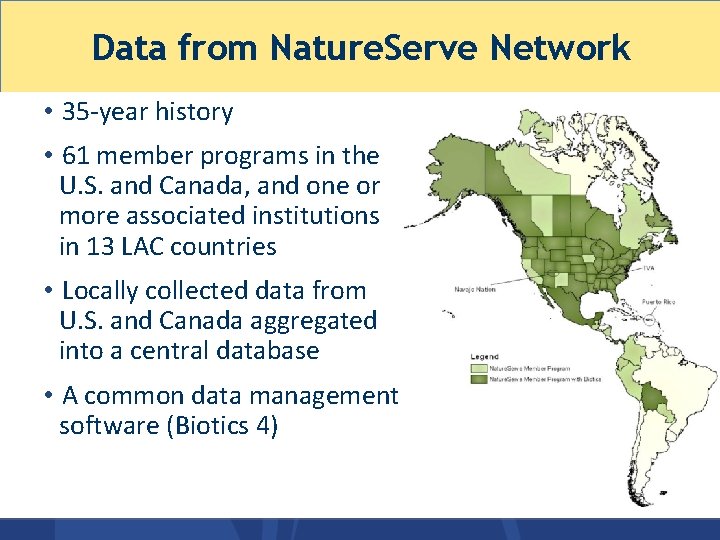
Data from Nature. Serve Network • 35 -year history • 61 member programs in the U. S. and Canada, and one or more associated institutions in 13 LAC countries • Locally collected data from U. S. and Canada aggregated into a central database • A common data management software (Biotics 4)
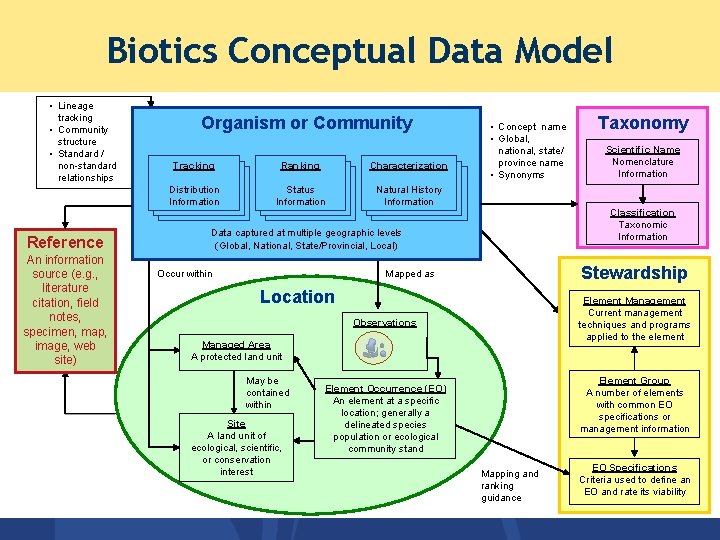
Biotics Conceptual Data Model • Lineage tracking • Community structure • Standard / non-standard relationships Reference An information source (e. g. , literature citation, field notes, specimen, map, image, web site) Organism or Community Tracking Ranking Characterization Distribution Information Status Information Natural History Information • Concept name • Global, national, state/ province name • Synonyms Stewardship Mapped as Location Element Management Current management techniques and programs applied to the element Observations Managed Area A protected land unit May be contained within Site A land unit of ecological, scientific, or conservation interest Scientific Name Nomenclature Information Classification Taxonomic Information Data captured at multiple geographic levels (Global, National, State/Provincial, Local) Occur within Taxonomy Element Group A number of elements with common EO specifications or management information Element Occurrence (EO) An element at a specific location; generally a delineated species population or ecological community stand Mapping and ranking guidance EO Specifications Criteria used to define an EO and rate its viability
Reference File • Over 570, 000 records • Books, journal articles, unpublished reports, field forms, specimens, personal communications, maps, websites, images • Less than 25% represent published sources (books, articles, etc. ) • Most of the “gray literature” is still on paper in natural heritage program offices
The Project Proposal Evaluate the usefulness and feasibility of exposing metadata and selected attributes from Nature. Serve’s reference database on the web
Goals • Contribute to improving access to gray literature by ‘publicizing’ its existence – Occurrence references – Documentation on conservation status, local phenology, ecosystem composition and changes over time, etc. • Ultimately, provide digital access to nonsensitive unpublished literature
Challenges • Nature. Serve is not the owner of the data Ø Current data sharing agreements with our affiliated programs that specify how data may be used do not address the reference data • Reference records may contain sensitive information (e. g. , notes about the location of an endangered species) Ø Can this concern can be addressed simply by excluding certain attributes? • Resources! Ø Seeking partners interested in the same goals
- Slides: 8