
Where Are You Please enter your location in

- Slides: 21
Where Are You? Please enter your location in the chat window (lower left of screen) 1
Emergency Unemployment Insurance Stabilization and Access Act of 2020 (EUISAA) Unemployment Insurance Program Letter (UIPL) 13 -20, released March 22, 2020 March 17, 2020
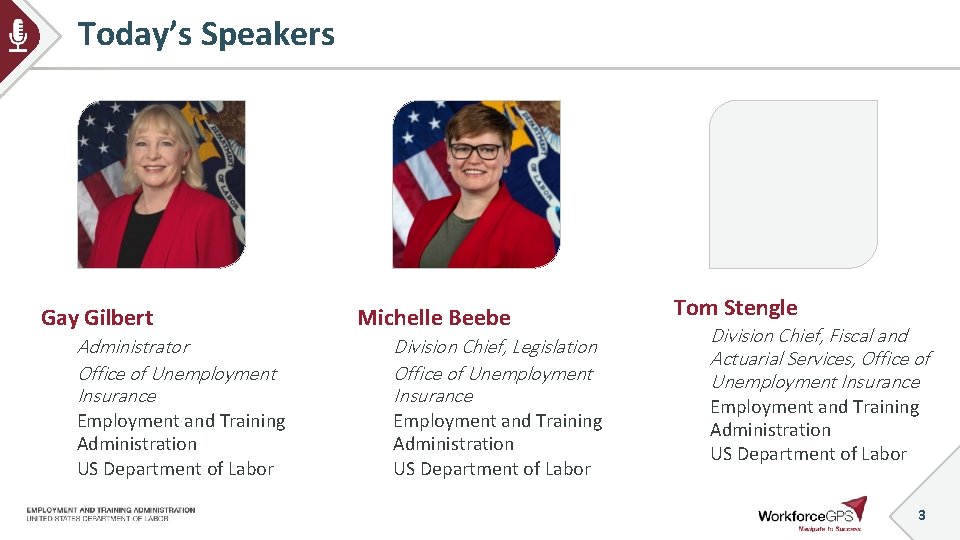
Today’s Speakers Gay Gilbert Michelle Beebe Administrator Office of Unemployment Insurance Division Chief, Legislation Office of Unemployment Insurance Employment and Training Administration US Department of Labor Tom Stengle Division Chief, Fiscal and Actuarial Services, Office of Unemployment Insurance Employment and Training Administration US Department of Labor 3
Summary and Background On Thursday evening, March 18, 2020, EUISAA was signed into law as part of the Families First Coronavirus Response Act (Public Law 116 -127) Sections 4101 through 4105 make many law changes to aid state UI agencies in responding to the impacts on the nation’s workforce caused by COVID-19, including: Emergency Flexibility allowing states to modify certain UC laws and policies A total of $1. 0 billion in Emergency Administrative Grants available to states meeting certain requirements Full Federal Funding of Extended Benefits (EB) Temporary Assistance with State Trust Fund Advances UIPL No. 13 -20 adds to, and where the flexibilities allowed by EUISAA are broader, expands the guidance provided in UIPL No. 10 -20. 4
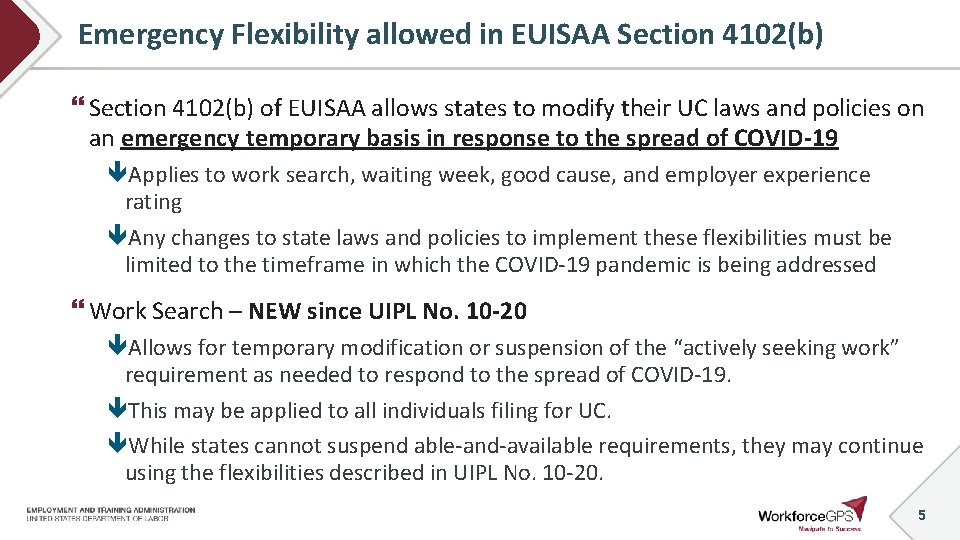
Emergency Flexibility allowed in EUISAA Section 4102(b) of EUISAA allows states to modify their UC laws and policies on an emergency temporary basis in response to the spread of COVID-19 Applies to work search, waiting week, good cause, and employer experience rating Any changes to state laws and policies to implement these flexibilities must be limited to the timeframe in which the COVID-19 pandemic is being addressed Work Search – NEW since UIPL No. 10 -20 Allows for temporary modification or suspension of the “actively seeking work” requirement as needed to respond to the spread of COVID-19. This may be applied to all individuals filing for UC. While states cannot suspend able-and-available requirements, they may continue using the flexibilities described in UIPL No. 10 -20. 5
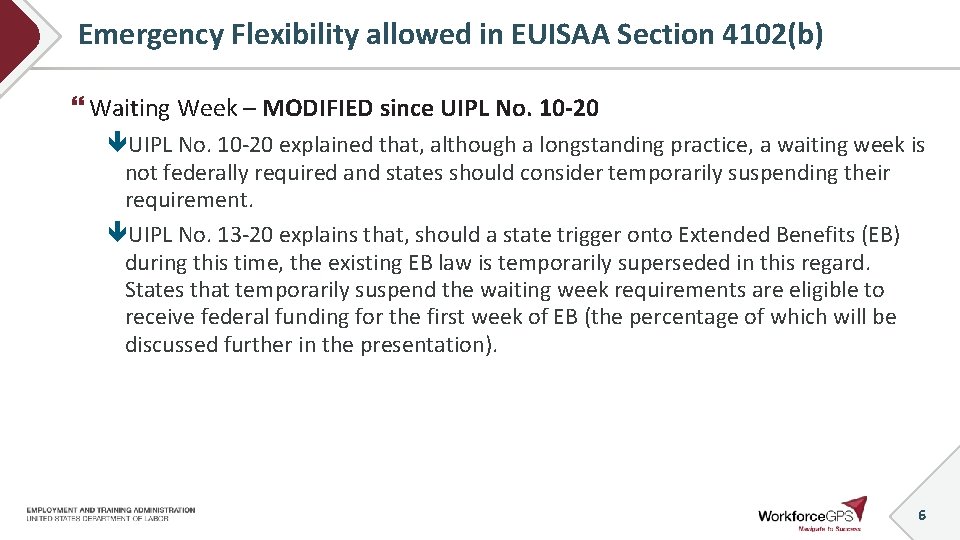
Emergency Flexibility allowed in EUISAA Section 4102(b) Waiting Week – MODIFIED since UIPL No. 10 -20 explained that, although a longstanding practice, a waiting week is not federally required and states should consider temporarily suspending their requirement. UIPL No. 13 -20 explains that, should a state trigger onto Extended Benefits (EB) during this time, the existing EB law is temporarily superseded in this regard. States that temporarily suspend the waiting week requirements are eligible to receive federal funding for the first week of EB (the percentage of which will be discussed further in the presentation). 6
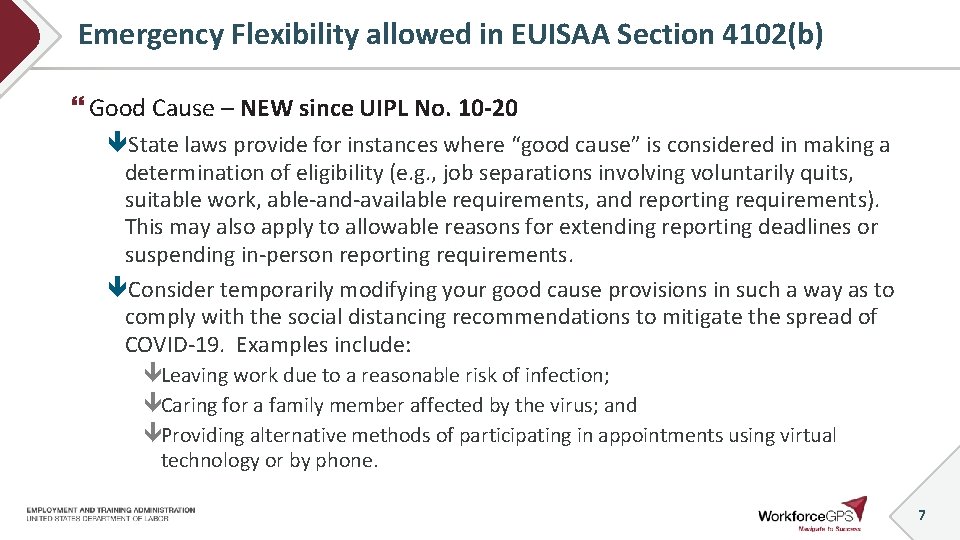
Emergency Flexibility allowed in EUISAA Section 4102(b) Good Cause – NEW since UIPL No. 10 -20 State laws provide for instances where “good cause” is considered in making a determination of eligibility (e. g. , job separations involving voluntarily quits, suitable work, able-and-available requirements, and reporting requirements). This may also apply to allowable reasons for extending reporting deadlines or suspending in-person reporting requirements. Consider temporarily modifying your good cause provisions in such a way as to comply with the social distancing recommendations to mitigate the spread of COVID-19. Examples include: Leaving work due to a reasonable risk of infection; Caring for a family member affected by the virus; and Providing alternative methods of participating in appointments using virtual technology or by phone. 7
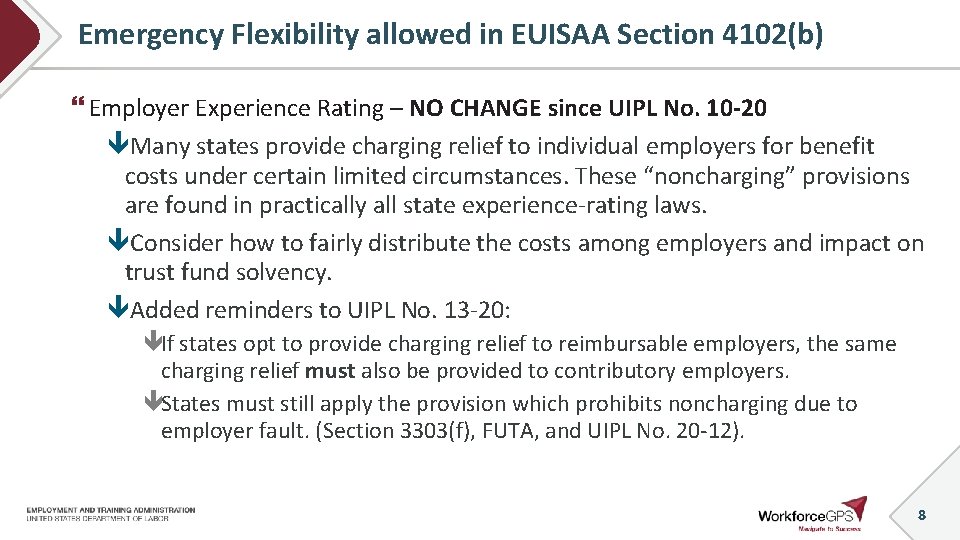
Emergency Flexibility allowed in EUISAA Section 4102(b) Employer Experience Rating – NO CHANGE since UIPL No. 10 -20 Many states provide charging relief to individual employers for benefit costs under certain limited circumstances. These “noncharging” provisions are found in practically all state experience-rating laws. Consider how to fairly distribute the costs among employers and impact on trust fund solvency. Added reminders to UIPL No. 13 -20: If states opt to provide charging relief to reimbursable employers, the same charging relief must also be provided to contributory employers. States must still apply the provision which prohibits noncharging due to employer fault. (Section 3303(f), FUTA, and UIPL No. 20 -12). 8
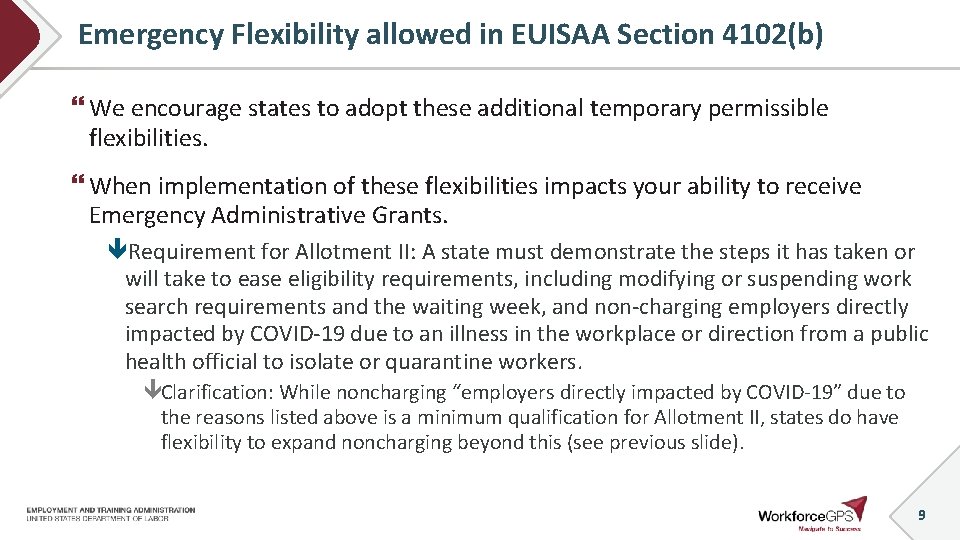
Emergency Flexibility allowed in EUISAA Section 4102(b) We encourage states to adopt these additional temporary permissible flexibilities. When implementation of these flexibilities impacts your ability to receive Emergency Administrative Grants. Requirement for Allotment II: A state must demonstrate the steps it has taken or will take to ease eligibility requirements, including modifying or suspending work search requirements and the waiting week, and non-charging employers directly impacted by COVID-19 due to an illness in the workplace or direction from a public health official to isolate or quarantine workers. Clarification: While noncharging “employers directly impacted by COVID-19” due to the reasons listed above is a minimum qualification for Allotment II, states do have flexibility to expand noncharging beyond this (see previous slide). 9
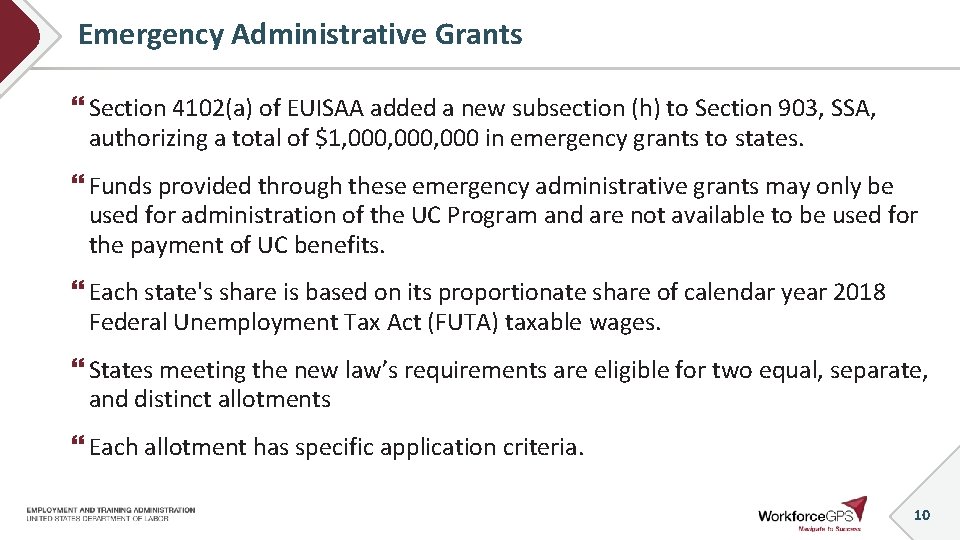
Emergency Administrative Grants Section 4102(a) of EUISAA added a new subsection (h) to Section 903, SSA, authorizing a total of $1, 000, 000 in emergency grants to states. Funds provided through these emergency administrative grants may only be used for administration of the UC Program and are not available to be used for the payment of UC benefits. Each state's share is based on its proportionate share of calendar year 2018 Federal Unemployment Tax Act (FUTA) taxable wages. States meeting the new law’s requirements are eligible for two equal, separate, and distinct allotments Each allotment has specific application criteria. 10
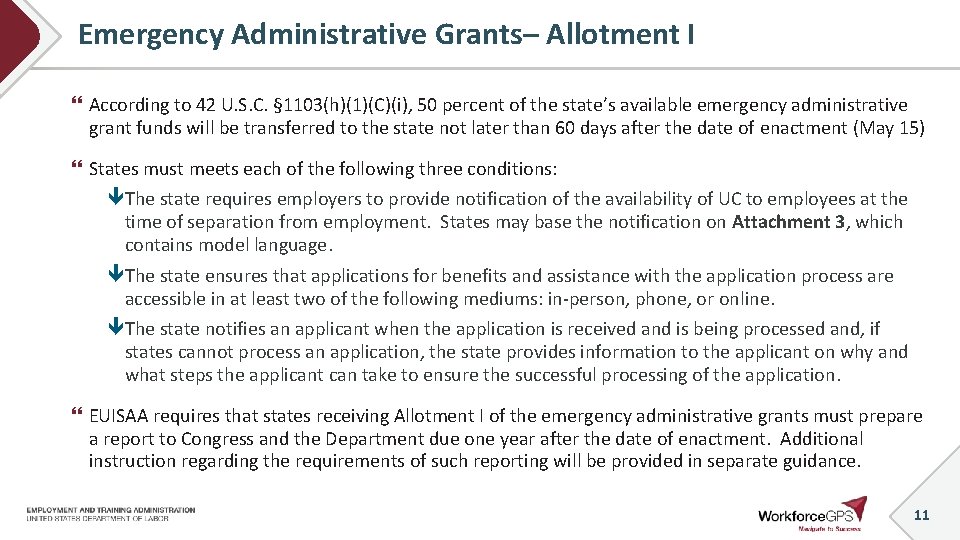
Emergency Administrative Grants– Allotment I According to 42 U. S. C. § 1103(h)(1)(C)(i), 50 percent of the state’s available emergency administrative grant funds will be transferred to the state not later than 60 days after the date of enactment (May 15) States must meets each of the following three conditions: The state requires employers to provide notification of the availability of UC to employees at the time of separation from employment. States may base the notification on Attachment 3, which contains model language. The state ensures that applications for benefits and assistance with the application process are accessible in at least two of the following mediums: in-person, phone, or online. The state notifies an applicant when the application is received and is being processed and, if states cannot process an application, the state provides information to the applicant on why and what steps the applicant can take to ensure the successful processing of the application. EUISAA requires that states receiving Allotment I of the emergency administrative grants must prepare a report to Congress and the Department due one year after the date of enactment. Additional instruction regarding the requirements of such reporting will be provided in separate guidance. 11
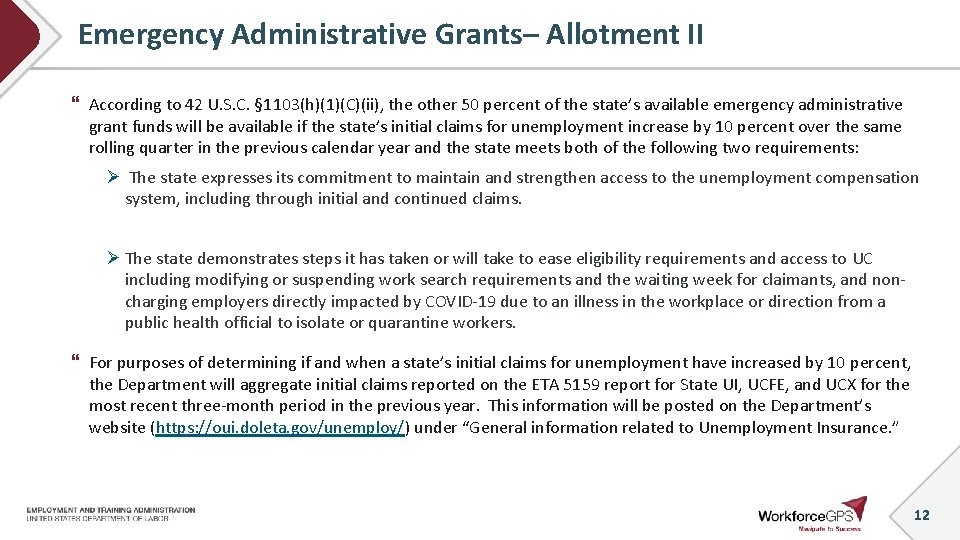
Emergency Administrative Grants– Allotment II According to 42 U. S. C. § 1103(h)(1)(C)(ii), the other 50 percent of the state’s available emergency administrative grant funds will be available if the state’s initial claims for unemployment increase by 10 percent over the same rolling quarter in the previous calendar year and the state meets both of the following two requirements: Ø The state expresses its commitment to maintain and strengthen access to the unemployment compensation system, including through initial and continued claims. Ø The state demonstrates steps it has taken or will take to ease eligibility requirements and access to UC including modifying or suspending work search requirements and the waiting week for claimants, and noncharging employers directly impacted by COVID-19 due to an illness in the workplace or direction from a public health official to isolate or quarantine workers. For purposes of determining if and when a state’s initial claims for unemployment have increased by 10 percent, the Department will aggregate initial claims reported on the ETA 5159 report for State UI, UCFE, and UCX for the most recent three-month period in the previous year. This information will be posted on the Department’s website (https: //oui. doleta. gov/unemploy/) under “General information related to Unemployment Insurance. ” 12
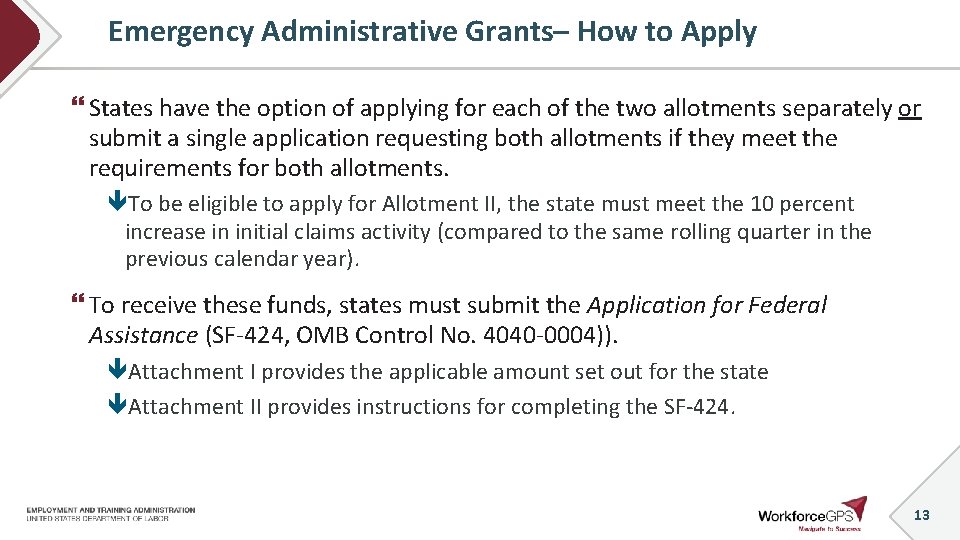
Emergency Administrative Grants– How to Apply States have the option of applying for each of the two allotments separately or submit a single application requesting both allotments if they meet the requirements for both allotments. To be eligible to apply for Allotment II, the state must meet the 10 percent increase in initial claims activity (compared to the same rolling quarter in the previous calendar year). To receive these funds, states must submit the Application for Federal Assistance (SF-424, OMB Control No. 4040 -0004)). Attachment I provides the applicable amount set out for the state Attachment II provides instructions for completing the SF-424. 13
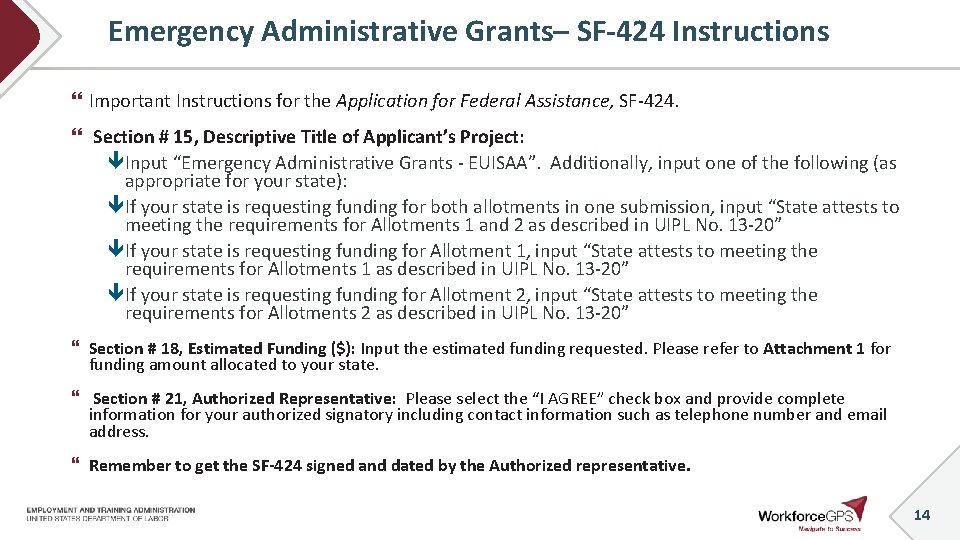
Emergency Administrative Grants– SF-424 Instructions Important Instructions for the Application for Federal Assistance, SF-424. Section # 15, Descriptive Title of Applicant’s Project: Input “Emergency Administrative Grants - EUISAA”. Additionally, input one of the following (as appropriate for your state): If your state is requesting funding for both allotments in one submission, input “State attests to meeting the requirements for Allotments 1 and 2 as described in UIPL No. 13 -20” If your state is requesting funding for Allotment 1, input “State attests to meeting the requirements for Allotments 1 as described in UIPL No. 13 -20” If your state is requesting funding for Allotment 2, input “State attests to meeting the requirements for Allotments 2 as described in UIPL No. 13 -20” Section # 18, Estimated Funding ($): Input the estimated funding requested. Please refer to Attachment 1 for funding amount allocated to your state. Section # 21, Authorized Representative: Please select the “I AGREE” check box and provide complete information for your authorized signatory including contact information such as telephone number and email address. Remember to get the SF-424 signed and dated by the Authorized representative. 14
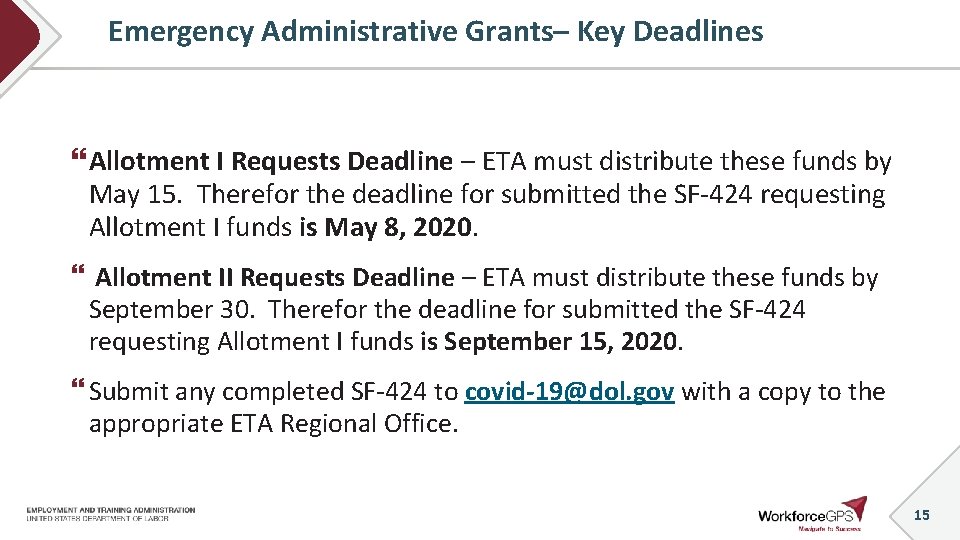
Emergency Administrative Grants– Key Deadlines Allotment I Requests Deadline – ETA must distribute these funds by May 15. Therefor the deadline for submitted the SF-424 requesting Allotment I funds is May 8, 2020. Allotment II Requests Deadline – ETA must distribute these funds by September 30. Therefor the deadline for submitted the SF-424 requesting Allotment I funds is September 15, 2020. Submit any completed SF-424 to covid-19@dol. gov with a copy to the appropriate ETA Regional Office. 15
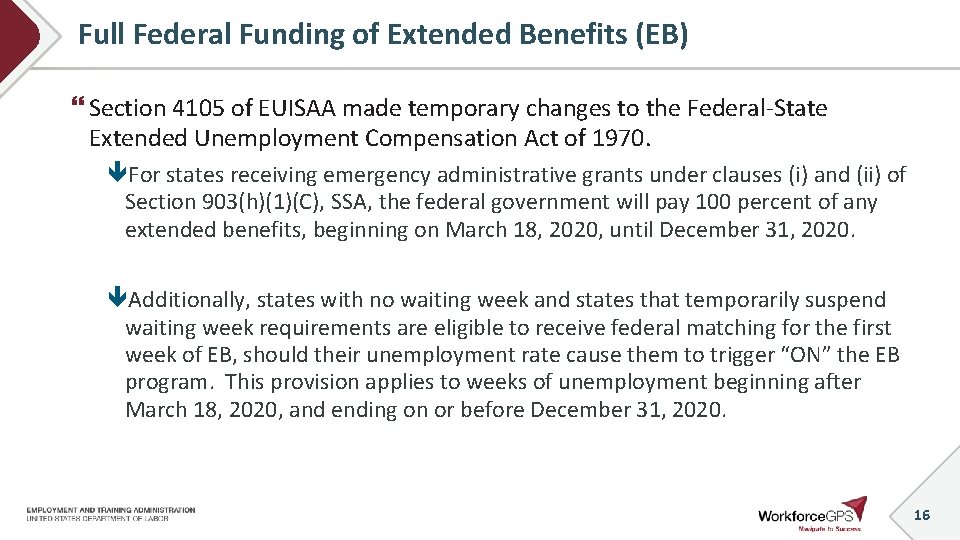
Full Federal Funding of Extended Benefits (EB) Section 4105 of EUISAA made temporary changes to the Federal-State Extended Unemployment Compensation Act of 1970. For states receiving emergency administrative grants under clauses (i) and (ii) of Section 903(h)(1)(C), SSA, the federal government will pay 100 percent of any extended benefits, beginning on March 18, 2020, until December 31, 2020. Additionally, states with no waiting week and states that temporarily suspend waiting week requirements are eligible to receive federal matching for the first week of EB, should their unemployment rate cause them to trigger “ON” the EB program. This provision applies to weeks of unemployment beginning after March 18, 2020, and ending on or before December 31, 2020. 16
State Trust Fund Advances Section 4103 of EUISAA deems any interest due on advances from the Federal Unemployment Account (FUA) in the Unemployment Trust Fund between March 18, 2020, and December 31, 2020, to be paid. Additionally, no interest shall accrue on any advances made to states from March 18, 2020, through December 31, 2020. 17
Future Additional Guidance on the Report to Congress and the Department on State Recipiency Rate Technical Assistance on Short-Time Compensation Any New Legislative Enactments related to UI – Guidance will be issued soon after enactment Status of Round 3 of Congressional Response to COVID 19 18
Resources Email covid-19@dol. gov with your questions CC to your regional office If proposing changes to state laws or rules, include your Division of Legislation state team member UIPL No. 13 -20 Families First Coronavirus Response Act, Division D Emergency Unemployment Insurance Stabilization and Access Act of 2020 https: //wdr. doleta. gov/directives/corr_doc. cfm? DO CN=8634 UIPL No. 10 -20 State Unemployment Insurance Trust Fund Solvency Report (Feb. 2020) Provides assistance in effectively evaluating a state’s trust fund solvency levels https: //oui. doleta. gov/unemploy/docs/trust. Fun d. Solv. Report 2020. pdf Guidance on Short-Time Compensation Workforce. GPS Landing Page https: //stc. workforcegps. org/ UIPL 22 -12, plus Change 1 and Change 2 https: //wdr. doleta. gov/directives/corr_doc. cfm? DOCN=9382 Unemployment Compensation for Individuals Affected by the Coronavirus Disease 2019 (COVID 19) https: //wdr. doleta. gov/directives/corr_doc. cfm? DOCN=8893 19
Thank You! Need help? Email: Support@workforce. GPS. org
Any Questions? Please type your question into the chat window. After the call, please direct any additional questions to covid-19@dol. gov 21