
Where are the Oceans Identify the Oceans Tides


- Slides: 21
Where are the Oceans? Identify the Oceans Tides Waves Currents Ocean Storms The Ocean Floor
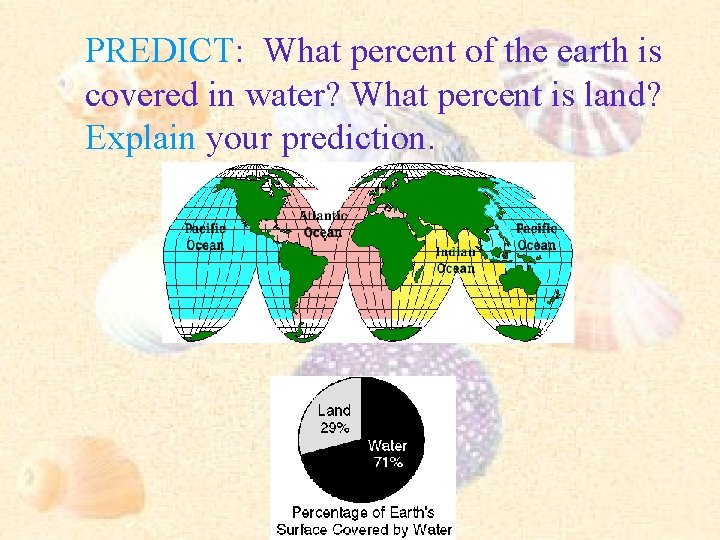
PREDICT: What percent of the earth is covered in water? What percent is land? Explain your prediction.
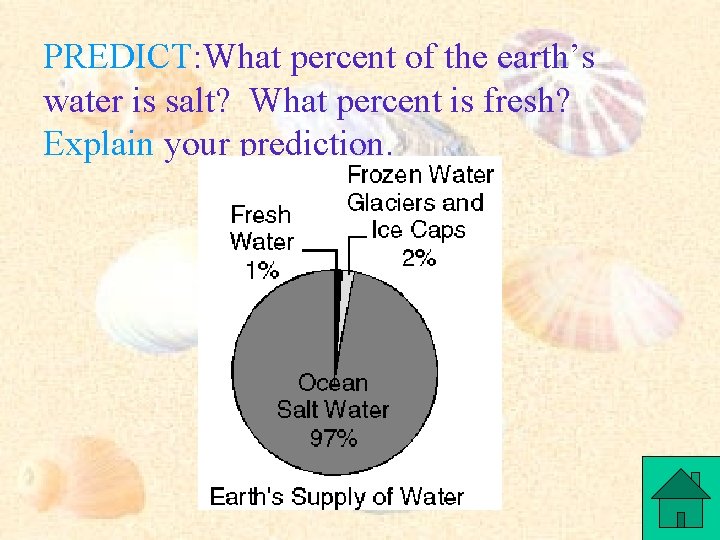
PREDICT: What percent of the earth’s water is salt? What percent is fresh? Explain your prediction.
World Ocean Facts Atlantic Ocean Pacific Ocean Indian Ocean Arctic Ocean Area (1, 000 km²) Volume (1, 000 km³) Average Depth (m) Maximum Depth (m) 82. 4 323. 6 3926 9200 165. 2 707. 6 4282 11, 022 73. 4 291. 0 3963 7460 14. 1 17. 0 1205 4300
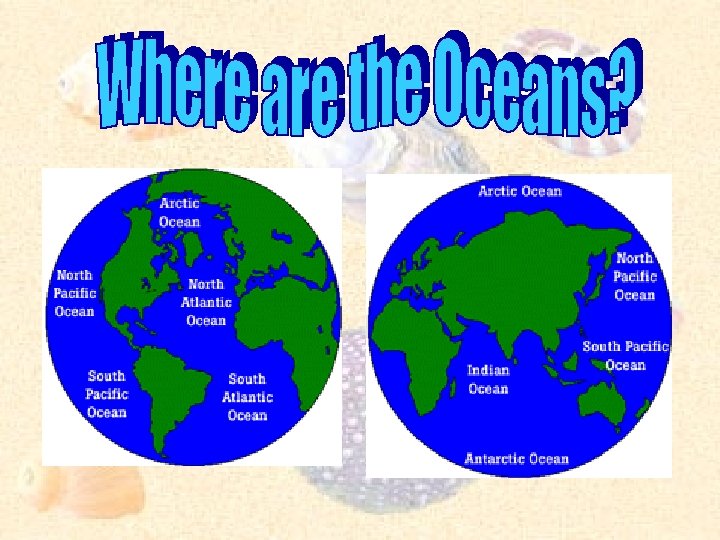
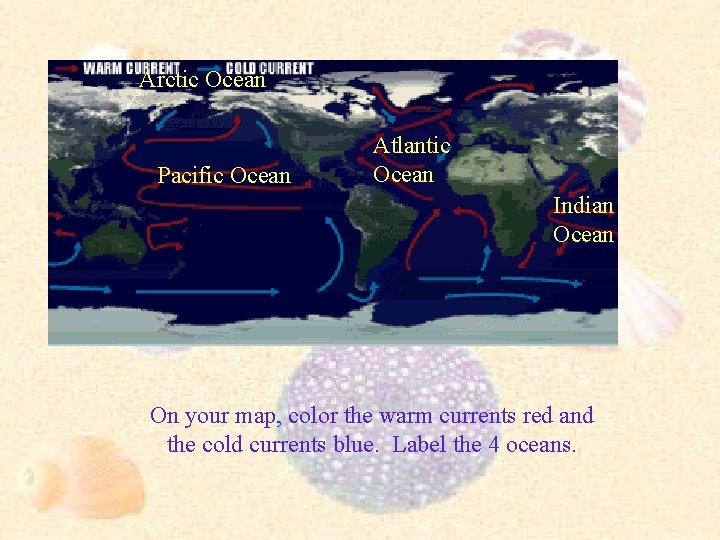
Arctic Ocean Pacific Ocean Atlantic Ocean Indian Ocean On your map, color the warm currents red and the cold currents blue. Label the 4 oceans.
Making Currents
What causes tides? üThe gravitational forces of the moon and sun on the water causes the tides. . üThe moon, being nearest, has the greatest effect even though the sun is the larger of the two. üHigh tides are generated on the sides of the Earth nearest to and farthest from the moon
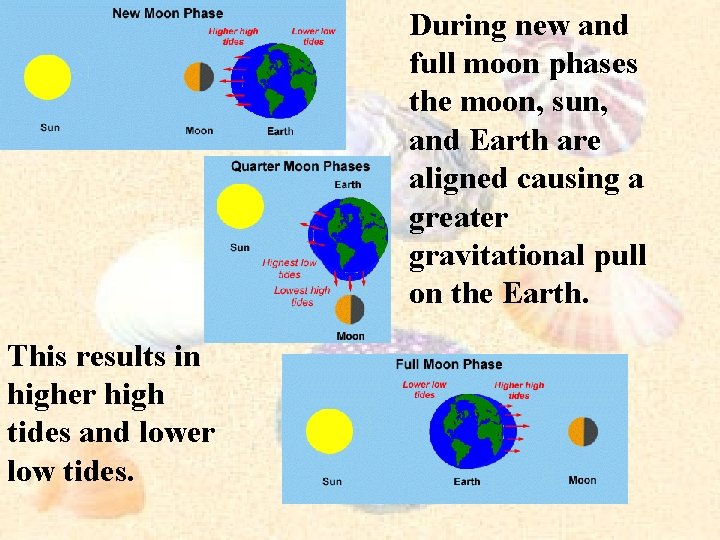
During new and full moon phases the moon, sun, and Earth are aligned causing a greater gravitational pull on the Earth. This results in higher high tides and lower low tides.
How are Tides Predicted?
• Still-Water Line - The level of the ocean if it were flat without any waves. Crest - The highest part of the wave above the stillwater line. Trough - The lowest part of the wave below the still -water line • Wave Height - The vertical distance between the crest and the trough. • Wavelength - The horizontal distance between each crest or each trough.
• Wave Period - The time it takes for two successive waves to pass a particular point. For example, it you are standing on a pier and start a stopwatch as the crest of a wave passes and then stop the stopwatch as the crest of the next wave passes, you have measured the wave period. Wave Frequency - The number of waves that pass a particular point in a given time period. Amplitude - The amplitude is equal to one-half the wave height or the distance from either the crest or the trough to the still-water line.
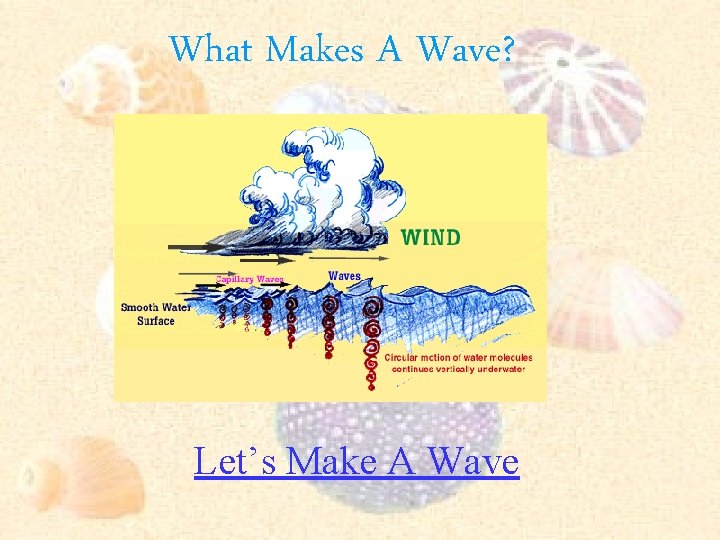
What Makes A Wave? Let’s Make A Wave
Hurricane Tsunami Ocean Storms Typhoon El Nino Cyclone
Neptune’s Web Ocean Weather, Temperature, and Tides Ocean Planet Exhibit in the Smithsonian Museum of Natural History Secrets at Sea Game