
Where are the Maya today The Maya from
- Slides: 20
Where are the Maya today? The Maya from the Spanish Conquest to Today Presentation created by Lori Riehl, November 2008
Do Now ü Assume that the Maya moved into the jungles and villages surrounding former cities. ü What challenges might bring them back together as a society? What cultural connections might they still have? List 3– 5 ideas. 2
The Spanish conquer the Aztecs ü What does “indigenous” mean? ü Spanish conquered Mexico’s Aztec rulers between 1519– 1521 ü Survival of “New Spain” depended on indigenous knowledge and labor: “Without the support from indigenous allies it is doubtful that Spain would have been successful in conquering Mexico. ”* ü Spanish took on paternalistic (fatherly) and protective role with indigenous people ü Indigenous populations included Maya & Aztecs ü The Yucatan was not conquered until 1542** 3
The Maya in Mexico in the 20 th century ü Mexican Revolution (1917) to 1970 s ü In 1917, 62 languages were spoken in Mexico ü In 1950: 65% spoke Mayan; 2000: 37%* ü Today: some villages speak almost entirely in Maya dialects* ü 12 million indigenous people (11– 12% of population) ü How are indigenous people treated by governments? Society? 4
Challenges faced by indigenous Maya ü Social exclusion ü Land struggles ü Poor health conditions ü Natural disasters ü Restricted political activity through civil rights abuses and military presence in Mayan regions ü Language discrimination (as recently as 2002 courts used Spanish and did not supply interpreters for non. Spanish speakers) 5
Indigenous Land Rights ü Indigenous people needed to retain their land üWhy is land ownership important? ü The Spaniards generally recognized the rights of the indigenous people to the land until 1940 6
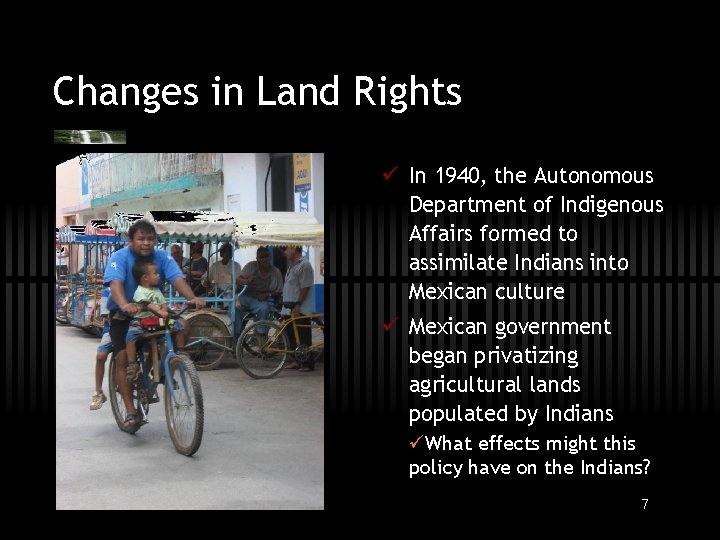
Changes in Land Rights ü In 1940, the Autonomous Department of Indigenous Affairs formed to assimilate Indians into Mexican culture ü Mexican government began privatizing agricultural lands populated by Indians üWhat effects might this policy have on the Indians? 7
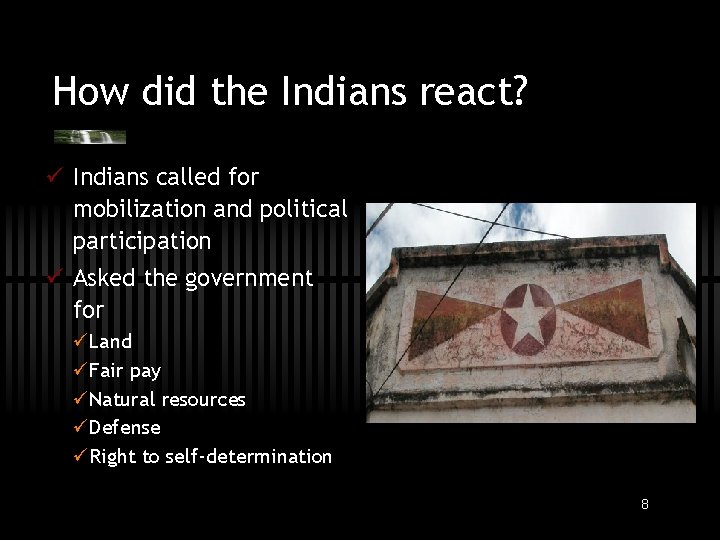
How did the Indians react? ü Indians called for mobilization and political participation ü Asked the government for üLand üFair pay üNatural resources üDefense üRight to self-determination 8
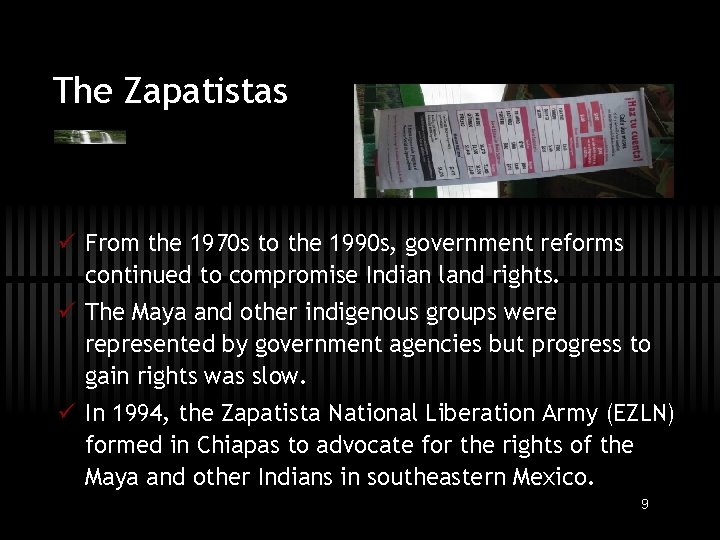
The Zapatistas ü From the 1970 s to the 1990 s, government reforms continued to compromise Indian land rights. ü The Maya and other indigenous groups were represented by government agencies but progress to gain rights was slow. ü In 1994, the Zapatista National Liberation Army (EZLN) formed in Chiapas to advocate for the rights of the Maya and other Indians in southeastern Mexico. 9
Zapatista resistance ü From the 1980 s to the 1990 s, several skirmishes occurred between the Zapatistas and the Mexican military—mostly in Chiapas ü January 1994: Zapatista uprising in Chiapas included the assassinations of Mexican leaders ü December 1997: Massacre of 45 indigenous peasants in Actael by the Mexican military ü Several violent, deadly clashes between EZLN and the military along with armed civilian groups 10
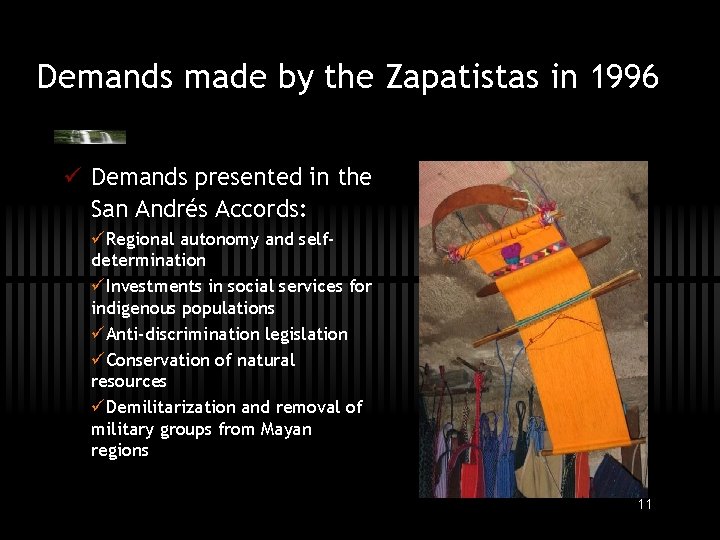
Demands made by the Zapatistas in 1996 ü Demands presented in the San Andrés Accords: üRegional autonomy and selfdetermination üInvestments in social services for indigenous populations üAnti-discrimination legislation üConservation of natural resources üDemilitarization and removal of military groups from Mayan regions 11
Peace reached ü In April 2001, the Mexican Congress passed the San Andrés Accords with revisions opposed by the EZLN. ü In 2003, Zapatista leader, subcomandante Marcos, announced that indigenous communities should take steps toward selfgovernance. ü Chiapas is one of the more autonomous states in Mexico; San Juan Chamula is an autonomous community within Chiapas. 12
Will the Zapatistas rebel again? ü Reasons for “Yes” üProtests persist üThe Maya are concentrated in a few key areas üThe EZLN is highly organized and cohesive üThe new President, Felipe Calderón, won in a contested election and could change Fox’s policies ü Reasons for “No” üIncreased democratic stability in the region üPresident Fox’s administration was committed to meeting indigenous demands üPublic support for indigenous peoples has increased üLack of serious conflicts in Guatemala 13
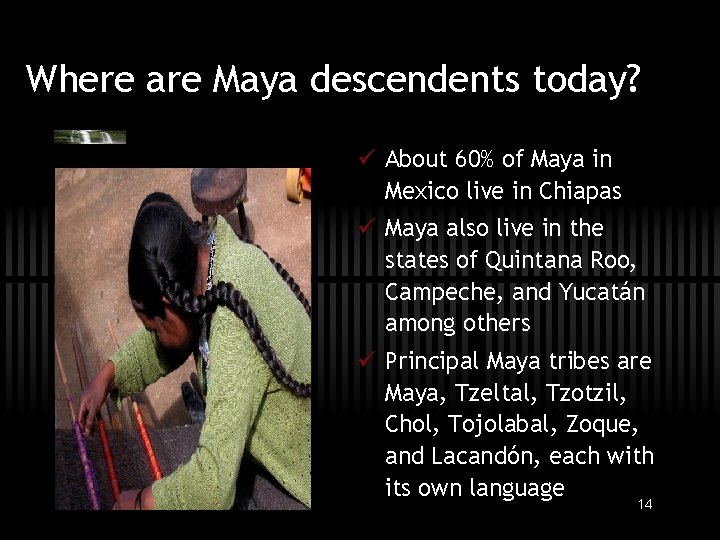
Where are Maya descendents today? ü About 60% of Maya in Mexico live in Chiapas ü Maya also live in the states of Quintana Roo, Campeche, and Yucatán among others ü Principal Maya tribes are Maya, Tzeltal, Tzotzil, Chol, Tojolabal, Zoque, and Lacandón, each with its own language 14
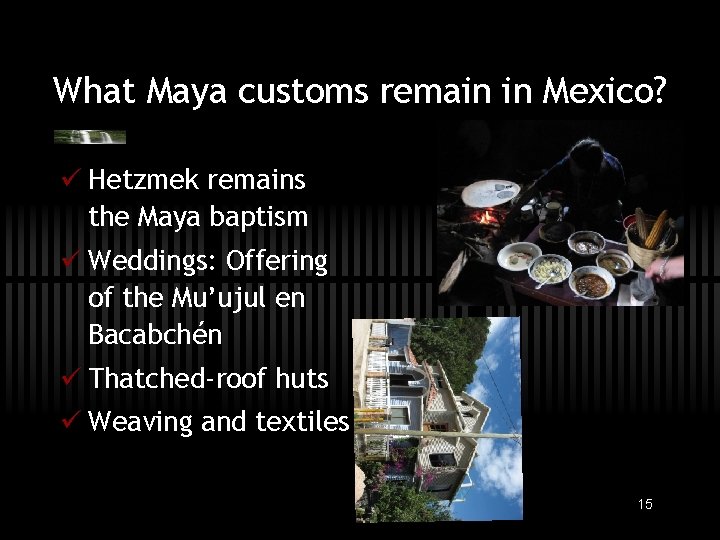
What Maya customs remain in Mexico? ü Hetzmek remains the Maya baptism ü Weddings: Offering of the Mu’ujul en Bacabchén ü Thatched-roof huts ü Weaving and textiles 15
Why do the Maya move? ü Based on 2008 data from one city with many Maya descendents, people moved for… ü economic reasons (74%) ü the “adventure” (25%) ü “What’s amazing is that most [recent immigrants] maintain [a] sense of hope-that [the move] will improve life for their families. ”* 16
Where do the Maya move today? ü 76% moved to another city in Mexico ü 24% moved to the United States ü 64% to San Francisco; 25% to other California cities ü In 2002, Mayan population in the Bay Area was estimated at 5, 000* ü “People don’t come to the U. S. simply looking for work—they go where they know someone [who] has told them there is work. ”* 17
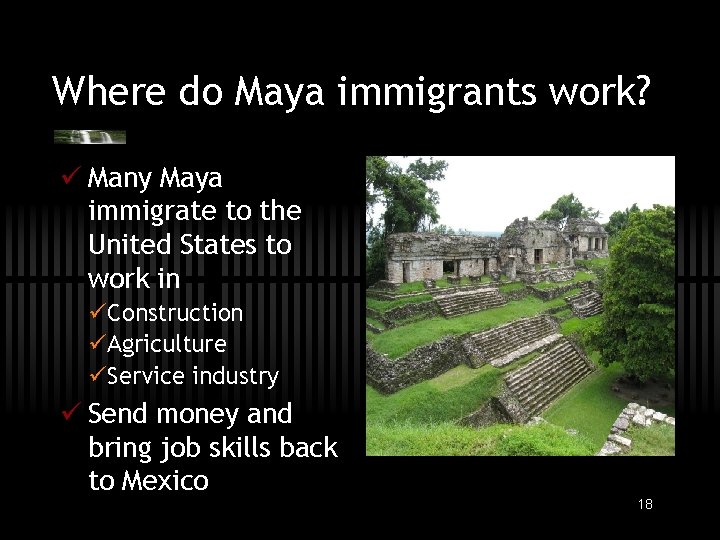
Where do Maya immigrants work? ü Many Maya immigrate to the United States to work in üConstruction üAgriculture üService industry ü Send money and bring job skills back to Mexico 18
Do Mayan cultural values transfer? ü “Depending on where they come from, a lot of the Mayan communities in southern Mexico bring their cultural norms and values with them. ” Renee Saucedo San Francisco Day Labor Program 19
Today’s Exit Tickets ü A completed note-taking organizer ü Responses to three questions: 1. What does indigenous mean? 2. What is the main issue around which the indigenous Maya are politicized today? 3. What is one question you have about what you learned today? 20