
Where Are Languages Distributed Language is a system
Where Are Languages Distributed? • Language is a system of communication through speech, a collection of sounds that a group of people understands to have the same meaning. • Literary tradition refers to a system of written communication. • Many countries designate at least one official language to be used for official documents and public objects—e. g. , road signs and money. © 2014 Pearson Education, Inc.

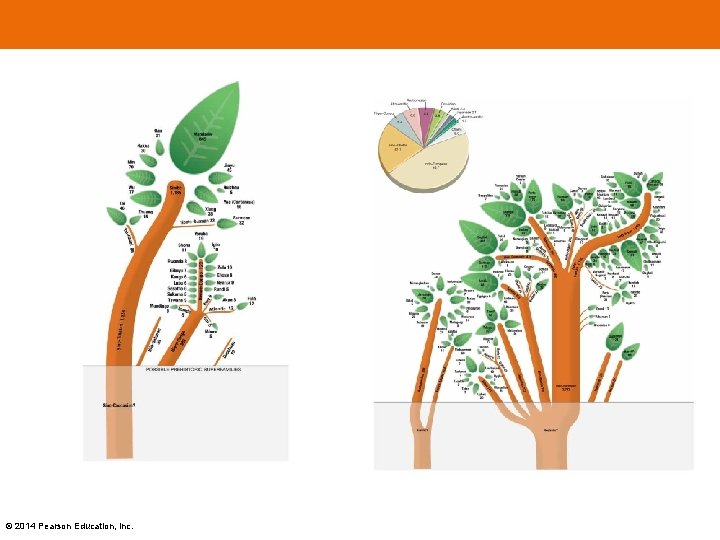
Where Are Languages Distributed? • World’s languages organized into: – Language Families: collection of languages related through a common ancestral language – Language Branches: collection of languages within a family related through a common ancestral language. Differences are not as significant or as old as between families. – Language Groups: collection of languages within a branch that share a common origin in the relatively recent past and display similar grammar and vocabulary. © 2014 Pearson Education, Inc.
© 2014 Pearson Education, Inc.
Why Is English Related to Other Languages? • Origin and Diffusion of Language Families – Modern English has evolved primarily from the language spoken by three Germanic tribes invading the British Isles. 1. Angles- from southern Denmark 2. Jutes- from northern Denmark 3. Saxons- from northwestern Germany – Over time, others invaded England their languages influenced the basic English. • • © 2014 Pearson Education, Inc. Vikings from present-day Norway Normans from present-day Normandy in France spoke French.

© 2014 Pearson Education, Inc.

Why Is English Related to Other Languages? • Origin and Diffusion of Language Families – English diffuses across the world. • English language migrated when England established colonies over four centuries. • Diffusion to North America – First successful colony was Jamestown, VA, in 1607. – Defeat of France by England secured English as the dominant language in North America. © 2014 Pearson Education, Inc.
Why Do Individual Languages Vary among Places? • Dialects of English – A dialect is a regional variation of a language distinguished by distinctive vocabulary, spelling, and pronunciation. – Boundaries of where regional words are used can be mapped: isogloss. © 2014 Pearson Education, Inc.
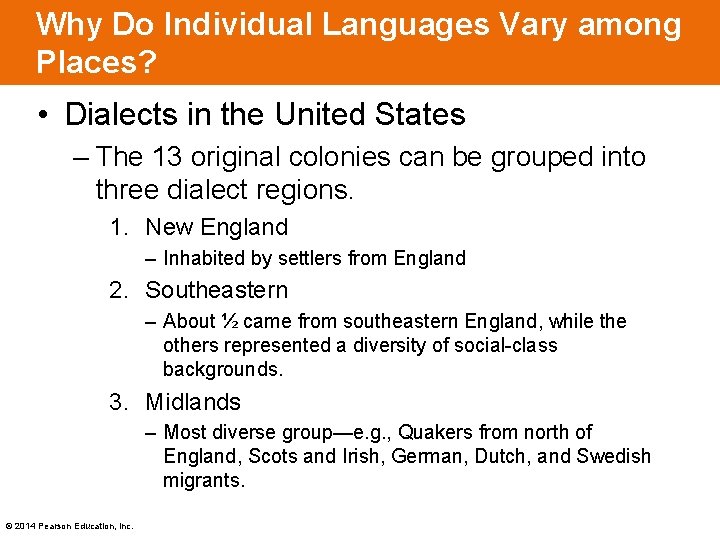
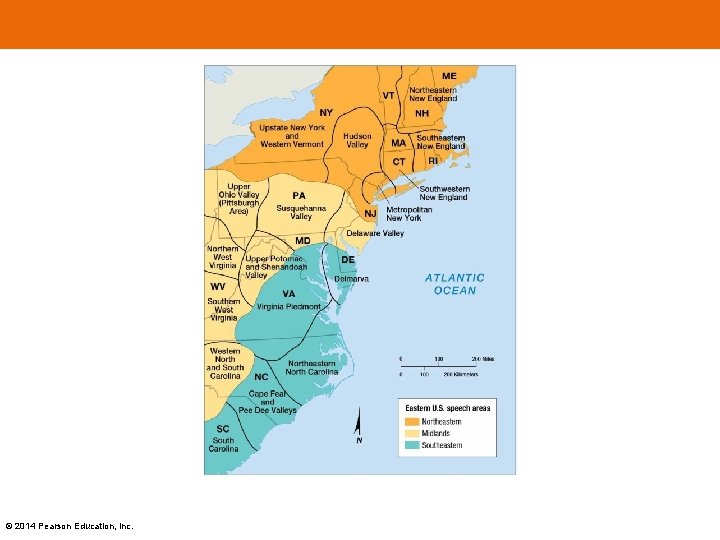
Why Do Individual Languages Vary among Places? • Dialects in the United States – The 13 original colonies can be grouped into three dialect regions. 1. New England – Inhabited by settlers from England 2. Southeastern – About ½ came from southeastern England, while the others represented a diversity of social-class backgrounds. 3. Midlands – Most diverse group—e. g. , Quakers from north of England, Scots and Irish, German, Dutch, and Swedish migrants. © 2014 Pearson Education, Inc.
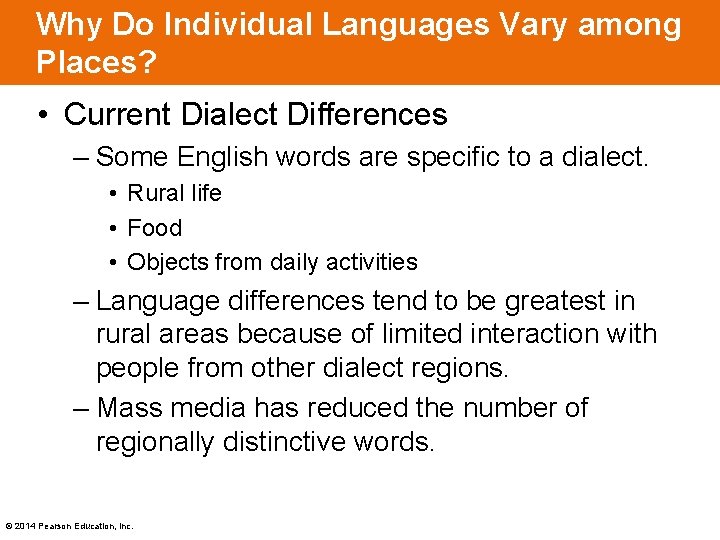
Why Do Individual Languages Vary among Places? • Current Dialect Differences – Some English words are specific to a dialect. • Rural life • Food • Objects from daily activities – Language differences tend to be greatest in rural areas because of limited interaction with people from other dialect regions. – Mass media has reduced the number of regionally distinctive words. © 2014 Pearson Education, Inc.

© 2014 Pearson Education, Inc.
© 2014 Pearson Education, Inc.

© 2014 Pearson Education, Inc.

Why Do Individual Languages Vary among Places? • British and American English Dialects – English language is noticeably different than English spoken in England in three ways. 1. Vocabulary – Settlers in America encountered many new objects and experiences not present in England. – Climate and geography differ significantly between England America. 2. Spelling – Noah Webster sought to make English used in America distinct from England to reduce cultural dependence by changing spellings of words in his dictionary. 3. Pronunciation – Chief cause was limited interaction between speakers of varying dialects. © 2014 Pearson Education, Inc.

Why Do People Preserve Local Languages? • Extinct and Revived Languages – An extinct language is one that is no longer spoken or read in daily activities by anyone in the world. • Presently, 473 languages nearly extinct – – – 46 in Africa 182 in Americas 84 in Asia 9 in Europe 152 in Pacific • Ex. Native Americans – 74 languages extinct in the United States that were once spoken by Native Americans. © 2014 Pearson Education, Inc.
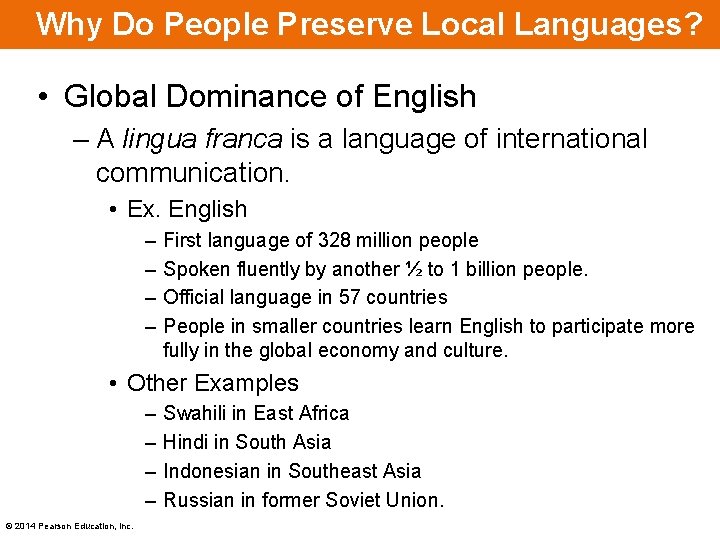
Why Do People Preserve Local Languages? • Global Dominance of English – A lingua franca is a language of international communication. • Ex. English – – First language of 328 million people Spoken fluently by another ½ to 1 billion people. Official language in 57 countries People in smaller countries learn English to participate more fully in the global economy and culture. • Other Examples – – © 2014 Pearson Education, Inc. Swahili in East Africa Hindi in South Asia Indonesian in Southeast Asia Russian in former Soviet Union.
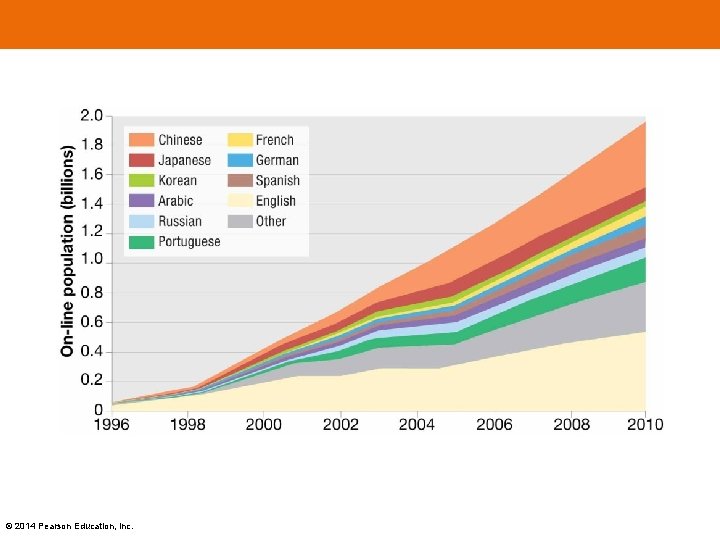
Why Do People Preserve Local Languages? • Global Dominance of English – English on the Internet • Majority of content on Internet is in English. – Dominance of content in English is waning. » Percentage of English-language online users declined from 46 percent in 2000 to 27 percent in 2010. – Mandarin will likely replace English as the most-frequently used online language before 2020. © 2014 Pearson Education, Inc.
© 2014 Pearson Education, Inc.
Why Do People Preserve Local Languages? • Global Dominance of English – Expansion Diffusion of English • Recent growth in the use of English is an example of expansion diffusion—the spread of a trait through the snowballing effect of an idea. • Expansion has occurred in two ways with English. 1. English is changing through diffusion of new vocabulary, spelling, and pronunciation. 2. English words are fusing with other languages. » Ex. Words, such as cowboy, hamburger, jeans, and T-shirt were allowed to diffuse into French. » Ex. English words have spurred the creation of English -like words to replace traditional Spanish words, such as parquin (Spanglish) for estacionamiento (Spanish) © 2014 Pearson Education, Inc.

© 2014 Pearson Education, Inc.
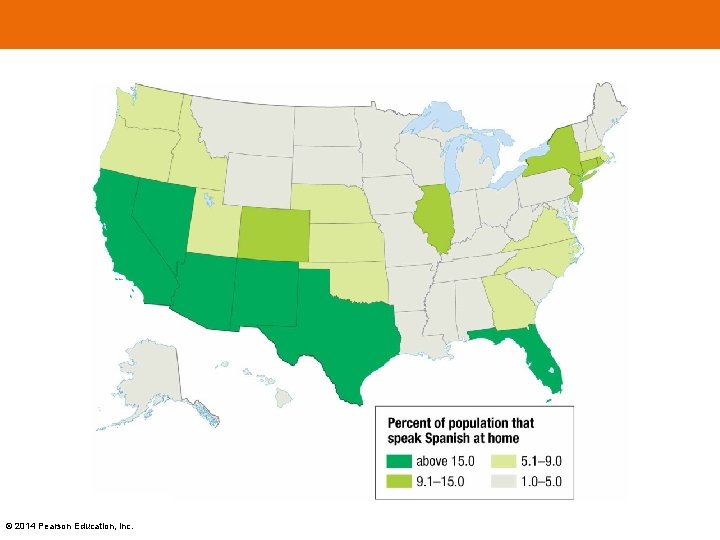
Why Do People Preserve Local Languages? • Spanish and French in the United States and Canada – Spanish • Increasingly important language in recent years in United States because of large-scale immigration from Latin America. – Some communities now issue public notices, government documents, and advertisements in Spanish. – Radio stations and TV now broadcast in Spanish in places where most of the 35 million Spanish speakers live. • In reaction, 30 states and number of localities have laws making English the official language. – Some courts have judged these laws to be unconstitutional restrictions on free speech. © 2014 Pearson Education, Inc.
© 2014 Pearson Education, Inc.
Why Do People Preserve Local Languages? • Spanish and French in the United States and Canada – French • Québec government has made the use of French mandatory in many daily activities. • Québec faces challenges integrating a large number of immigrants from Europe, Asia, and Latin America who don’t speak French. – Immigrants prefer to use English as the lingua franca because of its greater global usage. © 2014 Pearson Education, Inc.
Summary • Languages can be classified as belonging to particular families. Some families are divided into branches and groups. • English is in the Germanic branch of the Indo-European language family. Because nearly ½ of all humans currently speak a language in the same family, English is related to other languages. • Languages vary among places because of the regional influence on language that stems from isolation. © 2014 Pearson Education, Inc.
Summary • People preserve local languages, because a culture’s identity is intimately intertwined with its local language. © 2014 Pearson Education, Inc.
- Slides: 24