
When Your Office Is Their Classroom Emily Frazier

- Slides: 17
When Your Office Is Their Classroom Emily Frazier Stacey Hummeldorf Christine Tonnis
Agenda 1. 2. 3. 4. 5. Theory of Reflective Practice Small Group Reflections Connections to YOUR Advising Interactive Exercise Q&A
Notecard 1. Name 2. Department Title ie; who do you advise? 3. What do hope to learn from this session today?
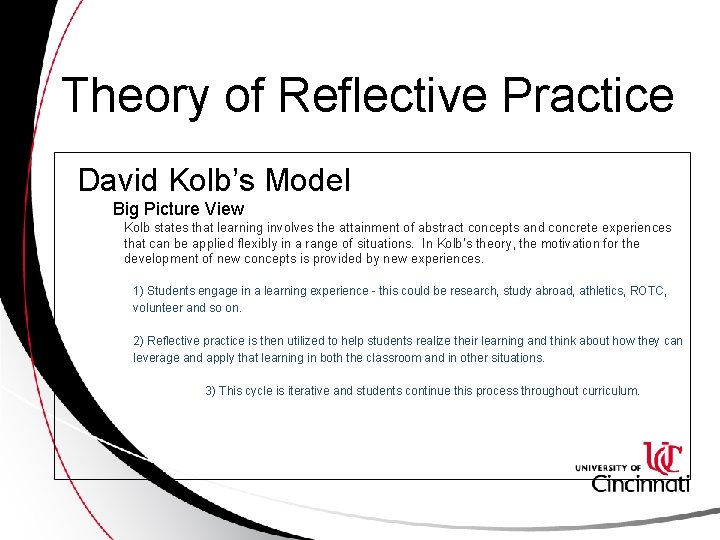
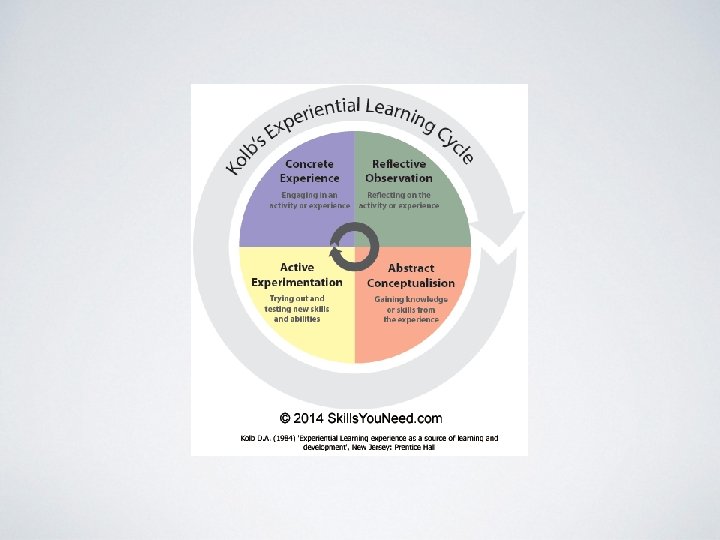
Theory of Reflective Practice David Kolb’s Model Big Picture View Kolb states that learning involves the attainment of abstract concepts and concrete experiences that can be applied flexibly in a range of situations. In Kolb’s theory, the motivation for the development of new concepts is provided by new experiences. 1) Students engage in a learning experience - this could be research, study abroad, athletics, ROTC, volunteer and so on. 2) Reflective practice is then utilized to help students realize their learning and think about how they can leverage and apply that learning in both the classroom and in other situations. 3) This cycle is iterative and students continue this process throughout curriculum.
Kolb’s Theory works particularly well with cooperative education and experiential learning, but is not limited to just those areas. He proposed six main characteristics, here are three to consider: • • • Learning is a continuous process, grounded in experience Learning is a holistic process of adaptation to the world Learning involves transactions between the person and the environment Contemplate scenarios in which these characteristics may connect with how you work with your students. Are there opportunities to implement reflection?
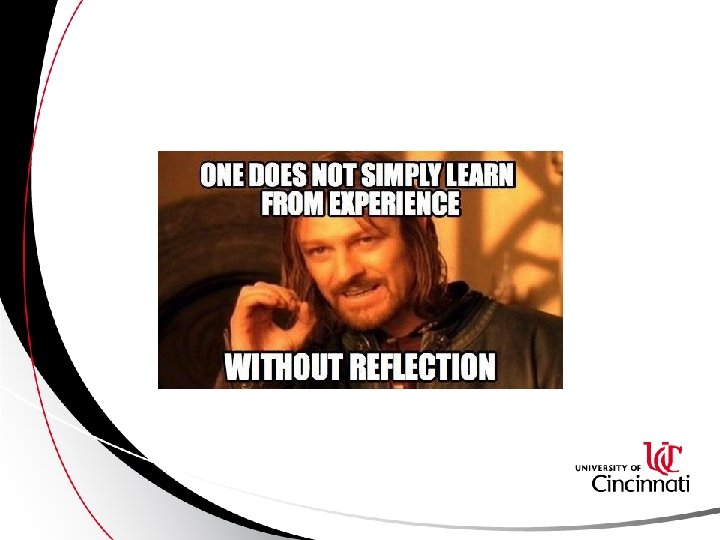
The Reflection Connection So, when do I use reflection? • When there may be an opportunity to help a student connect an experience to another experience, class or skill. How do I begin, what are some methods? • In the following slides we will cover activities and discussionbased reflection. What to expect post-reflection, what are the results? • Think of this as building blocks, from this reflection, new ideas and thoughts will grow that the student can then apply in future experiences. Ideally, the student will begin to actively learn and reflect independently with each experience they have.
Reflection Session Activities • Guided Reflection • Think, Pair, Share • Theme Identification
Guided Reflection • Get the students talking! • Keep in mind what connections you want them to make. – An example from Co-op would be the Learning Outcomes for each coop assignment/work term. • What tools as the advisor/educator do you have? – An example from Co-op, would be the Student and Employer Reports • Allow time for students to put thoughts together, recall experiences and share out with facilitator and cohorts.
Guided Reflection • Reflection in one-on-one or small group setting may look like this: – Five, first time co-op students (after first, before second) connecting their coop work experience to learning objective topic, “Taking Initiative” • “What do you think is meant by taking initiative? ” • “Did you have an opportunity to take initiative? If so, in what ways? Was it successful? What did you learn about yourself? ” • “If you did not feel there were opportunities for initiative, why do you think that was the case? What can you do differently next time? ” • “Looking at your coursework this semester, how can you use what you learned regarding taking initiative to be more successful in the classroom? ” • “How might you apply this in other areas of your life? ”
Think, Pair, Share Participants after are given a compilation of employer evaluations to read and consider: • • • Think: Individual – What does your cohort do well? Why do you think this is the case? – What stands out to you as pressing needs/issues for your cohort? – What may be the root causes for the challenges? Pair: Discuss with partner – Thoughts – Observations – Concerns Share: Share out to large group
Theme Identification Students discuss questions about their experiences 1. Divide into small groups 2. Complete group activity 3. Share results
What do students bring? • Students in a structured experiential learning program (co-op, academic internship, research, etc. ) may be coming with a report or write-up done while on the experience or shortly after it ended. – Often serve as the basis for the reflection. • How could this translate to other advising? – Ask student(s) to prepare for the meeting in advance. • Create an agenda • Bring a list of questions • Answer prompts advisor provides ahead of time.
Group Discussion on “Deliverables” • Divide into groups
Group Discussion Topic • Discuss how to leverage the current deliverables to promote the deepest learning opportunities • Discuss possibilities for deliverables for your team and how you can use them • Report back to the larger group
Q&A