
When signing in Print your name legibly and
When signing in: Print your name legibly and Specify BMC or BUMC
The Safety Office
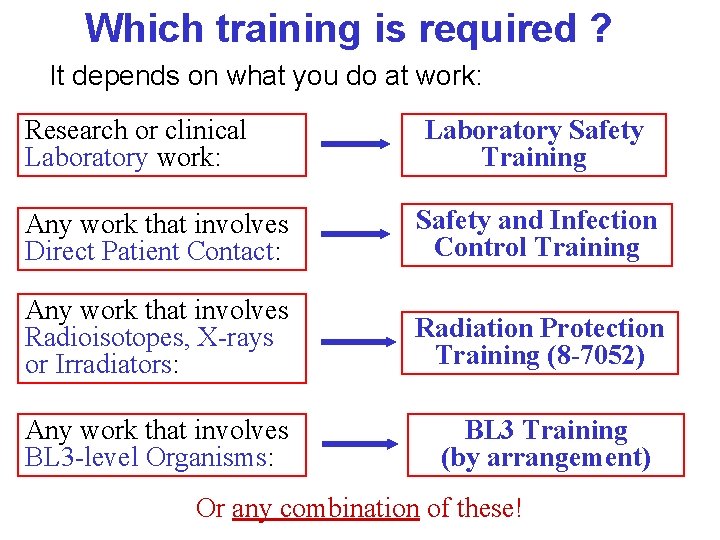
Which training is required ? It depends on what you do at work: Research or clinical Laboratory work: Laboratory Safety Training Any work that involves Direct Patient Contact: Safety and Infection Control Training Any work that involves Radioisotopes, X-rays or Irradiators: Radiation Protection Training (8 -7052) Any work that involves BL 3 -level Organisms: BL 3 Training (by arrangement) Or any combination of these!
We rely on you to help ensure the safety of each and every employee, patient,
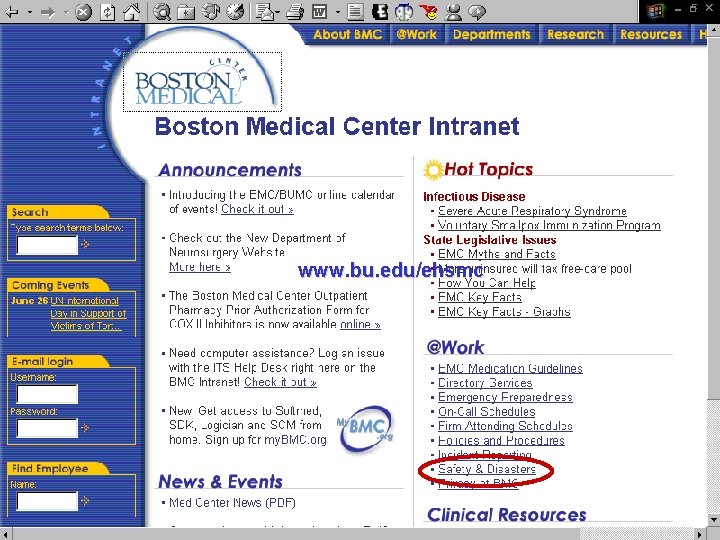
www. bu. edu/ehsmc
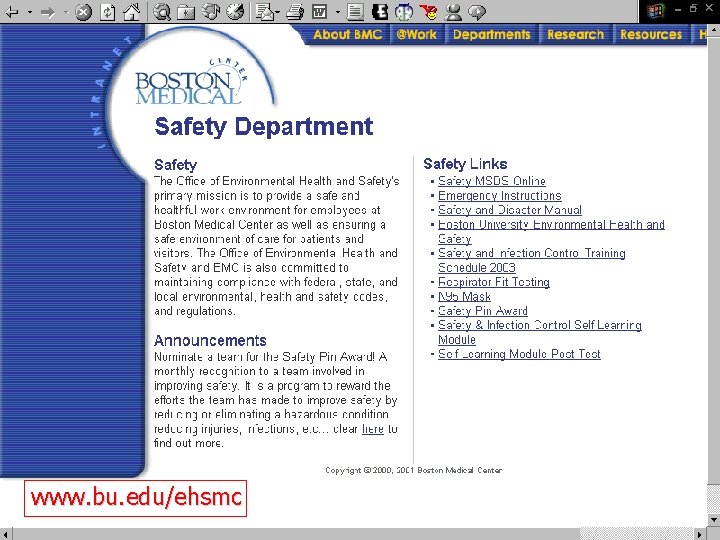
www. bu. edu/ehsmc
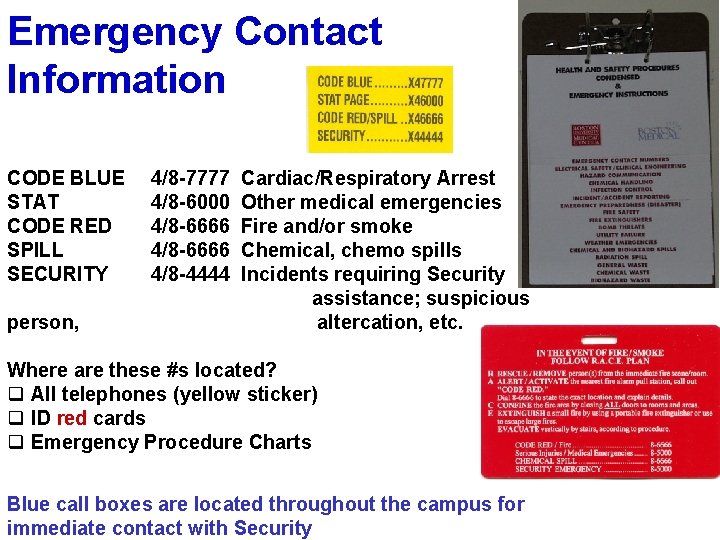
Emergency Contact Information CODE BLUE STAT CODE RED SPILL SECURITY person, 4/8 -7777 4/8 -6000 4/8 -6666 4/8 -4444 Cardiac/Respiratory Arrest Other medical emergencies Fire and/or smoke Chemical, chemo spills Incidents requiring Security assistance; suspicious altercation, etc. Where are these #s located? q All telephones (yellow sticker) q ID red cards q Emergency Procedure Charts Blue call boxes are located throughout the campus for immediate contact with Security
EMERGENCY PREPAREDNESS Types of Disasters… • Internal • External • Natural
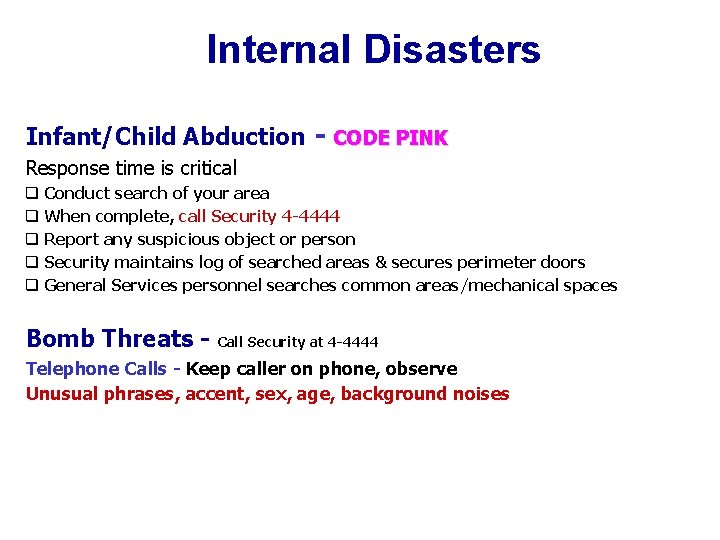
Internal Disasters Infant/Child Abduction - CODE PINK Response time is critical q Conduct search of your area q When complete, call Security 4 -4444 q Report any suspicious object or person q Security maintains log of searched areas & secures perimeter doors q General Services personnel searches common areas/mechanical spaces Bomb Threats - Call Security at 4 -4444 Telephone Calls - Keep caller on phone, observe Unusual phrases, accent, sex, age, background noises
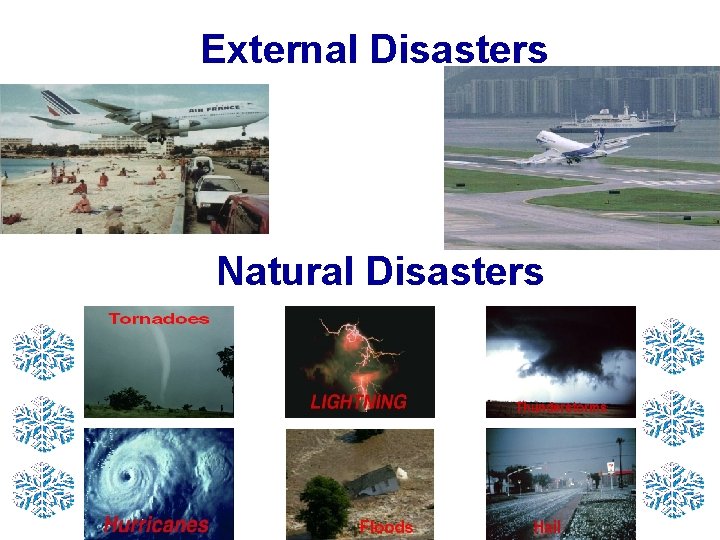
External Disasters Natural Disasters
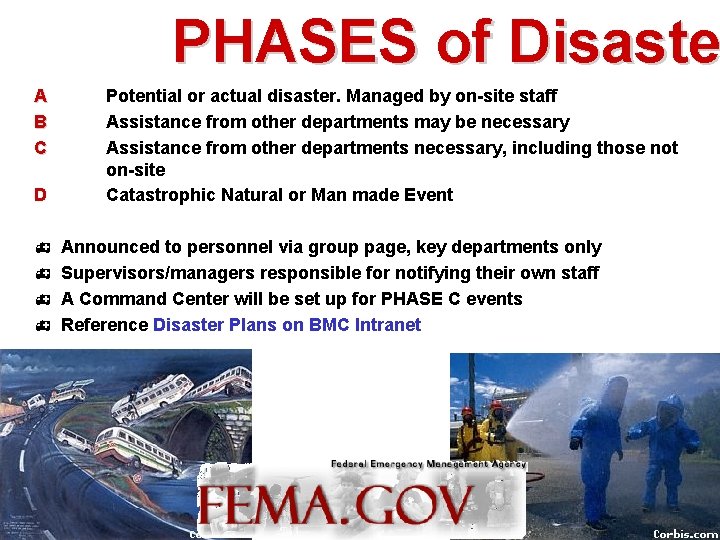
PHASES of Disaste A B C D h h Potential or actual disaster. Managed by on-site staff Assistance from other departments may be necessary Assistance from other departments necessary, including those not on-site Catastrophic Natural or Man made Event Announced to personnel via group page, key departments only Supervisors/managers responsible for notifying their own staff A Command Center will be set up for PHASE C events Reference Disaster Plans on BMC Intranet
Incident Commander Command Center Staffing Medical Campus Administrative Services Other Departments as determined by type of incident Command Center Power Plant, 1 st Floor, Command Control Center Alternate -Harrison Pavilion, 2 nd Floor, Conference Room C Alternate - Health Services Building, Basement, Security Operations Center Command Center Phones (always active) Extension 8 -6860 (617 -638 -6860) Extension 4 -6860 (617 -414 -6860)
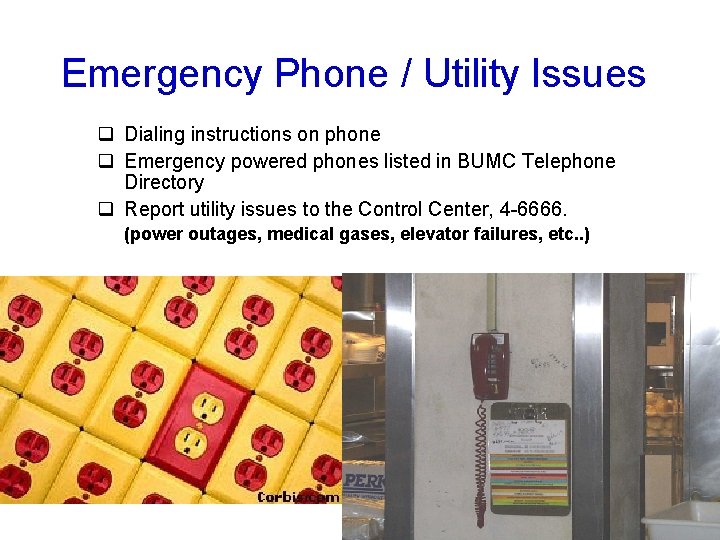
Emergency Phone / Utility Issues q Dialing instructions on phone q Emergency powered phones listed in BUMC Telephone Directory q Report utility issues to the Control Center, 4 -6666. (power outages, medical gases, elevator failures, etc. . )
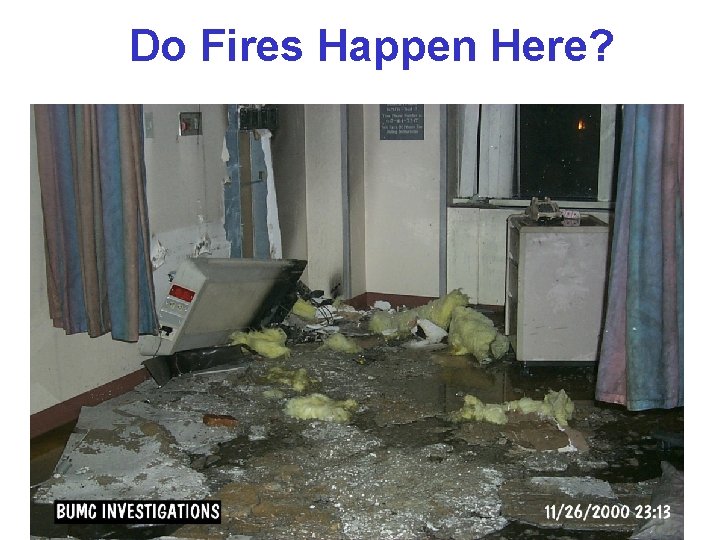
Do Fires Happen Here?
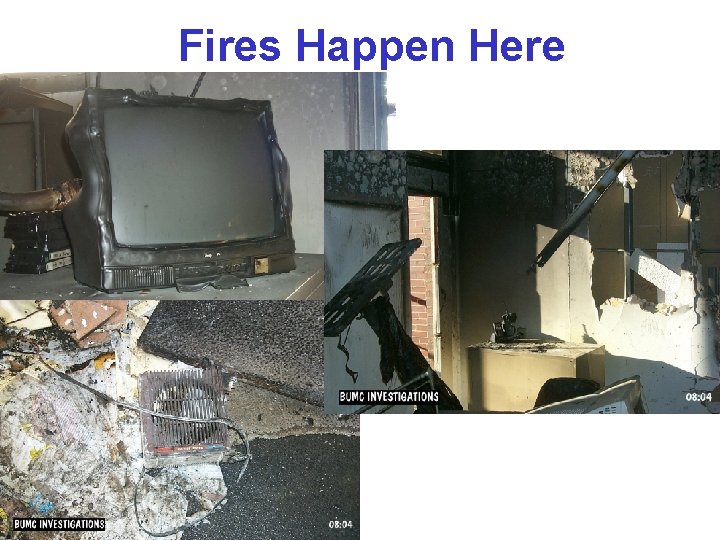
Fires Happen Here
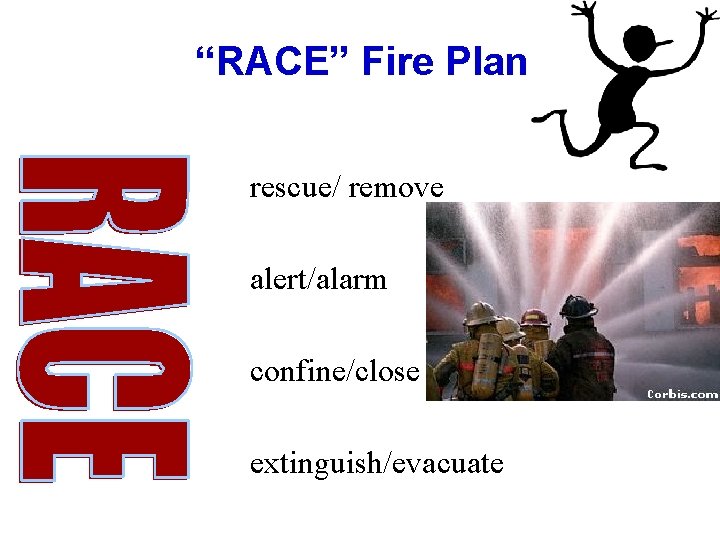
“RACE” Fire Plan rescue/ remove alert/alarm confine/close extinguish/evacuate
Fire Alarms “High Rise System” Pre-recorded Voice Message: “Attention Please, The signal tone you have just heard indicates a report of an emergency in this building. If your floor evacuation signal sounds after this message walk to the nearest stairway exit and leave the floor. All handicap occupants shall follow the building evacuation plan. While this report is being verified, occupants on other floors should await further instructions. ” Buildings with this type of system: HP, DOB, H, ACC, Dowling, Evans (E), Fuller (M), EBRC (X), CABR (W), GSDM (G), Talbot (T), BCD, Houseman (R). Traditional Alarm System Alarm sounds throughout building… everyone evacuates! (All other BUMC building)
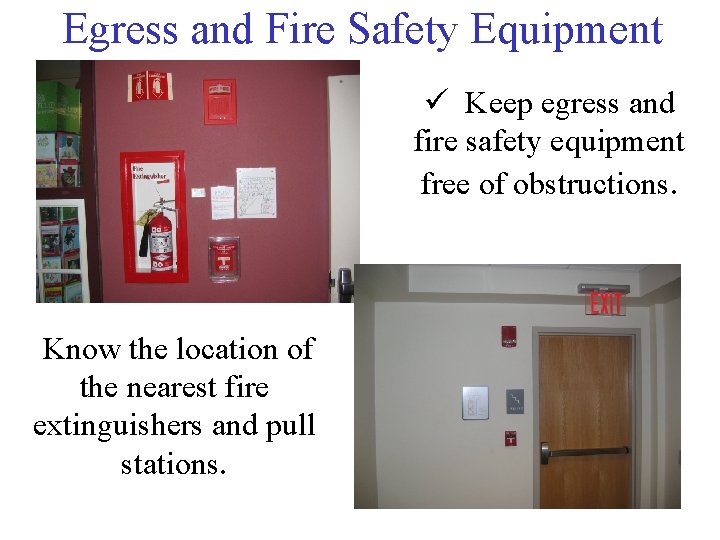
Egress and Fire Safety Equipment ü Keep egress and fire safety equipment free of obstructions. Know the location of the nearest fire extinguishers and pull stations.
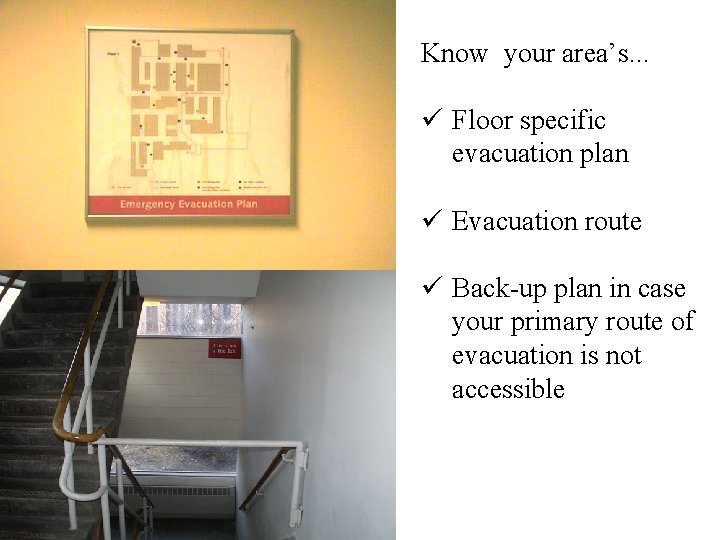
Know your area’s. . . ü Floor specific evacuation plan ü Evacuation route ü Back-up plan in case your primary route of evacuation is not accessible
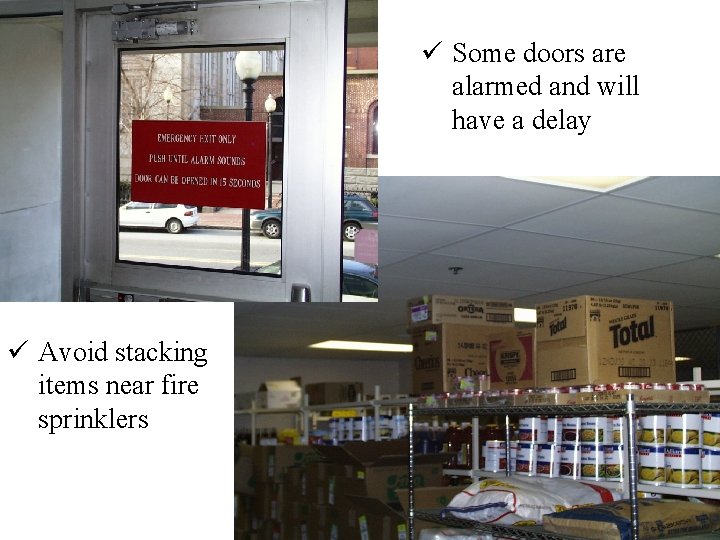
ü Some doors are alarmed and will have a delay ü Avoid stacking items near fire sprinklers
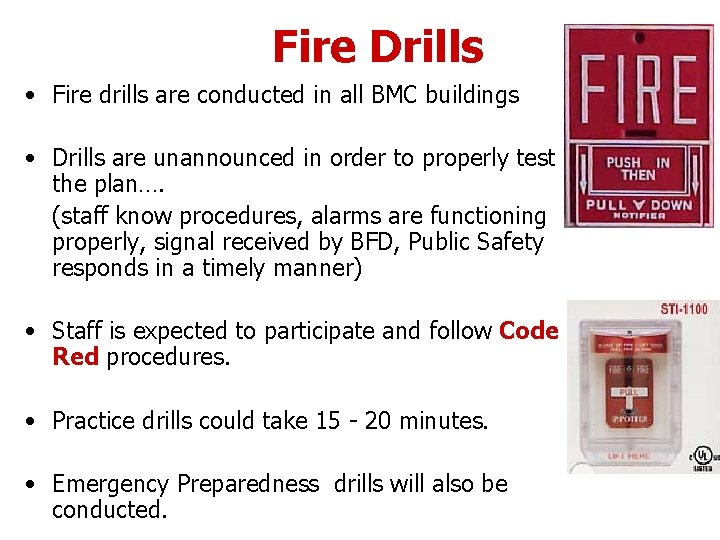
Fire Drills • Fire drills are conducted in all BMC buildings • Drills are unannounced in order to properly test the plan…. (staff know procedures, alarms are functioning properly, signal received by BFD, Public Safety responds in a timely manner) • Staff is expected to participate and follow Code Red procedures. • Practice drills could take 15 - 20 minutes. • Emergency Preparedness drills will also be conducted.
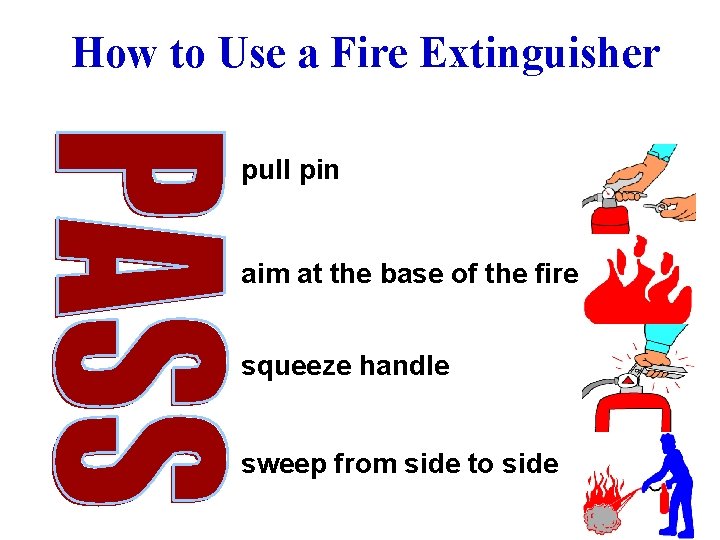
How to Use a Fire Extinguisher pull pin aim at the base of the fire squeeze handle sweep from side to side
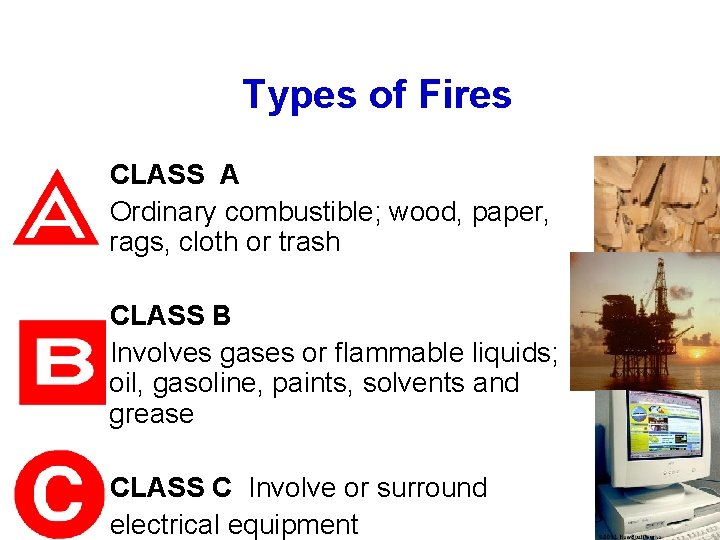
Types of Fires CLASS A Ordinary combustible; wood, paper, rags, cloth or trash CLASS B Involves gases or flammable liquids; oil, gasoline, paints, solvents and grease CLASS C Involve or surround electrical equipment
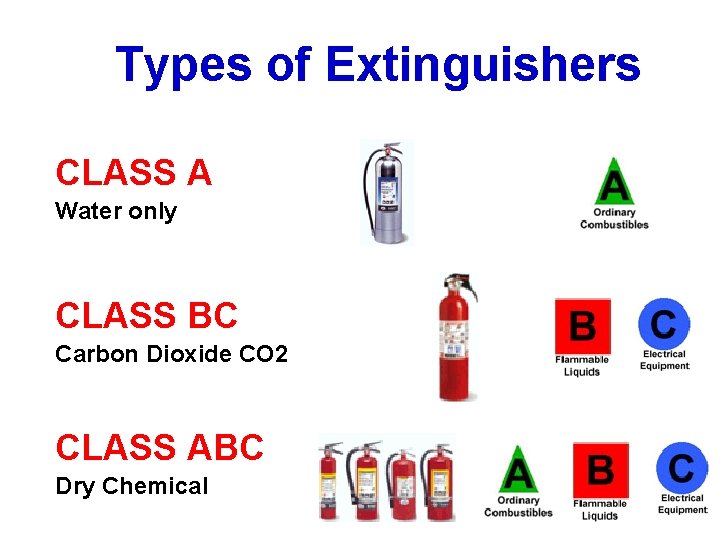
Types of Extinguishers CLASS A Water only CLASS BC Carbon Dioxide CO 2 CLASS ABC Dry Chemical
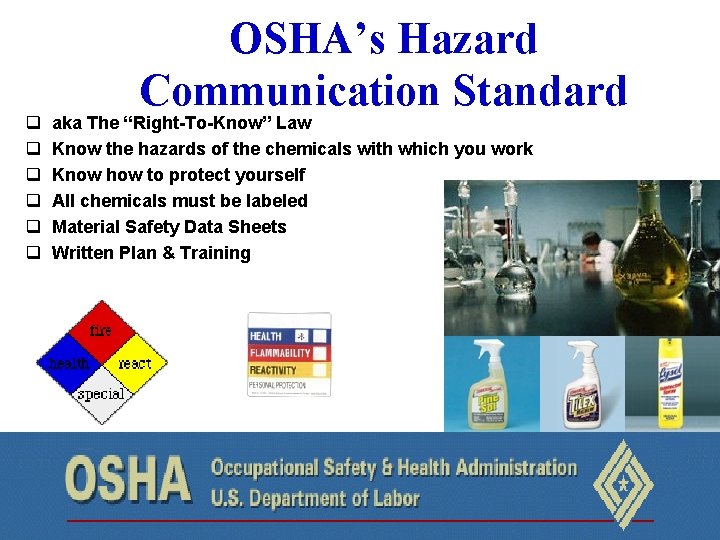
q q q OSHA’s Hazard Communication Standard aka The “Right-To-Know” Law Know the hazards of the chemicals with which you work Know how to protect yourself All chemicals must be labeled Material Safety Data Sheets Written Plan & Training
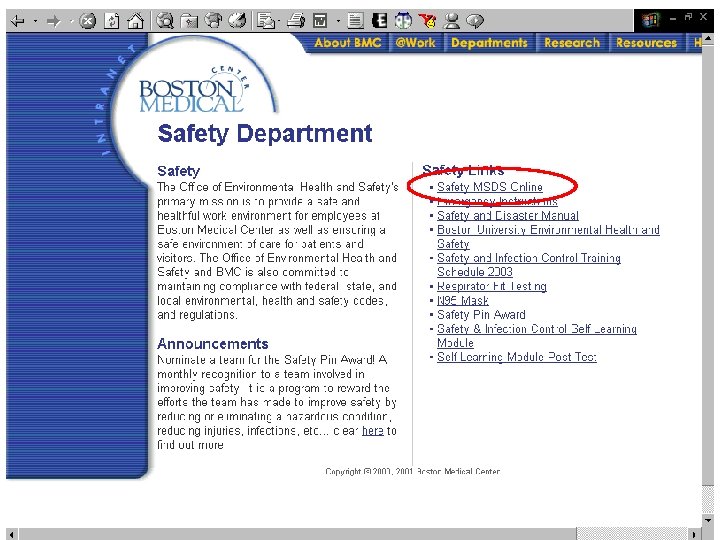
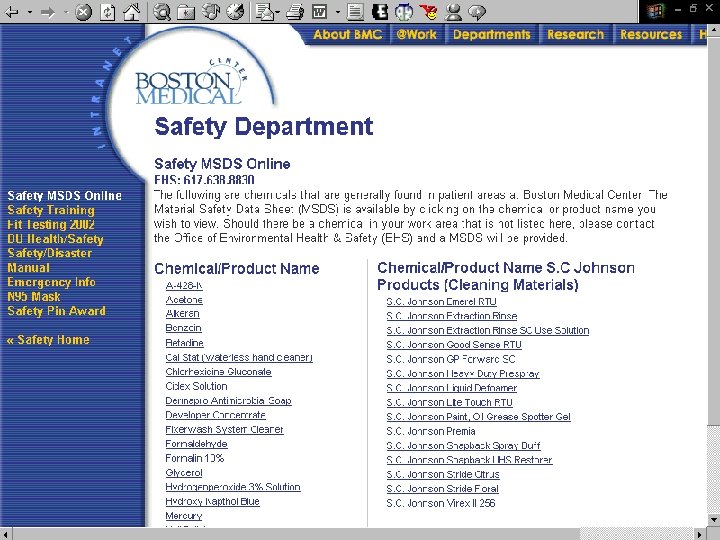
Material Safety Data Sheets Where can you find these? BMC Intranet MSDS Binders located throughout hospital or from EHS at 638 -8830 MSDS Information Developed and Supplied by the Manufacturer MUST be available for all employees Provides Synonyms Formula/Ingredients Emergency & First Aid PEL’s Fire & Explosion Properties or Hazards Personal Protective Equipment Routes of Exposure Safe Handling Procedures Storage & Disposal
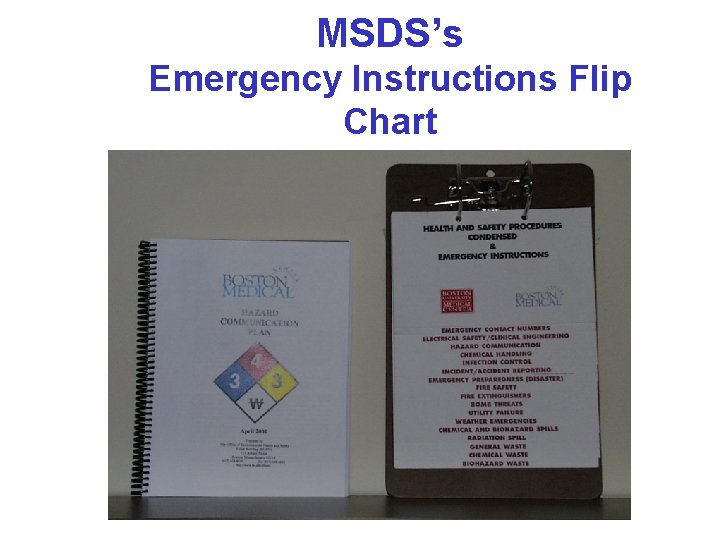
MSDS’s Emergency Instructions Flip Chart
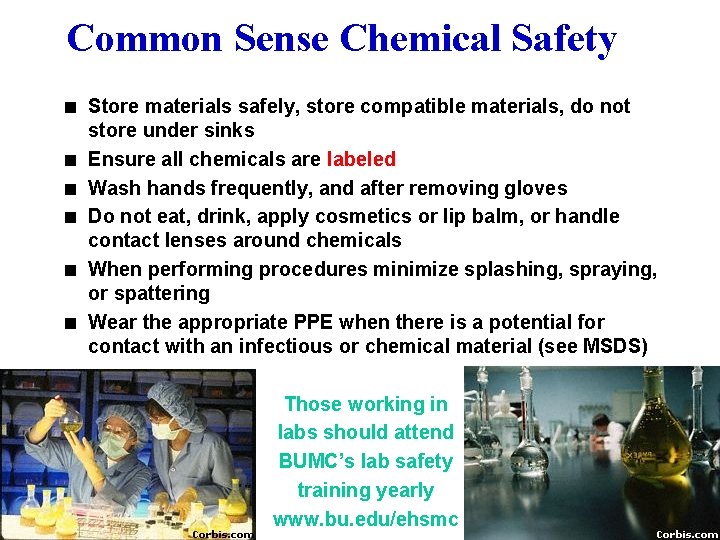
Common Sense Chemical Safety < Store materials safely, store compatible materials, do not store under sinks < Ensure all chemicals are labeled < Wash hands frequently, and after removing gloves < Do not eat, drink, apply cosmetics or lip balm, or handle contact lenses around chemicals < When performing procedures minimize splashing, spraying, or spattering < Wear the appropriate PPE when there is a potential for contact with an infectious or chemical material (see MSDS) Those working in labs should attend BUMC’s lab safety training yearly www. bu. edu/ehsmc
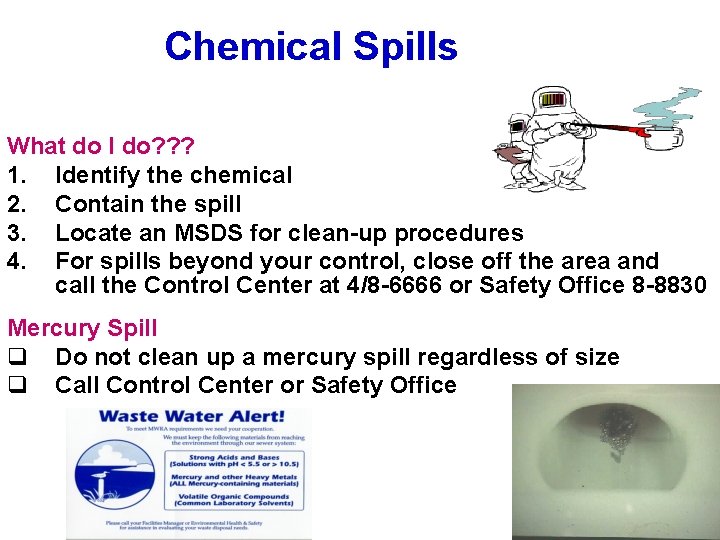
Chemical Spills What do I do? ? ? 1. Identify the chemical 2. Contain the spill 3. Locate an MSDS for clean-up procedures 4. For spills beyond your control, close off the area and call the Control Center at 4/8 -6666 or Safety Office 8 -8830 Mercury Spill q Do not clean up a mercury spill regardless of size q Call Control Center or Safety Office
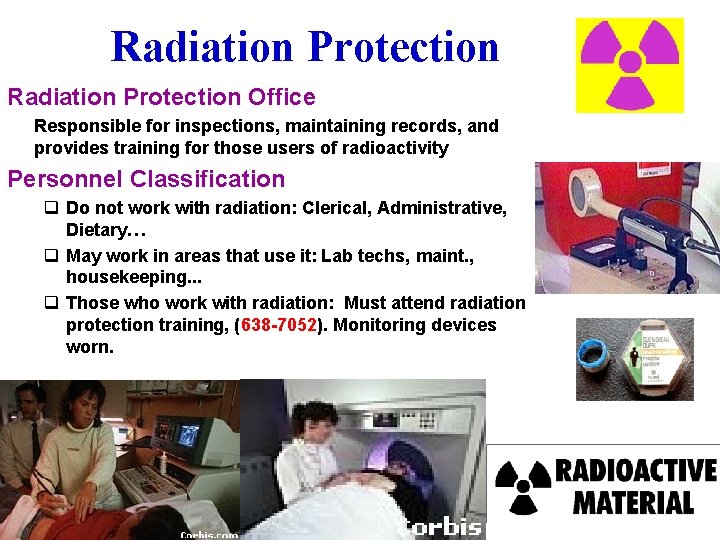
Radiation Protection Office Responsible for inspections, maintaining records, and provides training for those users of radioactivity Personnel Classification q Do not work with radiation: Clerical, Administrative, Dietary… q May work in areas that use it: Lab techs, maint. , housekeeping. . . q Those who work with radiation: Must attend radiation protection training, (638 -7052). Monitoring devices worn.
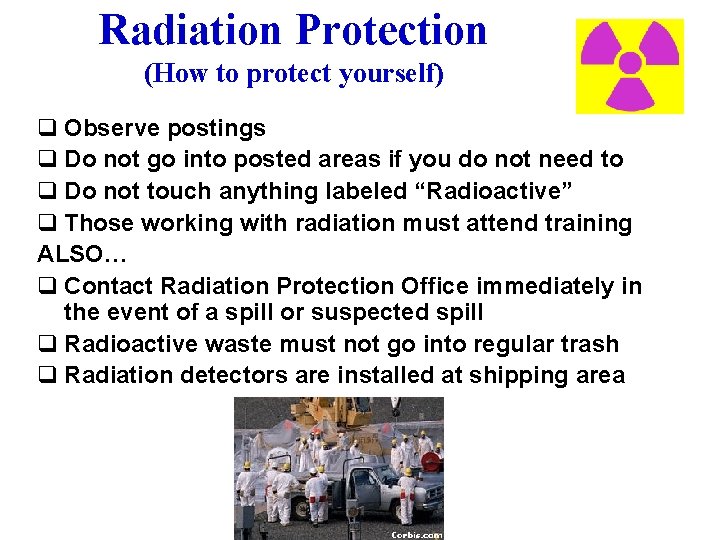
Radiation Protection (How to protect yourself) q Observe postings q Do not go into posted areas if you do not need to q Do not touch anything labeled “Radioactive” q Those working with radiation must attend training ALSO… q Contact Radiation Protection Office immediately in the event of a spill or suspected spill q Radioactive waste must not go into regular trash q Radiation detectors are installed at shipping area
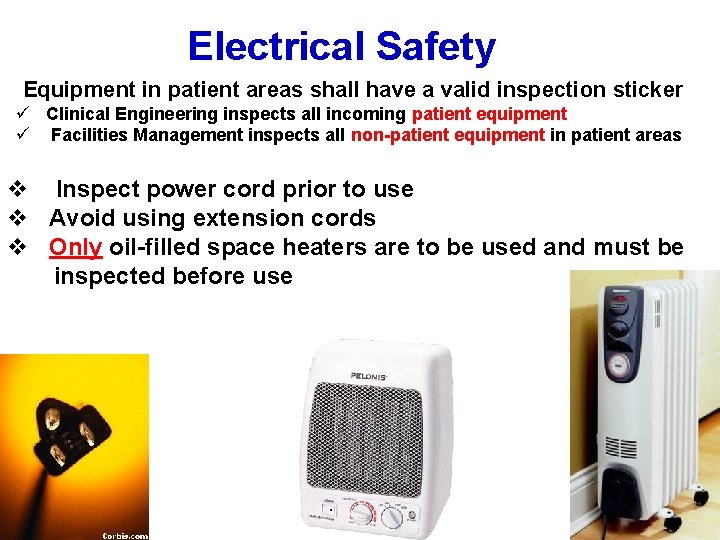
Electrical Safety Equipment in patient areas shall have a valid inspection sticker ü Clinical Engineering inspects all incoming patient equipment ü Facilities Management inspects all non-patient equipment in patient areas v Inspect power cord prior to use v Avoid using extension cords v Only oil-filled space heaters are to be used and must be inspected before use
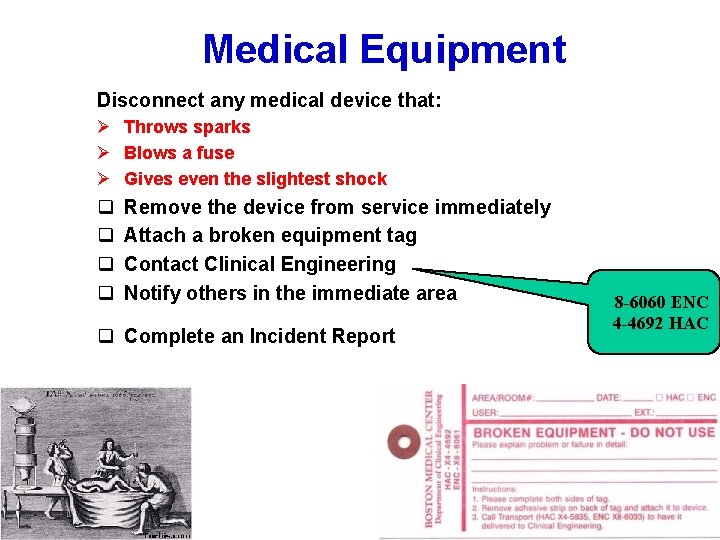
Medical Equipment Disconnect any medical device that: Ø Throws sparks Ø Blows a fuse Ø Gives even the slightest shock q q Remove the device from service immediately Attach a broken equipment tag Contact Clinical Engineering Notify others in the immediate area q Complete an Incident Report 8 -6060 ENC 4 -4692 HAC
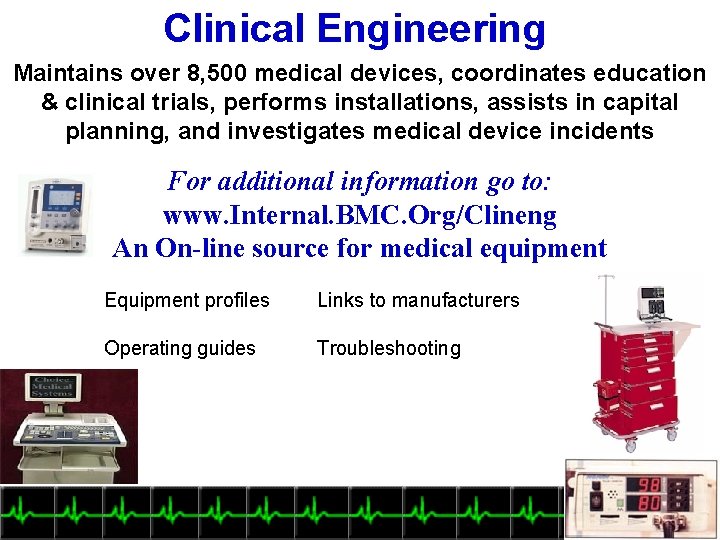
Clinical Engineering Maintains over 8, 500 medical devices, coordinates education & clinical trials, performs installations, assists in capital planning, and investigates medical device incidents For additional information go to: www. Internal. BMC. Org/Clineng An On-line source for medical equipment Equipment profiles Links to manufacturers Operating guides Troubleshooting
Cell Phone Use To minimize the potential for interference with medical devices ÈRestrict use in hospital except for lobbies and cafeteria’s ÈObserve sensitive areas posted with signage ÈInform guests observed using cell phones ÈPolicy on Clinical Engineering Web Site
Ergonomics What is it and why is it important? Ergonomics is the science of fitting jobs to people. It focuses on designing workstations, tools and work tasks for safety, efficiency and comfort. Effective ergonomic design reduces discomfort and injuries and increases job satisfaction and productivity. What are the common ergonomic risk factors? • Awkward body postures – prolonged periods of bending, twisting, etc. • Excessive repetition – same motion over and over • Excessive force – physical exertion or pressure while pushing, gripping, etc. • Contact stress - pressure by tools, edges or hard surfaces on soft tissues of the body
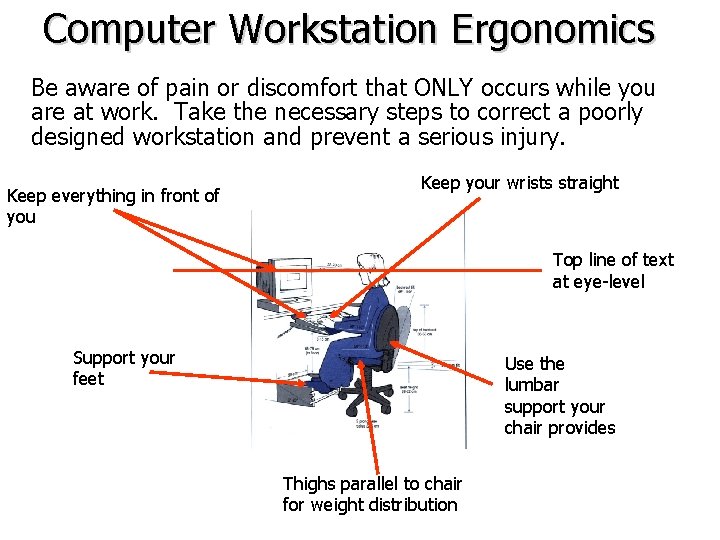
Computer Workstation Ergonomics Be aware of pain or discomfort that ONLY occurs while you are at work. Take the necessary steps to correct a poorly designed workstation and prevent a serious injury. Keep everything in front of you Keep your wrists straight Top line of text at eye-level Support your feet Use the lumbar support your chair provides Thighs parallel to chair for weight distribution
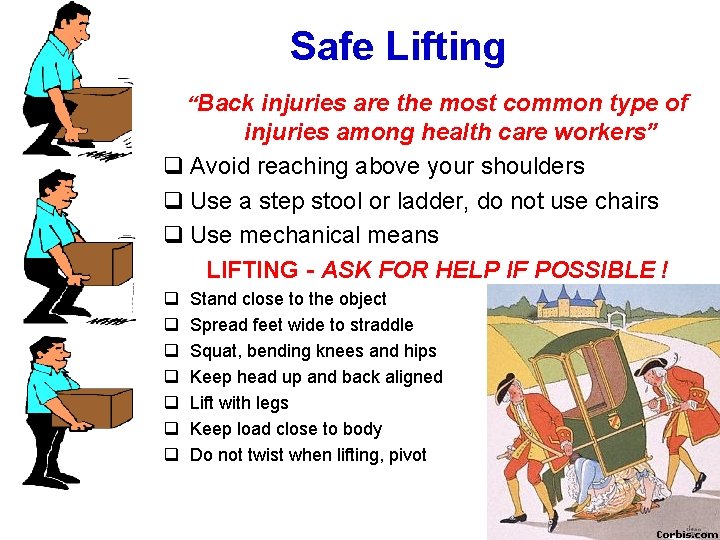
Safe Lifting “Back injuries are the most common type of injuries among health care workers” q Avoid reaching above your shoulders q Use a step stool or ladder, do not use chairs q Use mechanical means LIFTING - ASK FOR HELP IF POSSIBLE ! q q q q Stand close to the object Spread feet wide to straddle Squat, bending knees and hips Keep head up and back aligned Lift with legs Keep load close to body Do not twist when lifting, pivot
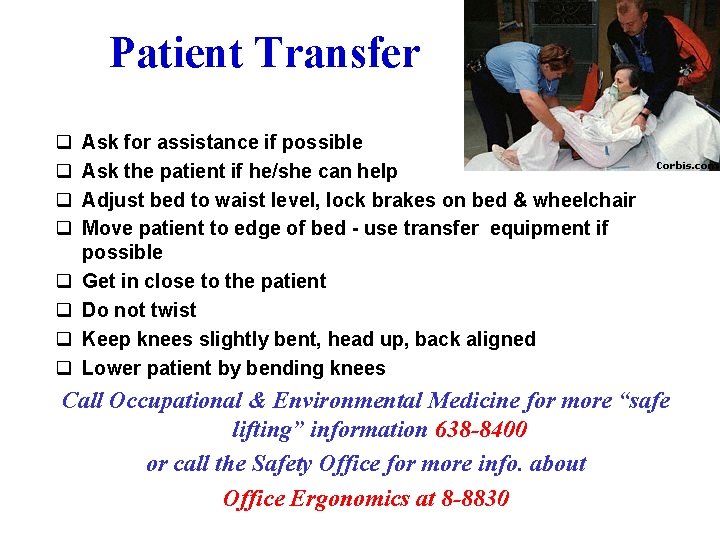
Patient Transfer q q q q Ask for assistance if possible Ask the patient if he/she can help Adjust bed to waist level, lock brakes on bed & wheelchair Move patient to edge of bed - use transfer equipment if possible Get in close to the patient Do not twist Keep knees slightly bent, head up, back aligned Lower patient by bending knees Call Occupational & Environmental Medicine for more “safe lifting” information 638 -8400 or call the Safety Office for more info. about Office Ergonomics at 8 -8830
Employee Accidents q Report to supervisor q Seek medical attention at OEM (F-5) 7: 30 - 4: 00 weekdays or one of the ED’s all other times q Complete with supervisor the Accident Reporting and Treatment (ART) q For Cardiac and Respiratory arrest follow CODE Blue procedures. q For Serious Injuries and Medical Emergencies contact Public Safety at 4 -4444. q Supervisors are responsible for conducting accident investigations. EHS is available for assistance q Corrective measures will be implemented as necessary to prevent reoccurrence
Crime Prevention q Keep valuables with you or locked. q Close and lock doors when not in your office. Always log off the network or use a password protected screensaver when you leave your workstation. q Check the identity of strangers. Notify security or your supervisor for assistance. q Always let someone know where you’ll be. q Always report any broken or flickering lights, doors that do not lock properly, or broken windows. q Do not advertise personal plans to visitors or strangers. q Keep emergency phone numbers posted near by.
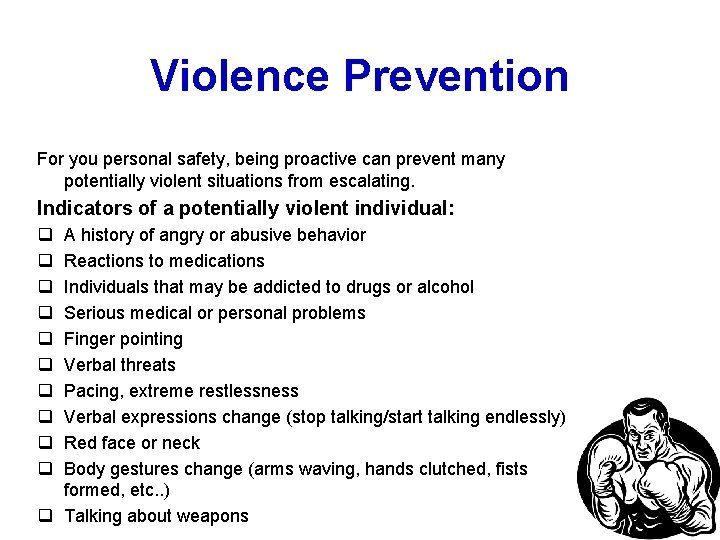
Violence Prevention For you personal safety, being proactive can prevent many potentially violent situations from escalating. Indicators of a potentially violent individual: q q q q q A history of angry or abusive behavior Reactions to medications Individuals that may be addicted to drugs or alcohol Serious medical or personal problems Finger pointing Verbal threats Pacing, extreme restlessness Verbal expressions change (stop talking/start talking endlessly) Red face or neck Body gestures change (arms waving, hands clutched, fists formed, etc. . ) q Talking about weapons
Workplace Violence Prevention • Any employee or staff member who witnesses and act of violence or immediate threat of an act of violence will immediately call Public Safety at 44444 and state “Code Green”. If the person calling feels they are unsafe in the area they should immediately leave the area and then make the call. The person making the call will be asked to provide descriptions of the person or persons involved and the location of the incident. General Services offers workplace violence seminars including deescalating techniques. Ask your supervisor or Security for details.
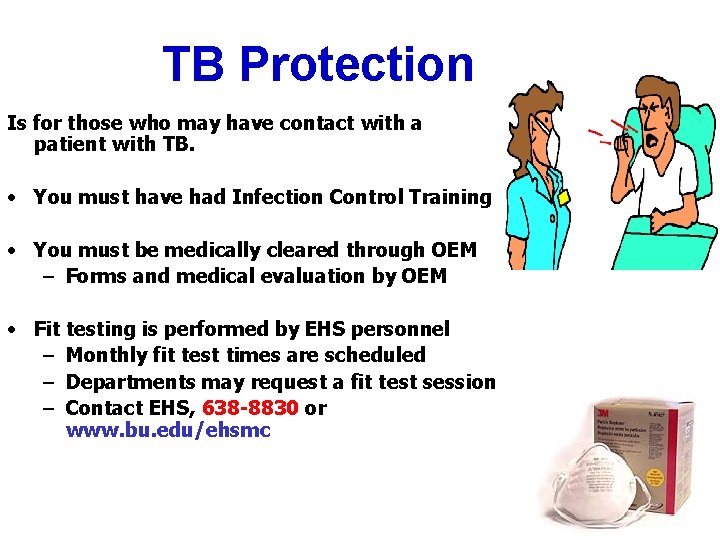
TB Protection Is for those who may have contact with a patient with TB. • You must have had Infection Control Training • You must be medically cleared through OEM – Forms and medical evaluation by OEM • Fit testing is performed by EHS personnel – Monthly fit test times are scheduled – Departments may request a fit test session – Contact EHS, 638 -8830 or www. bu. edu/ehsmc
Recap q Does the hospital expect you to put out fires? q What is the Hospital fire plan? q Where are your fire extinguishers located? q Who do you notify in the event of a fire? q What do you do in the event of a bomb threat? q What is a MSDS? q Where can a MSDS be found? q What do you do in the event of a chemical spill?
THANK YOU FOR YOUR TIME! PLEASE work safely
- Slides: 49