
When Prisoners Come Home Public Safety and Reintegration
When Prisoners Come Home: Public Safety and Reintegration Challenges Joan Petersilia, Ph. D. Department of Criminology, Law & Society University of California, Irvine
I will discuss… n n Data on prisoner reentry, stressing its emerging importance; How we think about reentry – urge more holistic view that includes collateral consequences; 2
Why Reentry is Emerging as Key Topic Now n n n Sheer numbers are staggering Parole caseloads rising, while parolees’ needs more serious System retains few treatment and work programs – some don’t even support Mandatory sentencing means that fewer screened for release-risk and more released “unconditionally” Parolees more concentrated in a few urban areas n 3/4 ths of state prisoners in NY come from 7 NY City neighborhoods 3
More Prisoners Leaving U. S. Prisons Than Ever Before n n This year, 585, 000 persons— 1, 600 a day Virtually all inmates come home n n 40% of all State inmates to be released in next year; 75% within 5 years And many return to prison n 62% of those released from State prison will be rearrested within 3 years; n n 41% returned to prison or jail “Success” declining: 1983, 57% of parolees discharged successfully, by 1997, the number declined to 45% 4
Characteristics of Parolees Changing, Complicating Re-Entry n n More females (7%) Growing older (35% older than 35 yrs) n n n More have a history of failure on supervision More drug law violators (35%) Will have spent more time in prison (27 months) More mentally ill (14%) and drug/alcohol involved (74%) More with infectious disease: ¼ of all people living with HIV or AIDS in US in 1997 were released from a prison or jail that year 5
Sentencing and Parole Policy Changed n Determinate, mandatory sentencing has diminished parole risk assessment function n 14 states abolished discretionary release for all inmates between 1977 -1998 Truth-in-sentencing limits parole boards’ power BJS estimates that 1 in 5 parolees leave prison without any post-custody supervision n 9% of all US parolees abscond 6
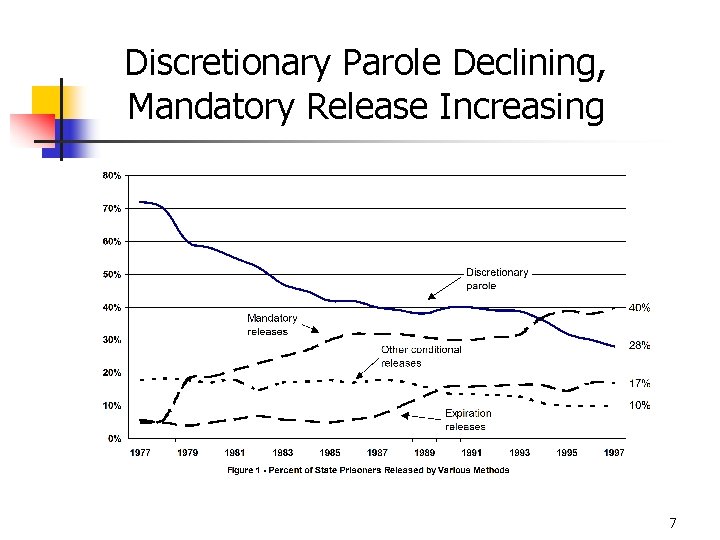
Discretionary Parole Declining, Mandatory Release Increasing 7
“Conditional” can be imprisoned again as part of previous sentence if violate conditions; “unconditional” inmates can not be reimprisoned under the same sentence for violations. 8
Services, Programs, and Public Tolerance Have Declined n Building prisons takes money from services n n n Parole caseloads about 70: 1, 35: 1 ideal. 80% of parolees on regular caseloads – means 2 15 -minute face-to-face contacts a month Public and some parole don’t support rehabilitation anyway—confusion over mission Greater parole restrictions, more community registration, greater public fear Parole Boards revoke parolees more quickly n Technology helps uncover violations, drugs 9
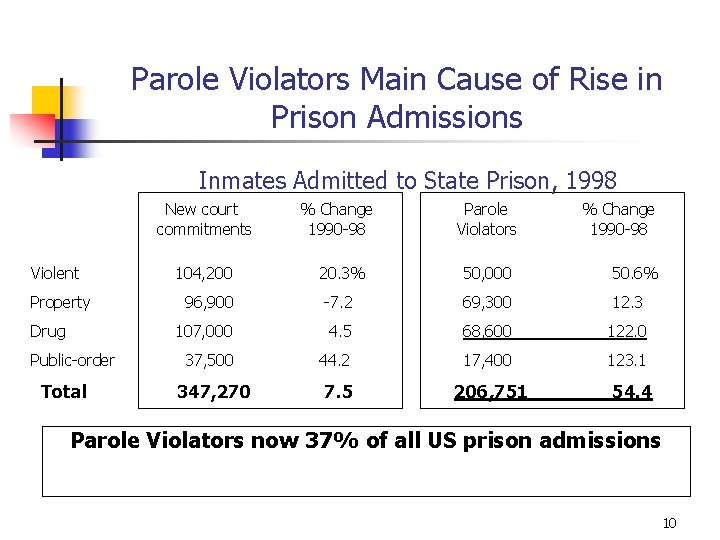
Parole Violators Main Cause of Rise in Prison Admissions Inmates Admitted to State Prison, 1998 New court commitments % Change 1990 -98 Parole Violators % Change 1990 -98 Violent 104, 200 20. 3% 50, 000 50. 6% Property 96, 900 -7. 2 69, 300 12. 3 Drug 107, 000 4. 5 68, 600 122. 0 Public-order 37, 500 44. 2 17, 400 123. 1 Total 347, 270 7. 5 206, 751 54. 4 Parole Violators now 37% of all US prison admissions 10
Handling Drug Offenders is Key n n n Parole violators returned on drug offenses more than doubled since 1990. Serious underlying problems, few programs, and cheap testing means more recycle back. Inmates who received drug treatment in prison declined from 30% in 1991 to 24% in 1997—while drug use increased. 11
In Short, More Prisoners Are Coming Home When: • They have more serious problems; • We are less clear about what we expect of them; and • We are less capable of assisting them in successful reintegration. 12
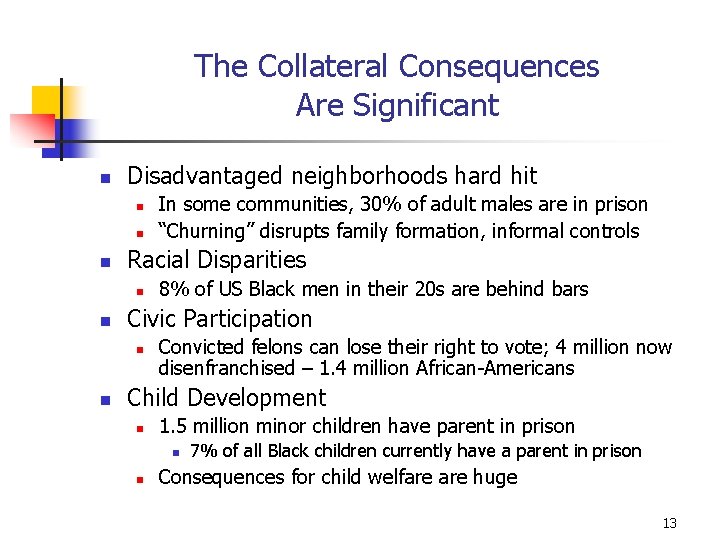
The Collateral Consequences Are Significant n Disadvantaged neighborhoods hard hit n n n Racial Disparities n n 8% of US Black men in their 20 s are behind bars Civic Participation n n In some communities, 30% of adult males are in prison “Churning” disrupts family formation, informal controls Convicted felons can lose their right to vote; 4 million now disenfranchised – 1. 4 million African-Americans Child Development n 1. 5 million minor children have parent in prison n n 7% of all Black children currently have a parent in prison Consequences for child welfare huge 13
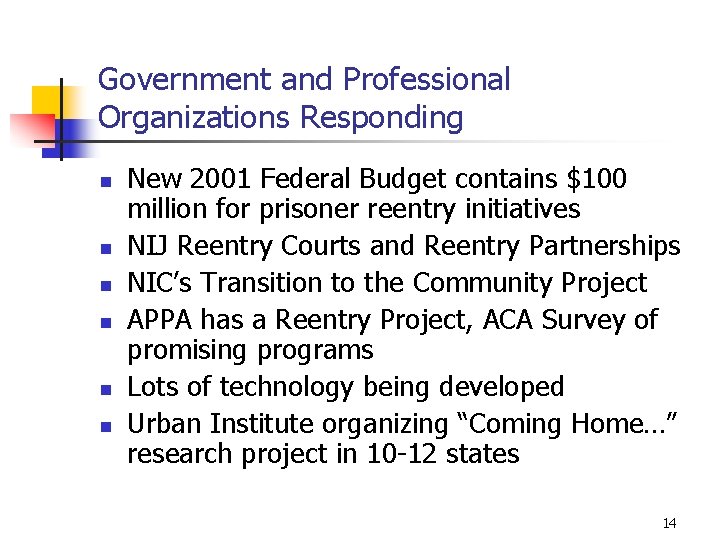
Government and Professional Organizations Responding n n n New 2001 Federal Budget contains $100 million for prisoner reentry initiatives NIJ Reentry Courts and Reentry Partnerships NIC’s Transition to the Community Project APPA has a Reentry Project, ACA Survey of promising programs Lots of technology being developed Urban Institute organizing “Coming Home…” research project in 10 -12 states 14
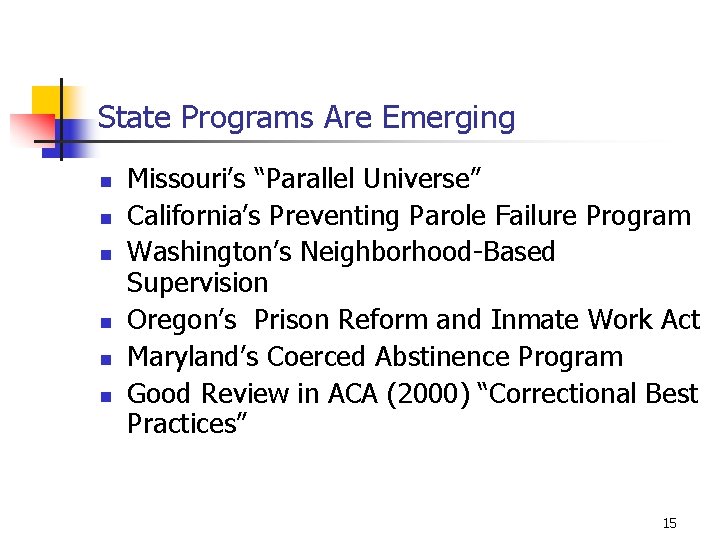
State Programs Are Emerging n n n Missouri’s “Parallel Universe” California’s Preventing Parole Failure Program Washington’s Neighborhood-Based Supervision Oregon’s Prison Reform and Inmate Work Act Maryland’s Coerced Abstinence Program Good Review in ACA (2000) “Correctional Best Practices” 15
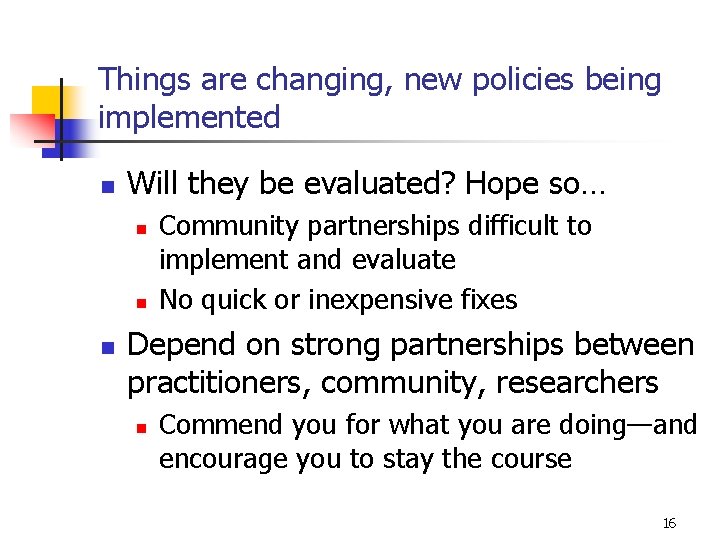
Things are changing, new policies being implemented n Will they be evaluated? Hope so… n n n Community partnerships difficult to implement and evaluate No quick or inexpensive fixes Depend on strong partnerships between practitioners, community, researchers n Commend you for what you are doing—and encourage you to stay the course 16
- Slides: 16