
When Is Polycentric Governance Sustainable Using Institutional Theory
When Is Polycentric Governance Sustainable? Using Institutional Theory to Identify Endogenous Sources of Dysfunctional Dynamics Michael D. Mc. Ginnis, Senior Research Fellow, Ostrom Workshop, & Professor Emeritus of Political Science, Indiana University, Bloomington, mcginnis@Indiana. edu Elizabeth B. Baldwin, Assistant Professor, School of Government & Public Policy, University of Arizona, Tucson, AZ, USA Andreas Thiel, Professor, International Agricultural Policy and Environmental Governance, University of Kassel, Germany Prepared for The Ostrom Workshop Monday Noon Colloquium Zoom Session, Sept. 14, 2020
Classic Definitions of Polycentric Governance (PG) • “The traditional pattern of government in a metropolitan area with its multiplicity of political jurisdictions may more appropriately be conceived as a ‘polycentric political system’. ‘Polycentric’ connotes many centers of decision-making which are formally independent of each other. Whether they actually function independently, or instead constitute an interdependent system of relations, is an empirical question in particular cases. ” (OTW 1961, 831, bolding added) • “A polycentric organization has been defined as a pattern of organization where many independent elements are capable of mutual adjustment for ordering their relationships with one another within a general system of rules. ” (V. Ostrom 1972, in Mc. Ginnis 1999, 73; bolding added) • “By ‘polycentric’ I mean a system where citizens are able to organize not just one but multiple governing authorities, as well as private arrangements, at different scales. ” (E. Ostrom 2003, in Cole and Mc. Ginnis, eds. , 2015, 61 bolding added) 9/14/2020 Mc. Ginnis, et al. , When is PG Sustainable? 2
Preliminary Findings from Literature Review • Scholarly interest in polycentricity is burgeoning & broadening • Studies acknowledge challenges, esp coordination and capacity • Most applications descriptive or policy advocacy, rarely used as explanatory factor • We’d like to see empirical propositions grounded in theory • Very few studies examine dynamics or evolution of PG systems, • We see endogenous dynamics of self-organization as a key missing element, to complement existing studies of adaptation to shocks • We identify negative syndromes that may emerge endogenously • and suggest ways policy actors may counteract these trends towards dysfunctionality. 9/14/2020 Mc. Ginnis, et al. , When is PG Sustainable? 3
Other Names for PG-Type Systems of Governance • Adaptive governance (Polanyi 1951, Folke et al. 2005, De. Caro et al. 2017) • Multi-level governance (Hooghe & Marks 2001, 2003) • FOCJ (Functional Overlapping Competing Jurisdictions) (Frey & Eichenberg 1996, 2004) • Collaborative governance (Bryson, Crosby, and Stone 2006, Ansell & Gash 2007, Emerson, Kirk, and Nabatchi 2015) • Cross-sector network governance (Feiock 2009, 2013, Swann & Kim 2018) • Marble-cake federalism (Grodzins 1960, Bohte & Meier 2000) • Regime clusters (Young 2002, Epstein et al. 2014, Blondin & Boin 2020) • Nexus governance (Villamayor-Tomas et al. 2015, de Loë & Patterson 2018) 9/14/2020 Mc. Ginnis, et al. , When is PG Sustainable? 4
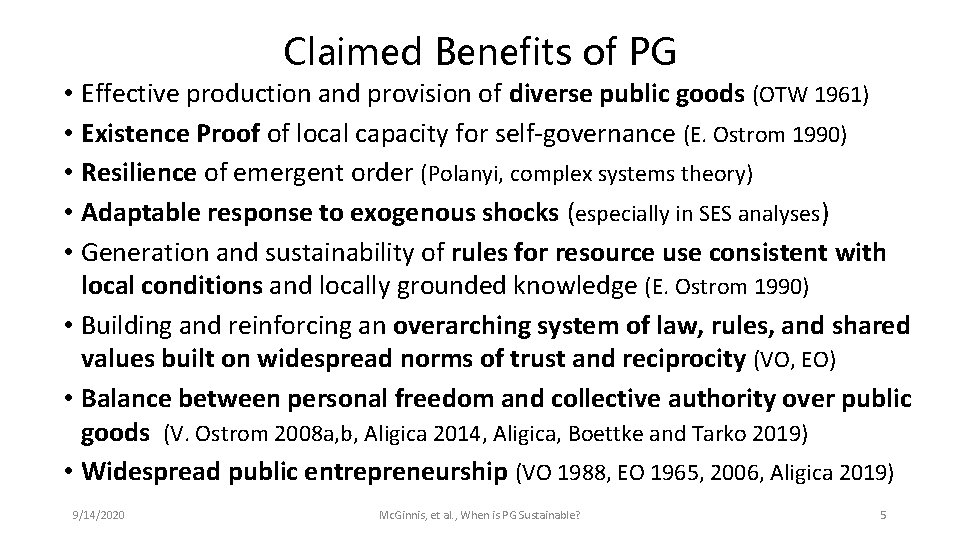
Claimed Benefits of PG • Effective production and provision of diverse public goods (OTW 1961) • Existence Proof of local capacity for self-governance (E. Ostrom 1990) • Resilience of emergent order (Polanyi, complex systems theory) • Adaptable response to exogenous shocks (especially in SES analyses) • Generation and sustainability of rules for resource use consistent with local conditions and locally grounded knowledge (E. Ostrom 1990) • Building and reinforcing an overarching system of law, rules, and shared values built on widespread norms of trust and reciprocity (VO, EO) • Balance between personal freedom and collective authority over public goods (V. Ostrom 2008 a, b, Aligica 2014, Aligica, Boettke and Tarko 2019) • Widespread public entrepreneurship (VO 1988, EO 1965, 2006, Aligica 2019) 9/14/2020 Mc. Ginnis, et al. , When is PG Sustainable? 5
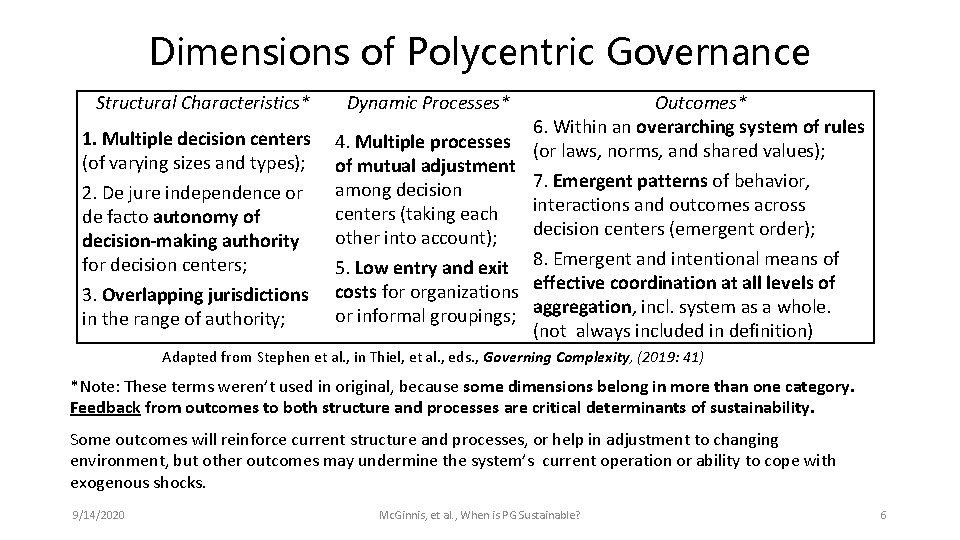
Dimensions of Polycentric Governance Structural Characteristics* Dynamic Processes* 1. Multiple decision centers (of varying sizes and types); 2. De jure independence or de facto autonomy of decision-making authority for decision centers; 3. Overlapping jurisdictions in the range of authority; 4. Multiple processes of mutual adjustment among decision centers (taking each other into account); 5. Low entry and exit costs for organizations or informal groupings; Outcomes* 6. Within an overarching system of rules (or laws, norms, and shared values); 7. Emergent patterns of behavior, interactions and outcomes across decision centers (emergent order); 8. Emergent and intentional means of effective coordination at all levels of aggregation, incl. system as a whole. (not always included in definition) Adapted from Stephen et al. , in Thiel, et al. , eds. , Governing Complexity, (2019: 41) *Note: These terms weren’t used in original, because some dimensions belong in more than one category. Feedback from outcomes to both structure and processes are critical determinants of sustainability. Some outcomes will reinforce current structure and processes, or help in adjustment to changing environment, but other outcomes may undermine the system’s current operation or ability to cope with exogenous shocks. 9/14/2020 Mc. Ginnis, et al. , When is PG Sustainable? 6
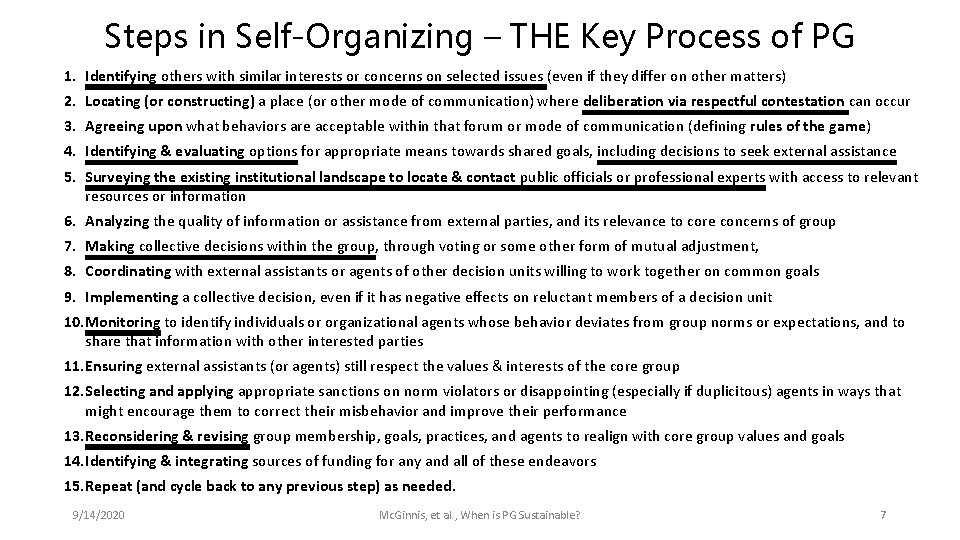
Steps in Self-Organizing – THE Key Process of PG 1. Identifying others with similar interests or concerns on selected issues (even if they differ on other matters) 2. Locating (or constructing) a place (or other mode of communication) where deliberation via respectful contestation can occur 3. Agreeing upon what behaviors are acceptable within that forum or mode of communication (defining rules of the game) 4. Identifying & evaluating options for appropriate means towards shared goals, including decisions to seek external assistance 5. Surveying the existing institutional landscape to locate & contact public officials or professional experts with access to relevant resources or information 6. Analyzing the quality of information or assistance from external parties, and its relevance to core concerns of group 7. Making collective decisions within the group, through voting or some other form of mutual adjustment, 8. Coordinating with external assistants or agents of other decision units willing to work together on common goals 9. Implementing a collective decision, even if it has negative effects on reluctant members of a decision unit 10. Monitoring to identify individuals or organizational agents whose behavior deviates from group norms or expectations, and to share that information with other interested parties 11. Ensuring external assistants (or agents) still respect the values & interests of the core group 12. Selecting and applying appropriate sanctions on norm violators or disappointing (especially if duplicitous) agents in ways that might encourage them to correct their misbehavior and improve their performance 13. Reconsidering & revising group membership, goals, practices, and agents to realign with core group values and goals 14. Identifying & integrating sources of funding for any and all of these endeavors 15. Repeat (and cycle back to any previous step) as needed. 9/14/2020 Mc. Ginnis, et al. , When is PG Sustainable? 7
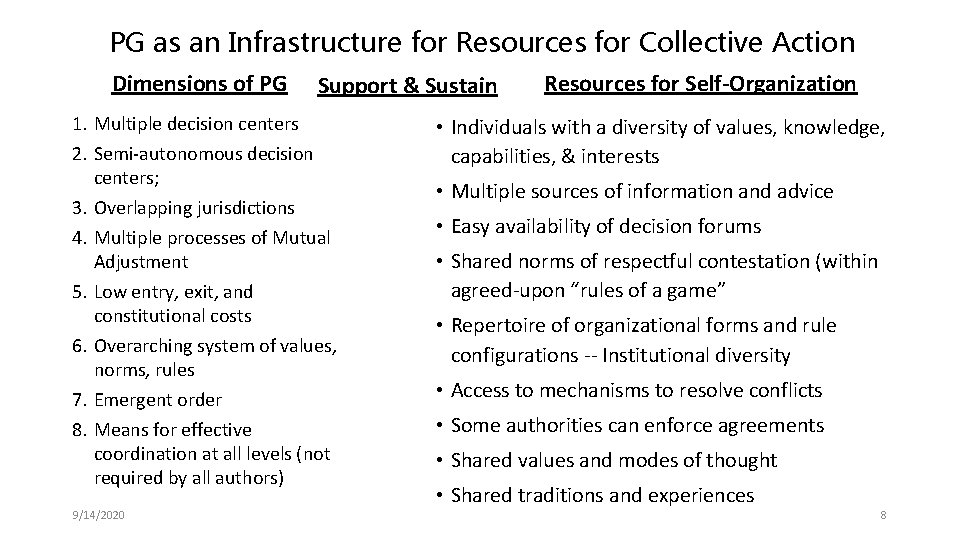
PG as an Infrastructure for Resources for Collective Action Dimensions of PG Support & Sustain 1. Multiple decision centers 2. Semi-autonomous decision centers; 3. Overlapping jurisdictions 4. Multiple processes of Mutual Adjustment 5. Low entry, exit, and constitutional costs 6. Overarching system of values, norms, rules 7. Emergent order 8. Means for effective coordination at all levels (not required by all authors) 9/14/2020 Resources for Self-Organization • Individuals with a diversity of values, knowledge, capabilities, & interests • Multiple sources of information and advice • Easy availability of decision forums • Shared norms of respectful contestation (within agreed-upon “rules of a game” • Repertoire of organizational forms and rule configurations -- Institutional diversity • Access to mechanisms to resolve conflicts • Some authorities can enforce agreements • Shared values and modes of thought • Shared traditions and experiences 8
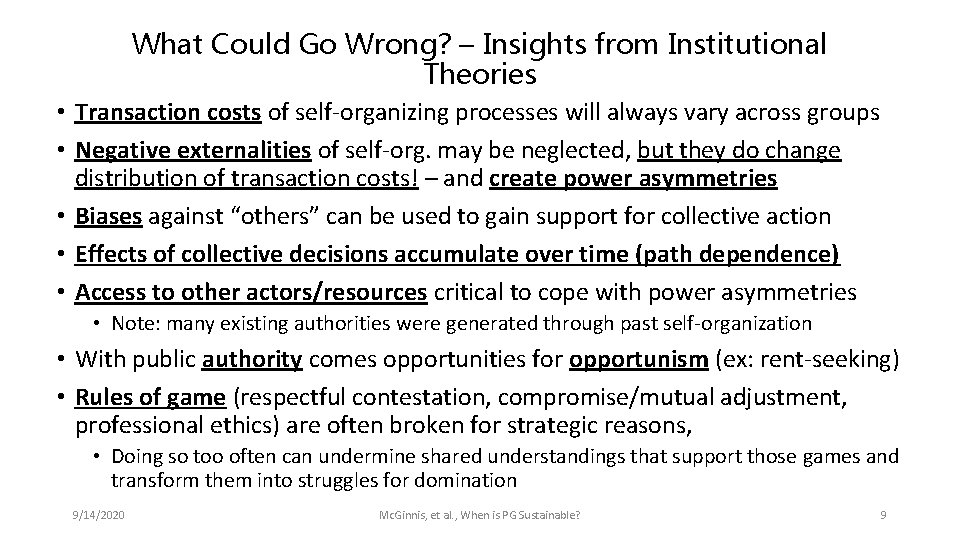
What Could Go Wrong? – Insights from Institutional Theories • Transaction costs of self-organizing processes will always vary across groups • Negative externalities of self-org. may be neglected, but they do change distribution of transaction costs! – and create power asymmetries • Biases against “others” can be used to gain support for collective action • Effects of collective decisions accumulate over time (path dependence) • Access to other actors/resources critical to cope with power asymmetries • Note: many existing authorities were generated through past self-organization • With public authority comes opportunities for opportunism (ex: rent-seeking) • Rules of game (respectful contestation, compromise/mutual adjustment, professional ethics) are often broken for strategic reasons, • Doing so too often can undermine shared understandings that support those games and transform them into struggles for domination 9/14/2020 Mc. Ginnis, et al. , When is PG Sustainable? 9
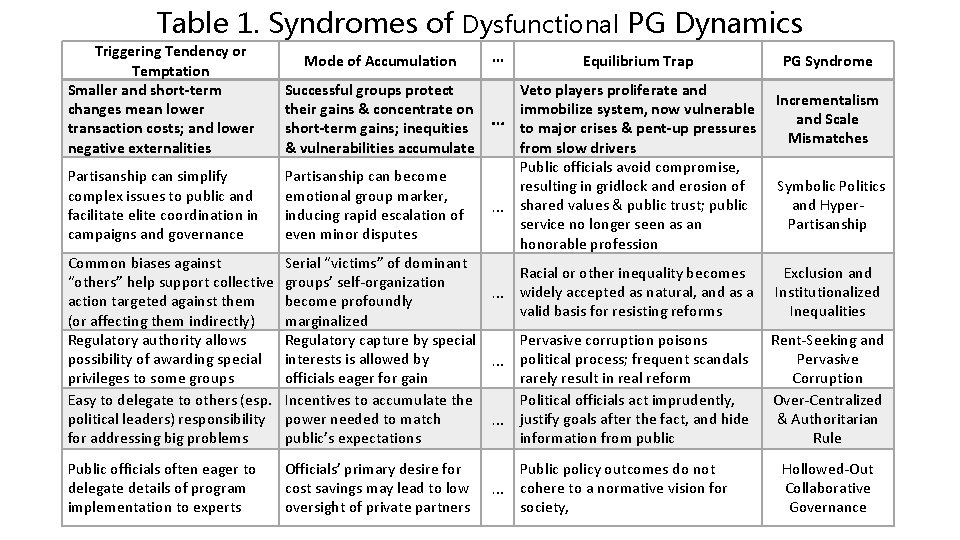
Table 1. Syndromes of Dysfunctional PG Dynamics Triggering Tendency or Temptation Smaller and short-term changes mean lower transaction costs; and lower negative externalities Successful groups protect their gains & concentrate on short-term gains; inequities & vulnerabilities accumulate Partisanship can simplify complex issues to public and facilitate elite coordination in campaigns and governance Partisanship can become emotional group marker, inducing rapid escalation of even minor disputes Common biases against “others” help support collective action targeted against them (or affecting them indirectly) Regulatory authority allows possibility of awarding special privileges to some groups Easy to delegate to others (esp. political leaders) responsibility for addressing big problems Serial “victims” of dominant groups’ self-organization become profoundly marginalized Regulatory capture by special interests is allowed by officials eager for gain Incentives to accumulate the power needed to match public’s expectations Public officials often eager to delegate details of program implementation to experts Officials’ primary desire for cost savings may lead to low oversight of private partners Mode of Accumulation … … … … Equilibrium Trap Veto players proliferate and immobilize system, now vulnerable to major crises & pent-up pressures from slow drivers Public officials avoid compromise, resulting in gridlock and erosion of shared values & public trust; public service no longer seen as an honorable profession PG Syndrome Incrementalism and Scale Mismatches Symbolic Politics and Hyper. Partisanship Racial or other inequality becomes widely accepted as natural, and as a valid basis for resisting reforms Exclusion and Institutionalized Inequalities Pervasive corruption poisons political process; frequent scandals rarely result in real reform Political officials act imprudently, justify goals after the fact, and hide information from public Rent-Seeking and Pervasive Corruption Over-Centralized & Authoritarian Rule Public policy outcomes do not cohere to a normative vision for society, Hollowed-Out Collaborative Governance
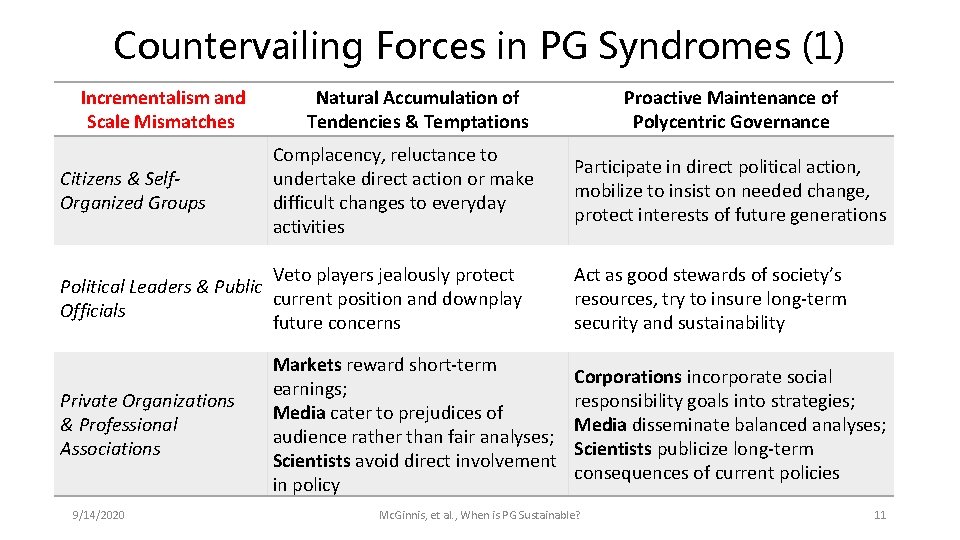
Countervailing Forces in PG Syndromes (1) Incrementalism and Scale Mismatches Citizens & Self. Organized Groups Natural Accumulation of Tendencies & Temptations Complacency, reluctance to undertake direct action or make difficult changes to everyday activities Veto players jealously protect Political Leaders & Public current position and downplay Officials future concerns Private Organizations & Professional Associations 9/14/2020 Markets reward short-term earnings; Media cater to prejudices of audience rather than fair analyses; Scientists avoid direct involvement in policy Proactive Maintenance of Polycentric Governance Participate in direct political action, mobilize to insist on needed change, protect interests of future generations Act as good stewards of society’s resources, try to insure long-term security and sustainability Corporations incorporate social responsibility goals into strategies; Media disseminate balanced analyses; Scientists publicize long-term consequences of current policies Mc. Ginnis, et al. , When is PG Sustainable? 11
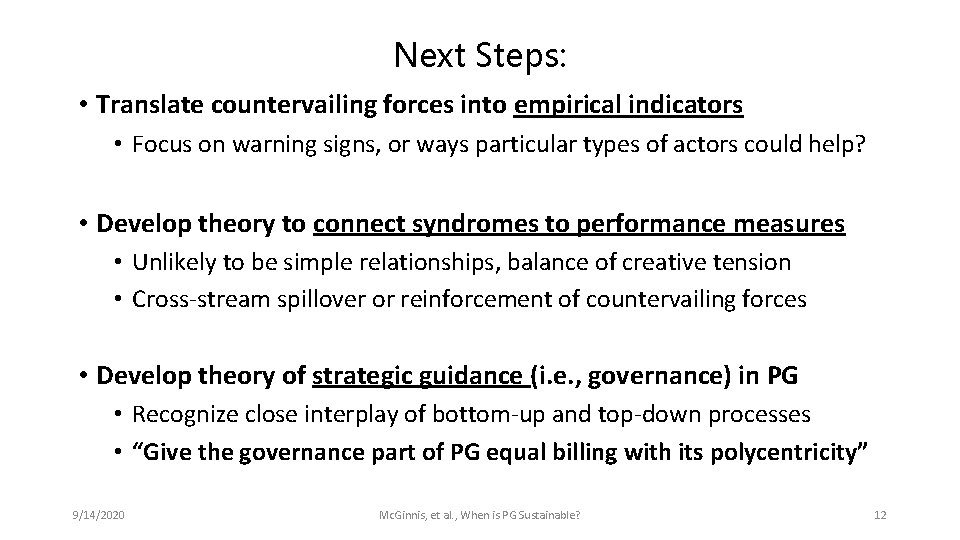
Next Steps: • Translate countervailing forces into empirical indicators • Focus on warning signs, or ways particular types of actors could help? • Develop theory to connect syndromes to performance measures • Unlikely to be simple relationships, balance of creative tension • Cross-stream spillover or reinforcement of countervailing forces • Develop theory of strategic guidance (i. e. , governance) in PG • Recognize close interplay of bottom-up and top-down processes • “Give the governance part of PG equal billing with its polycentricity” 9/14/2020 Mc. Ginnis, et al. , When is PG Sustainable? 12

Additional Slides 9/14/2020 Mc. Ginnis, et al. , When is PG Sustainable? 13
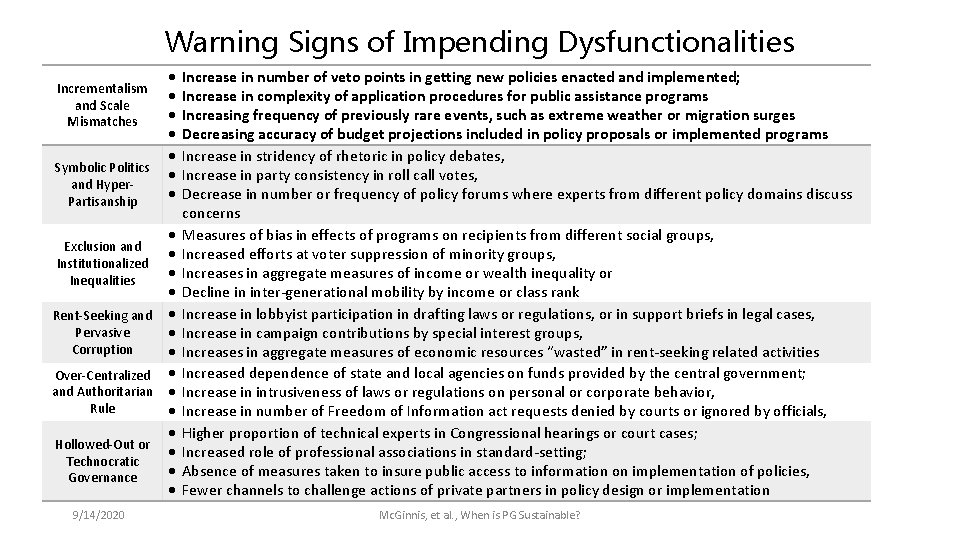
Warning Signs of Impending Dysfunctionalities Incrementalism and Scale Mismatches Symbolic Politics and Hyper. Partisanship Rent-Seeking and Pervasive Corruption Over-Centralized and Authoritarian Rule Hollowed-Out or Technocratic Governance Exclusion and Institutionalized Inequalities 9/14/2020 Increase in number of veto points in getting new policies enacted and implemented; Increase in complexity of application procedures for public assistance programs Increasing frequency of previously rare events, such as extreme weather or migration surges Decreasing accuracy of budget projections included in policy proposals or implemented programs Increase in stridency of rhetoric in policy debates, Increase in party consistency in roll call votes, Decrease in number or frequency of policy forums where experts from different policy domains discuss concerns Measures of bias in effects of programs on recipients from different social groups, Increased efforts at voter suppression of minority groups, Increases in aggregate measures of income or wealth inequality or Decline in inter-generational mobility by income or class rank Increase in lobbyist participation in drafting laws or regulations, or in support briefs in legal cases, Increase in campaign contributions by special interest groups, Increases in aggregate measures of economic resources “wasted” in rent-seeking related activities Increased dependence of state and local agencies on funds provided by the central government; Increase in intrusiveness of laws or regulations on personal or corporate behavior, Increase in number of Freedom of Information act requests denied by courts or ignored by officials, Higher proportion of technical experts in Congressional hearings or court cases; Increased role of professional associations in standard-setting; Absence of measures taken to insure public access to information on implementation of policies, Fewer channels to challenge actions of private partners in policy design or implementation Mc. Ginnis, et al. , When is PG Sustainable?
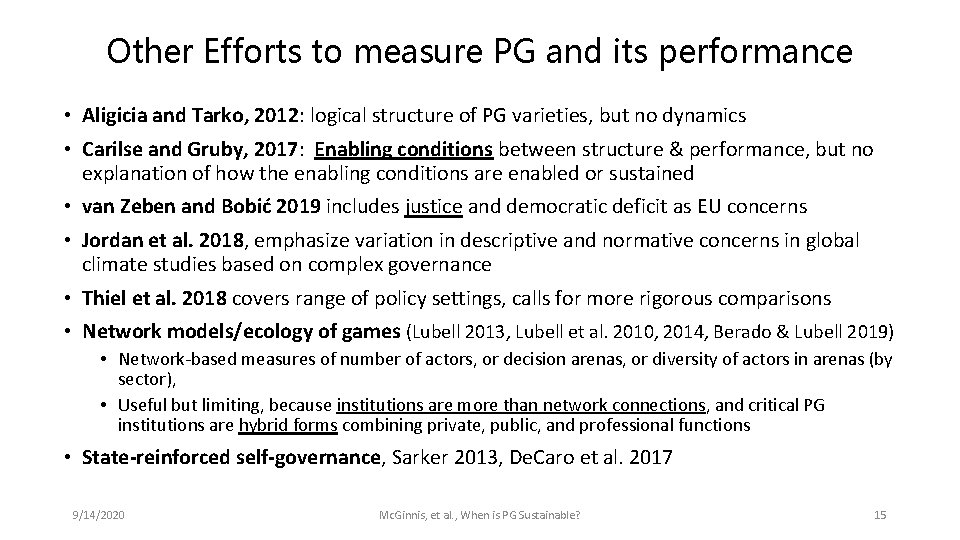
Other Efforts to measure PG and its performance • Aligicia and Tarko, 2012: logical structure of PG varieties, but no dynamics • Carilse and Gruby, 2017: Enabling conditions between structure & performance, but no explanation of how the enabling conditions are enabled or sustained • van Zeben and Bobić 2019 includes justice and democratic deficit as EU concerns • Jordan et al. 2018, emphasize variation in descriptive and normative concerns in global climate studies based on complex governance • Thiel et al. 2018 covers range of policy settings, calls for more rigorous comparisons • Network models/ecology of games (Lubell 2013, Lubell et al. 2010, 2014, Berado & Lubell 2019) • Network-based measures of number of actors, or decision arenas, or diversity of actors in arenas (by sector), • Useful but limiting, because institutions are more than network connections, and critical PG institutions are hybrid forms combining private, public, and professional functions • State-reinforced self-governance, Sarker 2013, De. Caro et al. 2017 9/14/2020 Mc. Ginnis, et al. , When is PG Sustainable? 15
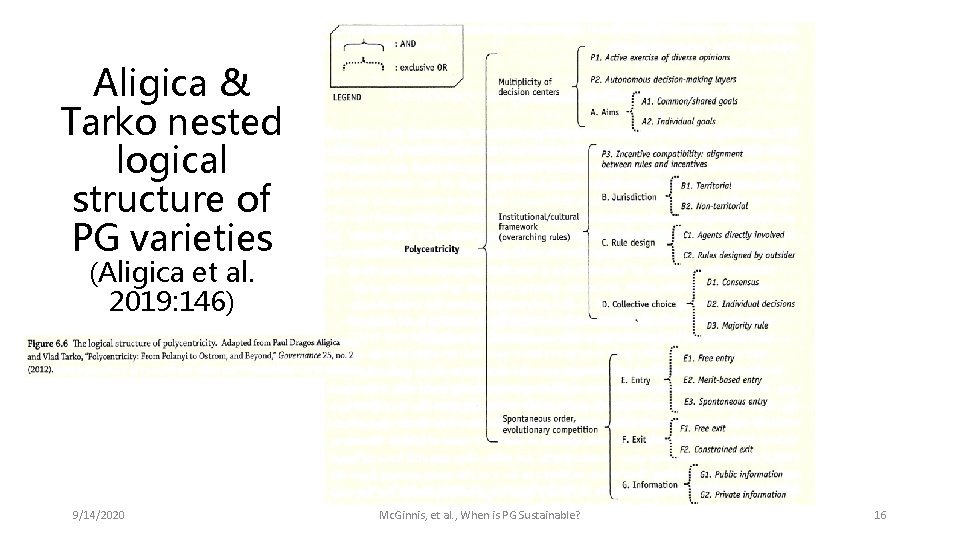
Aligica & Tarko nested logical structure of PG varieties (Aligica et al. 2019: 146) 9/14/2020 Mc. Ginnis, et al. , When is PG Sustainable? 16
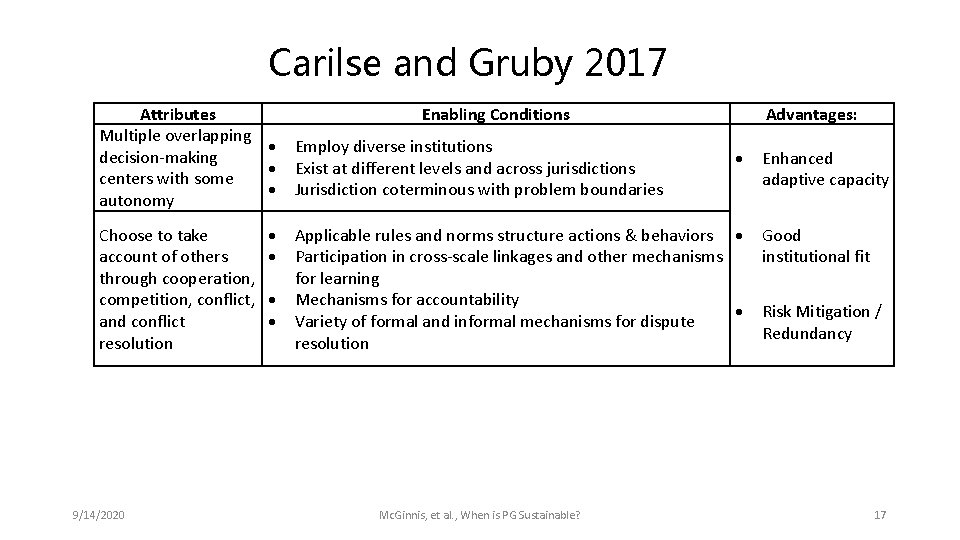
Carilse and Gruby 2017 Attributes Multiple overlapping decision-making centers with some autonomy Choose to take account of others through cooperation, competition, conflict, and conflict resolution 9/14/2020 Enabling Conditions Employ diverse institutions Exist at different levels and across jurisdictions Jurisdiction coterminous with problem boundaries Advantages: Applicable rules and norms structure actions & behaviors Participation in cross-scale linkages and other mechanisms for learning Mechanisms for accountability Variety of formal and informal mechanisms for dispute resolution Mc. Ginnis, et al. , When is PG Sustainable? Enhanced adaptive capacity Good institutional fit Risk Mitigation / Redundancy 17
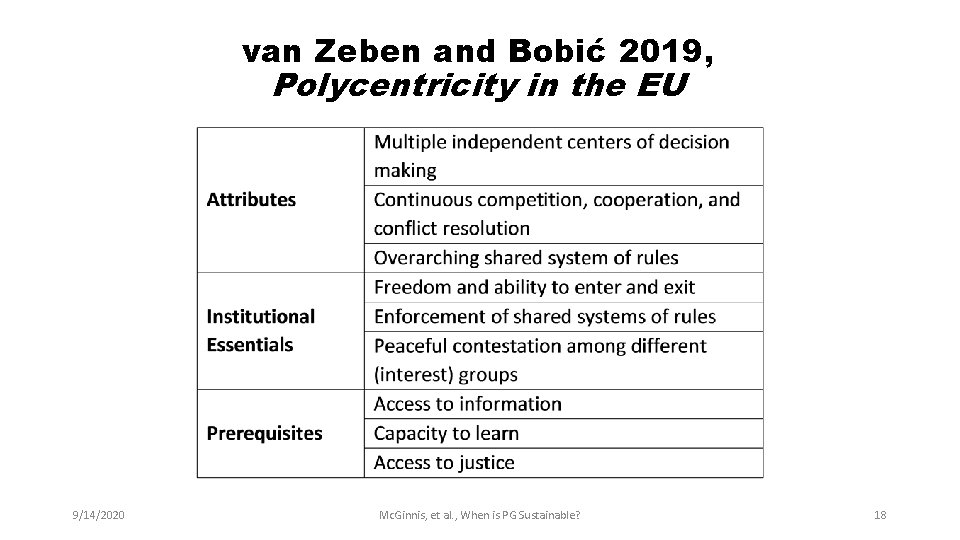
van Zeben and Bobić 2019, Polycentricity in the EU 9/14/2020 Mc. Ginnis, et al. , When is PG Sustainable? 18
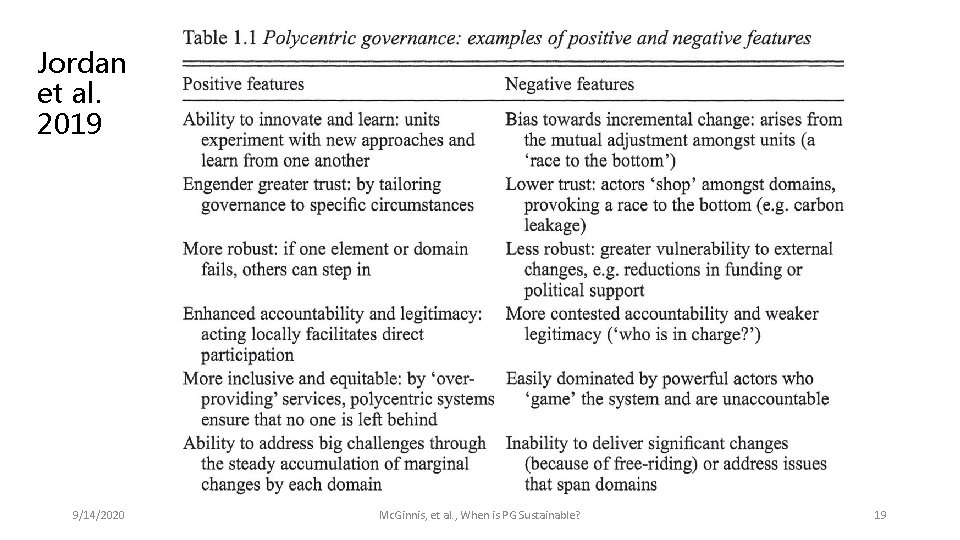
Jordan et al. 2019 9/14/2020 Mc. Ginnis, et al. , When is PG Sustainable? 19
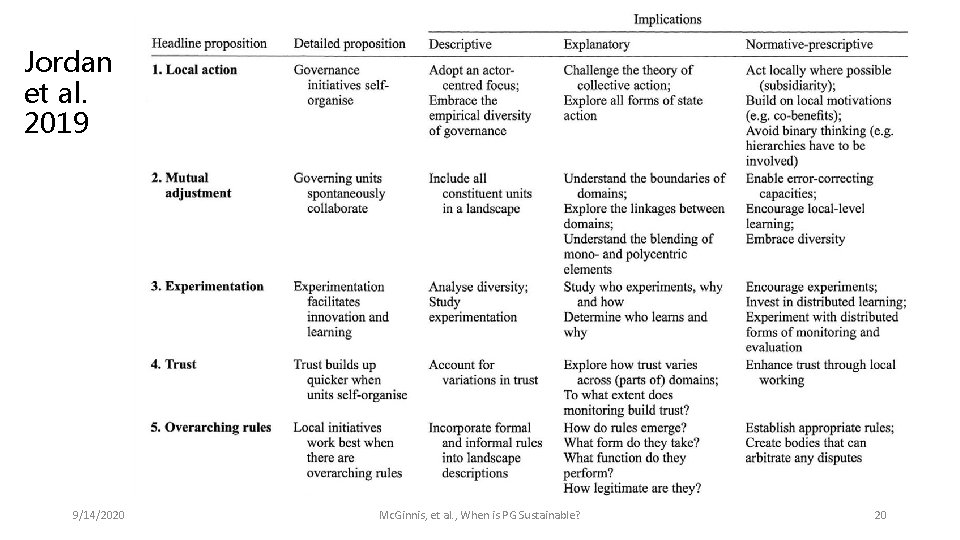
Jordan et al. 2019 9/14/2020 Mc. Ginnis, et al. , When is PG Sustainable? 20
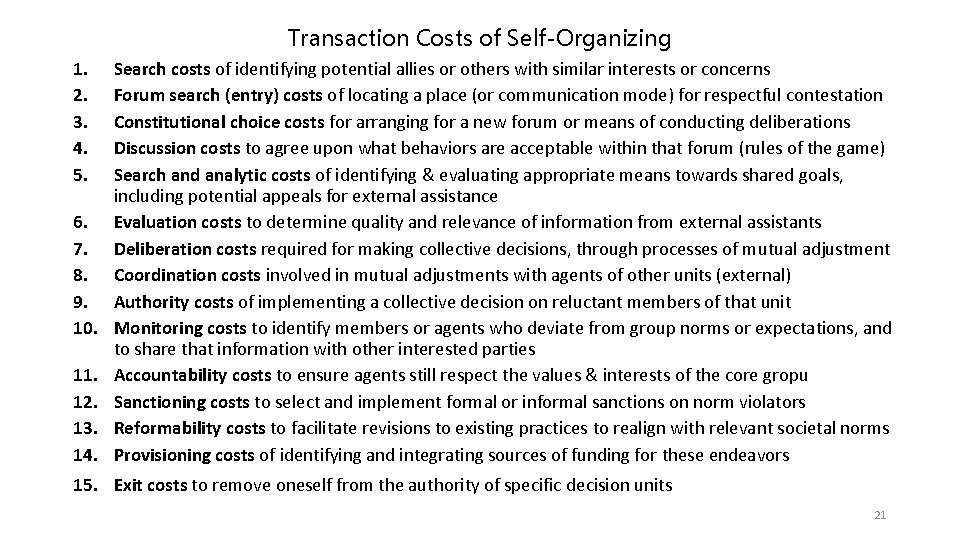
Transaction Costs of Self-Organizing 1. 2. 3. 4. 5. 6. 7. 8. 9. 10. 11. 12. 13. 14. Search costs of identifying potential allies or others with similar interests or concerns Forum search (entry) costs of locating a place (or communication mode) for respectful contestation Constitutional choice costs for arranging for a new forum or means of conducting deliberations Discussion costs to agree upon what behaviors are acceptable within that forum (rules of the game) Search and analytic costs of identifying & evaluating appropriate means towards shared goals, including potential appeals for external assistance Evaluation costs to determine quality and relevance of information from external assistants Deliberation costs required for making collective decisions, through processes of mutual adjustment Coordination costs involved in mutual adjustments with agents of other units (external) Authority costs of implementing a collective decision on reluctant members of that unit Monitoring costs to identify members or agents who deviate from group norms or expectations, and to share that information with other interested parties Accountability costs to ensure agents still respect the values & interests of the core gropu Sanctioning costs to select and implement formal or informal sanctions on norm violators Reformability costs to facilitate revisions to existing practices to realign with relevant societal norms Provisioning costs of identifying and integrating sources of funding for these endeavors 15. Exit costs to remove oneself from the authority of specific decision units 21
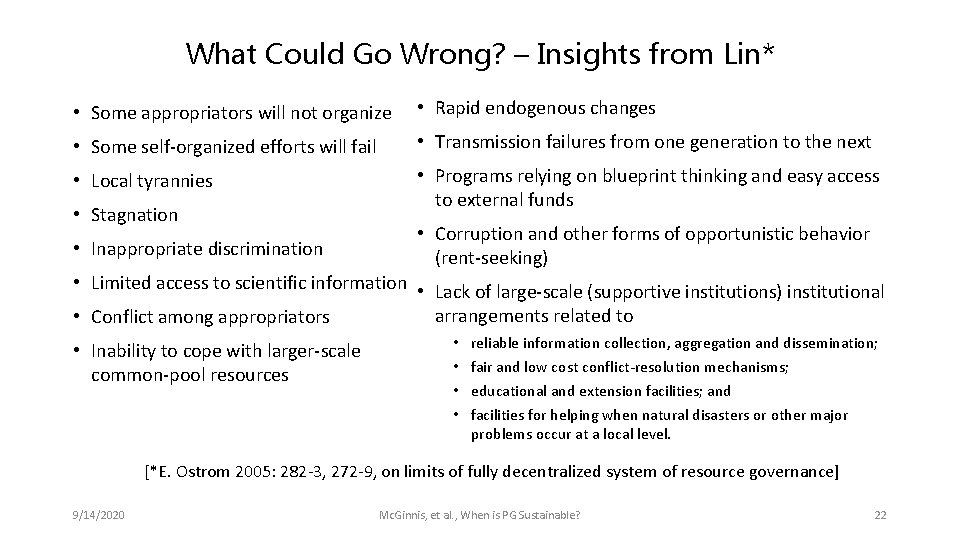
What Could Go Wrong? – Insights from Lin* • Some appropriators will not organize • Rapid endogenous changes • Some self-organized efforts will fail • Transmission failures from one generation to the next • Local tyrannies • Programs relying on blueprint thinking and easy access to external funds • Stagnation • Inappropriate discrimination • Corruption and other forms of opportunistic behavior (rent-seeking) • Limited access to scientific information • Lack of large-scale (supportive institutions) institutional arrangements related to • Conflict among appropriators • Inability to cope with larger-scale common-pool resources • • reliable information collection, aggregation and dissemination; fair and low cost conflict-resolution mechanisms; educational and extension facilities; and facilities for helping when natural disasters or other major problems occur at a local level. [*E. Ostrom 2005: 282 -3, 272 -9, on limits of fully decentralized system of resource governance] 9/14/2020 Mc. Ginnis, et al. , When is PG Sustainable? 22
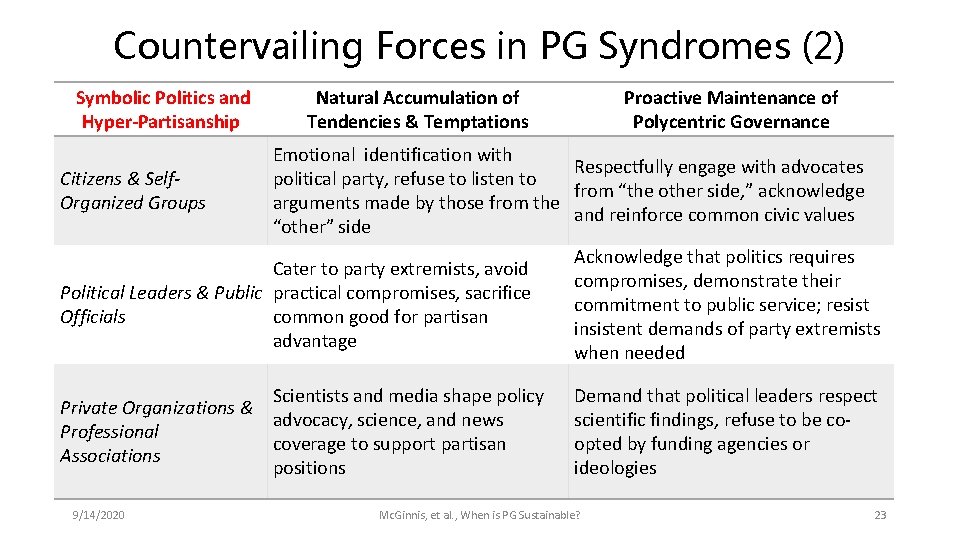
Countervailing Forces in PG Syndromes (2) Symbolic Politics and Hyper-Partisanship Citizens & Self. Organized Groups Natural Accumulation of Tendencies & Temptations Proactive Maintenance of Polycentric Governance Emotional identification with Respectfully engage with advocates political party, refuse to listen to from “the other side, ” acknowledge arguments made by those from the and reinforce common civic values “other” side Cater to party extremists, avoid Political Leaders & Public practical compromises, sacrifice Officials common good for partisan advantage Acknowledge that politics requires compromises, demonstrate their commitment to public service; resist insistent demands of party extremists when needed Scientists and media shape policy Private Organizations & advocacy, science, and news Professional coverage to support partisan Associations positions Demand that political leaders respect scientific findings, refuse to be coopted by funding agencies or ideologies 9/14/2020 Mc. Ginnis, et al. , When is PG Sustainable? 23
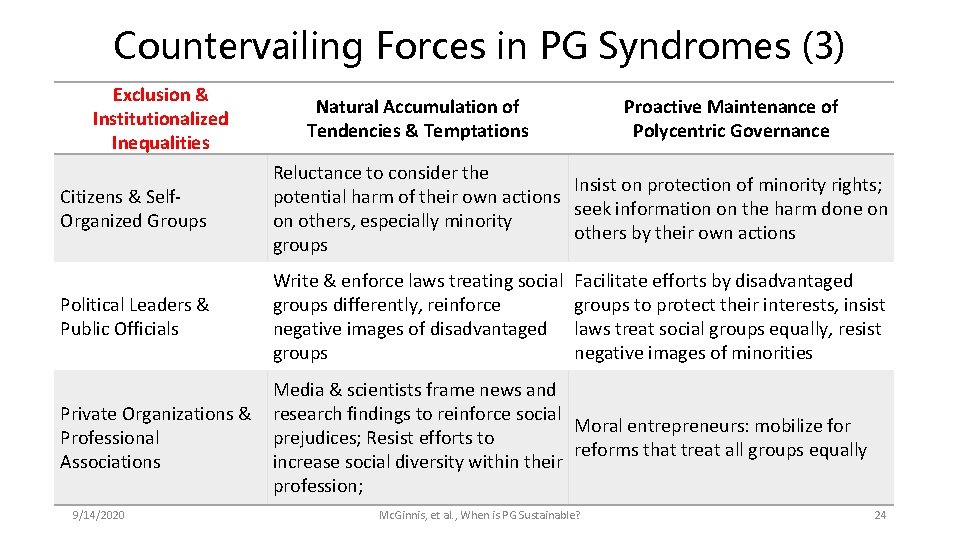
Countervailing Forces in PG Syndromes (3) Exclusion & Institutionalized Inequalities Natural Accumulation of Tendencies & Temptations Proactive Maintenance of Polycentric Governance Citizens & Self. Organized Groups Reluctance to consider the Insist on protection of minority rights; potential harm of their own actions seek information on the harm done on on others, especially minority others by their own actions groups Political Leaders & Public Officials Write & enforce laws treating social groups differently, reinforce negative images of disadvantaged groups Private Organizations & Professional Associations Media & scientists frame news and research findings to reinforce social Moral entrepreneurs: mobilize for prejudices; Resist efforts to reforms that treat all groups equally increase social diversity within their profession; 9/14/2020 Facilitate efforts by disadvantaged groups to protect their interests, insist laws treat social groups equally, resist negative images of minorities Mc. Ginnis, et al. , When is PG Sustainable? 24
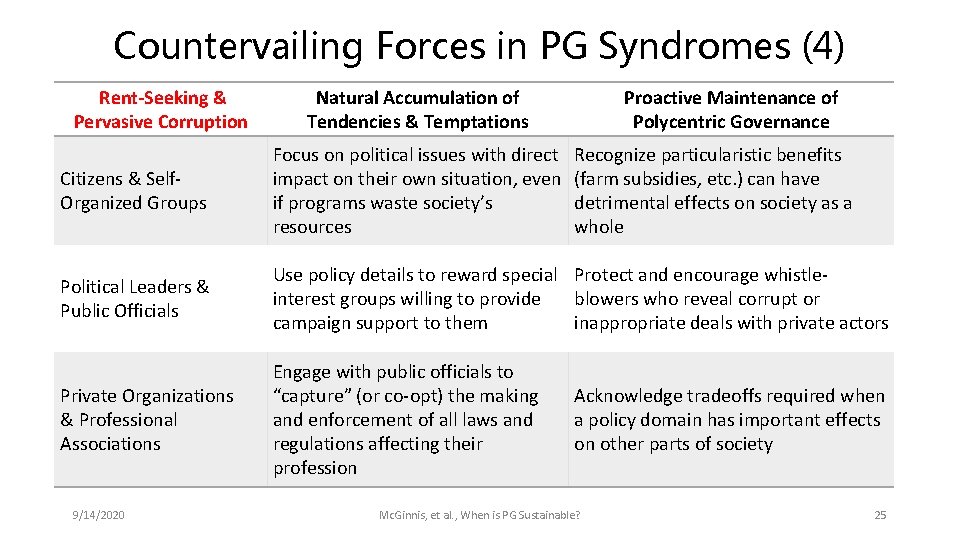
Countervailing Forces in PG Syndromes (4) Rent-Seeking & Pervasive Corruption Natural Accumulation of Tendencies & Temptations Proactive Maintenance of Polycentric Governance Citizens & Self. Organized Groups Focus on political issues with direct impact on their own situation, even if programs waste society’s resources Political Leaders & Public Officials Use policy details to reward special Protect and encourage whistleinterest groups willing to provide blowers who reveal corrupt or campaign support to them inappropriate deals with private actors Private Organizations & Professional Associations Engage with public officials to “capture” (or co-opt) the making and enforcement of all laws and regulations affecting their profession 9/14/2020 Recognize particularistic benefits (farm subsidies, etc. ) can have detrimental effects on society as a whole Acknowledge tradeoffs required when a policy domain has important effects on other parts of society Mc. Ginnis, et al. , When is PG Sustainable? 25
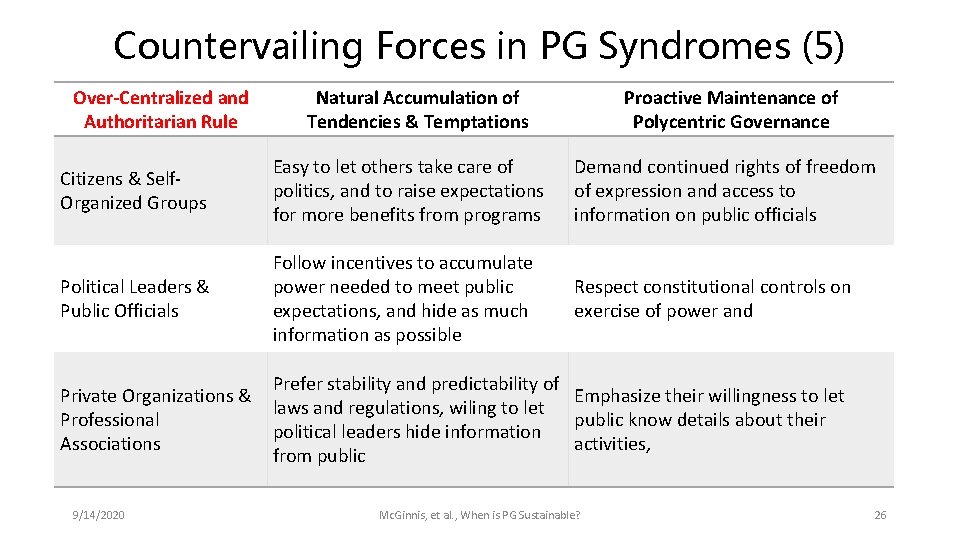
Countervailing Forces in PG Syndromes (5) Over-Centralized and Authoritarian Rule Natural Accumulation of Tendencies & Temptations Proactive Maintenance of Polycentric Governance Citizens & Self. Organized Groups Easy to let others take care of politics, and to raise expectations for more benefits from programs Demand continued rights of freedom of expression and access to information on public officials Political Leaders & Public Officials Follow incentives to accumulate power needed to meet public expectations, and hide as much information as possible Respect constitutional controls on exercise of power and Private Organizations & Professional Associations Prefer stability and predictability of Emphasize their willingness to let laws and regulations, wiling to let public know details about their political leaders hide information activities, from public 9/14/2020 Mc. Ginnis, et al. , When is PG Sustainable? 26
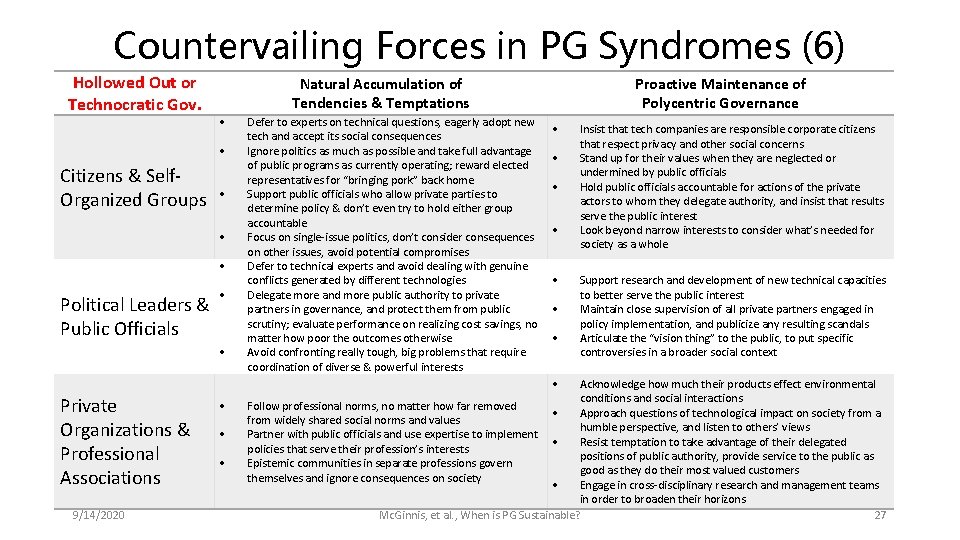
Countervailing Forces in PG Syndromes (6) Hollowed Out or Technocratic Gov. Natural Accumulation of Tendencies & Temptations Citizens & Self. Organized Groups Political Leaders & Public Officials Defer to experts on technical questions, eagerly adopt new tech and accept its social consequences Ignore politics as much as possible and take full advantage of public programs as currently operating; reward elected representatives for “bringing pork” back home Support public officials who allow private parties to determine policy & don’t even try to hold either group accountable Focus on single-issue politics, don’t consider consequences on other issues, avoid potential compromises Defer to technical experts and avoid dealing with genuine conflicts generated by different technologies Delegate more and more public authority to private partners in governance, and protect them from public scrutiny; evaluate performance on realizing cost savings, no matter how poor the outcomes otherwise Avoid confronting really tough, big problems that require coordination of diverse & powerful interests Proactive Maintenance of Polycentric Governance Private Organizations & Professional Associations 9/14/2020 Insist that tech companies are responsible corporate citizens that respect privacy and other social concerns Stand up for their values when they are neglected or undermined by public officials Hold public officials accountable for actions of the private actors to whom they delegate authority, and insist that results serve the public interest Look beyond narrow interests to consider what’s needed for society as a whole Support research and development of new technical capacities to better serve the public interest Maintain close supervision of all private partners engaged in policy implementation, and publicize any resulting scandals Articulate the “vision thing” to the public, to put specific controversies in a broader social context Acknowledge how much their products effect environmental conditions and social interactions Follow professional norms, no matter how far removed Approach questions of technological impact on society from a from widely shared social norms and values humble perspective, and listen to others’ views Partner with public officials and use expertise to implement Resist temptation to take advantage of their delegated policies that serve their profession’s interests positions of public authority, provide service to the public as Epistemic communities in separate professions govern good as they do their most valued customers themselves and ignore consequences on society Engage in cross-disciplinary research and management teams in order to broaden their horizons Mc. Ginnis, et al. , When is PG Sustainable? 27
- Slides: 27