
When is a partnership truly a partnership Tips
- Slides: 17
When is a partnership truly a partnership? Tips for a successful ARC linkage collaboration, from Australian Education Jurisdictions
Overview of Presentation • The importance of the ARC Linkage Scheme: Benefits and challenges (Annemaree Carroll) • Successful prior partnerships lay the foundation (Angela Ferguson) • Research priorities and interests of research jurisdictions (Rob Stevens) • Engaging schools in research projects and translating research into practice (Shani Prendergast) “Turnbull Wants End to Publish or Perish” – Sydney Morning Herald: 16 November, 2015 Incoming Chief Scientist Alan Finkel, who is president of the Australian Academy of Technological Sciences and Engineering, has spearheaded a campaign to transform the way Australia funds research so that engagement with industry is valued as much as research excellence, which is largely measured on citations in peer-reviewed publications.
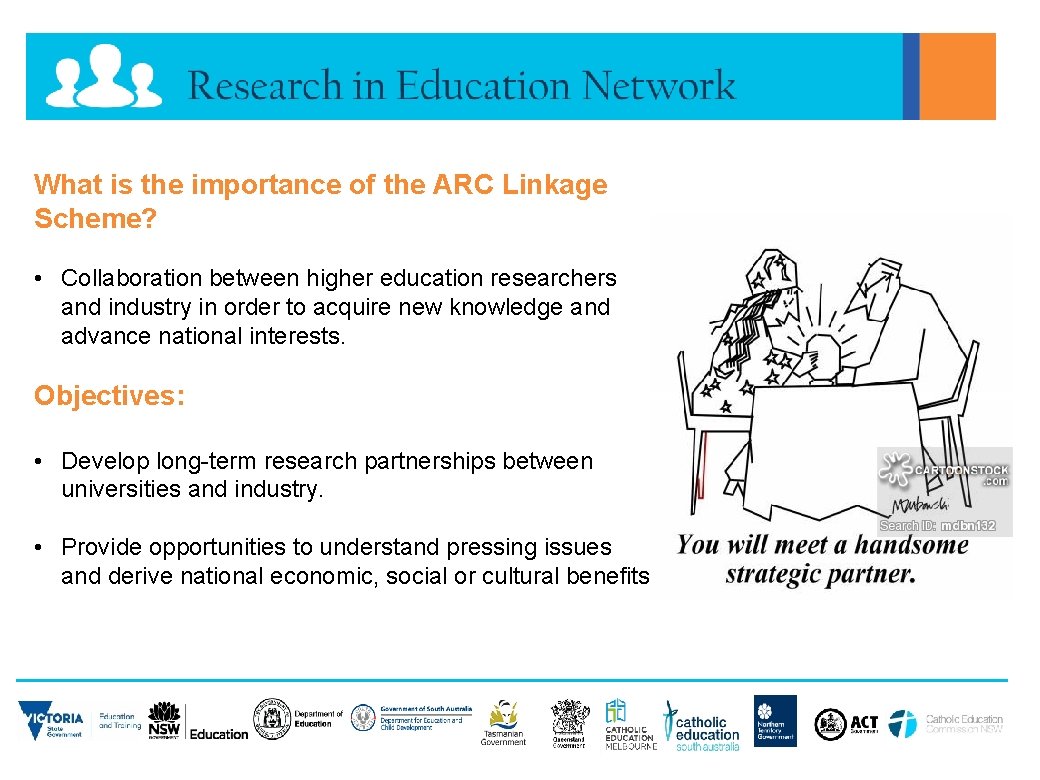
What is the importance of the ARC Linkage Scheme? • Collaboration between higher education researchers and industry in order to acquire new knowledge and advance national interests. Objectives: • Develop long-term research partnerships between universities and industry. • Provide opportunities to understand pressing issues and derive national economic, social or cultural benefits.
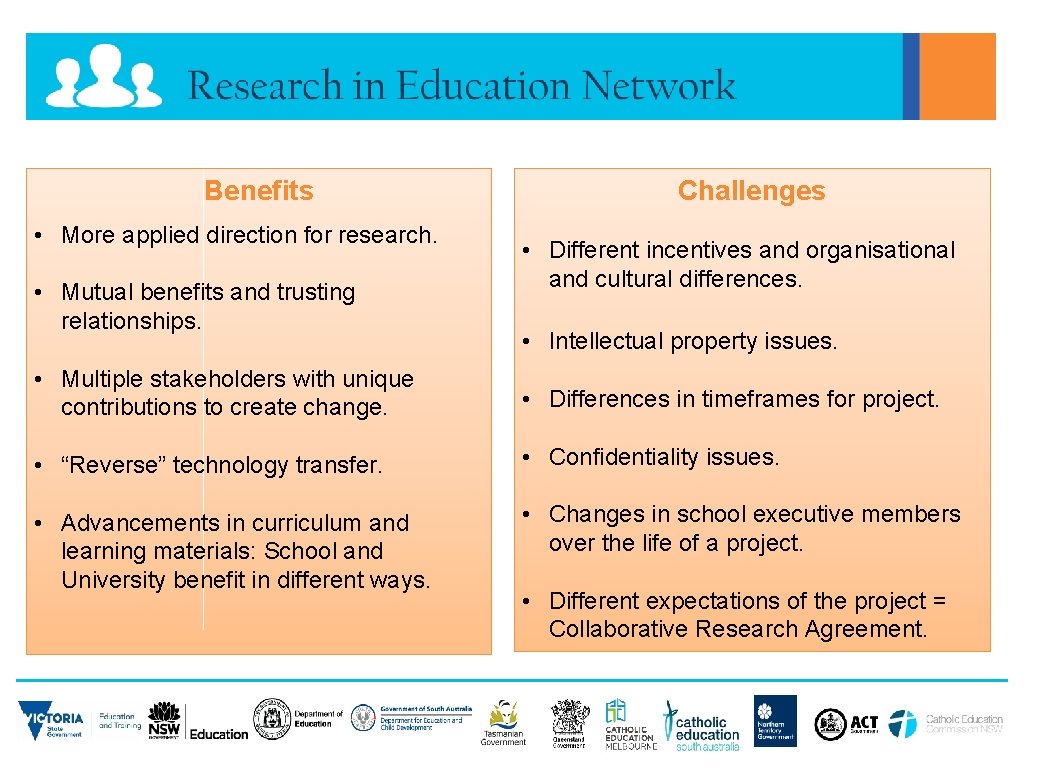
Benefits • More applied direction for research. • Mutual benefits and trusting relationships. Challenges • Different incentives and organisational and cultural differences. • Intellectual property issues. • Multiple stakeholders with unique contributions to create change. • Differences in timeframes for project. • “Reverse” technology transfer. • Confidentiality issues. • Advancements in curriculum and learning materials: School and University benefit in different ways. • Changes in school executive members over the life of a project. • Different expectations of the project = Collaborative Research Agreement.
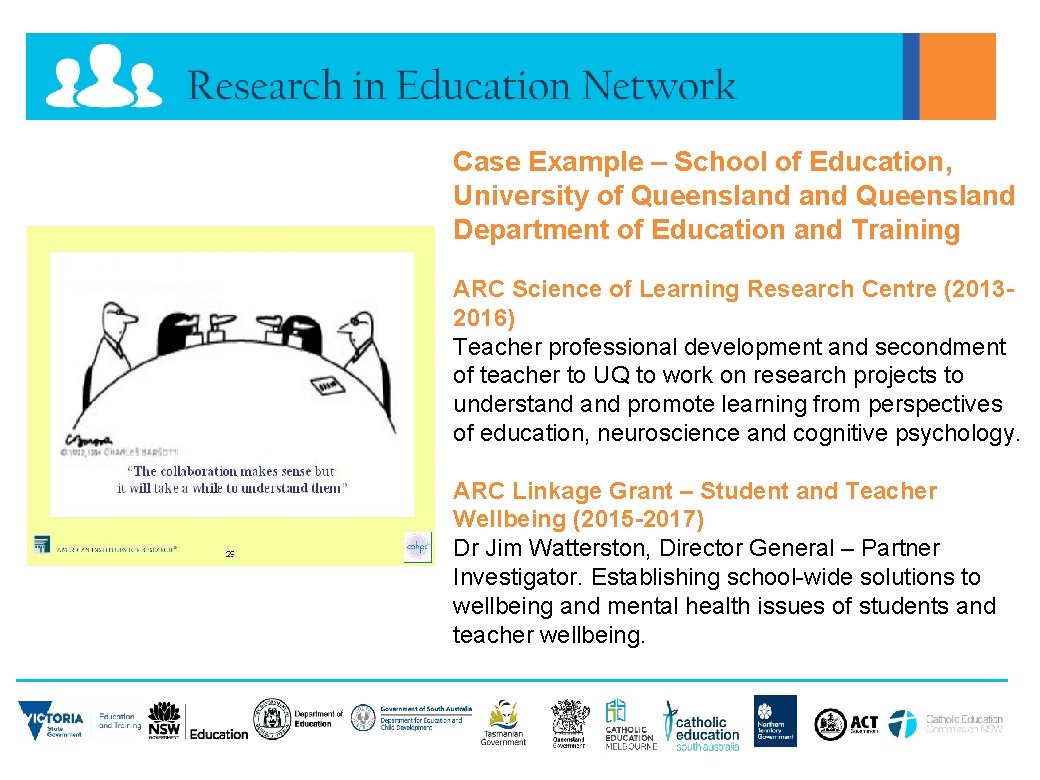
Case Example – School of Education, University of Queensland Department of Education and Training ARC Science of Learning Research Centre (20132016) Teacher professional development and secondment of teacher to UQ to work on research projects to understand promote learning from perspectives of education, neuroscience and cognitive psychology. ARC Linkage Grant – Student and Teacher Wellbeing (2015 -2017) Dr Jim Watterston, Director General – Partner Investigator. Establishing school-wide solutions to wellbeing and mental health issues of students and teacher wellbeing.
Successful early engagement • Education jurisdictions are often large, bureaucratic entities • Start small • Talk early • Success breeds success • The Research in Education Network can help
About the Research in Education Network (REN) Terms of Reference: • • To harmonise procedures and processes across jurisdictions to deliver consistency and quality To influence a purposeful research agenda that aligns with jurisdictional and national needs To promote the role of research in improving the wellbeing, educational and child development outcomes of children and young people To collaborate in research processes, strategies and capability development.
About the REN Jurisdiction Email Telephone ACT Education and Training Directorate DETResearch@act. gov. au 02 6205 9189 NSW Department of Education and Communities serap@det. nsw. edu. au 02 9244 5060 NT Department of Education Research. Apps. DET@nt. gov. au 08 8999 5829 QLD Department of Education and Training Research. stratpol@dete. qld. gov. au 07 3034 5929 SA Department for Education and Child Development (DECD) TAS Department of Education DECD. Research. Unit@sa. gov. au 08 8226 3825 educationalperformanceservices@education. tas. gov. au 03 61655706 VIC Department of Education and Training research@edumail. vic. gov. au 03 9637 2707 WA Department of Education researchandpolicy@education. wa. edu. au 08 9264 5512 Catholic Education Office Melbourne (CEOM) apr@ceomelb. catholic. edu. au 03 9267 0228
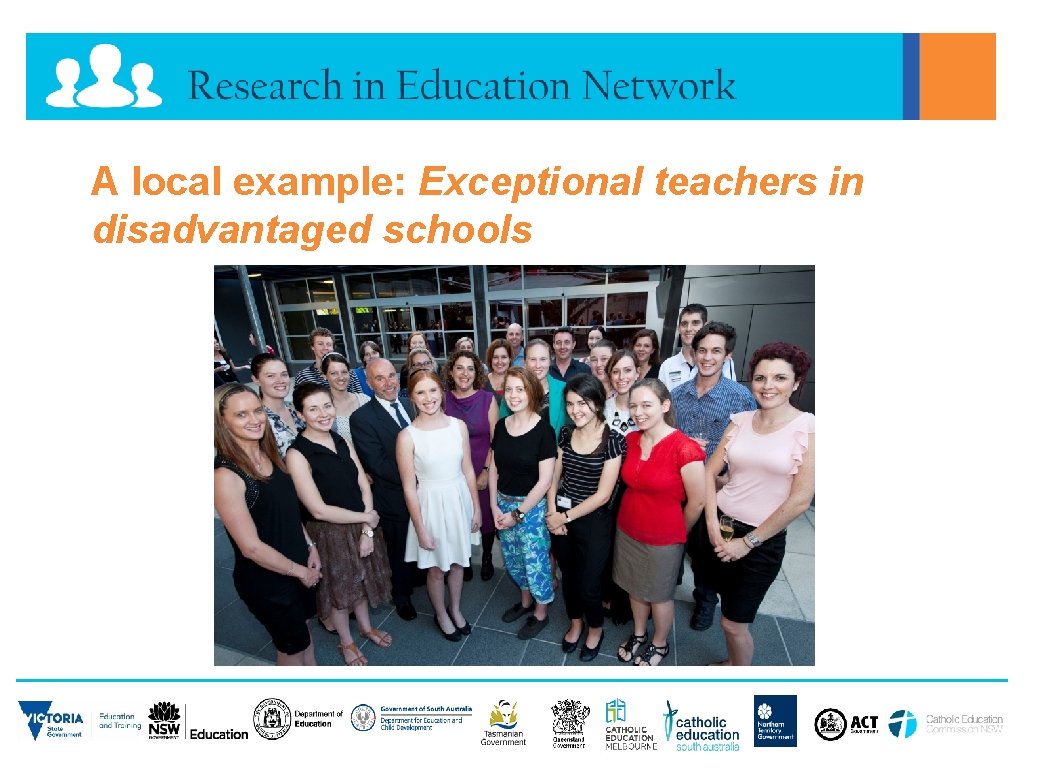
A local example: Exceptional teachers in disadvantaged schools
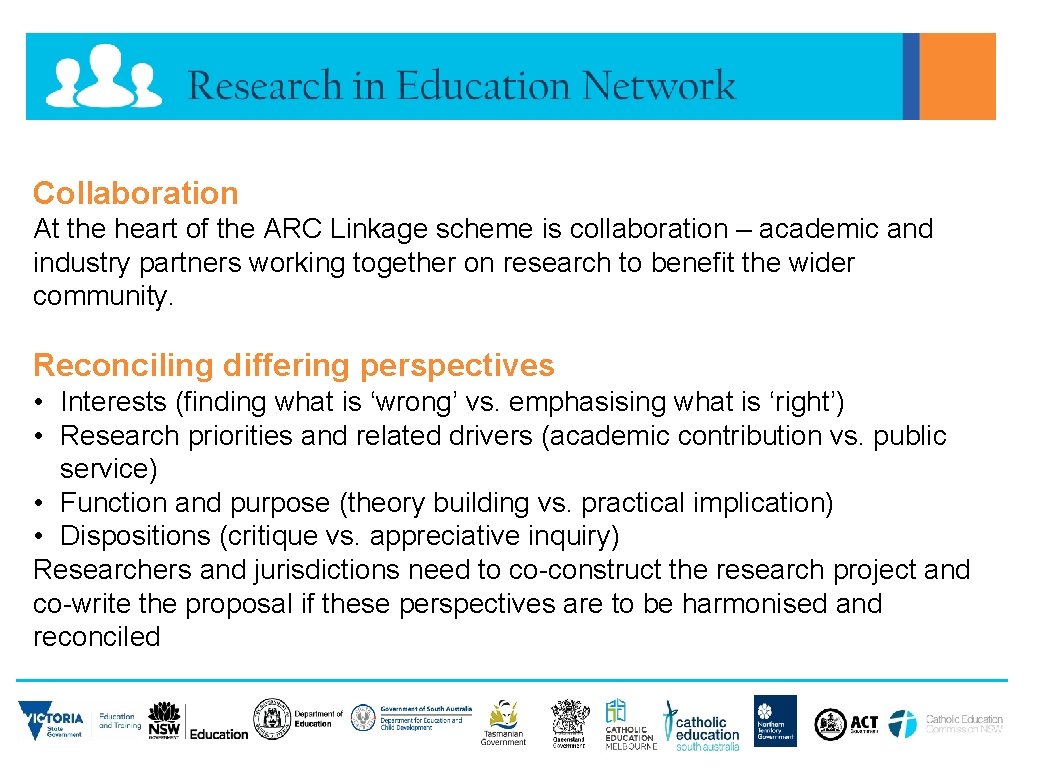
Collaboration At the heart of the ARC Linkage scheme is collaboration – academic and industry partners working together on research to benefit the wider community. Reconciling differing perspectives • Interests (finding what is ‘wrong’ vs. emphasising what is ‘right’) • Research priorities and related drivers (academic contribution vs. public service) • Function and purpose (theory building vs. practical implication) • Dispositions (critique vs. appreciative inquiry) Researchers and jurisdictions need to co-construct the research project and co-write the proposal if these perspectives are to be harmonised and reconciled
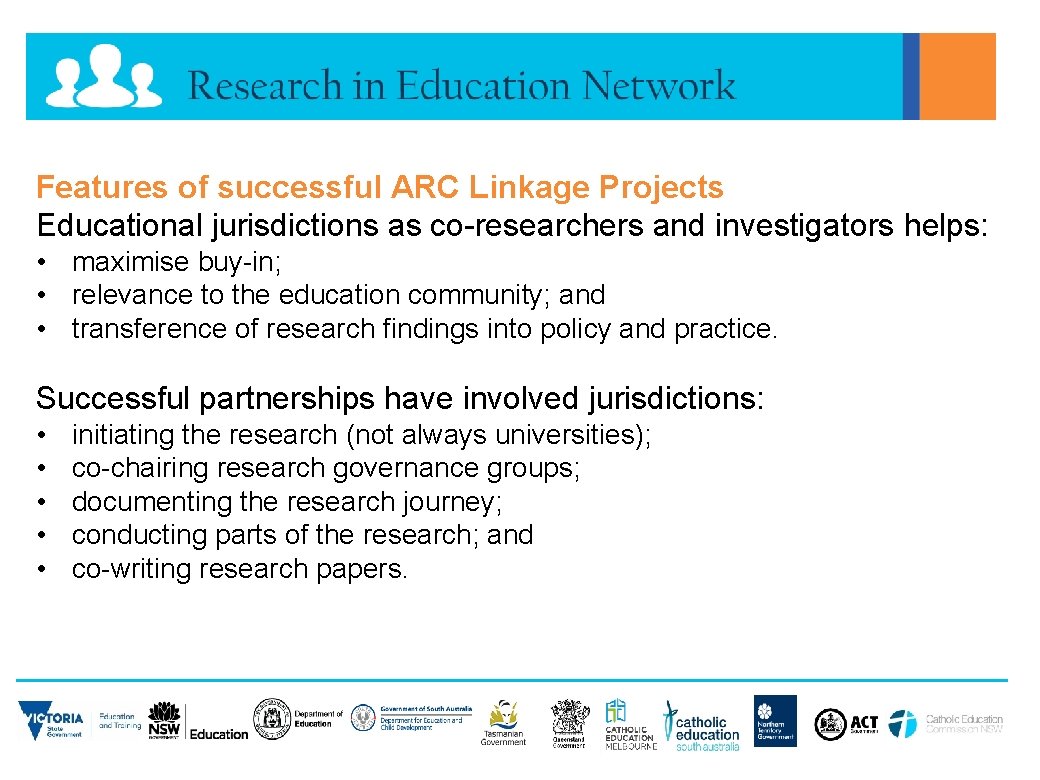
Features of successful ARC Linkage Projects Educational jurisdictions as co-researchers and investigators helps: • maximise buy-in; • relevance to the education community; and • transference of research findings into policy and practice. Successful partnerships have involved jurisdictions: • • • initiating the research (not always universities); co-chairing research governance groups; documenting the research journey; conducting parts of the research; and co-writing research papers.
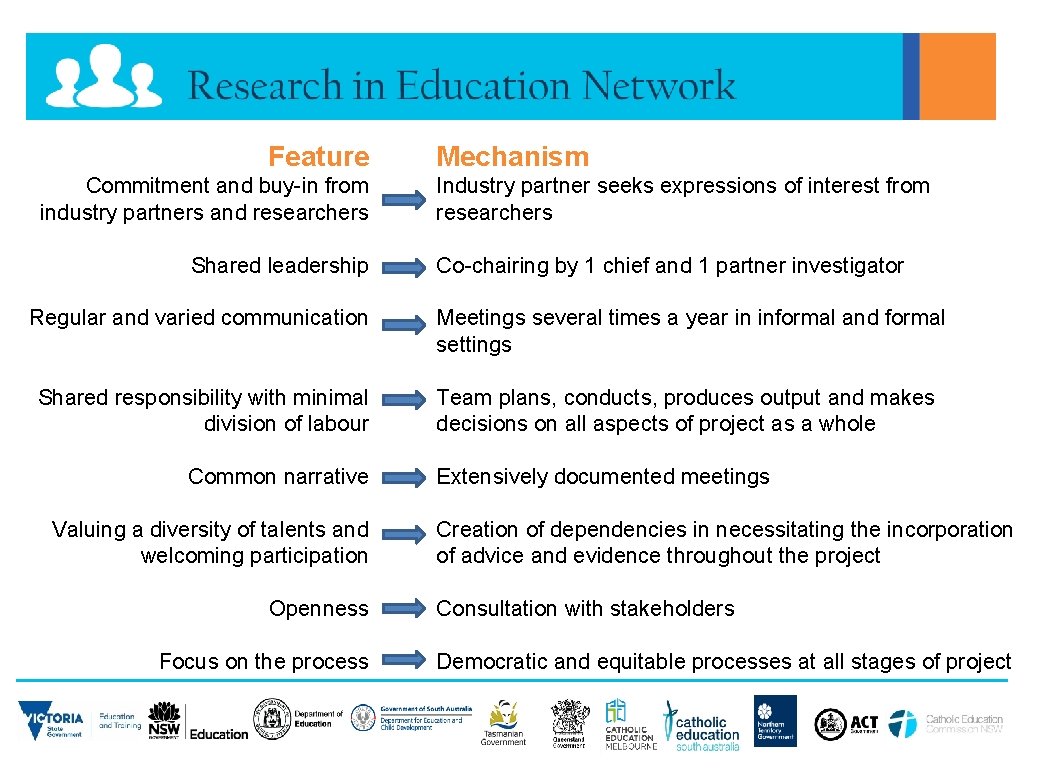
Feature Commitment and buy-in from industry partners and researchers Shared leadership Mechanism Industry partner seeks expressions of interest from researchers Co-chairing by 1 chief and 1 partner investigator Regular and varied communication Meetings several times a year in informal and formal settings Shared responsibility with minimal division of labour Team plans, conducts, produces output and makes decisions on all aspects of project as a whole Common narrative Valuing a diversity of talents and welcoming participation Openness Focus on the process Extensively documented meetings Creation of dependencies in necessitating the incorporation of advice and evidence throughout the project Consultation with stakeholders Democratic and equitable processes at all stages of project
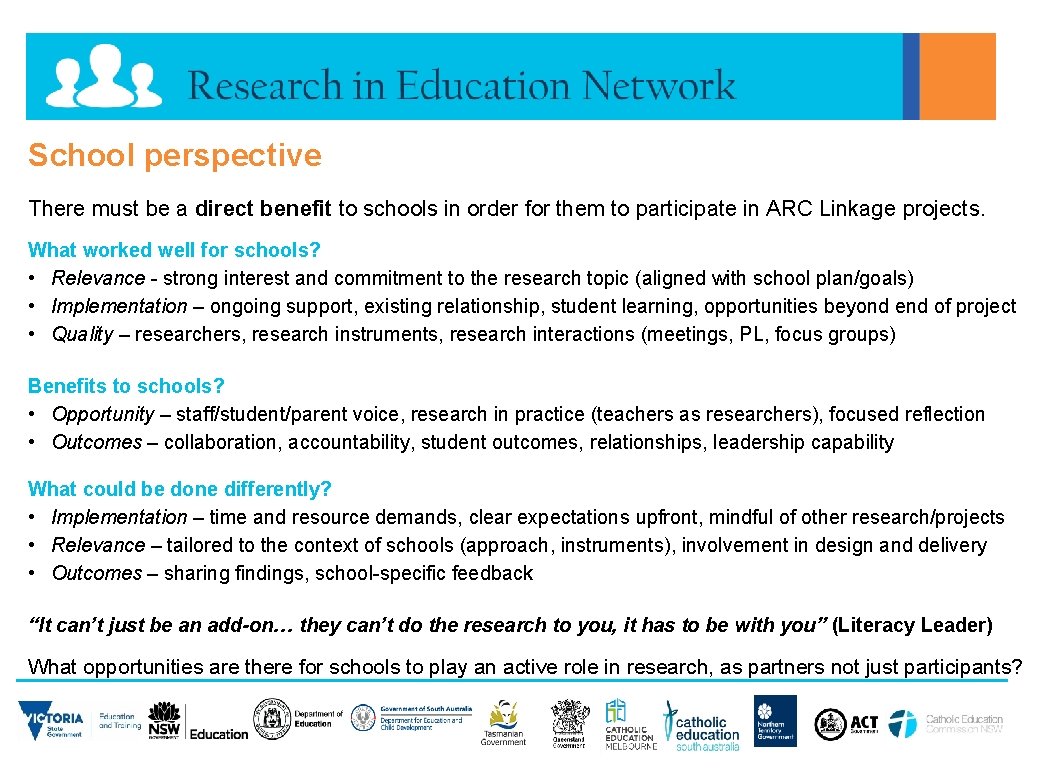
School perspective There must be a direct benefit to schools in order for them to participate in ARC Linkage projects. What worked well for schools? • Relevance - strong interest and commitment to the research topic (aligned with school plan/goals) • Implementation – ongoing support, existing relationship, student learning, opportunities beyond end of project • Quality – researchers, research instruments, research interactions (meetings, PL, focus groups) Benefits to schools? • Opportunity – staff/student/parent voice, research in practice (teachers as researchers), focused reflection • Outcomes – collaboration, accountability, student outcomes, relationships, leadership capability What could be done differently? • Implementation – time and resource demands, clear expectations upfront, mindful of other research/projects • Relevance – tailored to the context of schools (approach, instruments), involvement in design and delivery • Outcomes – sharing findings, school-specific feedback “It can’t just be an add-on… they can’t do the research to you, it has to be with you” (Literacy Leader) What opportunities are there for schools to play an active role in research, as partners not just participants?
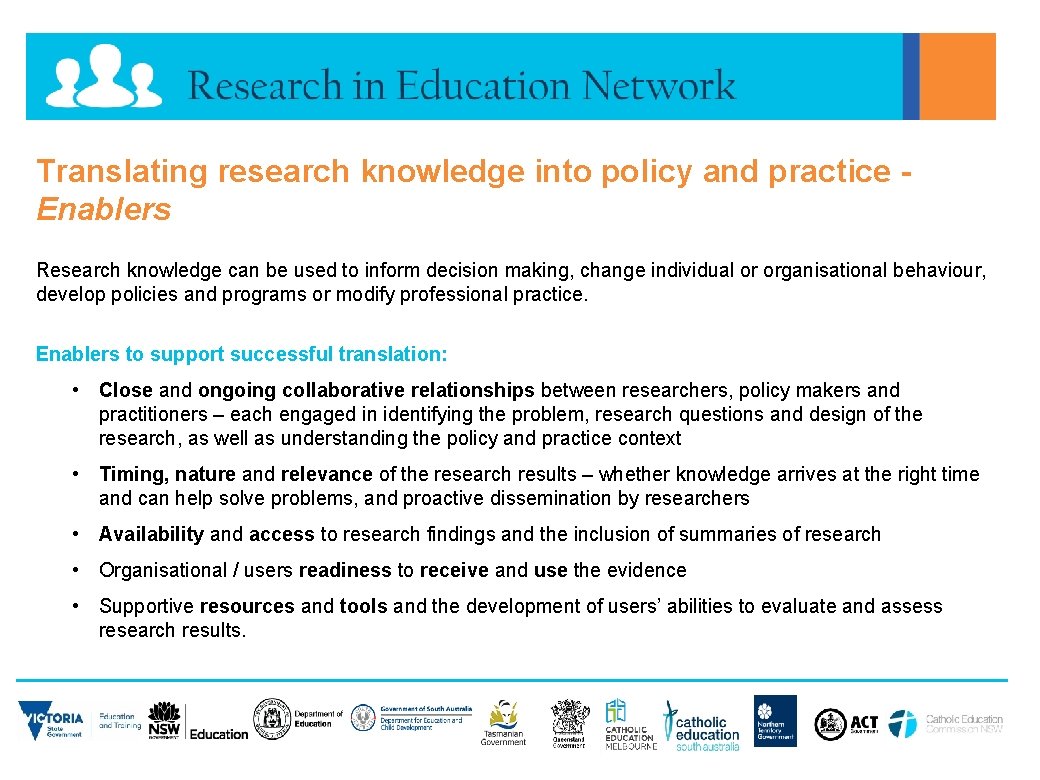
Translating research knowledge into policy and practice Enablers Research knowledge can be used to inform decision making, change individual or organisational behaviour, develop policies and programs or modify professional practice. Enablers to support successful translation: • Close and ongoing collaborative relationships between researchers, policy makers and practitioners – each engaged in identifying the problem, research questions and design of the research, as well as understanding the policy and practice context • Timing, nature and relevance of the research results – whether knowledge arrives at the right time and can help solve problems, and proactive dissemination by researchers • Availability and access to research findings and the inclusion of summaries of research • Organisational / users readiness to receive and use the evidence • Supportive resources and tools and the development of users’ abilities to evaluate and assess research results.
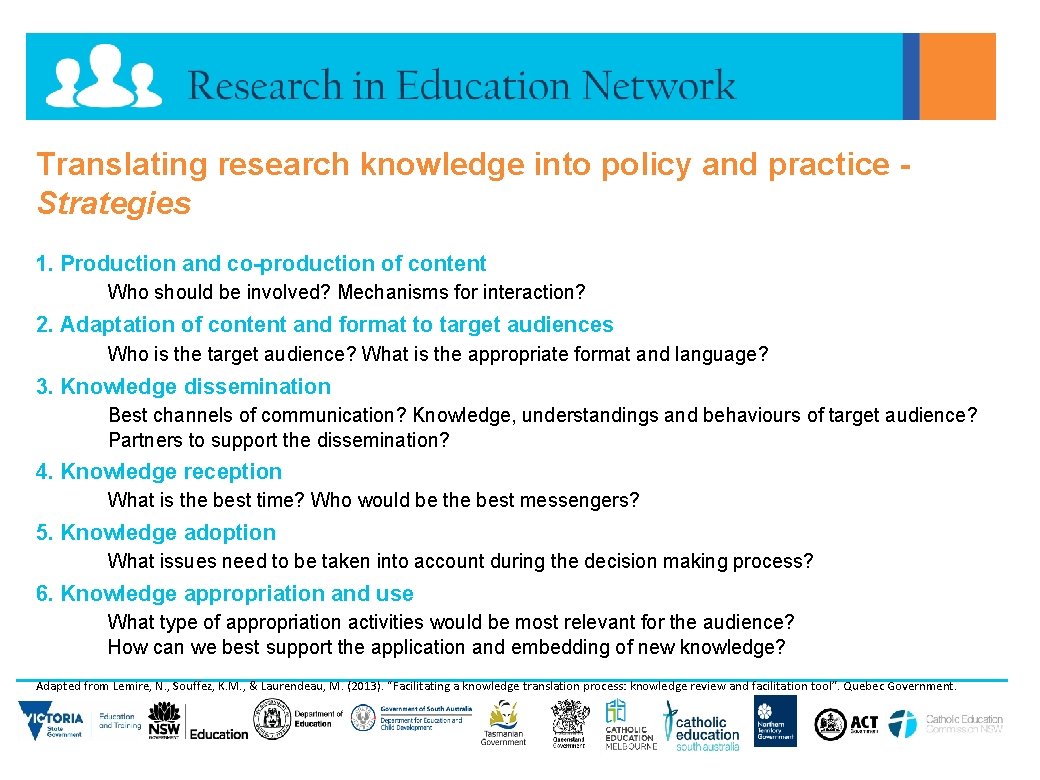
Translating research knowledge into policy and practice Strategies 1. Production and co-production of content Who should be involved? Mechanisms for interaction? 2. Adaptation of content and format to target audiences Who is the target audience? What is the appropriate format and language? 3. Knowledge dissemination Best channels of communication? Knowledge, understandings and behaviours of target audience? Partners to support the dissemination? 4. Knowledge reception What is the best time? Who would be the best messengers? 5. Knowledge adoption What issues need to be taken into account during the decision making process? 6. Knowledge appropriation and use What type of appropriation activities would be most relevant for the audience? How can we best support the application and embedding of new knowledge? Adapted from Lemire, N. , Souffez, K. M. , & Laurendeau, M. (2013). “Facilitating a knowledge translation process: knowledge review and facilitation tool”. Quebec Government.
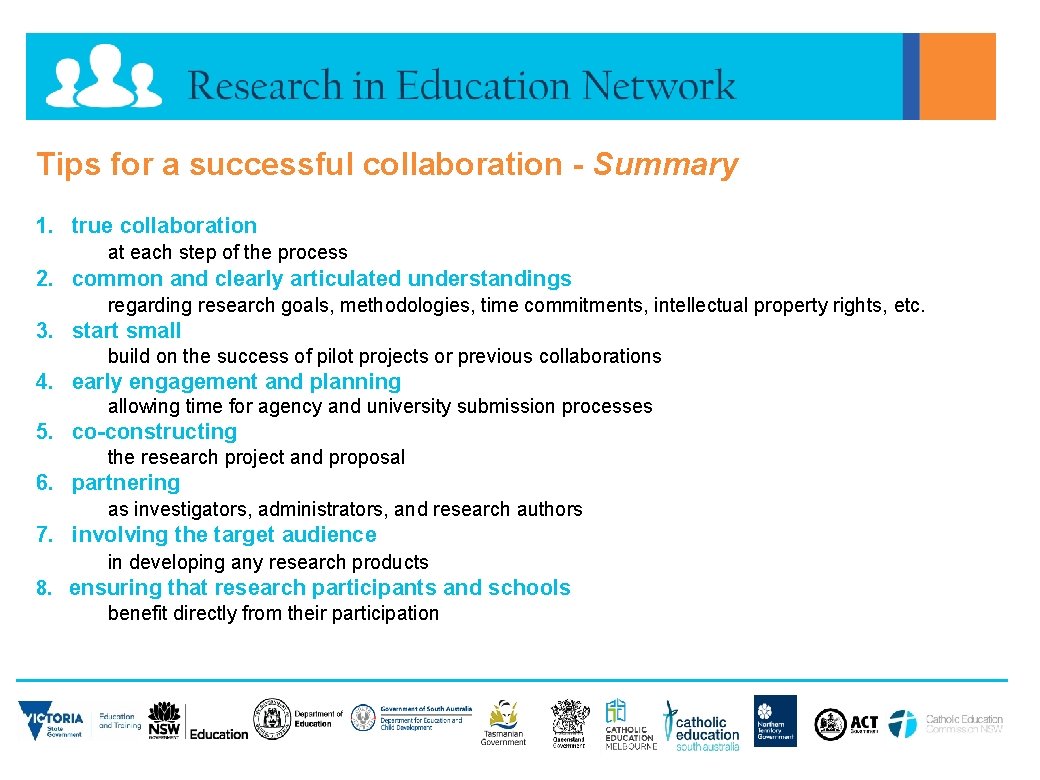
Tips for a successful collaboration - Summary 1. true collaboration at each step of the process 2. common and clearly articulated understandings regarding research goals, methodologies, time commitments, intellectual property rights, etc. 3. start small build on the success of pilot projects or previous collaborations 4. early engagement and planning allowing time for agency and university submission processes 5. co-constructing the research project and proposal 6. partnering as investigators, administrators, and research authors 7. involving the target audience in developing any research products 8. ensuring that research participants and schools benefit directly from their participation
QUESTIONS