
WHEN DOES COLLABORATION BECOME COLLUSION Lisa Huett Competition

WHEN DOES COLLABORATION BECOME COLLUSION? Lisa Huett, Competition Partner King & Wood Mallesons 1 August 2019
01 Importance of compliance 02 Cartel arrangements 03 04 Defences and exceptions Things to keep in mind King & Wood Mallesons / www. kwm. com 2
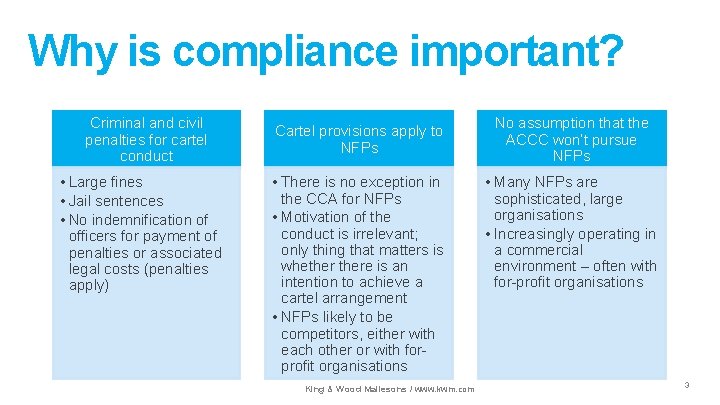
Why is compliance important? Criminal and civil penalties for cartel conduct • Large fines • Jail sentences • No indemnification of officers for payment of penalties or associated legal costs (penalties apply) Cartel provisions apply to NFPs • There is no exception in the CCA for NFPs • Motivation of the conduct is irrelevant; only thing that matters is whethere is an intention to achieve a cartel arrangement • NFPs likely to be competitors, either with each other or with forprofit organisations King & Wood Mallesons / www. kwm. com No assumption that the ACCC won’t pursue NFPs • Many NFPs are sophisticated, large organisations • Increasingly operating in a commercial environment – often with for-profit organisations 3
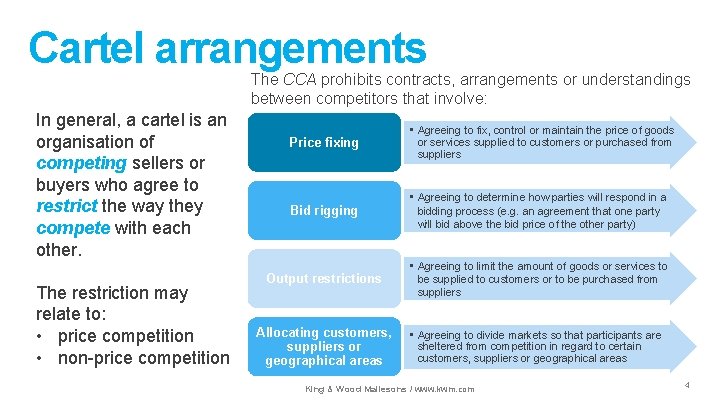
Cartel arrangements The CCA prohibits contracts, arrangements or understandings between competitors that involve: In general, a cartel is an organisation of competing sellers or buyers who agree to restrict the way they compete with each other. The restriction may relate to: • price competition • non-price competition Price fixing • Agreeing to fix, control or maintain the price of goods or services supplied to customers or purchased from suppliers Bid rigging • Agreeing to determine how parties will respond in a bidding process (e. g. an agreement that one party will bid above the bid price of the other party) Output restrictions • Agreeing to limit the amount of goods or services to be supplied to customers or to be purchased from suppliers Allocating customers, suppliers or geographical areas • Agreeing to divide markets so that participants are sheltered from competition in regard to certain customers, suppliers or geographical areas King & Wood Mallesons / www. kwm. com 4
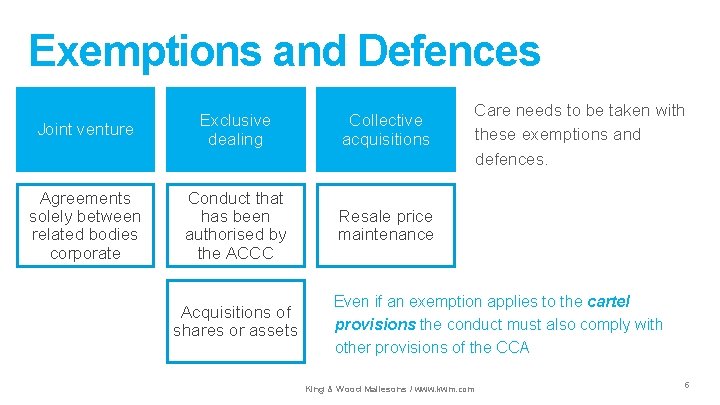
Exemptions and Defences Joint venture Exclusive dealing Collective acquisitions Agreements solely between related bodies corporate Conduct that has been authorised by the ACCC Resale price maintenance Acquisitions of shares or assets Care needs to be taken with these exemptions and defences. Even if an exemption applies to the cartel provisions the conduct must also comply with other provisions of the CCA King & Wood Mallesons / www. kwm. com 5
Scenarios where cartel issues may arise • Consortium of not-for-profits and/or private sector firms collectively bid for a project (without a JV). • Government agency asks a specific charitable sector to get together and “agree on contract terms” before bidding for a major government contract. • A peak body for a number of charities negotiates a bulk procurement arrangement with a provider of core services to that sector. King & Wood Mallesons / www. kwm. com 6
Things to keep in mind • In what circumstances will charities and NFPs be ‘competitors’ for the purposes of the CCA. • Bid rigging (i. e. collusive tendering) is the most common form of anticompetitive conduct in government procurement. • In previous enforcement priorities, the ACCC said it will focus on detecting and deterring cartels, with a focus on cartels in government procurement (including by raising awareness about cartels with government procurement officers to identify the signs of cartel conduct). King & Wood Mallesons / www. kwm. com 7

Questions? 8
- Slides: 8