
WHEN DO WE GET TO PLAY APPLYING THE

- Slides: 9
WHEN DO WE GET TO PLAY? APPLYING THE TACTICAL GAMES APPROACH Dr. Stanley Cramer West Chester University
Tactical Games Approach This approach to teaching tactics, skills, and offthe-ball movements using modified or conditioned games allows greater flexibility for the teacher. What’s more, it increases the transfer of tactics and skills across games for students and allows students to experience the excitement of play before practicing specific skills.
Tactical Games Approach Sequencing developmentally appropriate games or game forms into progressively more complex games. Focuses on questioning, and solving tactical problems. Cognitive Psychomotor Differing levels of complexity
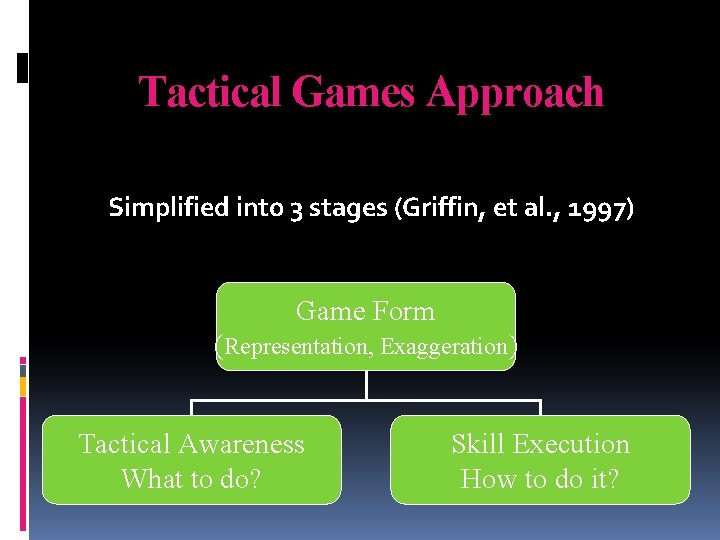
Tactical Games Approach Simplified into 3 stages (Griffin, et al. , 1997) Game Form (Representation, Exaggeration) Tactical Awareness What to do? Skill Execution How to do it?
Tactical Games Approach 4 categories Net/wall Invasion Fielding/Run Scoring Target Broad definition of game performance On the ball skills Off the ball skills
Tactical Games Approach 3 assumptions (Griffin, Mitchell, Oslin, 1997) 1. Games can be modified for tactical problems 2. Game forms can provide authentic assessment 3. Games have tactical problems that transfer within that categories
Research on Tactical Games Approach Tactical and cognitive decision making improved. Learning outcomes comparable to those of skill based approach. Increased interest and enjoyment Off the ball skills improved Some skills may be sport specific and don’t transfer Skill improvement is slightly higher in a Skill based model
What Teachers Need To Know Longer units are more effective Teachers need to be knowledgeable in the sport Posing relevant questions Creating developmentally appropriate game and game forms More time invested in tactical discussions can lower activity time. Managing multiple games at once takes time to develop
Resources for Teaching Griffin, L. , Mitchell, S. A. , & Oslin, J. L. (1997). Teaching sports concepts and skills: A tactical games approach. Champaign, IL: Human Kinetics. Griffin, L. (1996). Improving net/wall game performance. JOPERD, 67(2), 34 Hopper. (2002). Four R's for tactical awareness: Applying game performance assessment in net/wall games. Teaching Elementary Physical Education, (In press). http: //www. educ. uvic. ca/Faculty/thopper/WEB/articles/Teach. Ele m. PE/Four%20 Rs 4%20 online. pdf