
Wheatstone bridge Introduce the history of Wheatstone bridge


Wheatstone bridge

Introduce the history of Wheatstone bridge • It was invented by Samuel Hunter Christie in 1833. • improved and popularized by Sir Charles Wheatstone in 1843.

• what are the benefits of using the Wheatstone bridge? To measure physical quantities such as temperature and pressure.
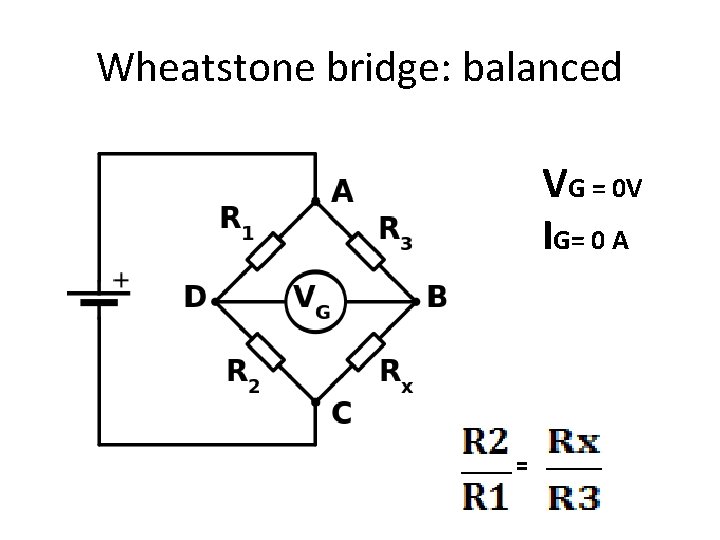
Wheatstone bridge: balanced VG = 0 V IG= 0 A =
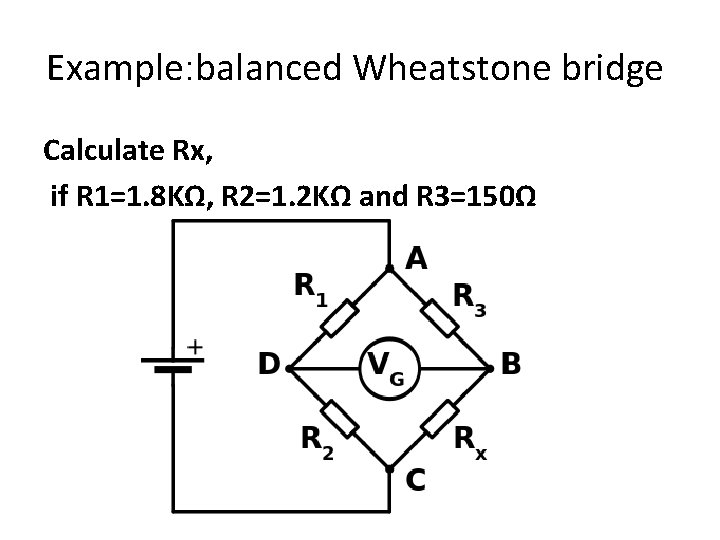
Example: balanced Wheatstone bridge Calculate Rx, if R 1=1. 8 KΩ, R 2=1. 2 KΩ and R 3=150Ω
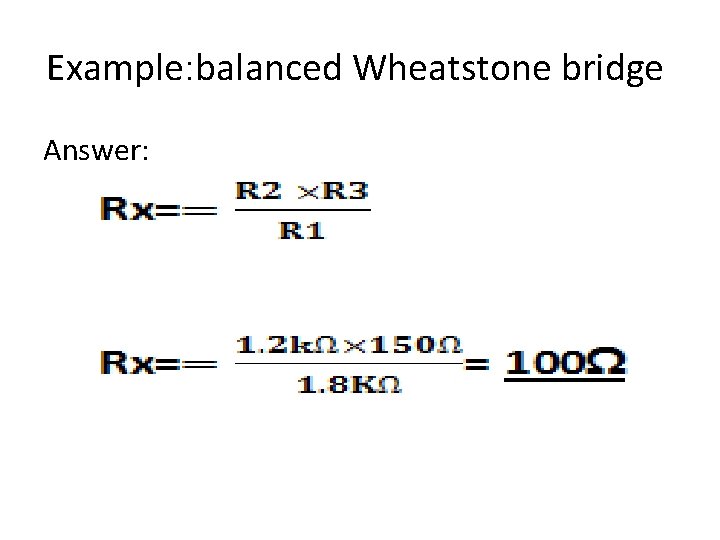
Example: balanced Wheatstone bridge Answer:
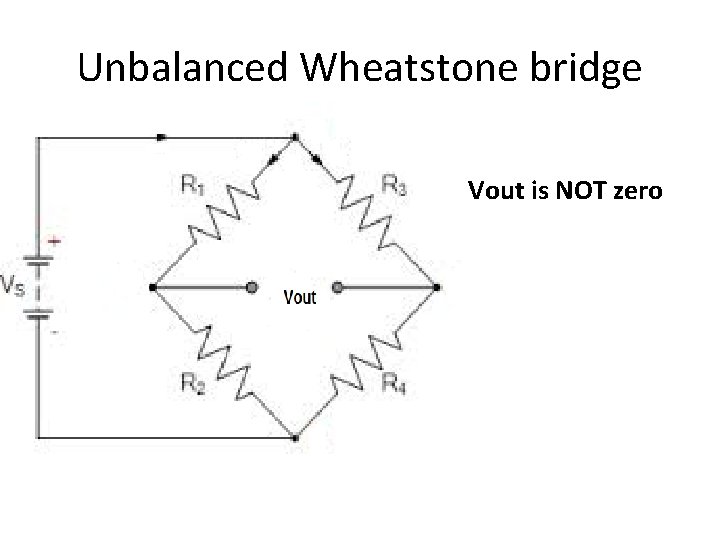
Unbalanced Wheatstone bridge Vout is NOT zero
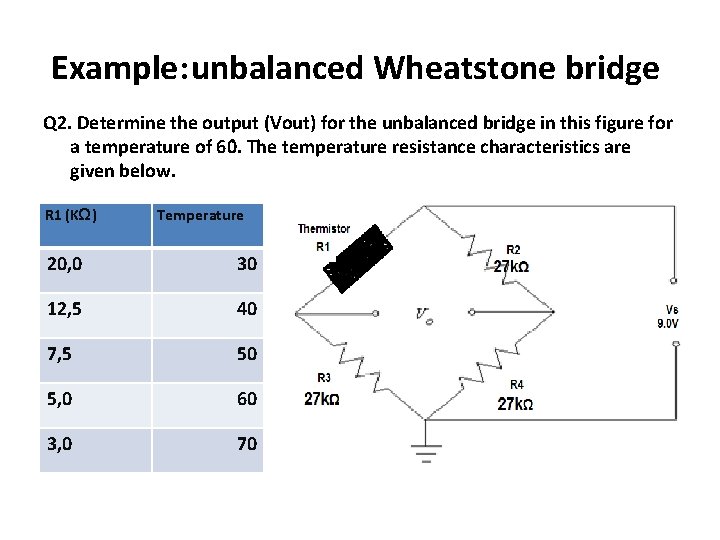
Example: unbalanced Wheatstone bridge Q 2. Determine the output (Vout) for the unbalanced bridge in this figure for a temperature of 60 . The temperature resistance characteristics are given below. R 1 (KΩ) Temperature 20, 0 30 12, 5 40 7, 5 50 5, 0 60 3, 0 70
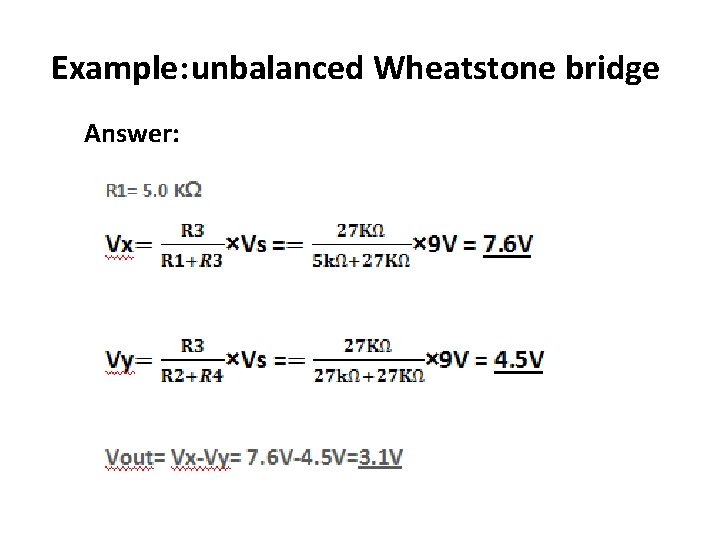
Example: unbalanced Wheatstone bridge Answer:
Experiment 1 balanced Wheatstone bridge 1 - Calculate Rx, 2 - Design this circuit on the test board And calculate the Vout by Voltmeter. Time: 10 mins
Experiment 2 unbalanced Wheatstone bridge 1 - Find R 1 from the table. 2 - Design this circuit on the test board And calculate the Vout by Voltmeter. Time: 10 mins

Summary • what is the different between balance and unbalance bridge? • what are the purposes of using the Wheatstone bridge?
- Slides: 14