
WHDG Brick and Comparing WHDG to ASWSH William
WHDG Brick and Comparing WHDG to ASW-SH William Horowitz The Ohio State University July 7, 2009 With many thanks to Brian Cole, Ulrich Heinz, and Yuri Kovchegov William Horowitz 7/7/09
Outline • • 7/7/09 Context Pedagogy (Some) brick results Comparing WHDG to ASW-SH Pedagogy Surprise! Conclusions TECHQM @ CERN William Horowitz 2
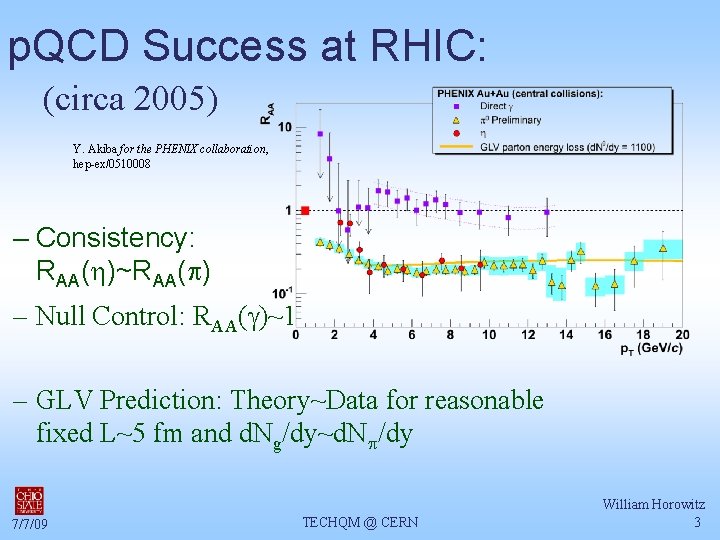
p. QCD Success at RHIC: (circa 2005) Y. Akiba for the PHENIX collaboration, hep-ex/0510008 – Consistency: RAA(h)~RAA(p) – Null Control: RAA(g)~1 – GLV Prediction: Theory~Data for reasonable fixed L~5 fm and d. Ng/dy~d. Np/dy 7/7/09 TECHQM @ CERN William Horowitz 3
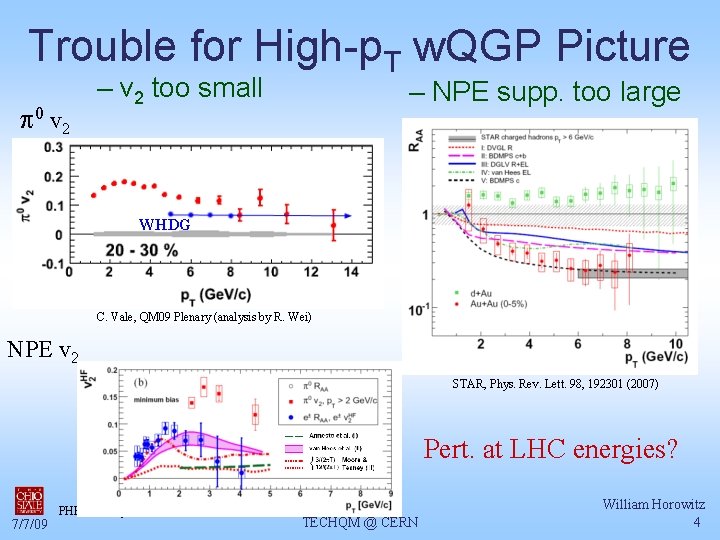
Trouble for High-p. T w. QGP Picture p 0 v 2 – v 2 too small – NPE supp. too large WHDG C. Vale, QM 09 Plenary (analysis by R. Wei) NPE v 2 STAR, Phys. Rev. Lett. 98, 192301 (2007) Pert. at LHC energies? 7/7/09 PHENIX, Phys. Rev. Lett. 98, 172301 (2007) TECHQM @ CERN William Horowitz 4
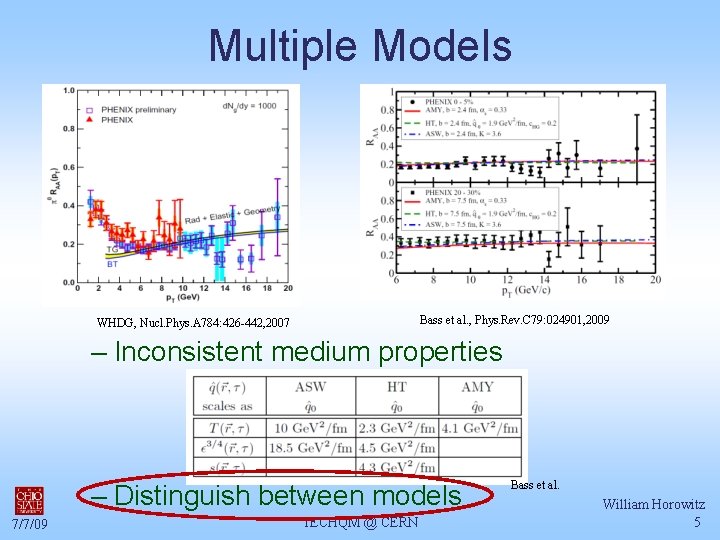
Multiple Models Bass et al. , Phys. Rev. C 79: 024901, 2009 WHDG, Nucl. Phys. A 784: 426 -442, 2007 – Inconsistent medium properties – Distinguish between models 7/7/09 TECHQM @ CERN Bass et al. William Horowitz 5
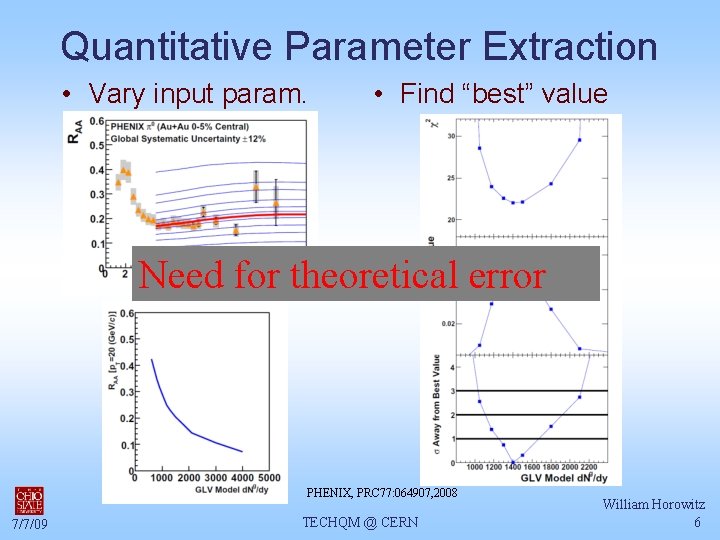
Quantitative Parameter Extraction • Vary input param. • Find “best” value Need for theoretical error PHENIX, PRC 77: 064907, 2008 7/7/09 TECHQM @ CERN William Horowitz 6
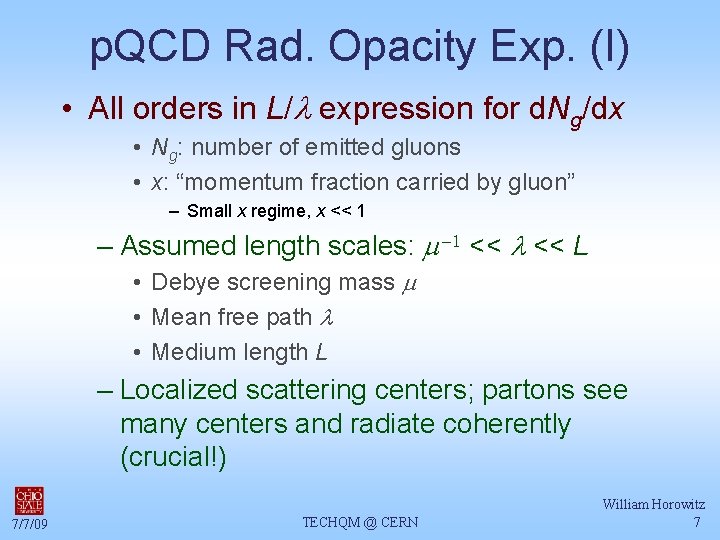
p. QCD Rad. Opacity Exp. (I) • All orders in L/l expression for d. Ng/dx • Ng: number of emitted gluons • x: “momentum fraction carried by gluon” – Small x regime, x << 1 – Assumed length scales: m -1 << l << L • Debye screening mass m • Mean free path l • Medium length L – Localized scattering centers; partons see many centers and radiate coherently (crucial!) 7/7/09 TECHQM @ CERN William Horowitz 7
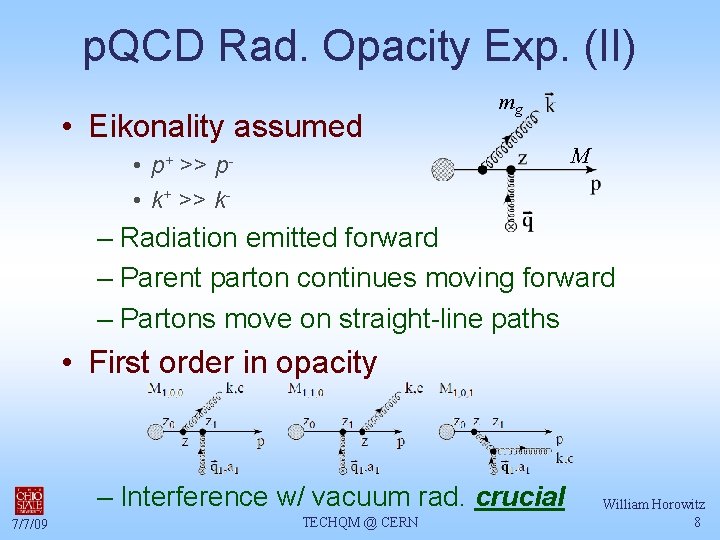
p. QCD Rad. Opacity Exp. (II) • Eikonality assumed mg • p+ >> p • k+ >> k- M – Radiation emitted forward – Parent parton continues moving forward – Partons move on straight-line paths • First order in opacity – Interference w/ vacuum rad. crucial 7/7/09 TECHQM @ CERN William Horowitz 8
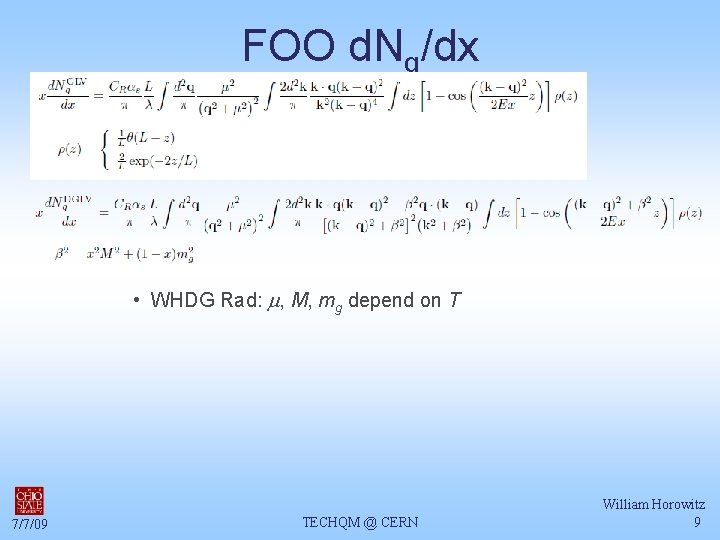
FOO d. Ng/dx • WHDG Rad: m, M, mg depend on T 7/7/09 TECHQM @ CERN William Horowitz 9
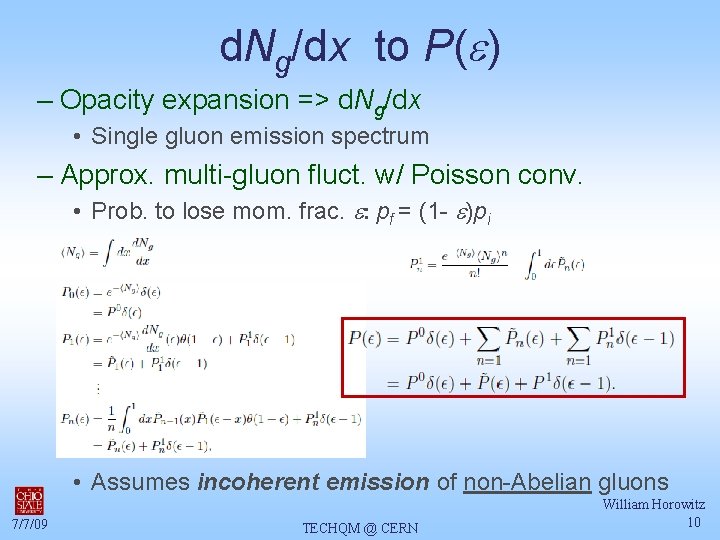
d. Ng/dx to P(e) – Opacity expansion => d. Ng/dx • Single gluon emission spectrum – Approx. multi-gluon fluct. w/ Poisson conv. • Prob. to lose mom. frac. e: pf = (1 - e)pi • Assumes incoherent emission of non-Abelian gluons 7/7/09 TECHQM @ CERN William Horowitz 10
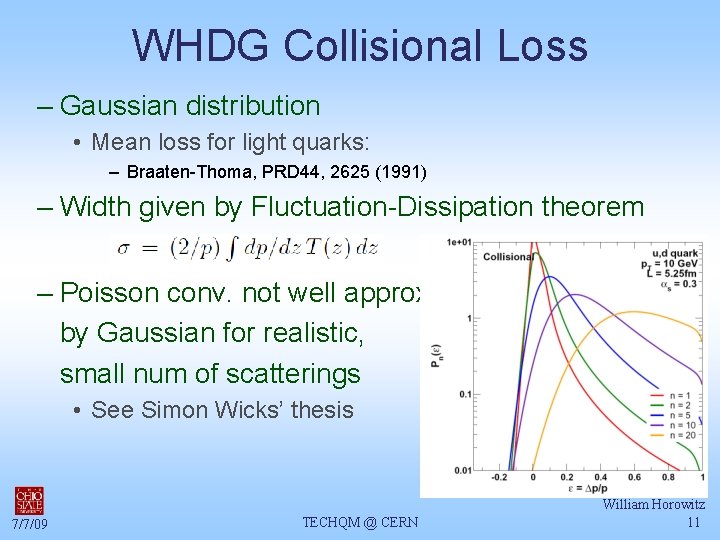
WHDG Collisional Loss – Gaussian distribution • Mean loss for light quarks: – Braaten-Thoma, PRD 44, 2625 (1991) – Width given by Fluctuation-Dissipation theorem – Poisson conv. not well approx by Gaussian for realistic, small num of scatterings • See Simon Wicks’ thesis 7/7/09 TECHQM @ CERN William Horowitz 11
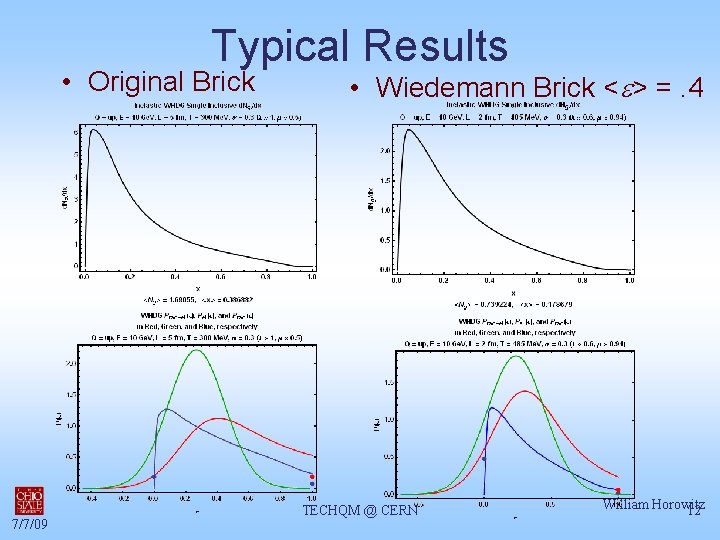
Typical Results • Original Brick 7/7/09 • Wiedemann Brick <e> =. 4 TECHQM @ CERN William Horowitz 12
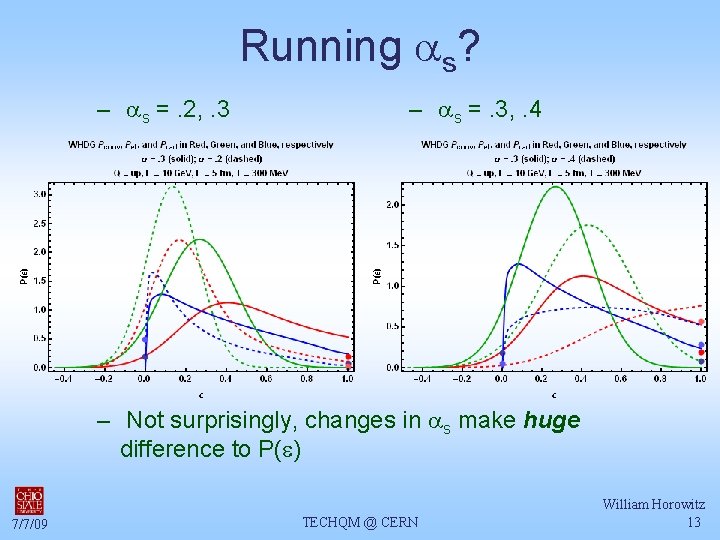
Running as? – as =. 2, . 3 – as =. 3, . 4 – Not surprisingly, changes in as make huge difference to P(e) 7/7/09 TECHQM @ CERN William Horowitz 13
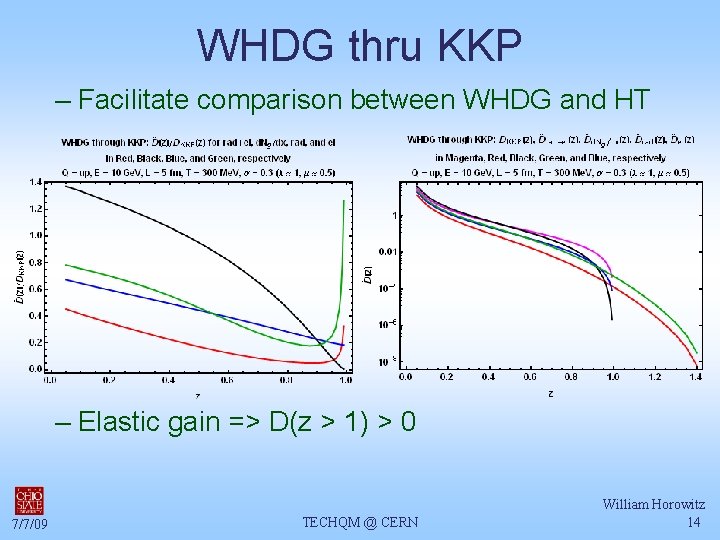
WHDG thru KKP – Facilitate comparison between WHDG and HT – Elastic gain => D(z > 1) > 0 7/7/09 TECHQM @ CERN William Horowitz 14
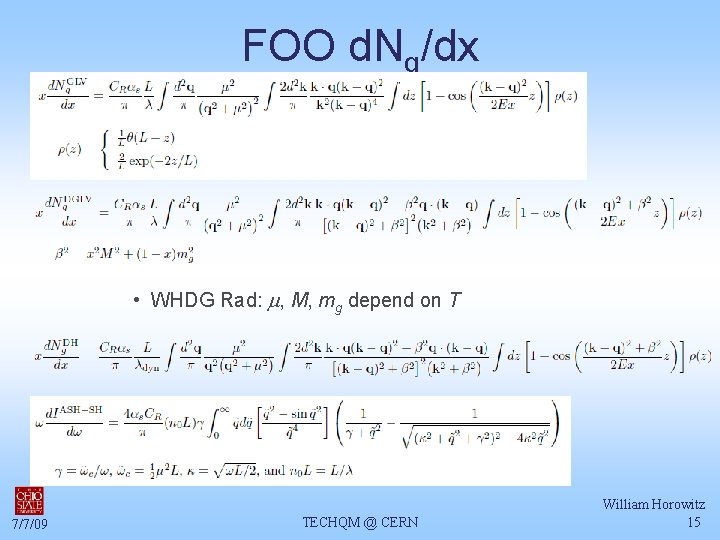
FOO d. Ng/dx • WHDG Rad: m, M, mg depend on T 7/7/09 TECHQM @ CERN William Horowitz 15
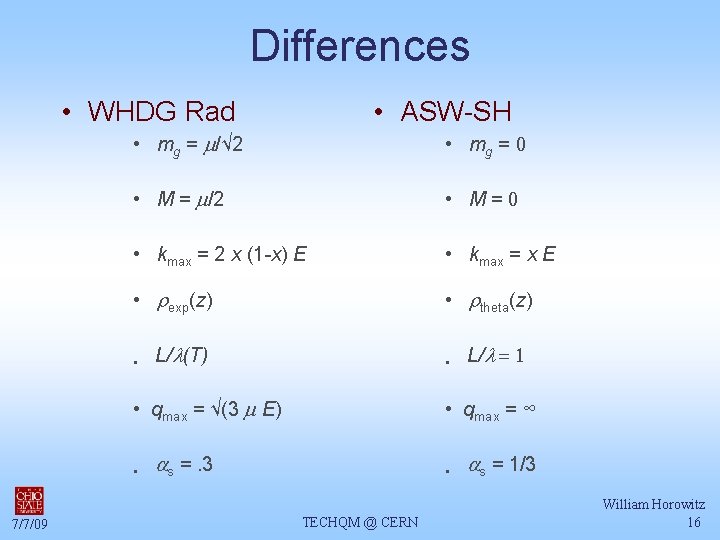
Differences • WHDG Rad • ASW-SH • mg = m/√ 2 • mg = 0 • M = m/2 • M=0 • kmax = 2 x (1 -x) E • kmax = x E • rexp(z) • rtheta(z) • L/l(T) • • qmax = √(3 m E) • 7/7/09 L/l = 1 • qmax = ∞ as =. 3 • TECHQM @ CERN as = 1/3 William Horowitz 16
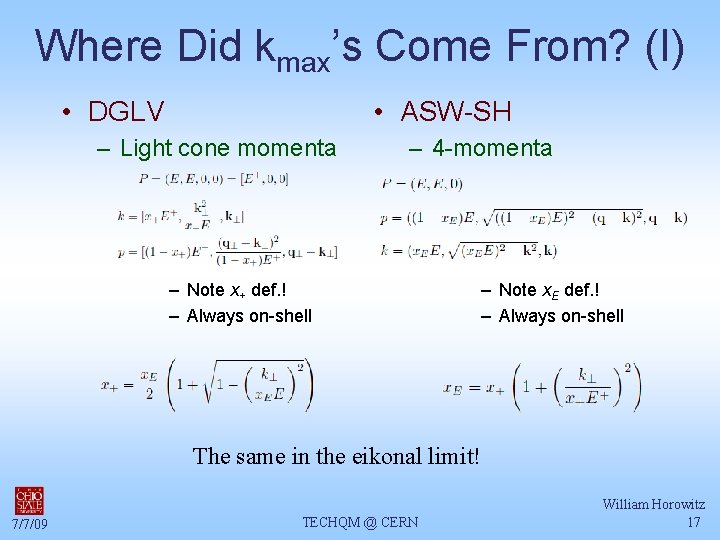
Where Did kmax’s Come From? (I) • DGLV • ASW-SH – Light cone momenta – 4 -momenta – Note x+ def. ! – Always on-shell – Note x. E def. ! – Always on-shell The same in the eikonal limit! 7/7/09 TECHQM @ CERN William Horowitz 17
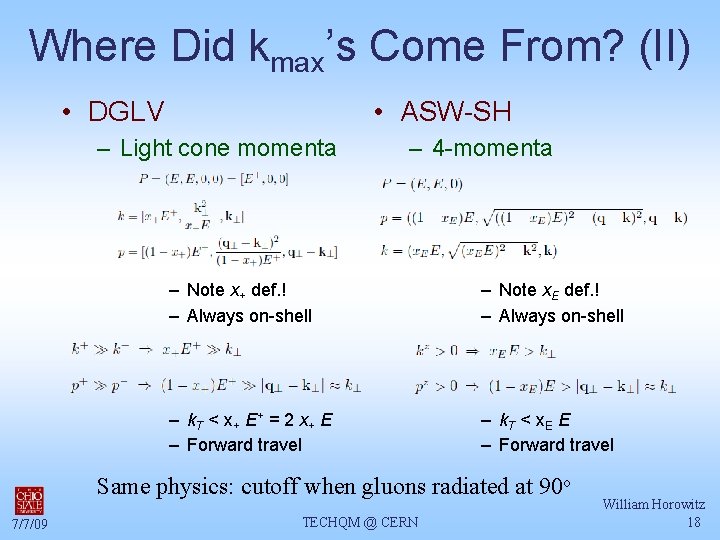
Where Did kmax’s Come From? (II) • DGLV • ASW-SH – Light cone momenta – 4 -momenta – Note x+ def. ! – Always on-shell – Note x. E def. ! – Always on-shell – k. T < x+ E+ = 2 x+ E – Forward travel – k. T < x. E E – Forward travel Same physics: cutoff when gluons radiated at 90 o 7/7/09 TECHQM @ CERN William Horowitz 18
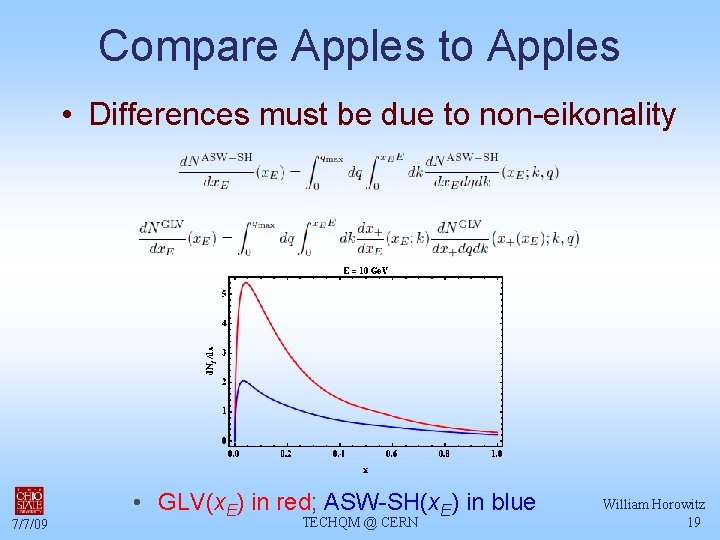
Compare Apples to Apples • Differences must be due to non-eikonality 7/7/09 • GLV(x. E) in red; ASW-SH(x. E) in blue TECHQM @ CERN William Horowitz 19
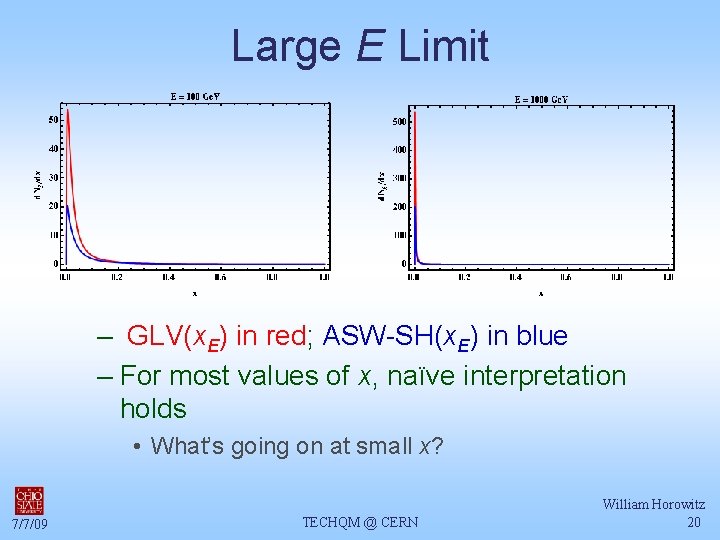
Large E Limit – GLV(x. E) in red; ASW-SH(x. E) in blue – For most values of x, naïve interpretation holds • What’s going on at small x? 7/7/09 TECHQM @ CERN William Horowitz 20
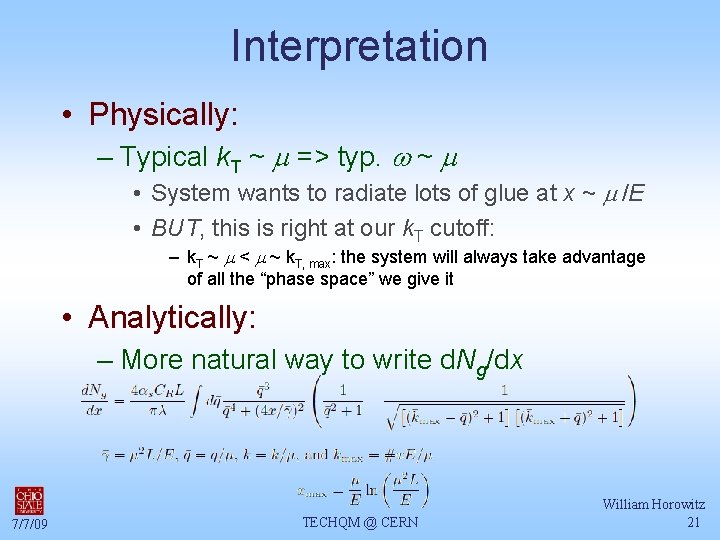
Interpretation • Physically: – Typical k. T ~ m => typ. w ~ m • System wants to radiate lots of glue at x ~ m /E • BUT, this is right at our k. T cutoff: – k. T ~ m < m ~ k. T, max: the system will always take advantage of all the “phase space” we give it • Analytically: – More natural way to write d. Ng/dx 7/7/09 TECHQM @ CERN William Horowitz 21
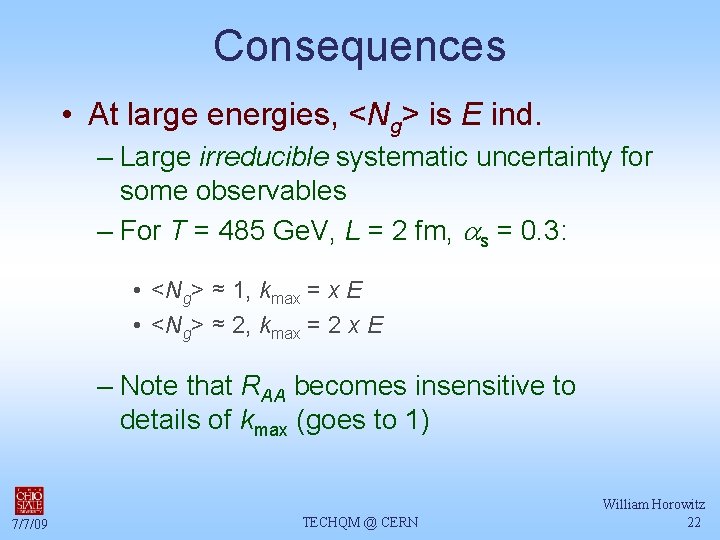
Consequences • At large energies, <Ng> is E ind. – Large irreducible systematic uncertainty for some observables – For T = 485 Ge. V, L = 2 fm, as = 0. 3: • <Ng> ≈ 1, kmax = x E • <Ng> ≈ 2, kmax = 2 x E – Note that RAA becomes insensitive to details of kmax (goes to 1) 7/7/09 TECHQM @ CERN William Horowitz 22
Conclusions – Current phen. comparisons of p. QCD to data unsatisfactory – WHDG not oversuppressed • Opacity expansion suffers from large systematic errors – Strong dependence on kmax = # x E • # is not specified by framework – Similar dependence on IR cutoff, mg – Irreducible? • Consequences for other models, parameter extractions? 7/7/09 WHDG Brick and Comparison to ASW-SH William Horowitz 23
Supplement 7/7/09 TECHQM @ CERN William Horowitz 24
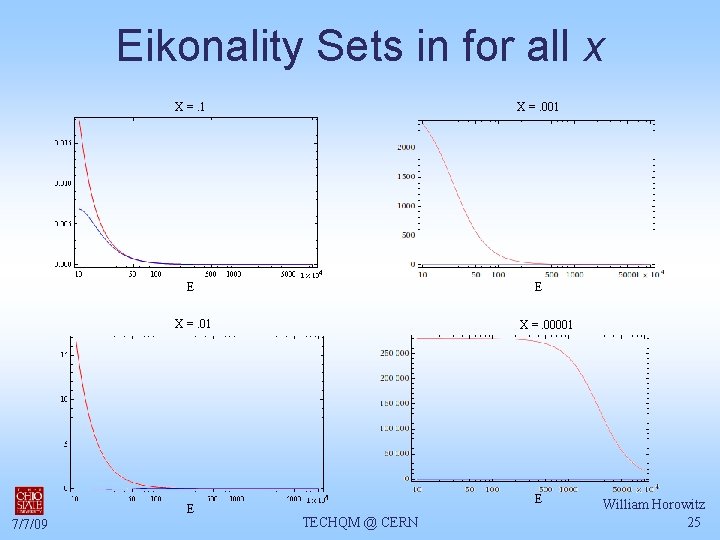
Eikonality Sets in for all x X =. 1 X =. 001 E E X =. 01 E 7/7/09 X =. 00001 E TECHQM @ CERN William Horowitz 25
- Slides: 25