
Whats Wrong with You Hidden Disabilities and Diversity
What’s Wrong with You? Hidden Disabilities and Diversity in the Library Workplace Nedelina Tchangalova, nedelina@umd. edu Aimee Babcock-Ellis, aimeebe@gmail. com University of Maryland Libraries National Diversity in Libraries Conference: From Groundwork to Action July 14 -16, 2010

Learning Outcomes 1. • Participants will recognize and understand hidden disabilities 2. • Participants will learn about potential accommodations 3. • Participants will learn how to advocate for people with hidden disabilities

Outline 1. The most common 7. Advocacy 6. Accommodations 2. Demographic statistics Hidden Disabilities 5. Specific characteristics 3. Definition 4. Research findings

Hidden disabilities are all around and inside us!
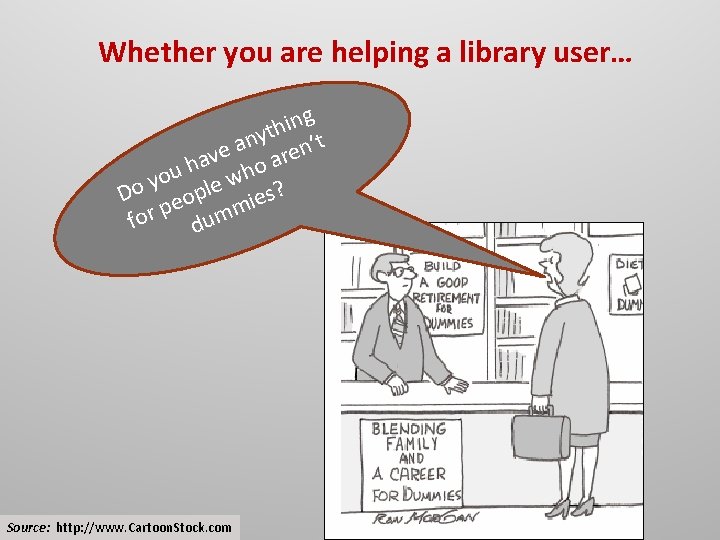
Whether you are helping a library user… g n i th t y n a n’ e e v r ha ho a u yo ple w ? o s D o e i e p m for dum Source: http: //www. Cartoon. Stock. com
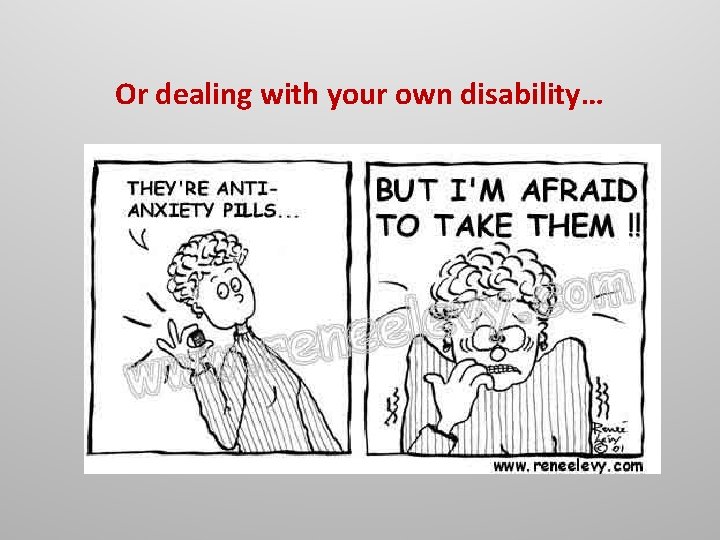
Or dealing with your own disability…
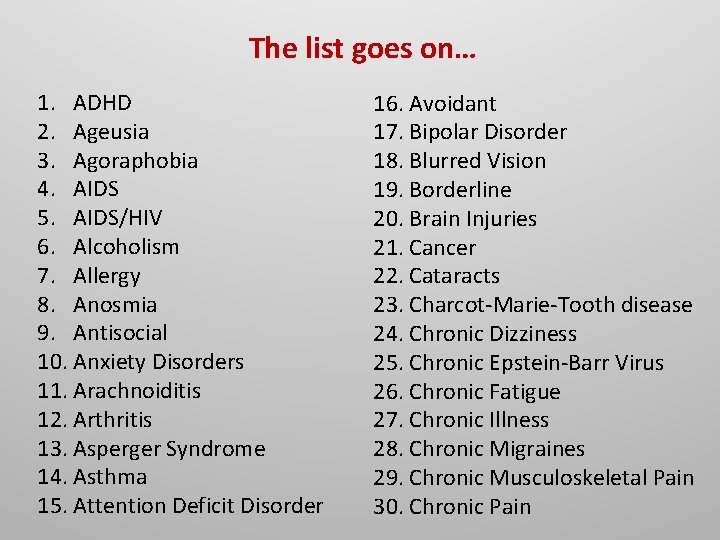
The list goes on… 1. ADHD 2. Ageusia 3. Agoraphobia 4. AIDS 5. AIDS/HIV 6. Alcoholism 7. Allergy 8. Anosmia 9. Antisocial 10. Anxiety Disorders 11. Arachnoiditis 12. Arthritis 13. Asperger Syndrome 14. Asthma 15. Attention Deficit Disorder 16. Avoidant 17. Bipolar Disorder 18. Blurred Vision 19. Borderline 20. Brain Injuries 21. Cancer 22. Cataracts 23. Charcot-Marie-Tooth disease 24. Chronic Dizziness 25. Chronic Epstein-Barr Virus 26. Chronic Fatigue 27. Chronic Illness 28. Chronic Migraines 29. Chronic Musculoskeletal Pain 30. Chronic Pain
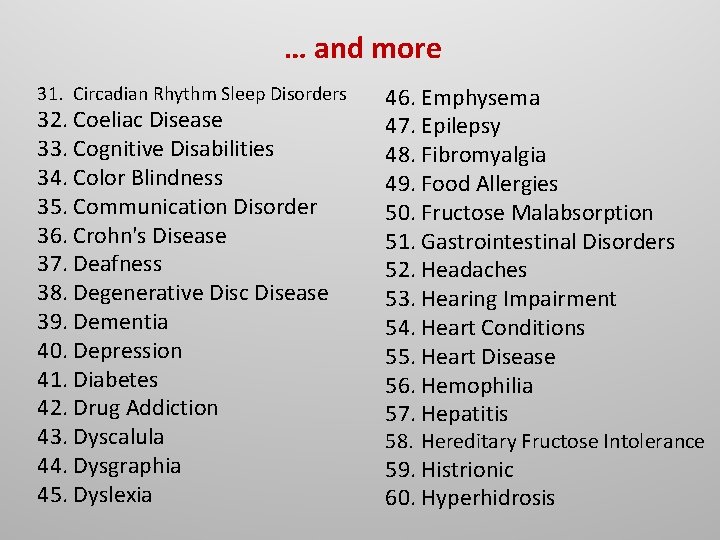
… and more 31. Circadian Rhythm Sleep Disorders 32. Coeliac Disease 33. Cognitive Disabilities 34. Color Blindness 35. Communication Disorder 36. Crohn's Disease 37. Deafness 38. Degenerative Disc Disease 39. Dementia 40. Depression 41. Diabetes 42. Drug Addiction 43. Dyscalula 44. Dysgraphia 45. Dyslexia 46. Emphysema 47. Epilepsy 48. Fibromyalgia 49. Food Allergies 50. Fructose Malabsorption 51. Gastrointestinal Disorders 52. Headaches 53. Hearing Impairment 54. Heart Conditions 55. Heart Disease 56. Hemophilia 57. Hepatitis 58. Hereditary Fructose Intolerance 59. Histrionic 60. Hyperhidrosis
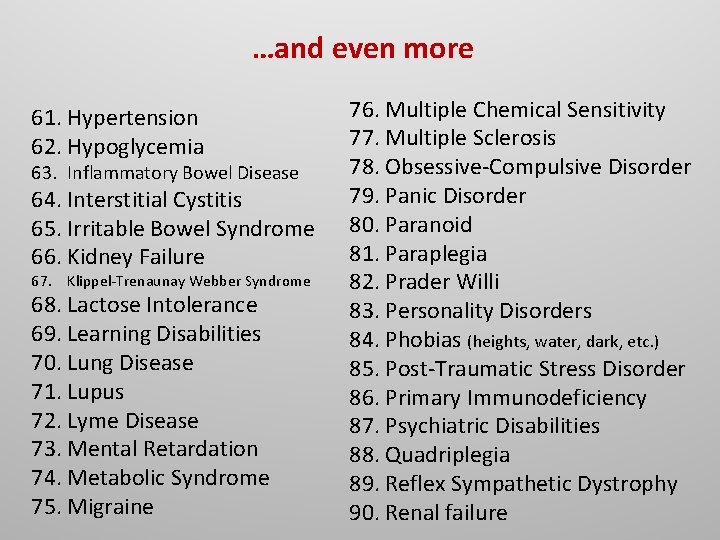
…and even more 61. Hypertension 62. Hypoglycemia 63. Inflammatory Bowel Disease 64. Interstitial Cystitis 65. Irritable Bowel Syndrome 66. Kidney Failure 67. Klippel-Trenaunay Webber Syndrome 68. Lactose Intolerance 69. Learning Disabilities 70. Lung Disease 71. Lupus 72. Lyme Disease 73. Mental Retardation 74. Metabolic Syndrome 75. Migraine 76. Multiple Chemical Sensitivity 77. Multiple Sclerosis 78. Obsessive-Compulsive Disorder 79. Panic Disorder 80. Paranoid 81. Paraplegia 82. Prader Willi 83. Personality Disorders 84. Phobias (heights, water, dark, etc. ) 85. Post-Traumatic Stress Disorder 86. Primary Immunodeficiency 87. Psychiatric Disabilities 88. Quadriplegia 89. Reflex Sympathetic Dystrophy 90. Renal failure
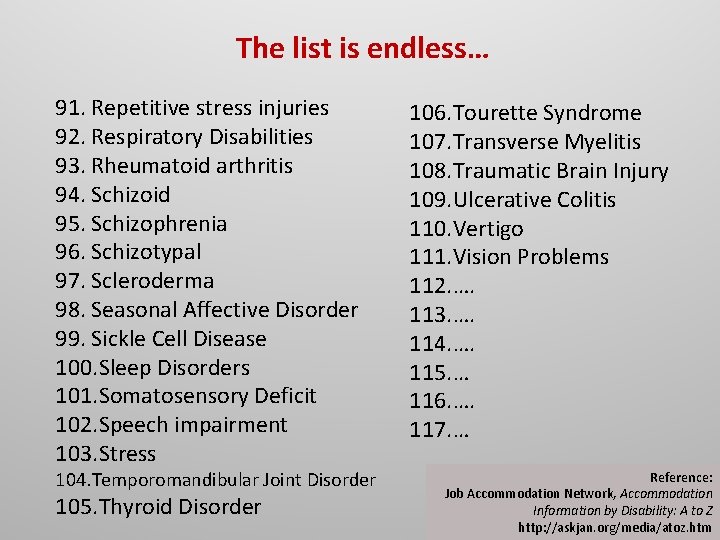
The list is endless… 91. Repetitive stress injuries 92. Respiratory Disabilities 93. Rheumatoid arthritis 94. Schizoid 95. Schizophrenia 96. Schizotypal 97. Scleroderma 98. Seasonal Affective Disorder 99. Sickle Cell Disease 100. Sleep Disorders 101. Somatosensory Deficit 102. Speech impairment 103. Stress 104. Temporomandibular Joint Disorder 105. Thyroid Disorder 106. Tourette Syndrome 107. Transverse Myelitis 108. Traumatic Brain Injury 109. Ulcerative Colitis 110. Vertigo 111. Vision Problems 112. …. 113. …. 114. …. 115. … 116. …. 117. … Reference: Job Accommodation Network, Accommodation Information by Disability: A to Z http: //askjan. org/media/atoz. htm
Source: http: //www. picturesdepot. com
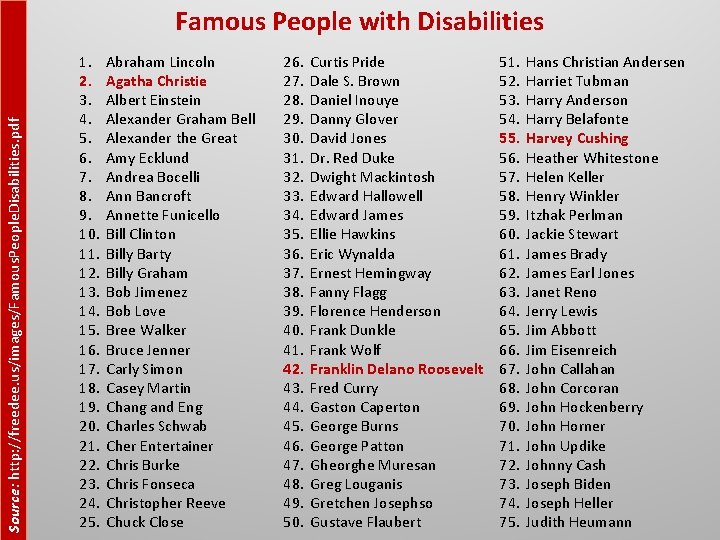
Source: http: //freedee. us/images/Famous. People. Disabilities. pdf Famous People with Disabilities 1. 2. 3. 4. 5. 6. 7. 8. 9. 10. 11. 12. 13. 14. 15. 16. 17. 18. 19. 20. 21. 22. 23. 24. 25. Abraham Lincoln Agatha Christie Albert Einstein Alexander Graham Bell Alexander the Great Amy Ecklund Andrea Bocelli Ann Bancroft Annette Funicello Bill Clinton Billy Barty Billy Graham Bob Jimenez Bob Love Bree Walker Bruce Jenner Carly Simon Casey Martin Chang and Eng Charles Schwab Cher Entertainer Chris Burke Chris Fonseca Christopher Reeve Chuck Close 26. 27. 28. 29. 30. 31. 32. 33. 34. 35. 36. 37. 38. 39. 40. 41. 42. 43. 44. 45. 46. 47. 48. 49. 50. Curtis Pride Dale S. Brown Daniel Inouye Danny Glover David Jones Dr. Red Duke Dwight Mackintosh Edward Hallowell Edward James Ellie Hawkins Eric Wynalda Ernest Hemingway Fanny Flagg Florence Henderson Frank Dunkle Frank Wolf Franklin Delano Roosevelt Fred Curry Gaston Caperton George Burns George Patton Gheorghe Muresan Greg Louganis Gretchen Josephso Gustave Flaubert 51. 52. 53. 54. 55. 56. 57. 58. 59. 60. 61. 62. 63. 64. 65. 66. 67. 68. 69. 70. 71. 72. 73. 74. 75. Hans Christian Andersen Harriet Tubman Harry Anderson Harry Belafonte Harvey Cushing Heather Whitestone Helen Keller Henry Winkler Itzhak Perlman Jackie Stewart James Brady James Earl Jones Janet Reno Jerry Lewis Jim Abbott Jim Eisenreich John Callahan John Corcoran John Hockenberry John Horner John Updike Johnny Cash Joseph Biden Joseph Heller Judith Heumann
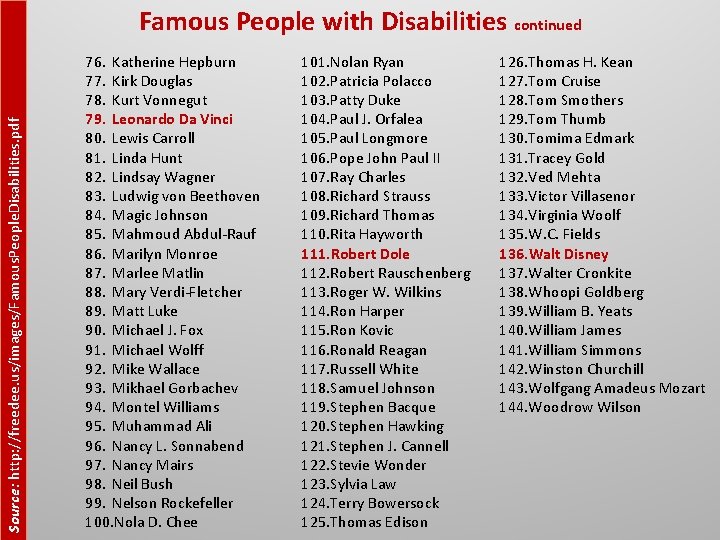
Source: http: //freedee. us/images/Famous. People. Disabilities. pdf Famous People with Disabilities continued 76. Katherine Hepburn 77. Kirk Douglas 78. Kurt Vonnegut 79. Leonardo Da Vinci 80. Lewis Carroll 81. Linda Hunt 82. Lindsay Wagner 83. Ludwig von Beethoven 84. Magic Johnson 85. Mahmoud Abdul-Rauf 86. Marilyn Monroe 87. Marlee Matlin 88. Mary Verdi-Fletcher 89. Matt Luke 90. Michael J. Fox 91. Michael Wolff 92. Mike Wallace 93. Mikhael Gorbachev 94. Montel Williams 95. Muhammad Ali 96. Nancy L. Sonnabend 97. Nancy Mairs 98. Neil Bush 99. Nelson Rockefeller 100. Nola D. Chee 101. Nolan Ryan 102. Patricia Polacco 103. Patty Duke 104. Paul J. Orfalea 105. Paul Longmore 106. Pope John Paul II 107. Ray Charles 108. Richard Strauss 109. Richard Thomas 110. Rita Hayworth 111. Robert Dole 112. Robert Rauschenberg 113. Roger W. Wilkins 114. Ron Harper 115. Ron Kovic 116. Ronald Reagan 117. Russell White 118. Samuel Johnson 119. Stephen Bacque 120. Stephen Hawking 121. Stephen J. Cannell 122. Stevie Wonder 123. Sylvia Law 124. Terry Bowersock 125. Thomas Edison 126. Thomas H. Kean 127. Tom Cruise 128. Tom Smothers 129. Tom Thumb 130. Tomima Edmark 131. Tracey Gold 132. Ved Mehta 133. Victor Villasenor 134. Virginia Woolf 135. W. C. Fields 136. Walt Disney 137. Walter Cronkite 138. Whoopi Goldberg 139. William B. Yeats 140. William James 141. William Simmons 142. Winston Churchill 143. Wolfgang Amadeus Mozart 144. Woodrow Wilson
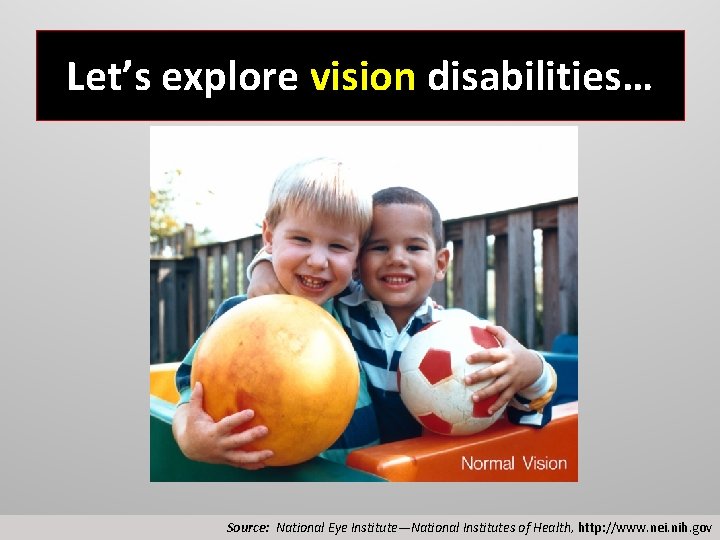
Let’s explore vision disabilities… Source: National Eye Institute—National Institutes of Health, http: //www. nei. nih. gov
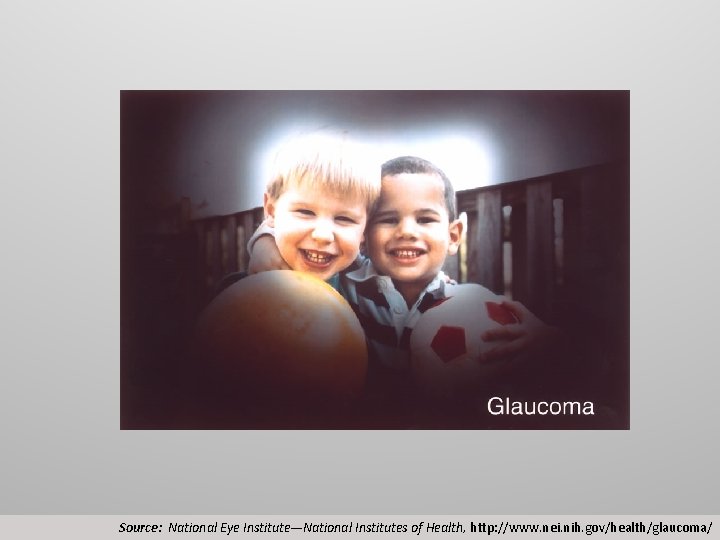
Source: National Eye Institute—National Institutes of Health, http: //www. nei. nih. gov/health/glaucoma/
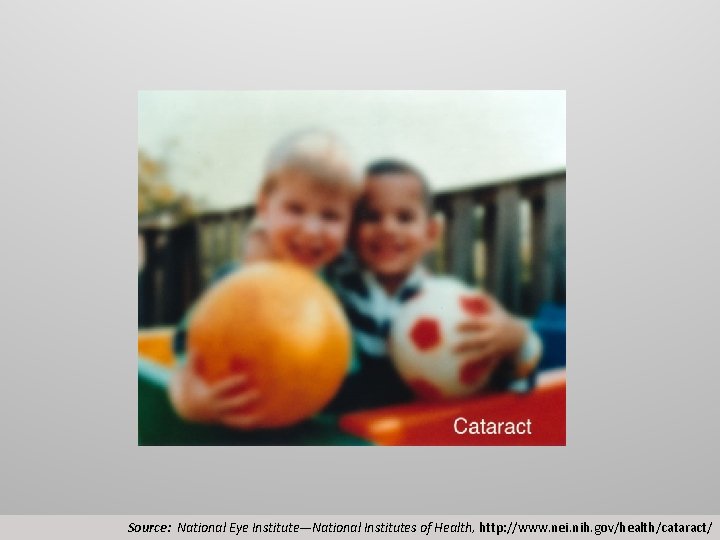
Source: National Eye Institute—National Institutes of Health, http: //www. nei. nih. gov/health/cataract/
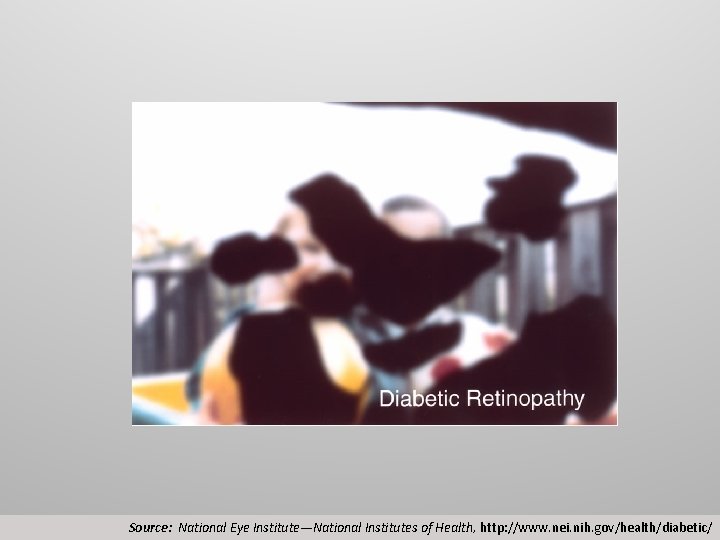
Source: National Eye Institute—National Institutes of Health, http: //www. nei. nih. gov/health/diabetic/
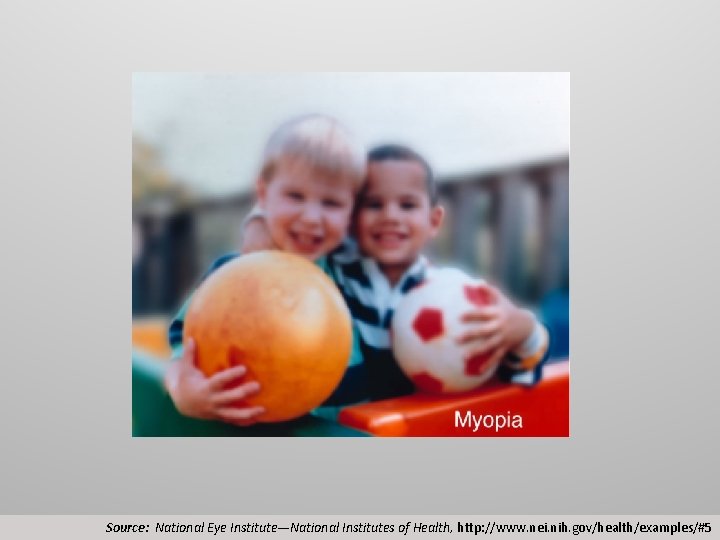
Source: National Eye Institute—National Institutes of Health, http: //www. nei. nih. gov/health/examples/#5

Source: National Eye Institute—National Institutes of Health, http: //www. nei. nih. gov/health/maculardegen/index. asp
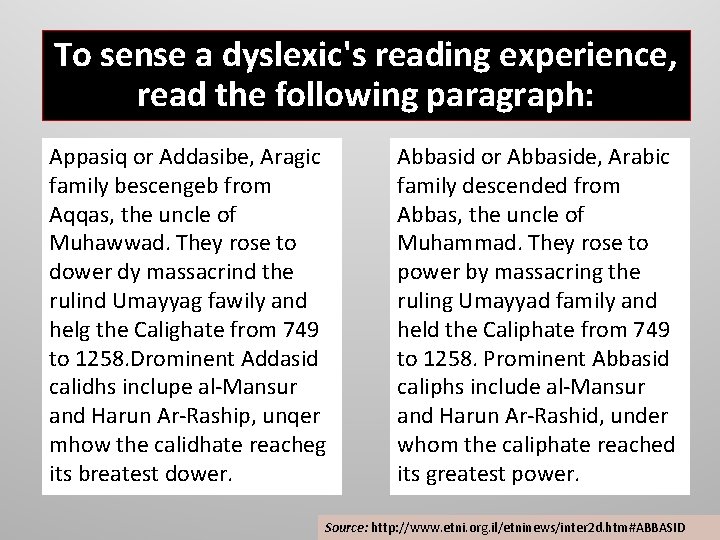
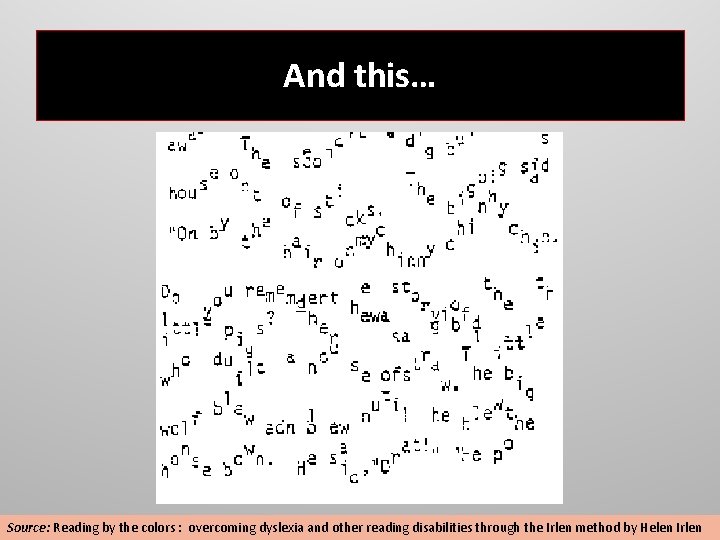
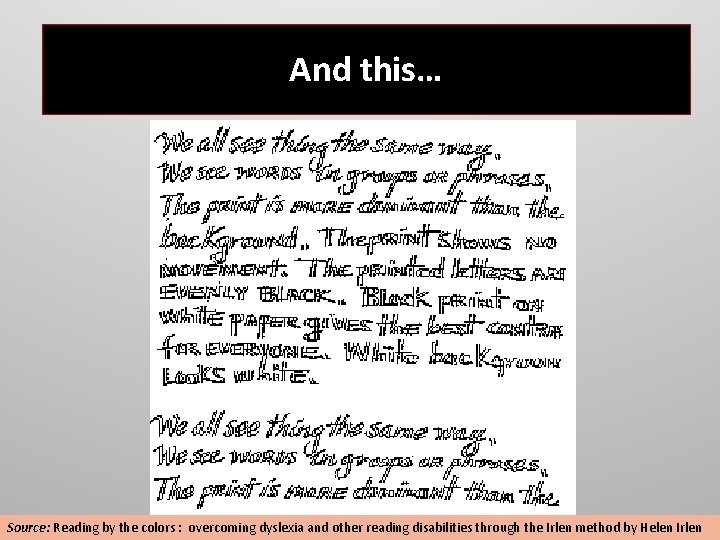
To sense a dyslexic's reading experience, read the following paragraph: Appasiq or Addasibe, Aragic family bescengeb from Aqqas, the uncle of Muhawwad. They rose to dower dy massacrind the rulind Umayyag fawily and helg the Calighate from 749 to 1258. Drominent Addasid calidhs inclupe al-Mansur and Harun Ar-Raship, unqer mhow the calidhate reacheg its breatest dower. Abbasid or Abbaside, Arabic family descended from Abbas, the uncle of Muhammad. They rose to power by massacring the ruling Umayyad family and held the Caliphate from 749 to 1258. Prominent Abbasid caliphs include al-Mansur and Harun Ar-Rashid, under whom the caliphate reached its greatest power. Source: http: //www. etni. org. il/etninews/inter 2 d. htm#ABBASID
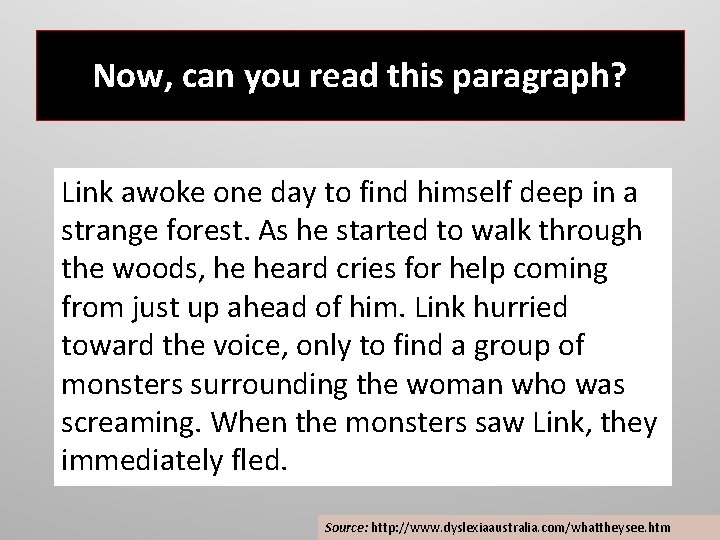
Now, can you read this paragraph? Link awoke one day to find himself deep in a strange forest. As he started to walk through the woods, he heard cries for help coming from just up ahead of him. Link hurried toward the voice, only to find a group of monsters surrounding the woman who was screaming. When the monsters saw Link, they immediately fled. Source: http: //www. dyslexiaaustralia. com/whattheysee. htm
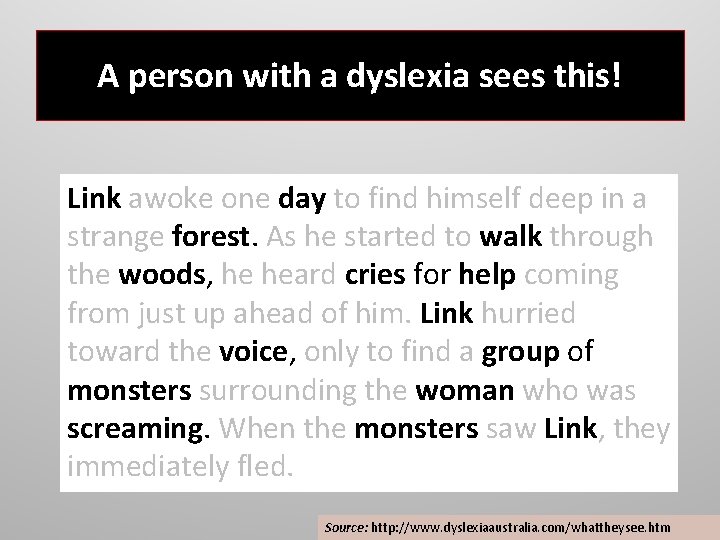
A person with a dyslexia sees this! Link awoke one day to find himself deep in a strange forest. As he started to walk through the woods, he heard cries for help coming from just up ahead of him. Link hurried toward the voice, only to find a group of monsters surrounding the woman who was screaming. When the monsters saw Link, they immediately fled. Source: http: //www. dyslexiaaustralia. com/whattheysee. htm
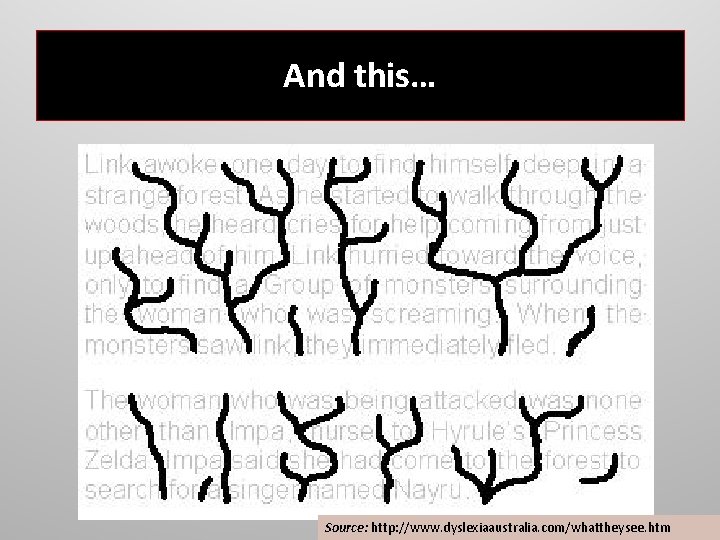
And this… Source: http: //www. dyslexiaaustralia. com/whattheysee. htm
And this… Source: Reading by the colors : overcoming dyslexia and other reading disabilities through the Irlen method by Helen Irlen
And this… Source: Reading by the colors : overcoming dyslexia and other reading disabilities through the Irlen method by Helen Irlen
And this… Source:
Now, let’s explore hearing disabilities… Public Service Announcement (PSA) PSA on Social Issue: Disability (1 min) http: //www. youtube. com/watch? v=l. XJg. Dig. UWa. A
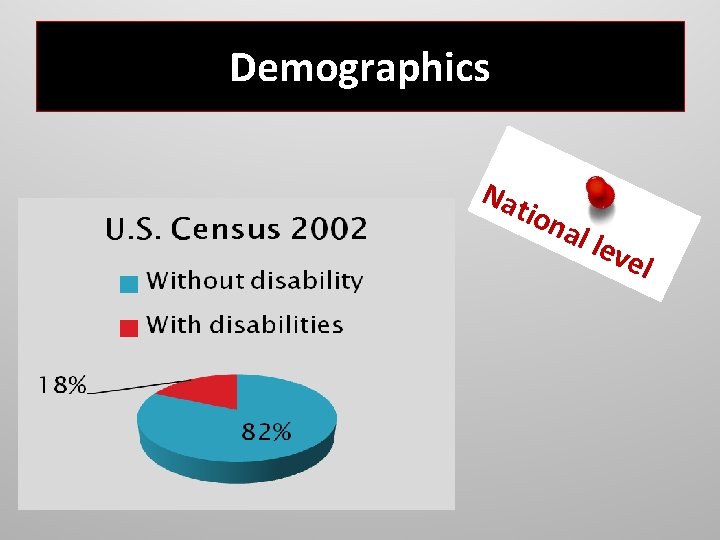
Demographics Nat ion al l eve l
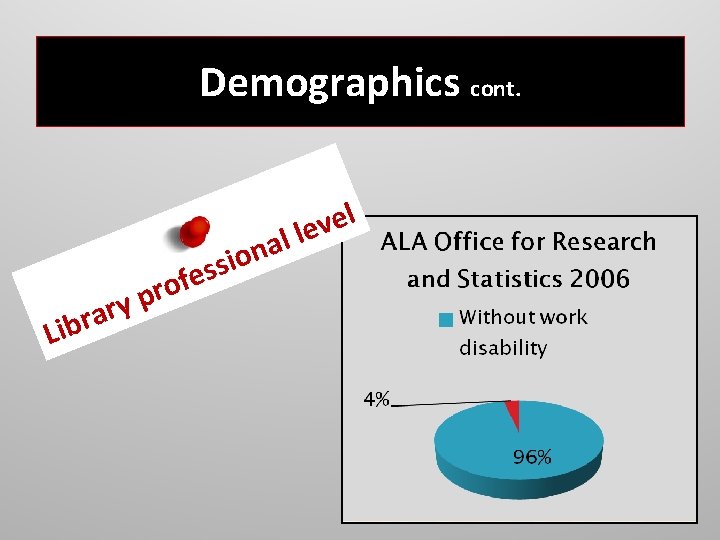
Demographics cont. a n o i s s e Lib f o r p y rar l e v l le
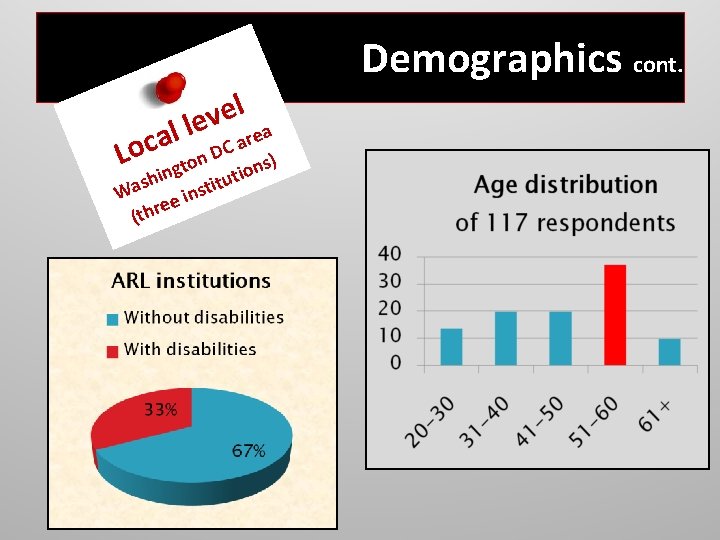
Demographics cont. oca l e v l le ea r a C D n s) o t n g o shin stituti a W e in e r (th L

Who are the individuals with hidden disabilities? “I had inherited my grandfather’s motivation and thirst for knowledge. ” “I am a 54 years old African American female. My goal is to obtain my Ph. D. I am an over-achiever, so I work very hard to work around my disabilities. ” “I am finishing up a doctoral program in Audiology. ”

Who are the individuals with hidden disabilities? “I had inherited my grandfather’s motivation and thirst for knowledge. ” “I am a 54 years old African American female. My goal is to obtain my Ph. D. I am an over-achiever, so I work very hard to work around my disabilities. ” “I am finishing up a doctoral program in Audiology. ”

Hidden Disabilities Defined Psychological Medical Hidden disabilities 1. 2. 3. 4. 5. 6. 7. 8. Impairment in functioning Decrease in quality of life Restricted lifestyle Focus on pain Feeling defensive Stigma Chronicity Feeling misunderstood Reference: Taylor, S. “Living well with a hidden disability”, Oakland, Calif. : New Harbinger , 1999
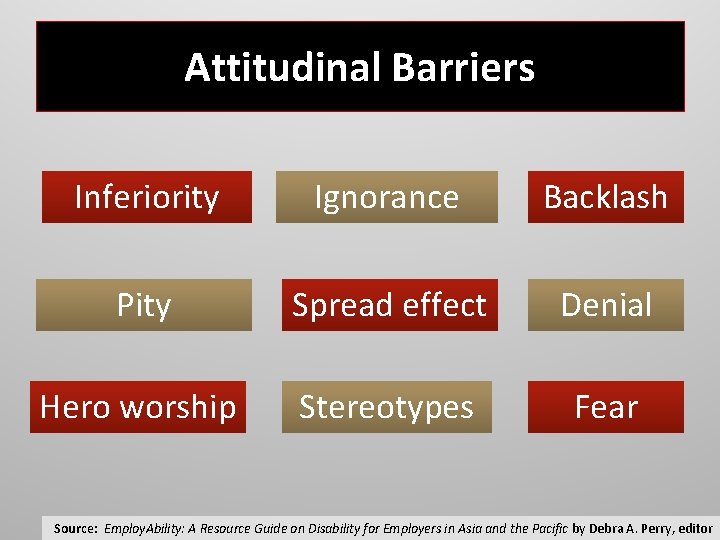
Attitudinal Barriers Inferiority Ignorance Backlash Pity Spread effect Denial Hero worship Stereotypes Fear Source: Employ. Ability: A Resource Guide on Disability for Employers in Asia and the Pacific by Debra A. Perry, editor
Research Findings 1. Supervisors don’t know policies and procedures 2. Staff don’t know if Libraries have a policy 3. Relationship of supervisor and staff determine disclosure 4. Environment not welcoming 5. Personal beliefs 6. Lack of education on hidden disabilities

Recognizing the Hidden Disability • • • Frequent requests to have information repeated Difficulty paying attention Confusion Difficulty following directions Impulsive behavior Sudden changes in mood Shortness of breath Significant fatigue Difficulty sitting still or standing for long periods Sudden weight loss or gain Frequent medical appointments or treatments
Accommodations • • Workspace Equipment Materials Work schedule Job restructuring/sharing Increased/modified supervision Mentoring

The X-Files (1993) Season 3, Episode 22: Quagmire
The X-Files: Quagmire (Excerpts from the episode) “No, I’m not being flippant. I mean, I’ve given this a lot of thought. If you have a peg leg or hooks for hands, you know, maybe it’s enough to simply carry on living – you know, bravely facing life with your disability. It’s heroic just to survive. But without these things, you’re actually expected… to make something of your life – achieve something, earn a raise, wear a necktie… because if I did have a peg leg I’d quite possibly be more happy and more content… and not feel the need to chase after these creatures of the unknown…”
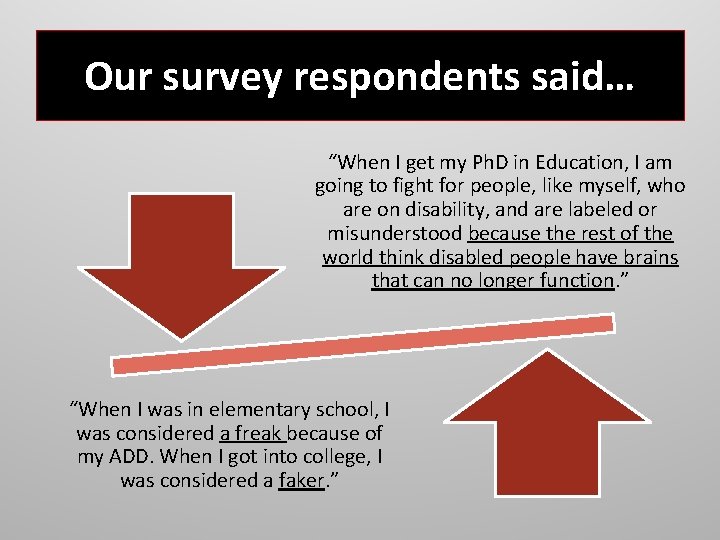
Our survey respondents said… “When I get my Ph. D in Education, I am going to fight for people, like myself, who are on disability, and are labeled or misunderstood because the rest of the world think disabled people have brains that can no longer function. ” “When I was in elementary school, I was considered a freak because of my ADD. When I got into college, I was considered a faker. ”
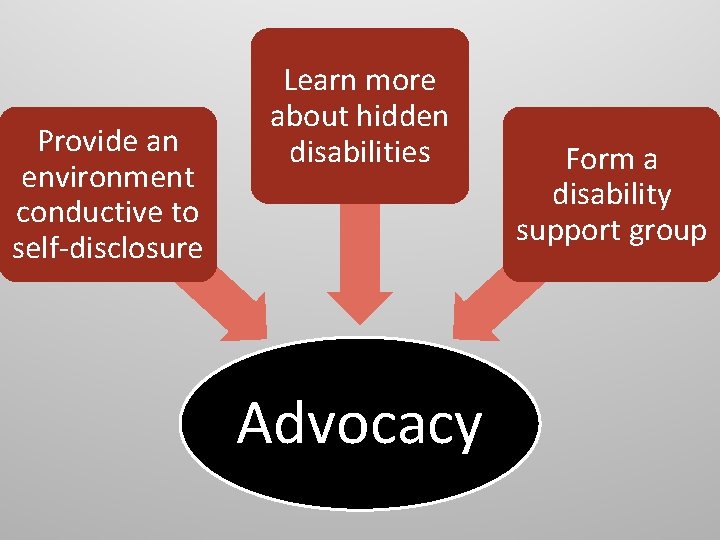
Provide an environment conductive to self-disclosure Learn more about hidden disabilities Advocacy Form a disability support group

- Slides: 43