
Whats the error Topic 1 Quadrilaterals Topic 2
- Slides: 4
What’s the error? Topic 1 Quadrilaterals Topic 2 Displaying Data Topic 3 Fractions, Decimals and Percentages
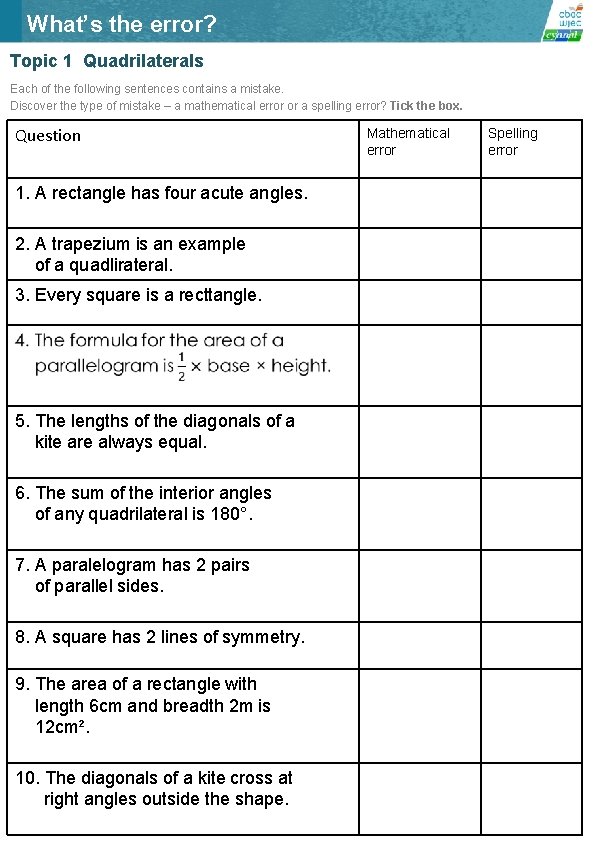
What’s the error? Topic 1 Quadrilaterals Each of the following sentences contains a mistake. Discover the type of mistake – a mathematical error or a spelling error? Tick the box. Question 1. A rectangle has four acute angles. 2. A trapezium is an example of a quadlirateral. 3. Every square is a recttangle. 5. The lengths of the diagonals of a kite are always equal. 6. The sum of the interior angles of any quadrilateral is 180°. 7. A paralelogram has 2 pairs of parallel sides. 8. A square has 2 lines of symmetry. 9. The area of a rectangle with length 6 cm and breadth 2 m is 12 cm². 10. The diagonals of a kite cross at right angles outside the shape. Mathematical error Spelling error
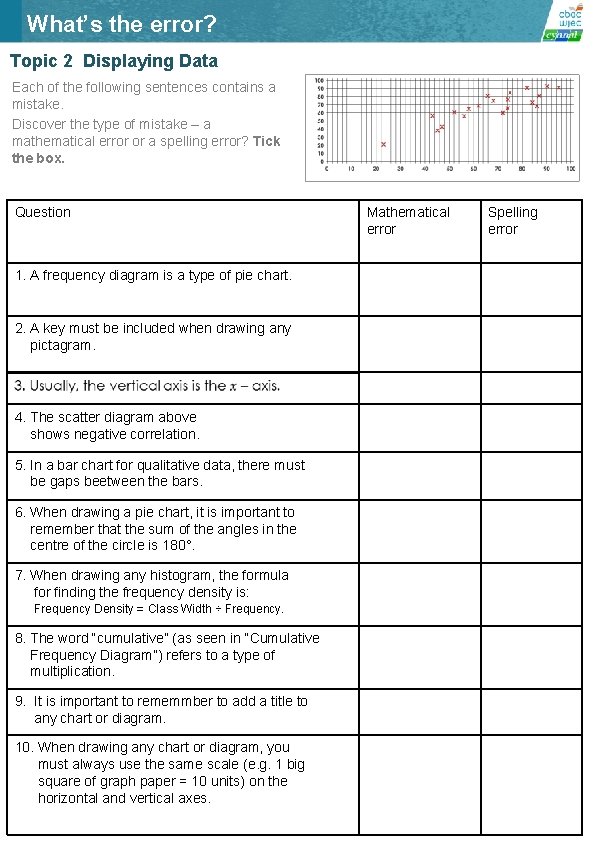
What’s the error? Topic 2 Displaying Data Each of the following sentences contains a mistake. Discover the type of mistake – a mathematical error or a spelling error? Tick the box. Question 1. A frequency diagram is a type of pie chart. 2. A key must be included when drawing any pictagram. 4. The scatter diagram above shows negative correlation. 5. In a bar chart for qualitative data, there must be gaps beetween the bars. 6. When drawing a pie chart, it is important to remember that the sum of the angles in the centre of the circle is 180°. 7. When drawing any histogram, the formula for finding the frequency density is: Frequency Density = Class Width ÷ Frequency. 8. The word “cumulative” (as seen in “Cumulative Frequency Diagram”) refers to a type of multiplication. 9. It is important to rememmber to add a title to any chart or diagram. 10. When drawing any chart or diagram, you must always use the same scale (e. g. 1 big square of graph paper = 10 units) on the horizontal and vertical axes. Mathematical error Spelling error
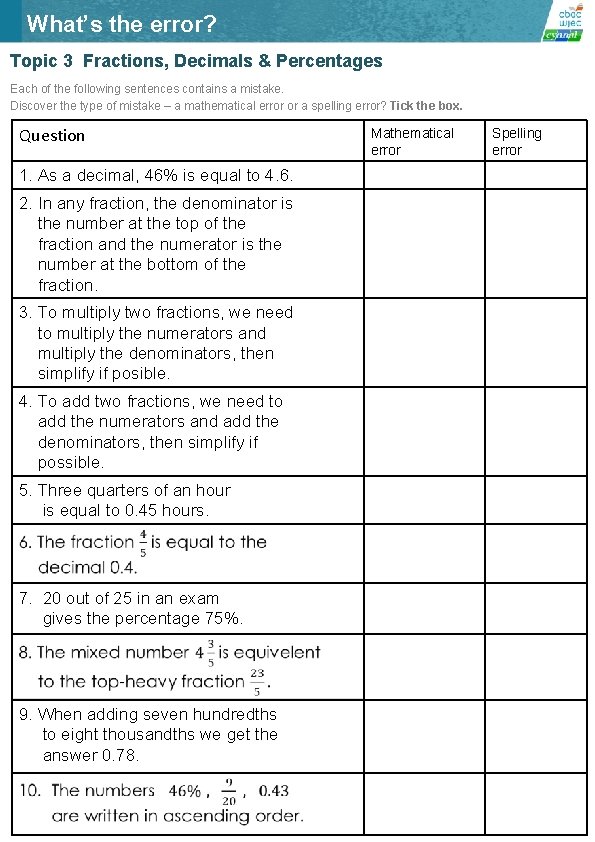
What’s the error? Topic 3 Fractions, Decimals & Percentages Each of the following sentences contains a mistake. Discover the type of mistake – a mathematical error or a spelling error? Tick the box. Question 1. As a decimal, 46% is equal to 4. 6. 2. In any fraction, the denominator is the number at the top of the fraction and the numerator is the number at the bottom of the fraction. 3. To multiply two fractions, we need to multiply the numerators and multiply the denominators, then simplify if posible. 4. To add two fractions, we need to add the numerators and add the denominators, then simplify if possible. 5. Three quarters of an hour is equal to 0. 45 hours. 7. 20 out of 25 in an exam gives the percentage 75%. 9. When adding seven hundredths to eight thousandths we get the answer 0. 78. Mathematical error Spelling error