
Whats New with CIP A 20 Year Perspective




- Slides: 38
What’s New with CIP? A 20 -Year Perspective of Cognitive Information Processing (CIP) Theory Denise E. Saunders, Ph. D Private Practice Robert C. Reardon, Ph. D Janet G. Lenz, Ph. D James P. Sampson, Jr. , Ph. D Gary W. Peterson, Ph. D Florida State University NCDA Global Conference, July 2008 Washington, DC
Overview • Context/History & purpose • Applying CIP theory in practice • CIP in program development • CIP research & theory developments • Question/answer 2
The Context • 4 th largest state in the U. S. • Tallahassee, FL--state capital • Florida State University, 4 -year, public research university, 40, 000 students
Center for the Study of Technology in Counseling and Career Development A unit of the Florida State University Career Center and College of Education Integrating theory, research, and practice Theory Research Practice www. career. fsu. edu/techcenter
History and Purpose • Current staff includes: – Drs. Sampson & Lenz, Co-Directors – Drs. Peterson & Reardon, Senior Research Associates – Dr. Garis, Research Associate – Ms. Epstein, Librarian – Graduate Students 5
History and Purpose • CIP Initial Introduction—A Theoretical Shift Sampson, J. , Peterson, G. , & Reardon, R. (1989). Counselor intervention strategies for computer-assisted career guidance: An information processing approach. Journal of Career Development, 16, 139 -154. • CIP/CTI Formal Introduction Peterson, G. , Sampson, J. , & Reardon, R. (1991). Career development and services: A cognitive approach. Pacific Grove, CA: Brooks/Cole. Sampson, J. , Peterson, G. , Lenz, J. , & Reardon, R. (1992). A cognitive approach to career services: Translating concepts into practice. Career Development Quarterly, 41, 67 -74. Sampson, J. , Peterson, G. , Lenz, J. , Reardon, R. , & Saunders, D. (1996). Career Thoughts Inventory (CTI). [Psychological Test] Odessa, FL: Psychological Assessment Resources, Inc. 6
History and Purpose • Dissemination *http: //www. career. fsu. edu/techcenter Tech Center established in 1986 Peterson, G. W. , Sampson, J. P. , Jr. , Lenz, J. L. , & Reardon, R. C. (2002). A cognitive information processing approach in career problem solving and decision making. In D. Brown (Ed. ), Career choice and development (4 th ed. , pp. 312 -369). San Francisco: Jossey-Bass. Sampson, J. P. , Jr. , Reardon, R. C. , Peterson, G. W. , & Lenz, J. L. (2004). Career counseling and services: A cognitive information processing approach. Pacific Grove, CA: Wadsworth-Brooks/Cole. Reardon, R. , Lenz, J. , Sampson, J. , & Peterson, G. (2009). Career development and planning: A comprehensive approach (3 rd ed. ). Mason, OH: Thomson Custom Solutions. 9
History and Purpose • CIP/CTI cited in: Brown (2002), Brown (2007), Capuzzi & Stauffer (2006), Herr, Cramer & Niles (2004), Luzzo (2000), Niles & Harris-Bowlsbey (2005), Sharf (2005), Zunker (2006) • CIP/CTI not cited in: Andersen & Vandehey (2006), Brown & Lent (2000), Brown & Lent (2005), Gibson & Mitchell (2006) 10
CIP Critiques Brown (2007): little information relative to diverse groups; CTI is intrusive measure for some cultural groups; model applies to clients expecting to make their own decisions. Capuzzi & Stauffer (2006): few empirical findings available yet; excellent for clients motivated to use linear decision making. Herr, Cramer, & Niles (2004): a learning-approach and bridge to situational, sociological, and contextual approaches.
CIP Critiques Niles & Harris-Bowlsbey (2005): built on research in cognitive psychology, uses clear definitions of constructs, committed to practical applications; research growing but not extensive. Sharf (2006): a prescriptive approach relatively new with little known relative to gender and diversity, an area of potential research. Zunker (2006): strength is a practical application for solving career problems.
History and Purpose • Analyzing the CIP bibliography – 20 dissertations from 6 different universities – CIP applications: About 45 citations – CTI research: About 35 citations – About 50 refereed journal articles published 13
History and Purpose • CIP: – Is informed by scholarship and practice and vice versa – Is freely disseminated to practitioners and clients – Has origins in human learning events, information processing, career service delivery, and technology – Uses a systems approach to service delivery – Not limited to counseling interventions 14
History and Purpose • Since 1986, the FSU Career Center and Tech Center: – Have been visited by persons from 40 countries – Staff have presented and consulted in 28 countries • Tech Center Web site visitors in 2008 are from more than 48 countries outside the U. S. 15
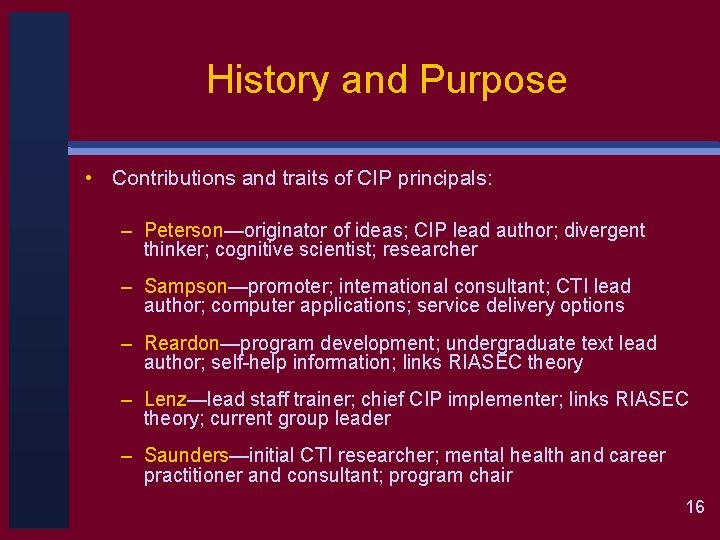
History and Purpose • Contributions and traits of CIP principals: – Peterson—originator of ideas; CIP lead author; divergent thinker; cognitive scientist; researcher – Sampson—promoter; international consultant; CTI lead author; computer applications; service delivery options – Reardon—program development; undergraduate text lead author; self-help information; links RIASEC theory – Lenz—lead staff trainer; chief CIP implementer; links RIASEC theory; current group leader – Saunders—initial CTI researcher; mental health and career practitioner and consultant; program chair 16
CIP in Practice • CIP provides a concrete application of how practitioners can be trained to apply theory in practice • Career practitioners agree that CIP can be easily learned and applied • Evidence of CIP replication in other settings
CIP in Practice • Experience has shown that CIP concepts can be successfully applied in all forms of service delivery – Self help – Brief staff- assisted – Individual
CIP in Practice • CIP focus is on creating a learning event • Goal: clients learn how to solve career problems and make decisions • CIP approach can be easily explained to clients
Using CIP & the CTI with Individual Clients • Provides a framework/model for the career decision making process • Allows clients to be involved in the process and identify areas to explore • Builds on existing knowledge, utilizes clients’ understanding of themselves • Enhances the counseling relationship as counselor and client jointly work at career issues
Using the CTI in Practice • Allows for a holistic approach to the career decision making process • Recognizes the complexity of career decision making • Often provides clients with the awareness of things that have kept them “stuck” • Provides an opportunity to relate this process to other life issues
Challenges in Training & Practice • Not all staff “buys in” to the approach • Inconsistent use of CIP theory and associated tools • Time pressures of drop-in services may impact use of CTI and CTI workbook • Ongoing training and supervision needed for most effective use of CTI and CTI workbook
CIP in Instruction • Undergraduate 3 -credit career development class • CIP integrated into text, class lectures, small group activities • CTI used as pre-post test • Study by Reed, Reardon, Lenz, & Leierer (2001) showed a significant decrease in students’ negative career thoughts • 3 rd edition of CIP-based undergraduate text to be published fall 2008
New Developments in CIP • Four steps in promoting effective use of Career Resources: 1. 2. 3. 4. Understanding Recommending Orienting Follow-up Sampson, J. P. , Jr. (2008). Designing and implementing career programs: A handbook for effective practice. Broken Arrow, OK: National Career Development Association.
Four-Step Process • Understanding – Clarifying the career assessment and information needs of an adolescent or adult • Recommending – Suggestions about career assessments and information on the ILP that are appropriate for the needs of the adolescent or adult – Selecting – Sequencing – Pacing
Four-Step Process • Orienting – Preparing adolescents and adults to make effective use of career assessments and information • Follow-Up – Checking that adolescents and adults have appropriately used the resources and services on their ILP and that they have a plan of action for the future
CIP in Program Development • International applications • CIP as a “social justice” approach to career services • Policy development & CIP • Diverse populations, translation of materials globally
CIP in Program Development • Career workshop with secondary school students: – “CIP Approach…can be successfully applied to promote career development on an international scale” (Hirschi & Lage, 2007) • 14 -week career assistance program—male cricketers, ages 15 -16; experimental group improved career goal decidedness and career awareness (AJCD, 2003) • Application of CIP to assist service members’ transition into the civilian world (Clemens & Milsom, CDQ, March 2008)
CIP/CTI Use • • • Australia Bermuda Canada China Finland Great Britain Greece Guam Hong Kong Iceland • • • India Indonesia Ireland Italy Japan Latvia Lithuania Malaysia Malta
CIP/CTI Use • • • Mexico New Zealand Northern Ireland Norway Pakistan Philippines Portugal Romania Scotland • • • Singapore South Africa South Korea Spain Sweden Switzerland Taiwan Turkey United States
CTI Translations • • • Korean Finnish Turkish Icelandic Greek Portuguese*
Developing National & State Systems for Career Services • Awareness of the need for change • Identify career service-delivery models • Select a cost-effective model • Develop an implementation plan • Implement improved career resources and services
Examples • Job. Link Centers in North Carolina • Workforce Centers in Oklahoma • Connexions Services in England • Careers Scotland Centres • Careers Service in Northern Ireland
Richmond Chambers Careers Service in Northern Ireland
CIP Applications Career Decision Making Tool (CDMT) http: //www. acrnetwork. org/decision. htm
CIP Theory Development • Validation through Structural Equation Modeling (SEM) • Integrating disability into CIP • Integrating mental health aspects • Theory generalization • Ongoing development of theory-based practice
Future Directions • CTI revision • Training in use of CTI & CTI workbook • Online delivery of CTI, CIP-based interventions • Further convergence of career & mental health counseling (e. g. , problem space worksheet) • Spirituality & vocational choice (Valuing)
Future Directions • Individual characteristics & effectiveness of CIP theory • Career thoughts in relation to other constructs, e. g. , motivation, self-efficacy, career stress • Learning styles & acquisition of career problem-solving & decision-making skills
Summary • Theory----practice----research----theory • Client & learning-focused approach • Paradigm shift in career theory • Balancing theory in the study of vocational behavior with applying theory in the design & delivery of career services and resources
Questions/Discussion Visit us online at www. career. fsu. edu/techcenter or come see us in our new facility, beginning September 2008