
Whats New at the USGS Patuxent Bird Banding
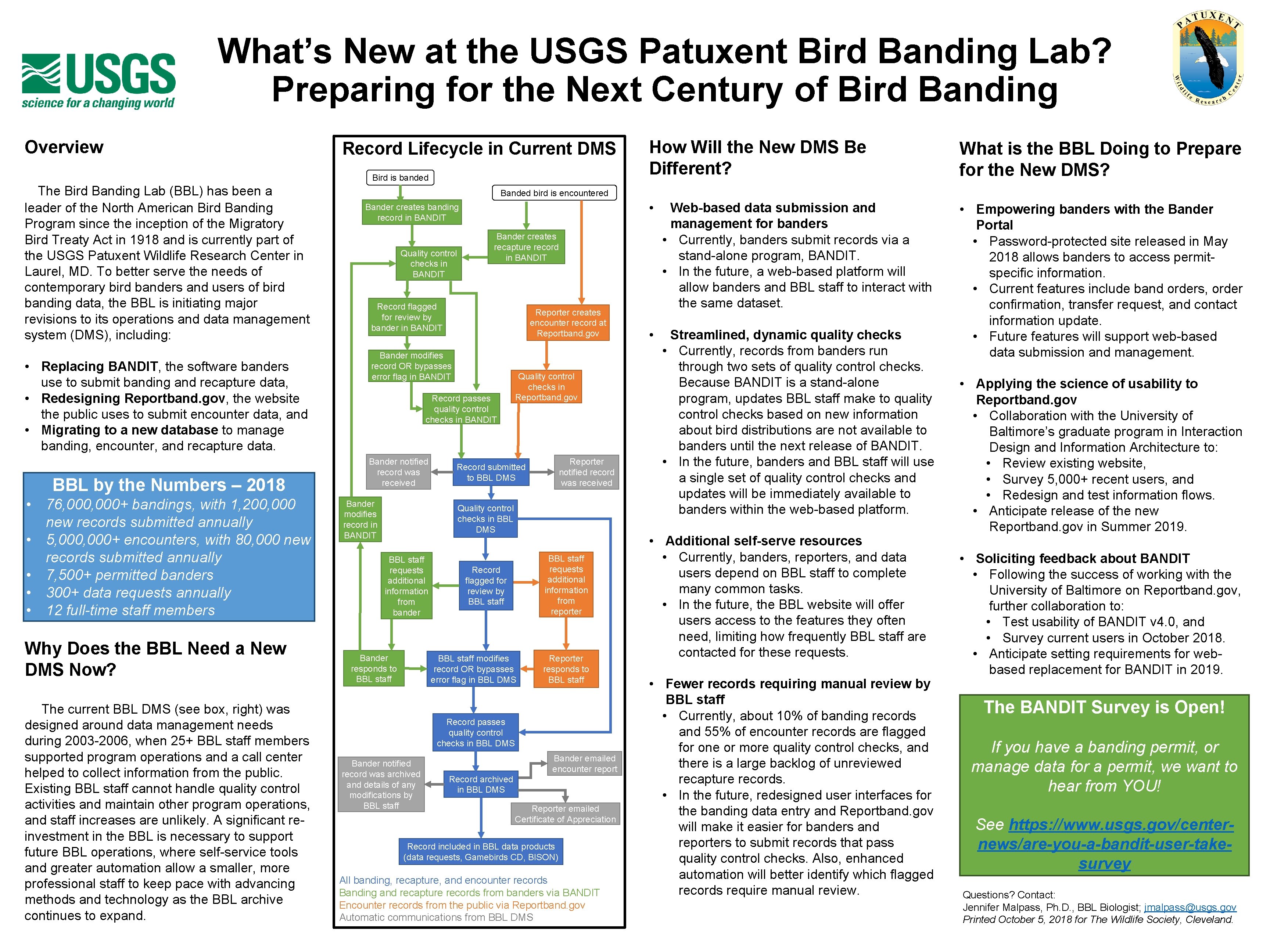
What’s New at the USGS Patuxent Bird Banding Lab? Preparing for the Next Century of Bird Banding Overview Record Lifecycle in Current DMS Bird is banded The Bird Banding Lab (BBL) has been a leader of the North American Bird Banding Program since the inception of the Migratory Bird Treaty Act in 1918 and is currently part of the USGS Patuxent Wildlife Research Center in Laurel, MD. To better serve the needs of contemporary bird banders and users of bird banding data, the BBL is initiating major revisions to its operations and data management system (DMS), including: • Replacing BANDIT, the software banders use to submit banding and recapture data, • Redesigning Reportband. gov, the website the public uses to submit encounter data, and • Migrating to a new database to manage banding, encounter, and recapture data. BBL by the Numbers – 2018 • 76, 000+ bandings, with 1, 200, 000 new records submitted annually • 5, 000+ encounters, with 80, 000 new records submitted annually • 7, 500+ permitted banders • 300+ data requests annually • 12 full-time staff members Why Does the BBL Need a New DMS Now? The current BBL DMS (see box, right) was designed around data management needs during 2003 -2006, when 25+ BBL staff members supported program operations and a call center helped to collect information from the public. Existing BBL staff cannot handle quality control activities and maintain other program operations, and staff increases are unlikely. A significant reinvestment in the BBL is necessary to support future BBL operations, where self-service tools and greater automation allow a smaller, more professional staff to keep pace with advancing methods and technology as the BBL archive continues to expand. How Will the New DMS Be Different? What is the BBL Doing to Prepare for the New DMS? • Web-based data submission and management for banders • Currently, banders submit records via a stand-alone program, BANDIT. • In the future, a web-based platform will allow banders and BBL staff to interact with the same dataset. • Streamlined, dynamic quality checks • Currently, records from banders run through two sets of quality control checks. Because BANDIT is a stand-alone program, updates BBL staff make to quality control checks based on new information about bird distributions are not available to banders until the next release of BANDIT. • In the future, banders and BBL staff will use a single set of quality control checks and updates will be immediately available to banders within the web-based platform. • Empowering banders with the Bander Portal • Password-protected site released in May 2018 allows banders to access permitspecific information. • Current features include band orders, order confirmation, transfer request, and contact information update. • Future features will support web-based data submission and management. Banded bird is encountered Bander creates banding record in BANDIT Quality control checks in BANDIT Bander creates recapture record in BANDIT Record flagged for review by bander in BANDIT Reporter creates encounter record at Reportband. gov Bander modifies record OR bypasses error flag in BANDIT Record passes quality control checks in BANDIT Bander notified record was received Bander modifies record in BANDIT Quality control checks in Reportband. gov Reporter notified record was received Record submitted to BBL DMS Quality control checks in BBL DMS BBL staff requests additional information from bander Bander responds to BBL staff requests additional information from reporter Record flagged for review by BBL staff modifies record OR bypasses error flag in BBL DMS Reporter responds to BBL staff Record passes quality control checks in BBL DMS Bander notified record was archived and details of any modifications by BBL staff Bander emailed encounter report Record archived in BBL DMS Reporter emailed Certificate of Appreciation Record included in BBL data products (data requests, Gamebirds CD, BISON) All banding, recapture, and encounter records Banding and recapture records from banders via BANDIT Encounter records from the public via Reportband. gov Automatic communications from BBL DMS • Additional self-serve resources • Currently, banders, reporters, and data users depend on BBL staff to complete many common tasks. • In the future, the BBL website will offer users access to the features they often need, limiting how frequently BBL staff are contacted for these requests. • Fewer records requiring manual review by BBL staff • Currently, about 10% of banding records and 55% of encounter records are flagged for one or more quality control checks, and there is a large backlog of unreviewed recapture records. • In the future, redesigned user interfaces for the banding data entry and Reportband. gov will make it easier for banders and reporters to submit records that pass quality control checks. Also, enhanced automation will better identify which flagged records require manual review. • Applying the science of usability to Reportband. gov • Collaboration with the University of Baltimore’s graduate program in Interaction Design and Information Architecture to: • Review existing website, • Survey 5, 000+ recent users, and • Redesign and test information flows. • Anticipate release of the new Reportband. gov in Summer 2019. • Soliciting feedback about BANDIT • Following the success of working with the University of Baltimore on Reportband. gov, further collaboration to: • Test usability of BANDIT v 4. 0, and • Survey current users in October 2018. • Anticipate setting requirements for webbased replacement for BANDIT in 2019. The BANDIT Survey is Open! If you have a banding permit, or manage data for a permit, we want to hear from YOU! See https: //www. usgs. gov/centernews/are-you-a-bandit-user-takesurvey Questions? Contact: Jennifer Malpass, Ph. D. , BBL Biologist; jmalpass@usgs. gov Printed October 5, 2018 for The Wildlife Society, Cleveland.
- Slides: 1