
WHATS IN A QUESTION A presentation about asking
WHAT’S IN A QUESTION A presentation about asking the right type of question in order to get the information you need. By: Katina Harshbarger
WHY TALK ABOUT QUESTIONS? As teachers we use questions to gain information from a multitude of people everyday. � Students � Parents � Fellow Teachers � Administrators When collaborating with others we need to make sure we are getting the information we need and want. How you ask a question can effect your relationship with others.
WHERE THE CONFUSION LIES You maybe asking the right question but using the wrong format Your perspective is different A question can convey an unintended message
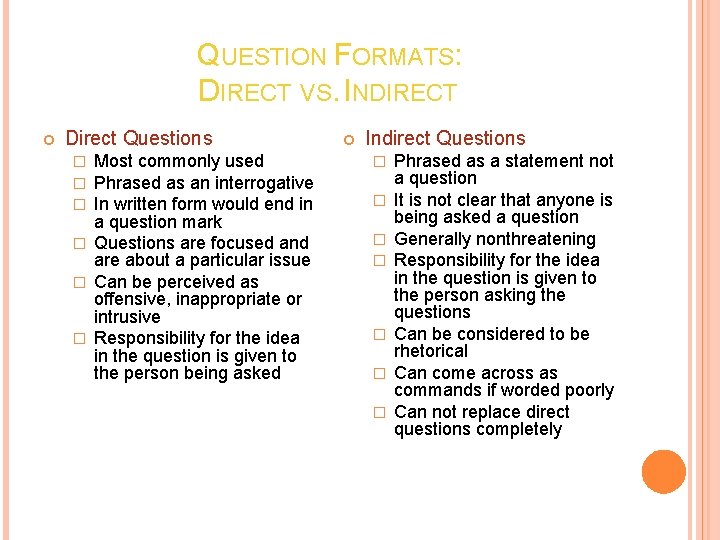
QUESTION FORMATS: DIRECT VS. INDIRECT Direct Questions Most commonly used Phrased as an interrogative In written form would end in a question mark � Questions are focused and are about a particular issue � Can be perceived as offensive, inappropriate or intrusive � Responsibility for the idea in the question is given to the person being asked � � � Indirect Questions � � � � Phrased as a statement not a question It is not clear that anyone is being asked a question Generally nonthreatening Responsibility for the idea in the question is given to the person asking the questions Can be considered to be rhetorical Can come across as commands if worded poorly Can not replace direct questions completely
EXAMPLES OF DIRECT AND INDIRECT QUESTIONS Direct question: Why is Timmy not in general education English class? Poorly worded indirect question: Tell me why Timmy is not in general education English class. Well worded indirect question: I wonder what it would look like if Timmy was in a general education English class.
QUESTION FORMAT: OPEN VS. CLOSED Open Questions � A question what has an infinite range of possible responses � Cannot predict the response � Makes the respondent think and reflect � Control of the conversation is in the hands of the person being asked the question � Develops trust and is perceived as less threatening than closed questions Closed Questions � Responses are limited � Often have circumscribed responses � Easier and quicker to ask than open questions � The person asking the question has more control � Often perceived as too focused and as interrogating � If person asking the question does not have adequate understanding of the context or situation the conversation can go in the wrong direction
EXAMPLES OF OPEN AND CLOSED QUESTIONS Open question What are the benefits to Timmy being in the Vocational Skills Program? Closed question Do you want Timmy to be in the Vocational Skills Program?
QUESTION FORMAT: SINGLE VS. MULTIPLE Single Questions � Ask only one question at a time � Preferable over multiple questions � One well phrased question allows the respondent the opportunity to share his/her ideas and perceptions Multiple Questions � Ask more than one question at a time � Leaves the respondent unsure of how to respond � May cause the respondent to feel suspicious or defensive � Should be avoid
EXAMPLES OF SINGLE AND MULTIPLE QUESTIONS Single Question When you think about Timmy’s transition plan which action plan do you feel will be most effective in helping him meet his post-secondary goals? Multiple Questions What do you think about Timmy’s action plan to do public transportation training? Do you really think he will be able to ride public transportation? Do you think he is too young to do the training?
REASONS WE USE MULTIPLE QUESTIONS We think and talk at the same time. We move from vague to focused questions. We have a series of related question that we ask at one time.
WHAT TO DO WHEN WE HAVESEVERAL QUESTIONS TO ASK Carefully phrase each one Ask the questions in a logical sequence Permit the responded time to respond after each questions
FINAL THOUGHTS Our questions need to be asked in a way that we gain the information we seek. The type of question format we use can be perceived differently by different people. No one question format is the best. Even with the best formed questions you still may not gain the information you seek. You should use a combination of formats in order to gain the most information but remember do not use a multiple question format. Take time to formulate your questions. Practice makes perfect.
ANY QUESTIONS?
- Slides: 13