
WHATS A PHRASAL VERB Phrasal verbs are multipart
WHAT’S A PHRASAL VERB? Phrasal verbs are multi-part verbs, that is to say, they are always made up of two (or more) words. VERB + PARTICLE(S) (particles are small words, prepositions or adverbs: up, down, in , away, to, back etc. ). The meaning of a phrasal verb is often very different from the meaning of the verb without the particle. Here’s an example:
TAKE Carry something from one place to another/ hold in your hands or arms • Can you take the kids to school tomorrow? • Can I take the baby? (so that I can hold her in my arms) TAKE AFTER Resemble one of your parents I don’t take after my father at all. He’s tall, he’s got fair hair, but I’m short and have got dark hair. As you can see ‘take after’ means something totally unrelated to ‘take’.
DOES THE PARTICLE ALWAYS COME DIRECTLY AFTER THE VERB? No, not always. But sometimes it has to. I know it’s not fair, but the fact is that some phrasal verbs are separable (words can stand between the verb and the particle) while others are inseparable (you can’t insert any word between the verb and the particle). This may sound a bit too technical, so it’s best to look at some examples. SEPARABLE PHRASAL VERBS:

CLEAN UP: tidy • You can’t go out until you clean up this mess. (clean up: not separated) • You can’t go out until you clean this mess up. (clean… up: separated) Both of the above sentences are correct- it doesn’t matter whether you insert ‘the mess’ between ‘clean’ and ‘up’. You can do it either way. TURN DOWN reduce • Can you turn down the heating, please? It’s boiling in here. (turn down: not separated) • Can you turn the heating down, please? It’s boiling in here. (turn… down: separated)
PUT ON dress yourself in something Mum, I don’t want to put on this dress. It’s hideous. Mum, I don’t want to put this dress on. It’s hideous. THROW AWAY get rid of something you don’t want anymore Don’t throw away those batteries. I’ll use them in my science project. Don’t throw those batteries away. I’ll use them in my science project. CALL OFF cancel Mr Brown has called off the meeting, again. Mr Brown has called the meeting off, again.
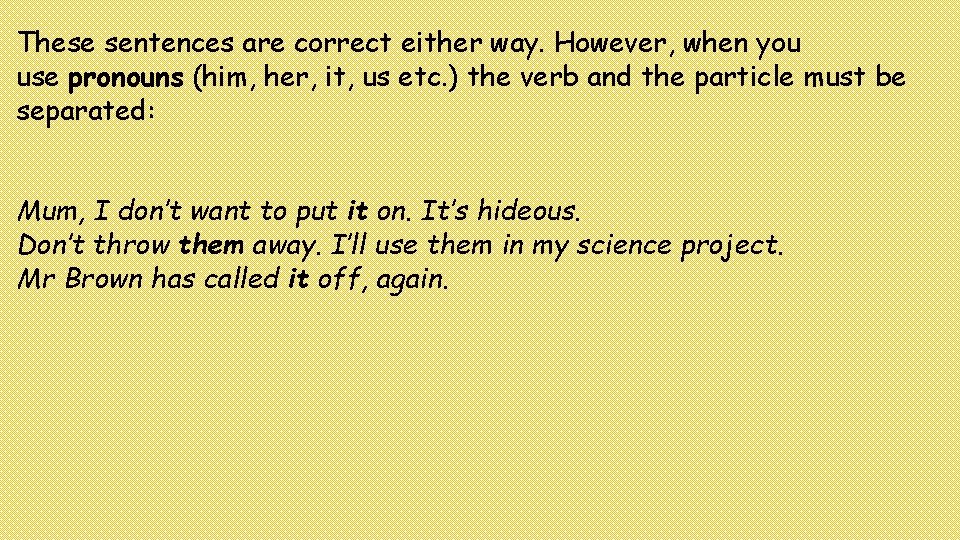
These sentences are correct either way. However, when you use pronouns (him, her, it, us etc. ) the verb and the particle must be separated: Mum, I don’t want to put it on. It’s hideous. Don’t throw them away. I’ll use them in my science project. Mr Brown has called it off, again.
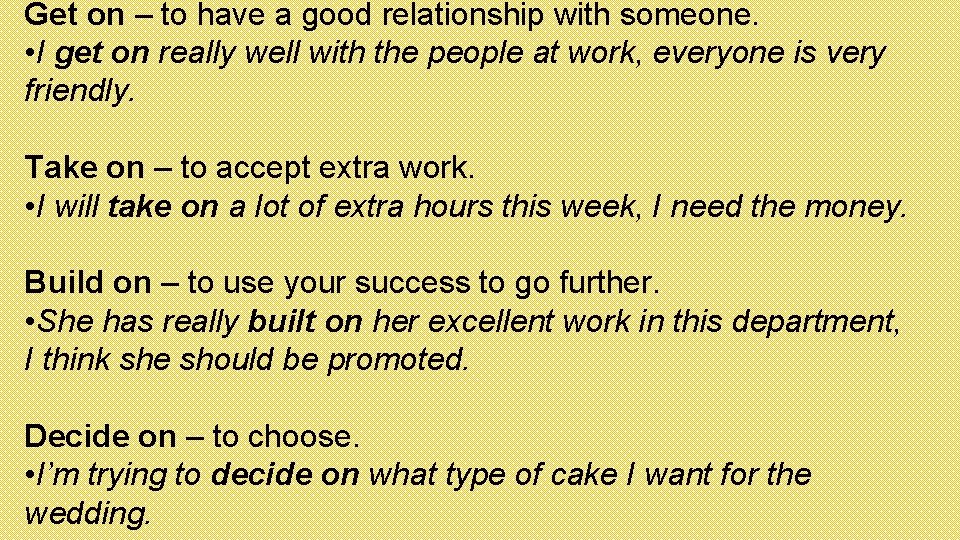
Get on – to have a good relationship with someone. • I get on really well with the people at work, everyone is very friendly. Take on – to accept extra work. • I will take on a lot of extra hours this week, I need the money. Build on – to use your success to go further. • She has really built on her excellent work in this department, I think she should be promoted. Decide on – to choose. • I’m trying to decide on what type of cake I want for the wedding.
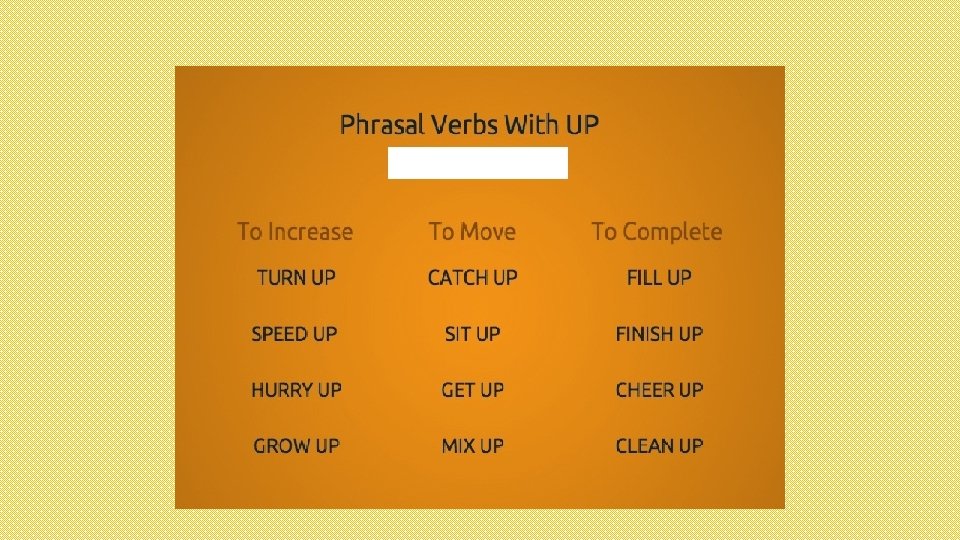
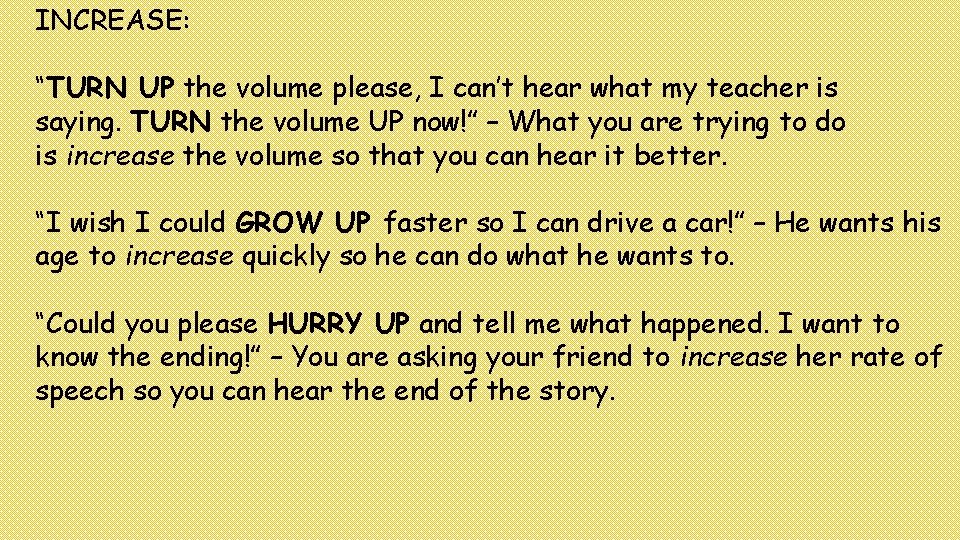
INCREASE: “TURN UP the volume please, I can’t hear what my teacher is saying. TURN the volume UP now!” – What you are trying to do is increase the volume so that you can hear it better. “I wish I could GROW UP faster so I can drive a car!” – He wants his age to increase quickly so he can do what he wants to. “Could you please HURRY UP and tell me what happened. I want to know the ending!” – You are asking your friend to increase her rate of speech so you can hear the end of the story.
MOVE: You will need to walk faster so you can CATCH UP with them and walk at the same pace again. You don’t want to get lost on your own! What does that mean? When we say CATCH UP, it means you will move forward at a faster speed than before. You need to alter your slouched position to an upright position to lengthen your spine, so your back doesn’t hurt anymore. So, SIT UP straight! Imagine, you are lying in your bed, it is a beautiful morning, but you need to go to school. What is it you need to? You need to GET UP.
COMPLETE How much orange juice would you like? Would you like me to FILL UP the glass or do you just want a little bit? I would help you FINISH it UP later. This action will be completed, as soon as I return home. When you see a sad friend, what could you say to them? CHEER UP, my friend! BLOW UP some balloons and be happy.
Hold on – to wait. • Please hold on, the manager isn’t ready to see you yet. Try on – to try clothes to see if they fit. • Could I try on this dress in a size ten please? Go on – to continue • Sorry about that interruption, please go on. Come on – to go down • Come on down kids! Dinner is ready! Pile on – to gain weight • He has been piling on the pounds lately.
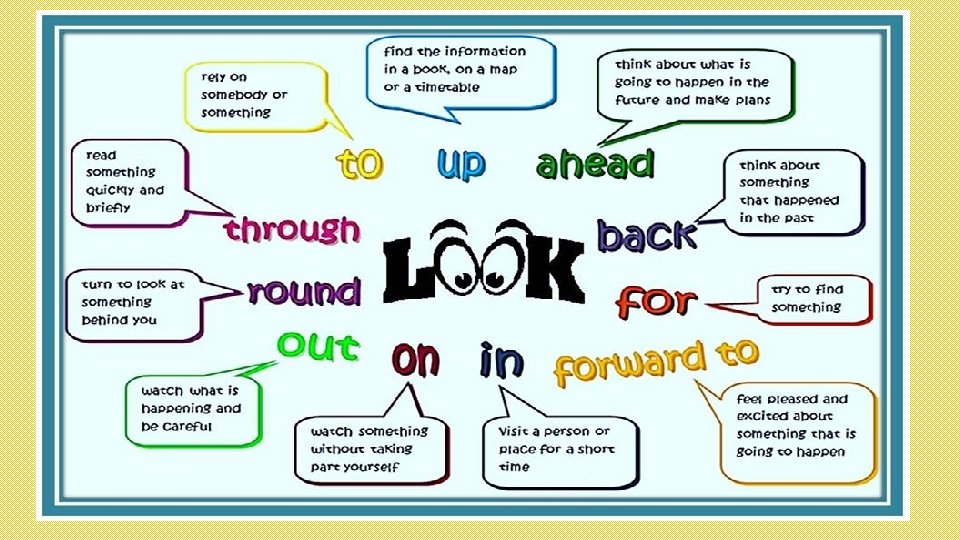
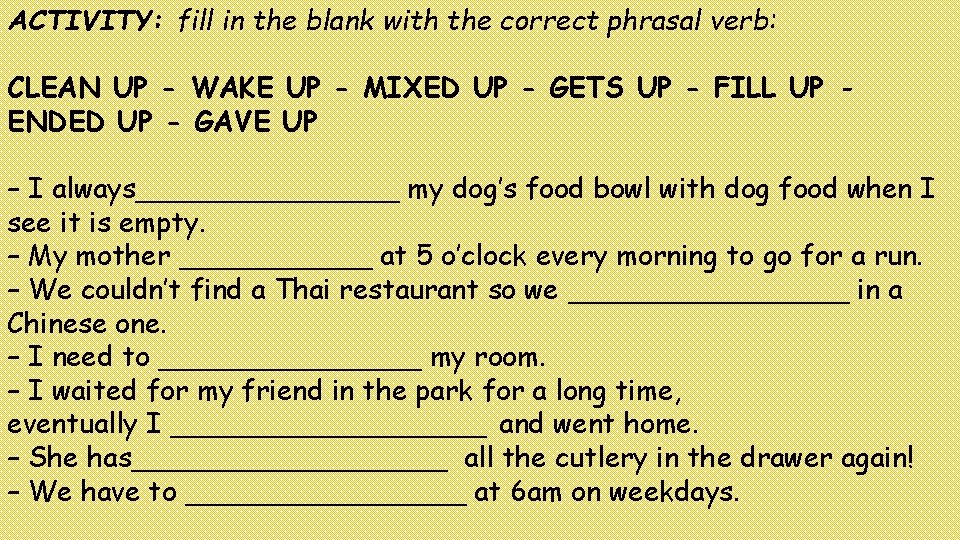
ACTIVITY: fill in the blank with the correct phrasal verb: CLEAN UP - WAKE UP - MIXED UP - GETS UP - FILL UP ENDED UP - GAVE UP – I always________ my dog’s food bowl with dog food when I see it is empty. – My mother ______ at 5 o’clock every morning to go for a run. – We couldn’t find a Thai restaurant so we ________ in a Chinese one. – I need to ________ my room. – I waited for my friend in the park for a long time, eventually I _________ and went home. – She has_________ all the cutlery in the drawer again! – We have to ________ at 6 am on weekdays.
- Slides: 14